Digital pathology CPT codes are Category III add-on codes, 0751T-0763T and 0827T-0856T, billed one-to-one with the base pathology code. Most payers treat them as tracking codes, so expect little or no payment.
The fix is simple. Bill each add-on with its exact base code on the same claim, use a small tracking charge, and only when the slides were read digitally for the diagnosis.
TL;DR: The digitization add-on codes capture the extra staff work of scanning glass slides into whole-slide images. Each one pairs with one base code, such as 0753T with 88305. Report them only when the pathologist used the digital image for the primary diagnosis. Medicare lists them as carrier priced with no RVUs. Novitas pays nothing extra for 0751T-0763T, and hospital outpatient claims package them under status indicator N. Bill them anyway for data, but do not count on the money.
Written by Manikandan J, CPC, CRCR, a certified coder and revenue cycle specialist. Published 26 November 2026. Last updated: 26 November 2026.
Table of Contents
How is digital pathology billed?
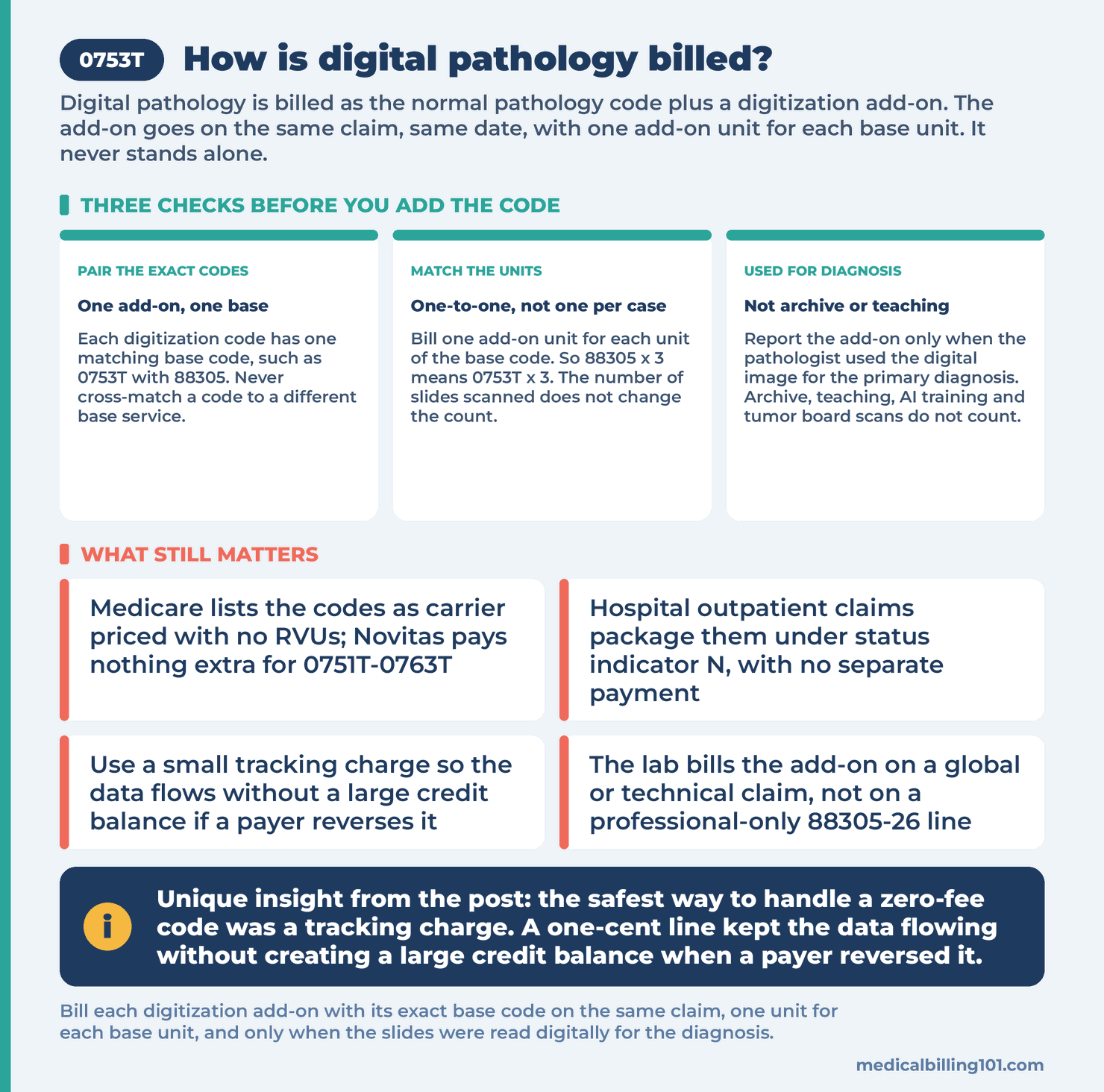
Digital pathology is billed as the normal pathology code plus a digitization add-on code. For example, a level IV surgical pathology exam read on screen is 88305 plus 0753T. The add-on goes on the same claim, same date, with one add-on unit for each base unit. It never stands alone.
Digital pathology means glass slides are scanned into whole-slide images, and the pathologist reads the images on a screen. A Category III code is a temporary CPT code for emerging services, used mainly to collect data. An add-on code is a code for extra work that is only billed with a primary code.
The College of American Pathologists digital pathology codes page reprints the CPT guidelines and every code pairing. The AMA added 0751T-0763T for 2023 and 0827T-0856T for 2024.
Example scenario (fictional names), part 1
Digital pathology example: what happened
Prairie Lantern Pathology is a fictional lab in Texas. Marguerite Haskell runs its billing. Dr. Anselm Okonkwo-Reyes is the lead pathologist.
The lab bought a slide scanner and started reading skin biopsies on screen. In the first month, it billed 88305 x 3 and 0753T x 1 on each claim, with a $45 charge per add-on.
Medicare paid nothing on 0753T. A commercial payer paid a few lines, then sent a recoupment letter.
What went wrong? Keep reading, or jump to how the case was resolved.
Which digital pathology CPT codes pair with which base codes?
Each digitization code has one matching base code in CPT. The surgical pathology add-ons follow the 88302-88309 levels. The 2024 codes cover cytology, frozen sections, consults, special stains, in situ hybridization and blood smears. Use the pairing below, and never cross-match a code to a different base service.
| Add-on code. | Use with. | Service. |
|---|---|---|
| 0751T-0755T. | 88302, 88304, 88305, 88307, 88309. | Surgical pathology levels II to VI. |
| 0756T-0759T. | 88312, 88313, 88314, 88319. | Special stains and enzyme stains. |
| 0760T-0762T. | 88342, 88341, 88344. | Immunohistochemistry, first, each added and multiplex stain. |
| 0763T. | 88360. | Manual morphometric tumor IHC, such as HER2. |
| 0827T-0834T. | 88104, 88106, 88108, 88112, 88141, 88160, 88161, 88162. | Cytopathology. |
| 0835T-0837T. | 88172, 88177, 88173. | Fine needle aspirate evaluation. |
| 0838T-0840T. | 88321, 88323, 88325. | Consultation on referred material. |
| 0841T-0844T. | 88331, 88332, 88333, 88334. | Frozen section and intraoperative cytology. |
| 0845T-0853T. | 88346, 88350, 88363, 88365, 88364, 88366, 88368, 88369, 88377. | Immunofluorescence, archival tissue, ISH and morphometric ISH. |
| 0854T-0856T. | 85060, 85097, 88348. | Blood smear, bone marrow smear and electron microscopy. |
Codes inside a range follow the base codes in the order shown. For example, 0752T goes with 88304, and 0761T goes with 88341. For a broader look at temporary codes, see Category III codes vs unlisted codes.
When should you not report a digitization code?
Do not report it when scanning is not part of the primary diagnosis. CPT bars the codes for slides scanned only for archive, teaching, AI training or validation, or tumor board. Photos or video of part of a slide on a phone or tablet do not count. The pathologist must read the digital image to reach the diagnosis.
A slide scanned after the case was signed out is an archive scan. No add-on applies, even if the image is later shared with a clinician.
A few codes carry extra limits. Do not report 0831T when an automated, computer-assisted screening system does the Pap imaging. Do not report 0838T-0840T when the referred slides were already digitized elsewhere.
How many units do you bill for a digitization add-on?
Bill one add-on unit for each unit of the base code. CPT calls this a one-to-one unit of service. So 88305 x 3 means 0753T x 3, not one unit per case. The number of slides scanned does not change the count, because units follow the specimen-based base code.
Medicare MUEs mostly track this rule. The October 2026 practitioner MUE file sets 0753T at 16 units, the same as 88305. But 0751T is 2 while 88302 is 4. The 2024 codes, 0827T-0856T, have no MUE in that file. Check limits in our MUE lookup and pairs in the NCCI edit checker.
Does Medicare pay for digital pathology codes?
Usually not in a meaningful way. The CMS physician fee schedule RVU file for October 2026 gives every digitization code status C, carrier priced. Each has zero RVUs, a ZZZ add-on global, and PC/TC indicator 3. Indicator 3 means technical component only, so no modifier 26 or TC split applies.
Carrier priced means each MAC sets the rate. Novitas re-evaluated 0751T-0763T and decided they exist for tracking. For dates of service on or after February 19, 2024, it makes no additional payment for them.
Hospital outpatient claims follow OPPS instead. The October 2026 OPPS Addendum B lists 0751T, 0753T, 0763T, 0827T and 0856T with status indicator N. N means packaged, with no separate payment. The base code 88305 is Q1, conditionally packaged.
What issues do payers raise with digital pathology add-ons?
The common issues are zero payment, bundling denials and later recoupment. Many lines come back paid at $0 as included in the base code. If a payer uses a bundling reason, read our CO-97 denial guide. A few payers pay at first, then take the money back after review.
The AMA explains Category III codes as temporary codes for data collection, typically carrier priced. They last five years and can be renewed. That is why most payers have no fee for them. Commercial plans set their own policy, so check each contract and medical policy before you expect payment.
In my 10+ years of billing and AR work, the safest way to handle a zero-fee code was a tracking charge. A one-cent line, such as $0.01, kept the data flowing without creating a large credit balance when a payer reversed it.
Who bills the digitization code, the lab or the pathologist?
The entity that performs or buys the slide digitization reports it. That is usually the lab or hospital, because the codes cover technical staff work. A CAP TODAY answer from April 2026 confirms this. A lab billing 88305 globally adds the code to the global line. A lab billing only the technical component adds it to the 88305-TC claim.
A pathologist who bills only 88305-26 does not add the digitization code. The professional read has no separate digitization share. For other split billing questions, see why modifier 26 is denied for an SNF patient.
What documentation supports a digital pathology add-on?
The report should show that the pathologist made the diagnosis from the digital image. Record the scanner or whole-slide imaging system, the slides scanned, and the date of review. A short line, such as “diagnosis rendered on whole-slide images,” closes most audit questions. Keep the image log linked to the accession number.
For more pathology coding answers, see perineural invasion of the prostate in ICD-10. It shows how pathology findings change the code you report.
Example scenario (fictional names), part 2
How the digital pathology case was resolved
- Marguerite saw that 0753T was billed once per claim, while 88305 had 3 units. CPT wants one add-on unit for each base unit.
- She checked the reports. Some cases were read on glass, and the slides were scanned later for the archive.
- She also saw the $45 charge. The codes are carrier priced, and Novitas, the Texas MAC, pays nothing extra for them.
Fix: the lab billed 0753T only when the report said the diagnosis was made on whole-slide images. It matched units to 88305 and dropped the charge to $0.01. It repaid the commercial payer for the archive-only lines.
Outcome: denials stopped looking like errors, and no new recoupment letters came. The data now shows real digital use for future pricing.
Names and details are illustrative; no real patient data.
To fix units on sent claims, follow our corrected claim guide.
3-step checklist
- Confirm the report says the pathologist made the diagnosis on the digital image, not glass.
- Pick the add-on that pairs with the base code, and bill the same number of units on the same claim.
- Set a tracking charge, check each payer’s policy, and expect $0 from Medicare and OPPS claims.
FAQ
What are the digital pathology CPT codes?
They are Category III add-on codes 0751T-0763T and 0827T-0856T. Each one describes digitizing glass slides for a matching base pathology code, such as 0753T with 88305.
Can 0753T be billed without 88305?
No. 0753T is an add-on code. It must be billed with 88305 on the same claim, with one add-on unit for each 88305 unit.
Does Medicare pay for 0751T-0763T?
Rarely. The codes are carrier priced with no RVUs. Novitas makes no additional payment for 0751T-0763T, and OPPS packages them under status indicator N.
Can you bill a digital pathology code for archived slides?
No. CPT bars the codes when slides are scanned only for archive, teaching, AI training or tumor board. The digital image must be used for the primary diagnosis.
Do digital pathology codes take modifier 26 or TC?
No. Medicare lists them with PC/TC indicator 3, technical component only. The lab adds them to a global or technical claim, not to a professional-only claim.
Sources
My methodology was simple. I checked the CPT guidelines as reprinted by the CAP, the October 2026 CMS RVU, MUE and OPPS files, and the Novitas billing notice.
- College of American Pathologists, Digital Pathology Codes, CPT 2023 and 2024 descriptors and guidelines (linked above). Accessed 26 Nov 2026.
- CMS, PFS Relative Value File October 2026 (linked above). Accessed 26 Nov 2026.
- CMS, Practitioner MUE file effective 10-01-2026 (linked above). Accessed 26 Nov 2026.
- CMS, October 2026 OPPS Addendum B (linked above). Accessed 26 Nov 2026.
- Novitas Solutions, Billing for digitization of glass microscope slides, CPT codes 0751T-0763T (linked above). Accessed 26 Nov 2026.
- American Medical Association, CPT code categories (linked above). Accessed 26 Nov 2026.
- CAP TODAY, Q&A column, April 2026 (linked above). Accessed 26 Nov 2026.
Read about the author, or contact us with a question. See our editorial policy.
Last updated: 26 November 2026 · Educational content for U.S. coding and billing teams. CPT descriptions are plain-language summaries; check the current CPT code set and your MAC’s policy for full wording.