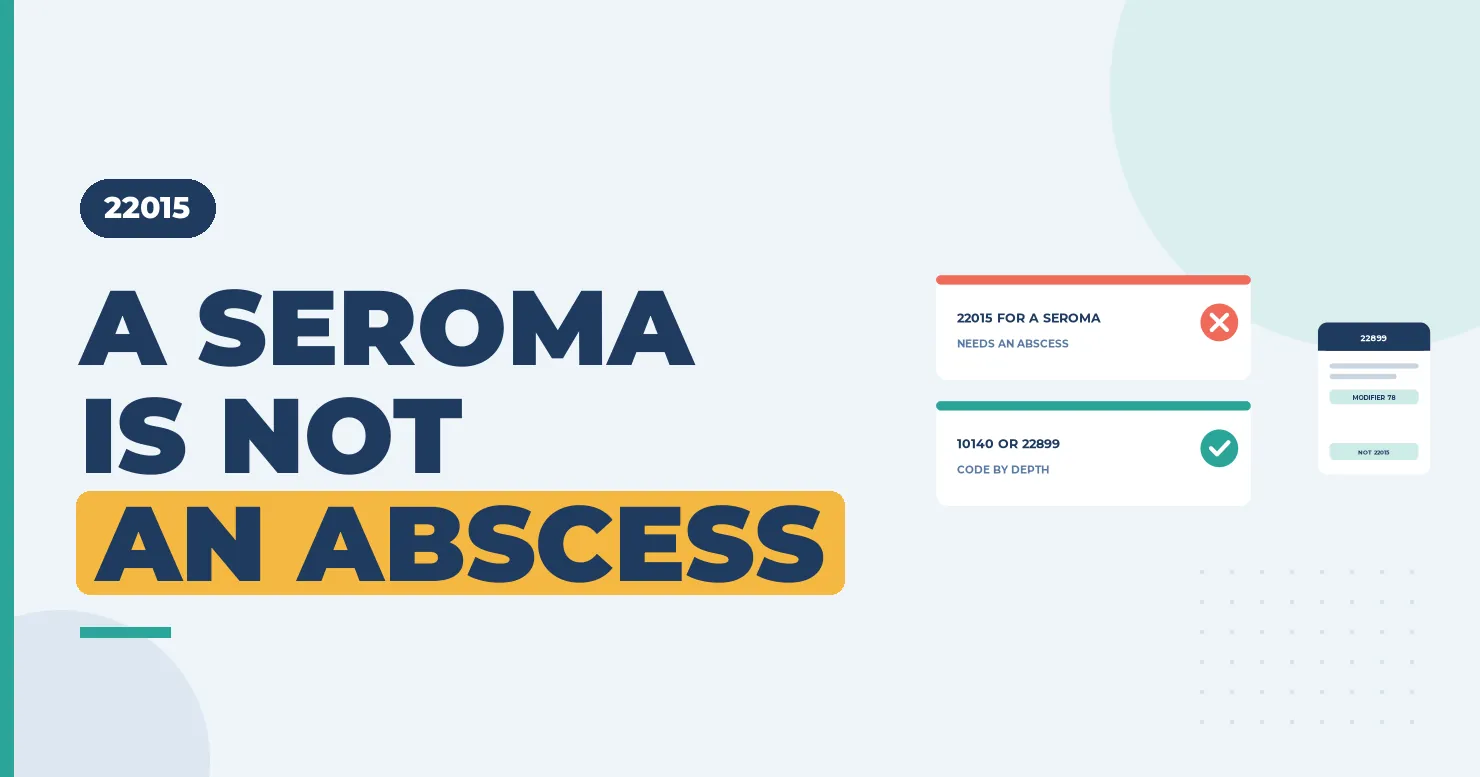
Lumbar seroma exploration CPT coding starts with one fact: no CPT code names a deep spinal seroma. Do not bill 22015, because that code needs an abscess.
The fix is simple. Bill 10140 for a superficial seroma, or 22899 for a subfascial one, and add modifier 78 in the fusion global period.
TL;DR: 22015 is incision and drainage of a deep abscess of the lumbar spine. A seroma with negative cultures is not an abscess. 22830 is exploration of a spinal fusion, and NCCI bars it with another spine procedure in the same area. 10140 covers a seroma or fluid collection, but CMS treats it as skin and subcutaneous drainage. When the surgeon opens the fascia, evacuates the collection and works around the hardware, 22899 with modifier 78 often fits best. The microscope, fluoroscopy, drain and closure have no separate payment here.
Written by Manikandan J, CPC, CRCR, a certified coder and revenue cycle specialist. Published 26 November 2026. Last updated: 26 November 2026.
Table of Contents
Which CPT code fits an open lumbar seroma exploration?
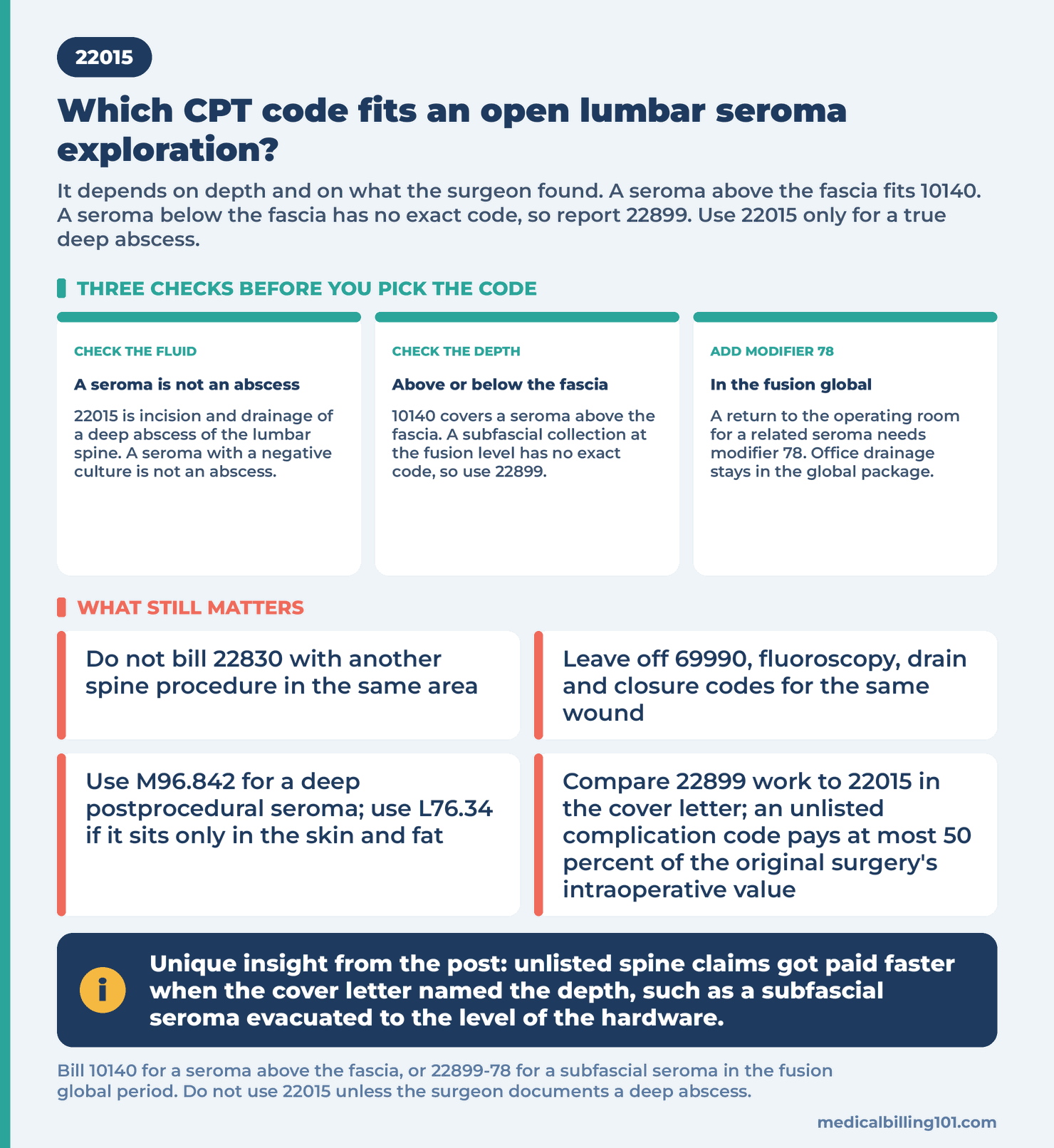
It depends on depth and on what the surgeon found. A seroma above the fascia fits 10140. A seroma below the fascia, at the fusion level, has no exact code. In that case, report the unlisted spine code 22899. Use 22015 only when the surgeon drains a true deep abscess.
A seroma is a pocket of clear or blood-tinged fluid that builds up in a surgical wound. An abscess is a pocket of pus from infection. Subfascial means under the fascia, the firm layer over the spinal muscles. These three words drive the code choice.
In the case on the forum, the fluid looked like seroma. An office aspiration had grown no bacteria. The surgeon reopened the incision and went down to L4-5 with a tubular retractor. He checked the dura and nerve root for a leak, then closed the fascia over a drain.
Example scenario (fictional names), part 1
Lumbar seroma example: what happened
Redstone Spine Associates is a fictional spine practice in Kansas. Lucinda Marchetti codes its surgeries. Dr. Ignatius Bello is the spine surgeon.
A 71-year-old Medicare patient had an L4-5 fusion. Six weeks later, a large fluid pocket formed under the incision. The office drained it once, and the culture was negative. It came back, so Dr. Bello took her back to the operating room.
The claim went out as 22015 and 22830 with no modifier. Medicare denied both lines.
What went wrong? Keep reading, or jump to how the case was resolved.
Can you bill 22015 for a lumbar seroma?
No, not for a seroma. CMS lists 22015 as incision and drainage of an abscess of the posterior spine, lumbar, sacral or lumbosacral. A seroma with a negative culture is not an abscess. If the surgeon finds pus and documents a deep infection, 22015 becomes the right code.
The CMS physician fee schedule RVU file for October 2026 shows these values for the codes in this question.
| Code. | CMS short descriptor. | Global days. | Intraoperative share. |
|---|---|---|---|
| 22015. | I&D abscess posterior spine, lumbar, sacral or lumbosacral. | 90. | 69 percent. |
| 10140. | I&D hematoma, seroma or fluid collection. | 10. | 80 percent. |
| 22830. | Exploration of spinal fusion. | 90. | 69 percent. |
| 22899. | Unlisted procedure, spine. | YYY (set by the MAC). | Priced by the MAC. |
| 69990. | Microsurgery add-on. | ZZZ. | Not applicable. |
The intraoperative share matters for modifier 78. Medicare pays only that part of the fee on a return to the operating room. Check local rates in our RVU calculator.
Does 10140 cover a deep fluid collection?
10140 names the right fluid, but not the right depth. CMS describes integumentary drainage as cutaneous or subcutaneous drainage of hematomas, seromas or fluid collections. A collection that sits under the fascia, around rods and screws, goes beyond that. Use 10140 when the surgeon stays above the fascia.
The Wellpoint Federal billing and coding article A56766 lists 10140 as incision and drainage of hematoma, seroma or fluid collection. It sits in the skin and subcutaneous article, next to 10180 for complex postoperative wound infection.
That skin and subcutaneous wording comes from the NCCI Policy Manual for 2026, chapter III, section D. Read the operative note for the words “fascia” or “subfascial” before you choose.
Can you bill 22830 with 10140 for the same wound?
No. NCCI says exploration of a surgical field is standard surgical practice. Chapter IV, section F.1, uses 22830 as the example. It shall not be reported with another spine procedure in the same anatomic area. Modifier 59 or XS applies only when the fusion exploration is in a different area.
22830 also needs a real fusion exploration. The note should describe a fusion problem, such as a loose screw or a failed fusion mass. In this case, the surgeon looked for a spinal fluid leak and drained a seroma. That is the drainage work, not a separate exploration of the fusion.
When should you use 22899 for a spinal seroma?
Use 22899 when the work is subfascial and no CPT code describes it. The Medicare Claims Processing Manual, chapter 12, section 40.2, says so. If no code describes the return-trip procedure, use the unlisted code in the correct series.
Send the operative note and a short cover letter. Compare the work to 22015, because it is the closest deep lumbar drainage code. The same chapter, in section 40, also limits payment. An unlisted complication code pays at most 50 percent of the original surgery’s intraoperative value.
For help with the letter, see how to write a comparable procedure narrative. Commercial payers may set their own rules for unlisted codes, so check the contract first.
In my 10+ years of billing and AR work, unlisted spine claims got paid faster when the cover letter named the depth. A single line like “subfascial seroma evacuated to the level of the hardware” answered the first question.
Which modifier do you use in the fusion global period?
Use modifier 78. Section 40.2 says to add it for a return to the operating room for a related procedure during the postoperative period. For example, a seroma at the fusion incision is related to the fusion. Medicare pays only the intraoperative part of the code, and no new global period starts.
The office drainage earlier in the global period is not billable. Section 40.1 of chapter 12 puts complications that do not need a return to the operating room inside the global package. Count the days with our global period calculator and review the global surgical package guide.
Can you bill 69990, fluoroscopy or the wound closure?
No. Chapter 12, section 20.4.5, pays 69990 only with a fixed list of codes. The list includes 63081-63308 and 61304-61546, but not 10140, 22015, 22830 or 22899. The NCCI PTP edits also pair 69990 with 10140, 22015 and 22830 at modifier indicator 0.
NCCI Policy Manual chapter IV, section F.6, says 76000 shall not be reported with spinal procedures unless CPT gives a specific instruction. Section I.23 puts closure of the surgical incision in the global package, so 13160 is not added. The drain, hemostatic agents, vancomycin powder and dural sealant are also included.
Which ICD-10 code fits a seroma after a lumbar fusion?
Use M96.842 for a deep seroma. The FY 2027 ICD-10-CM code files define it as postprocedural seroma of a musculoskeletal structure following a musculoskeletal system procedure. Add Z98.1, arthrodesis status, if your payer wants it.
If the seroma sits only in the skin and fat, L76.34 fits better. It is postprocedural seroma of skin and subcutaneous tissue following other procedure. If the surgeon finds infection, T81.4- codes apply and the CPT choice moves toward 22015.
Which NCCI and MUE edits apply to these codes?
The NCCI practitioner PTP edits, version 32.3, list 22015 with 10140 at modifier indicator 1. So 10140 bundles into 22015 when both describe the same wound. The edit allows a modifier only for a truly separate site.
The October 2026 practitioner MUE file sets 22015 and 10140 at 2 units, and 22830 and 69990 at 1. Check pairs in our NCCI edit checker and units in the MUE lookup.
Example scenario (fictional names), part 2
How the lumbar seroma case was resolved
- Lucinda read the note again. It said the fluid looked like seroma, the culture was negative, and the fascia was opened and closed.
- She saw that 22015 needed an abscess, and 22830 could not go with another spine procedure in the same area.
- She also saw that neither line had modifier 78, so both landed inside the fusion global period.
Fix: a corrected claim with 22899-78, diagnosis M96.842 and Z98.1, and a cover letter comparing the work to 22015. The microscope and fluoroscopy lines were left off.
Outcome: the MAC priced the unlisted line and paid it. The practice added a rule: every return to the operating room in a global period gets a depth check and modifier 78 before billing.
Names and details are illustrative; no real patient data.
To send the fix, follow our corrected claim guide. For another spine coding question, see whether both co-surgeons add modifier 62 to 22860.
3-step checklist
- Read the note for fluid type and depth. Pus means 22015, seroma above the fascia means 10140, and seroma below it means 22899.
- Add modifier 78 when the patient returns to the operating room in the fusion global period.
- Leave off 22830, 69990, 76000 and closure codes for the same wound, and attach the note to any 22899 claim.
FAQ
What is the CPT code for evacuation of a lumbar seroma?
No CPT code names a deep spinal seroma. Use 10140 for a seroma above the fascia. Use unlisted code 22899 for a subfascial seroma at the fusion level, and compare it to 22015.
Can 22015 be used for a seroma?
No. CMS describes 22015 as incision and drainage of an abscess of the lumbar posterior spine. A seroma with a negative culture is not an abscess.
Can 22830 be billed with 10140?
Not for the same wound. NCCI says 22830 shall not be reported with another spine procedure in the same anatomic area. Modifier 59 or XS applies only to a different area.
Does a seroma drainage in the global period need modifier 78?
Yes, when the patient returns to the operating room. Medicare pays the intraoperative part of the code, and no new global period starts. Office drainage stays in the global package.
Which ICD-10 code fits a seroma after spinal fusion?
Use M96.842 for a deep postprocedural seroma of a musculoskeletal structure. Use L76.34 for a seroma in skin and subcutaneous tissue only.
Sources
My methodology was simple. I checked the CMS manuals, the NCCI Policy Manual, the October 2026 RVU, MUE and NCCI files, and the FY 2027 ICD-10-CM files.
- CMS, PFS Relative Value File October 2026 (linked above). Accessed 26 Nov 2026.
- CMS, Medicare NCCI Policy Manual 2026, chapter III section D and chapter IV sections F.1, F.6 and I.23 (linked above). Accessed 26 Nov 2026.
- CMS, Medicare Claims Processing Manual, chapter 12, sections 20.4.5, 40.1, 40.2 and the section 40 payment rules for return trips (linked above). Accessed 26 Nov 2026.
- Wellpoint Federal, Billing and Coding: Incision and Drainage (I&D) of Abscess of Skin, Subcutaneous and Accessory Structures, A56766 (linked above). Accessed 26 Nov 2026.
- CMS, NCCI practitioner PTP edits v32.3, Practitioner MUE file effective 10-01-2026, FY 2027 ICD-10-CM code descriptions (linked above). Accessed 26 Nov 2026.
Read about the author, or contact us with a question. See our editorial policy.
Last updated: 26 November 2026 · Educational content for U.S. coding and billing teams. CPT descriptions are plain-language summaries; check the current CPT code set and your MAC’s policy for full wording.