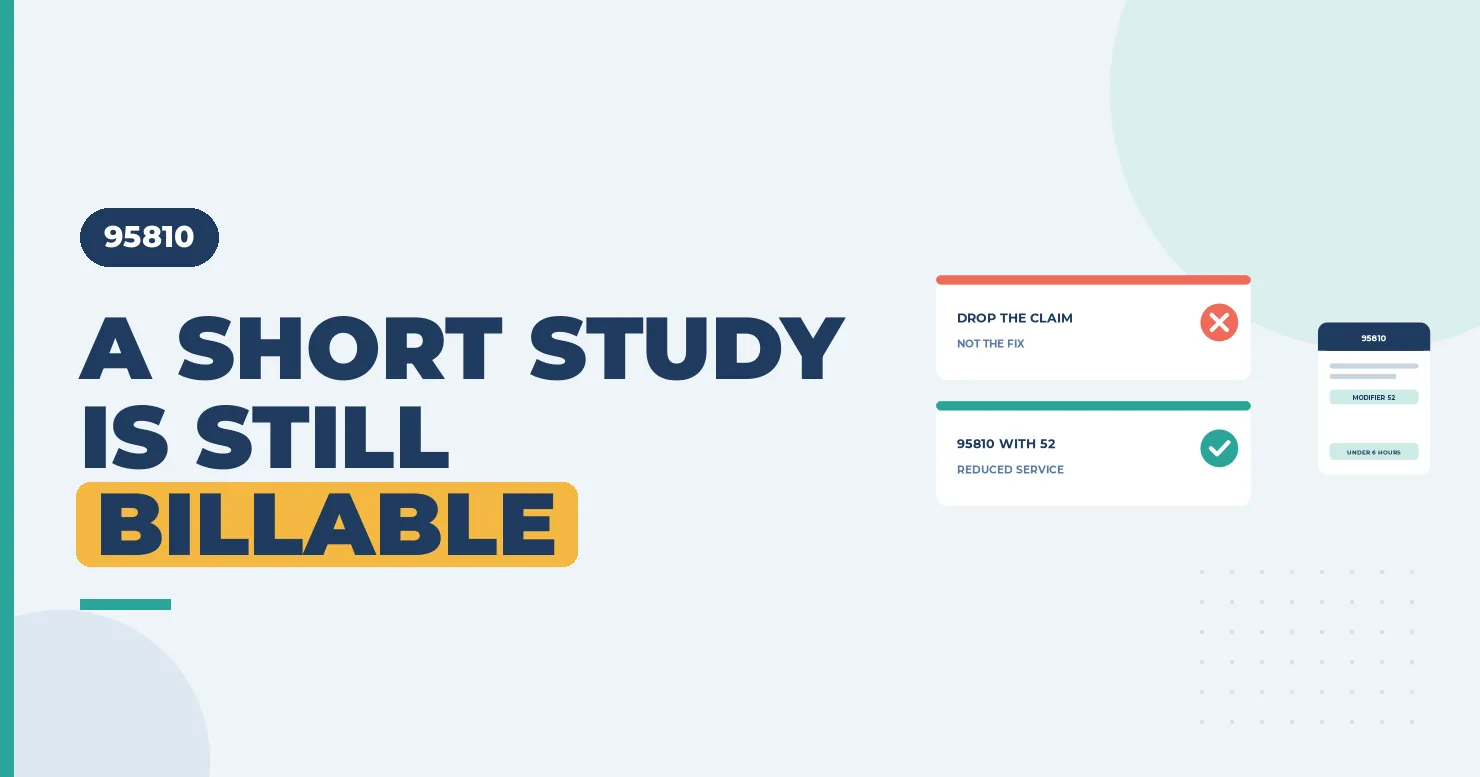
95810 reduced services means a short sleep study is billed as 95810 with modifier 52. Do not drop the claim, and do not bill the tech, bed or equipment separately.
The fix is simple. Bill 95810-52 with a reduced charge, document the recording and sleep times, and bill the repeat study as a full 95810.
TL;DR: CPT defines polysomnography as 6 or more hours of recording. A study with 160 minutes of recording and 74 minutes of sleep is a reduced service. Report 95810 with modifier 52. The technologist time, bed and equipment are already part of 95810, so they have no separate codes. The rescheduled full study is billed as 95810 without modifier 52.
Written by Manikandan J, CPC, CRCR, a certified coder and revenue cycle specialist. Published 26 November 2026. Last updated: 26 November 2026.
Table of Contents
Is a 95810 sleep study billable when recording time is minimal?
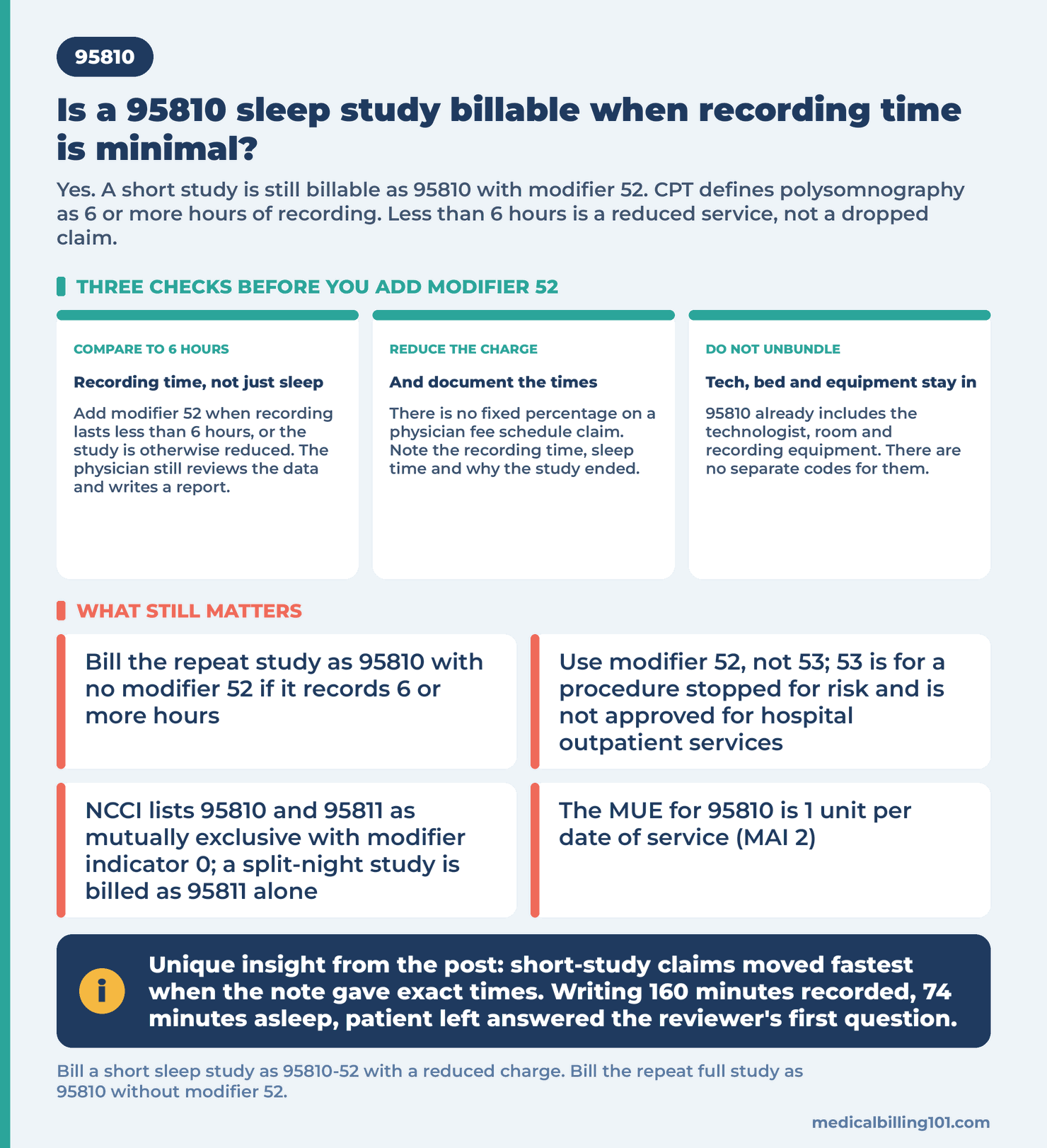
Yes. A short study is still billable as 95810 with modifier 52. The patient was set up, monitored by a technologist and recorded. The physician also reviewed the data. Modifier 52 tells the payer that the service was real but less than the full study.
95810 is Polysomnography; age 6 years or older, sleep staging with 4 or more additional parameters of sleep, attended by a technologist. The Novitas LCD L35050 for outpatient sleep studies repeats the CPT definition. Sleep studies mean continuous recording of sleep parameters for 6 or more hours, with physician review, interpretation and report.
Modifier 52 (reduced services) means a service was partly reduced or eliminated. The basic code stays the same. Recording time is the total time the equipment captured data. Sleep time is the part of that recording in which the patient was asleep.
Example scenario (fictional names), part 1
Short sleep study example: what happened
Lakeshore Sleep Center is a fictional independent sleep lab in Michigan. Henrietta Lindqvist codes its studies. Dr. Caspian Oduya reads the studies.
A 58-year-old Medicare patient came in for an attended diagnostic study for suspected sleep apnea. Recording ran 160 minutes, with 74 minutes of sleep. The patient chose to go home. Dr. Oduya wrote that the data was not enough for a diagnosis and ordered a repeat.
The night was billed as 95810 at the full charge with no modifier. Two weeks later, the repeat study was billed as 95810 too. The MAC sent a records request for the second study.
What went wrong? Keep reading, or jump to how the case was resolved.
When do you add modifier 52 to 95810?
Add modifier 52 when recording lasts less than 6 hours, or the study is otherwise reduced. First Coast’s billing and coding article A57496 says it directly. Report with modifier 52 if less than 6 hours of recording or in other cases of reduced services.
The WPS billing and coding article A56903 gives the same rule. A sleep study performed for less than 6 hours is billed with modifier 52. It adds one more step. Report the service with the appropriate reduced original charge.
In this case, recording was 160 minutes, well under 6 hours. The physician still reviewed the data and wrote a report. So 95810-52 fits.
Can you bill the sleep tech, bed and equipment separately?
No. 95810 already includes them. For example, the technical component pays for the technologist, the room and the recording equipment. The professional component pays for the physician’s review and report. There are no separate codes for tech time or a sleep lab bed.
The CMS physician fee schedule RVU file for October 2026 splits 95810 into parts. It shows PC/TC indicator 1, global period XXX and these national values before the locality adjustment.
| 95810 line. | Total RVUs (non-facility). | National amount at $33.4009. |
|---|---|---|
| 95810 global (tech and physician). | 20.17. | About $673.70. |
| 95810-TC (technical component). | 16.59. | About $554.12. |
| 95810-26 (professional component). | 3.58. | About $119.58. |
A sleep lab that bills globally reports 95810-52. A lab that bills only the technical part reports 95810-TC-52. A reading physician who bills separately reports 95810-26-52. Check the local amount in our RVU calculator.
How much does Medicare pay for 95810 with modifier 52?
There is no fixed percentage for a physician fee schedule claim. You set a reduced charge, and the payer prices the claim. The A56903 article asks for the reduced original charge. Send the recording and sleep times so the reviewer can see how much was done.
Hospital outpatient claims follow a different rule. The Medicare Claims Processing Manual, chapter 4, section 20.6.4, covers modifier 52 under OPPS. A service without planned anesthesia that is partly reduced is paid at 50 percent of the full OPPS amount.
In my 10+ years of billing and AR work, short-study claims moved fastest when the note gave exact times. Writing “160 minutes recorded, 74 minutes asleep, patient left” answered the reviewer’s first question.
Should you use modifier 53 instead of 52?
No, not in this case. Modifier 53 is for a procedure the physician stops because of extenuating circumstances or risk to the patient. The sleep testing rule already names modifier 52 for short recordings. Chapter 4 also says modifier 53 is not approved for hospital outpatient services.
Modifier 52 covers a service that was reduced but still produced data and a report. That matches a short study. For a full side-by-side, read which modifier fits a discontinued or reduced service.
How do you bill the repeat sleep study?
Bill the repeat as 95810 with no modifier 52, if it records 6 or more hours. The LCDs accept a repeat study for reasons such as a patient who could not sleep or slept too little for a diagnosis. The record must show that reason.
The Medicare Benefit Policy Manual, chapter 15, section 70, says one polysomnogram can ordinarily diagnose sleep apnea. More than one testing session needs persuasive medical evidence. That is why the first night’s note matters.
Keep the technologist log and the physician’s statement that the data was not enough. If the second study is denied for frequency, see our CO-151 guide.
Which NCCI and MUE edits apply to 95810?
The October 2026 practitioner MUE file sets 95810 at 1 unit per date of service. The hospital outpatient MUE is also 1. Both use MAI 2, a date-of-service policy edit.
The NCCI practitioner PTP edits, version 32.3, pair 95810 with 95811 as mutually exclusive, modifier indicator 0. A split-night study is billed as 95811 alone, as A57496 also says. Check pairs in our NCCI edit checker and units in the MUE lookup.
Example scenario (fictional names), part 2
How the short sleep study case was resolved
- Henrietta pulled the technologist log. It showed 160 minutes recorded, 74 minutes asleep and the time the patient left.
- Dr. Oduya’s report said the study was not adequate for a diagnosis and a repeat was needed.
- She saw that the first night had been billed as a full study with no modifier 52.
Fix: a corrected claim for the first night as 95810-52 with a reduced charge and a short note with the times. The records for the repeat study included the first report and the log.
Outcome: the MAC accepted the repeat study as medically necessary. The lab added a rule: any study under 6 hours of recording gets modifier 52 before billing.
Names and details are illustrative; no real patient data.
To send the first-night fix, follow our corrected claim guide. For another component modifier question, see why Medicare denies modifier 26 for a SNF patient.
3-step checklist
- Compare recording time to 6 hours. If it is less, add modifier 52 to 95810.
- Lower the charge and note the recording time, sleep time and reason the study ended.
- Bill the repeat study as 95810 and keep the first report that shows why it was needed.
FAQ
Can you bill 95810 if the patient leaves the sleep study early?
Yes. Bill 95810 with modifier 52 when recording is less than 6 hours. Lower the charge and document the recording time, sleep time and why the study ended.
How many hours are required for 95810?
CPT defines sleep studies and polysomnography as 6 or more hours of recording with physician review, interpretation and report. Less than 6 hours is reported with modifier 52.
Can the sleep technologist time be billed separately?
No. The technologist, room and equipment are part of the 95810 technical component. There is no separate code for them.
Is the repeat sleep study covered?
It can be. Medicare LCDs list insufficient sleep time for a diagnosis as a reason for a repeat study. The record must support it, because more than one session needs persuasive medical evidence.
Can 95810 and 95811 be billed on the same night?
No. NCCI lists 95810 and 95811 as mutually exclusive with modifier indicator 0. A split-night study is billed as 95811 alone.
Sources
My methodology was simple. I checked the Medicare sleep study LCDs and billing articles, the CMS manuals, and the October 2026 RVU, MUE and NCCI files.
- First Coast, Billing and Coding: Polysomnography and Sleep Testing, A57496 (LCD L33405) (linked above). Accessed 26 Nov 2026.
- WPS, Billing and Coding: Polysomnography and Other Sleep Studies, A56903 (LCD L36839) (linked above). Accessed 26 Nov 2026.
- Novitas, LCD L35050, Outpatient Sleep Studies (linked above). Accessed 26 Nov 2026.
- CMS, Medicare Claims Processing Manual, chapter 4, section 20.6.4, and Benefit Policy Manual, chapter 15, section 70 (linked above). Accessed 26 Nov 2026.
- CMS, PFS Relative Value File October 2026, Practitioner MUE file effective 10-01-2026, NCCI PTP edits v32.3 (linked above). Accessed 26 Nov 2026.
Read about the author, or contact us with a question. See our editorial policy.
Last updated: 26 November 2026 · Educational content for U.S. coding and billing teams. CPT descriptions are plain-language summaries; check the current CPT code set and your MAC’s policy for full wording.