
The discontinued procedure modifier 53 vs 52 choice depends on why the service was cut short. Use 52 when the provider chose a smaller scope. Use 53 when the provider had to stop for safety or another extenuating reason.
So when BCBS denies 76830 asking for a “discontinued or reduced services” modifier, check the ultrasound note first. Then rebill with 52, rebill with 53, or appeal with proof of a full exam.
TL;DR: Modifier 52 means reduced services by the provider’s choice. Modifier 53 means a physician stopped a started procedure because of patient risk or an extenuating event. Modifiers 73 and 74 are the hospital and ASC versions for procedures with planned anesthesia. If the full 76830 exam was done, do not add either modifier. Appeal with the report and images instead.
Written by Manikandan J, CPC, CRCR, a certified coder and revenue cycle specialist. Published 17 November 2026. Last updated: 17 November 2026.
Table of Contents
What is the difference between modifier 52 and 53?
Modifier 52 is the reduced services modifier. The provider chose to do less than the full code describes. Modifier 53 is the discontinued procedure modifier. The physician started the service and then stopped it because of an unusual event or a risk to the patient.
The key word is choice. A smaller scope by design is 52. An unplanned stop is 53. Noridian’s modifier 52 guide says 52 covers partial reduction or elimination of a service without changing the base code. Its modifier 53 guide says 53 is for professional services only.
| Modifier | Who reports it | When to use it | Medicare payment effect |
|---|---|---|---|
| 52 | Physician or facility. | Service reduced by choice; facility use only when anesthesia is not planned. | Professional: bill the reduced charge. Facility: half the OPPS amount. |
| 53 | Physician only. | Started procedure stopped for patient risk or a rare event. | No automatic cut; bill the share of the service done. |
| 73 | Hospital outpatient or ASC. | Stopped after prep and room entry, before anesthesia. | Half the OPPS amount. |
| 74 | Hospital outpatient or ASC. | Stopped after anesthesia or after the procedure started. | Full OPPS amount. |
Why would BCBS deny 76830 for a missing discontinued or reduced services modifier?
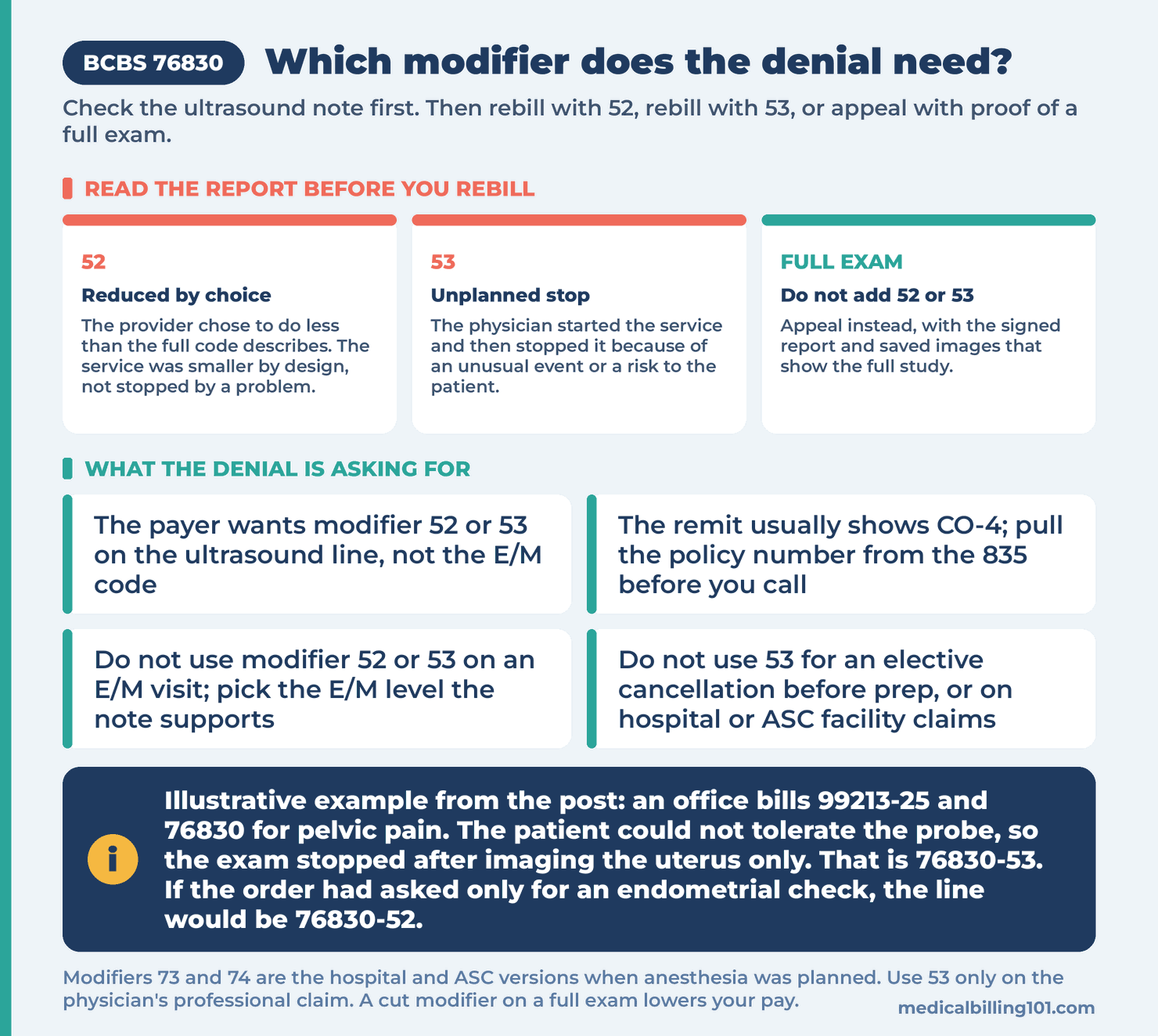
CPT 76830 is the code for a transvaginal ultrasound, non-obstetric. BCBS denies 76830 this way when its claim edit thinks the ultrasound was not a full exam. The payer wants modifier 52 or 53 on the ultrasound line. It is not asking about the E/M code. Modifier 25 on the E/M is a separate issue.
The remit usually shows CO-4. The X12 claim adjustment reason code list says CARC 4 means the code is inconsistent with the modifier used. Its usage note points to the policy ID in the 835 REF segment of loop 2110. Pull that policy number before you call.
A phone rep reading the denial text cannot tell you which modifier fits. That answer comes from the ultrasound report. Our breakdown of a modifier 62 denial for a missing or inconsistent modifier walks through the same remit logic.
When should you add modifier 52 to 76830?
Add modifier 52 to 76830 when the provider chose to do only part of the transvaginal exam. For example, the order asked for one structure only and the report covers only that structure. The service was smaller by design, not stopped by a problem.
Chapter 4, section 20.6.6 of the Medicare Claims Processing Manual gives the radiology rule. Code to the extent of the procedure done. If no code exists for the smaller service, report the intended code with modifier 52. 76830 has no limited version, so 52 is the way to show a reduced exam.
Noridian adds two steps for Medicare Part B. Write “reduced services” and a short reason in item 19 or the electronic note field. Then reduce the charge by the share of the service not done.
When should you add modifier 53 to 76830?
Add modifier 53 to 76830 when the provider started the transvaginal ultrasound and had to stop. Common reasons include events such as severe patient pain, a vasovagal episode or equipment failure. The note must say why the exam stopped and what was completed before the stop.
Noridian lists the limits on 53. Do not use it for an elective cancellation before the patient is prepped. Do not use it on E/M or anesthesia codes. Do not use it on hospital or ASC facility claims. Medicare does not cut 53 claims automatically, so bill the share of the service you actually did.
Some codes have set 53 values. Take an incomplete colonoscopy billed with 53. Chapter 12, section 30.1 of the Medicare Claims Processing Manual pays it at a rate built on half the inputs.
When do you use modifier 73 or 74 instead of 53?
Use modifier 73 or 74 on hospital outpatient and ASC facility claims. Use 53 only on the physician’s professional claim. Chapter 4, section 20.6.4 says modifier 53 is not approved for outpatient hospital services. Modifiers 73 and 74 apply only when anesthesia was planned or given.
- Modifier 73 is for a stopped facility case before anesthesia. The patient was prepped and taken to the room, then the case stopped before anesthesia. OPPS pays half the APC amount.
- Modifier 74 is for a stopped facility case after anesthesia. The case stopped after anesthesia started or after the procedure began. OPPS pays the full APC amount.
- Modifier 52 (facility): No anesthesia was planned, and the service was reduced or stopped after room prep. OPPS pays half the APC amount.
For CMS, “anesthesia” here includes local, regional blocks, moderate sedation, deep sedation and general anesthesia. Our answer on a Blue Cross ASC nerve block denial shows how facility and professional claims follow different modifier rules.
Can you use modifier 52 or 53 on an E/M visit?
No. Medicare does not pay partial E/M visits, so modifier 52 does not go on an E/M code. Chapter 12, section 30.6.18 states this directly. Noridian also lists E/M codes as an incorrect use of modifier 53. Pick the E/M level the note supports instead.
In the 76830 case, the E/M with modifier 25 stays as billed if it is separately supported. Only the ultrasound line needs the fix. Our modifier 25 and 59 helper can check the E/M side.
What if the 76830 exam was complete?
If the transvaginal exam was complete, do not add 52 or 53. A cut modifier on a full exam lowers your pay. It also tells the payer the wrong story. Appeal instead, with the signed report and saved images that show the full study.
In 2026, 76830 carries 3.52 total non-facility RVUs in the Medicare fee schedule. At the $33.4009 conversion factor, that is about $117.57 nationally before locality adjustment. A wrongful 52 can drop that sharply. You can check the math in our RVU calculator.
When I worked imaging denials, I always pulled the payer’s edit or policy number before rebilling a modifier.
Build the appeal around three facts. The order, the full report and the image count all match a complete exam. Our appeal letter generator gives you a clean starting letter.
What does a corrected 76830 claim look like?
Here is an illustrative example. An office bills 99213-25 and 76830 for pelvic pain. The patient could not tolerate the probe, so the sonographer stopped after imaging the uterus only. The report states the reason and the structures not seen.
That is an unplanned stop for patient comfort and safety, so the professional line is 76830-53. The E/M stays 99213-25. If the order had asked only for an endometrial check, the line would be 76830-52 instead. Send it as a corrected claim if the payer allows it.
3-step checklist
- Read the ultrasound report: full exam, reduced by choice, or stopped for a problem.
- Full exam means appeal; reduced by choice means 52; stopped for risk means 53 (73 or 74 on facility claims).
- Pull the 835 policy ID, reduce the charge for 52 or 53, and send a corrected claim.
FAQ
Is modifier 52 or 53 used for a reduced service?
Modifier 52 is used when the provider chose to reduce the service. Modifier 53 is used when the physician started a procedure and stopped it because of extenuating circumstances or a threat to the patient.
Can a hospital use modifier 53?
No. Medicare Claims Processing Manual Chapter 4, section 20.6.4 says modifier 53 is not approved for outpatient hospital services. Facilities use 73, 74 or 52 instead.
What is the difference between modifier 73 and 74?
Modifier 73 means the facility case stopped before anesthesia, after prep and room entry. Modifier 74 means it stopped after anesthesia or after the procedure began. OPPS pays half the amount for 73 and the full amount for 74.
Does Medicare reduce payment automatically for modifier 53?
No. Noridian says the claims system does not automatically reduce payment for modifier 53. The provider bills the share of the service actually completed.
Can modifier 52 be used on an E/M code?
No. Medicare does not pay partial E/M visits, and modifier 52 cannot be used to report them. Bill the E/M level the note supports.
Sources
My methodology was simple. I checked the CMS claims manuals, Noridian’s Medicare modifier guides, the X12 reason code list and the 2026 Medicare fee schedule file. BCBS plans and other commercial payers may differ, so confirm each payer’s current policy.
- CMS, Medicare Claims Processing Manual, Chapter 4, sections 20.6.4 and 20.6.6 (linked above). Accessed 17 Nov 2026.
- CMS, Medicare Claims Processing Manual, Chapter 12, sections 30.1 and 30.6.18 (linked above). Accessed 17 Nov 2026.
- Noridian JF Part B, Modifier 52 and Modifier 53 pages (linked above). Accessed 17 Nov 2026.
- X12, Claim Adjustment Reason Codes, CARC 4 (linked above). Accessed 17 Nov 2026.
- CMS, PFS Relative Value Files, CY 2026 RVU26D (CMS page). Accessed 17 Nov 2026.
Read about the author, or contact us with a question. See our editorial policy.
Last updated: 17 November 2026 · Educational content for U.S. billers. Check each payer’s current rules.