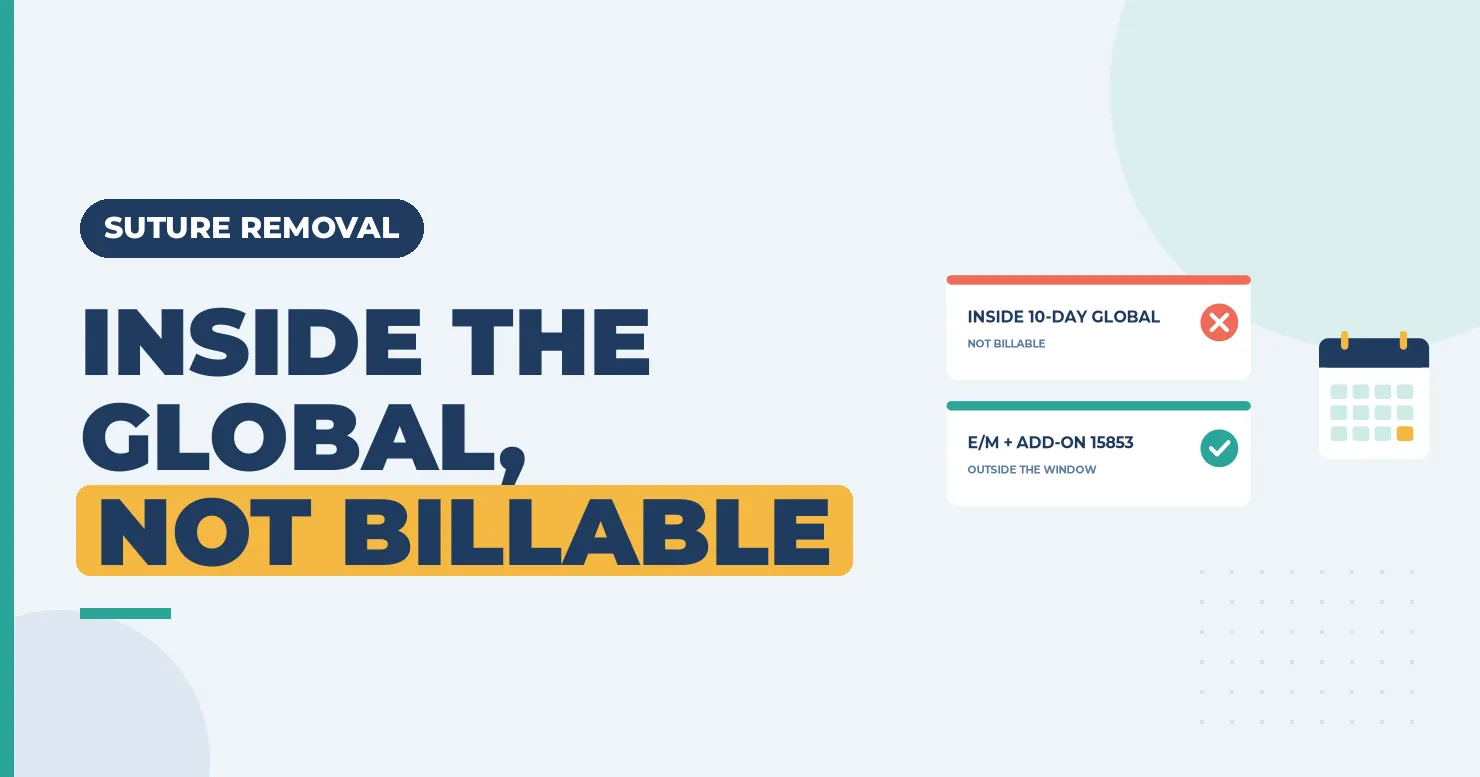
A suture removal visit billing question comes down to the global period. Inside a 10-day global, the visit is included and not billable. Outside it, bill an E/M code such as 99212 or 99211 plus add-on 15853, with Z48.02 first.
The add-on never pays alone. It pays only when the E/M on the same claim is supported and paid.
TL;DR: Count the global days first. CMS counts the surgery day plus 10 days for an 010 code. After that window, suture removal is billed as an E/M visit with add-on 15853. List Z48.02 first and Z85.828 second when the cancer was fully excised. The E/M must stand on its own documentation.
Written by Manikandan J, CPC, CRCR, a certified coder and revenue cycle specialist. Published 17 November 2026. Last updated: 17 November 2026.
Table of Contents
Is a suture removal visit billable after a skin excision?
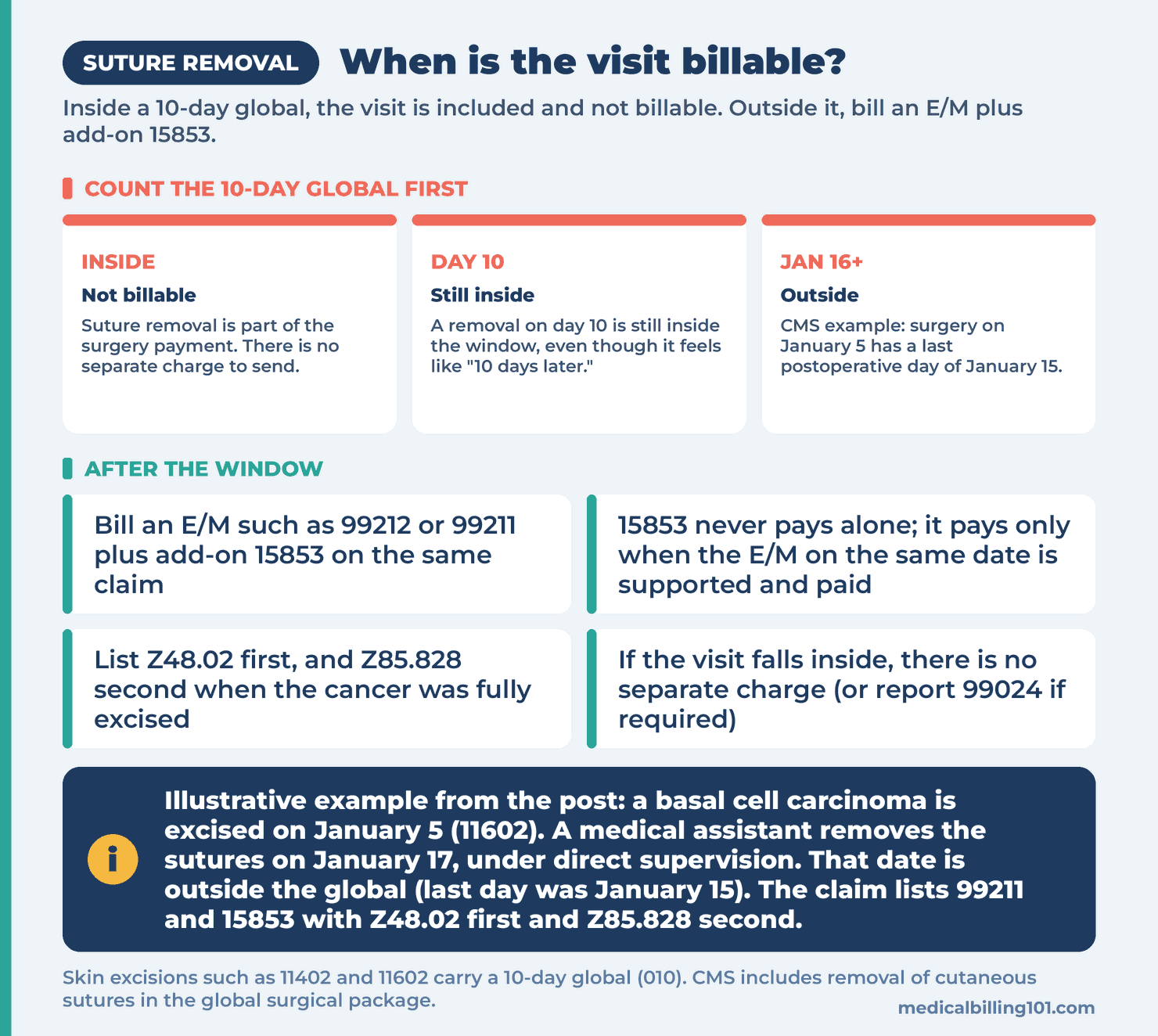
A suture removal visit is billable only after the excision’s global period ends. Skin excisions such as 11402 and 11602 carry a 10-day global (010) in the Medicare fee schedule. Inside that window, suture removal is part of the surgery payment. After it, the visit is a separate service.
CMS lists “removal of cutaneous sutures and staples” as a service included in the global surgical package. That rule is in the Medicare Claims Processing Manual, Chapter 12, section 40.1. The same section says Medicare does not pay separately for related visits within 10 days of a minor surgery.
Our global surgical package guide explains the full package. For a quick date check, use the global period calculator.
How do you count a 10-day global period?
A 10-day global period is the day of surgery plus the 10 days right after it. Chapter 12, section 40.1 gives this exact example. Surgery on January 5 has a last postoperative day of January 15. A suture removal visit on January 16 or later is outside the global period.
Many claims fail this simple test. A removal on day 10 is still inside the window, even though it feels like “10 days later.” Check the date before you build an E/M claim. If the visit falls inside, there is no separate charge to send.
Some practices must report 99024 for visits inside the global. The CMS Global Surgery booklet says groups of 10 or more practitioners in nine states must report it for required codes. Those states are Florida, Kentucky, Louisiana, Nevada, New Jersey, North Dakota, Ohio, Oregon and Rhode Island.
What is CPT 15853 and why does it not pay?
CPT 15853 is the add-on code for removal of sutures or staples not requiring anesthesia. It is listed in addition to an E/M code. It has no doctor work value. It pays for staff time and supplies only. So 15853 cannot pay unless an E/M visit on the same date pays.
The family physicians’ journal guide on suture and staple removal codes says to bill 15853 with an E/M when the visit is outside the global. It also says never to report 15853 without the primary E/M. Use 15854 instead when both sutures and staples are removed.
The 2026 Medicare fee schedule lists 15853 with global “ZZZ,” the add-on indicator. Its facility practice expense is marked “NA.” That means it has no facility price, so a hospital outpatient claim will not price it. You can check the values in our RVU calculator.
| Code | What it is | 2026 national non-facility RVUs | About (x $33.4009) |
|---|---|---|---|
| 15853 | Suture or staple removal, no anesthesia, add-on | 0.40 | $13.36 |
| 99211 | Established patient visit, may be clinical staff | 0.73 | $24.38 |
| 99212 | Established patient visit, straightforward MDM or 10 minutes | 1.78 | $59.45 |
| 99024 | Postoperative follow-up visit inside the global | Status B, bundled | $0 |
Should you bill 99212 or 99211 for suture removal?
Bill 99212 only when a physician or other qualified professional personally evaluates the patient. The note must show simple decision making or at least 10 minutes of the provider’s time. A wound check with a documented assessment and plan can support it. A quick snip-and-go visit usually cannot.
99211 is the visit code for clinical staff work. Bill it when clinical staff, such as a nurse or medical assistant, removes the sutures. The AMA E/M guidelines say 99211 face-to-face work may be done by clinical staff. For Medicare, staff visits must also meet incident-to rules, including direct supervision.
Those incident-to rules are in the Medicare Benefit Policy Manual, Chapter 15, section 60. Chapter 12, section 30.6.1 adds that medical need is the main test for payment. Do not pick a higher level to “make room” for the add-on.
CPT also lists 15853 with 99202-99205, so a new patient visit can work when another practice placed the sutures.
Which diagnosis codes go on a suture removal visit?
Z48.02 is the ICD-10-CM code for an encounter for removal of sutures. List it first. The ICD-10-CM guidelines say aftercare codes are generally first-listed to explain the reason for the encounter. Then add Z85.828, Personal history of other malignant neoplasm of skin, when the skin cancer was fully excised.
The FY 2027 ICD-10-CM Official Guidelines support that pairing. Section I.C.2.d says to use a Z85 code when the cancer was removed and no more treatment is aimed at that site. Section I.C.21.c.7 says not to use an aftercare code if care still treats a current disease.
So do not swap in an active cancer code just to get paid. Use the active C44 code only when the visit still treats the cancer, such as positive margins with more treatment planned. If the wound is infected or opened up, code that complication instead of routine aftercare. Our CO-11 page covers diagnosis mismatch denials.
Why was the E/M denied for a suture removal visit?
A denied suture removal E/M usually means one of four things. The visit fell inside the global. The E/M was not supported. The add-on had no paid primary code. Or the payer bundles the visit by its own policy.
- Inside the global: The remit often shows CO-97, service included in another service. Recount the days.
- Not medically necessary: Look for CO-50. Review whether the note shows a real evaluation.
- Add-on without a primary: 15853 denies when the E/M denies or is missing. Fix the E/M first.
- Same surgeon, unrelated problem: If the patient raises a new problem during the global, use modifier 24 on the visit.
When I worked dermatology denials, I always checked the excision date against the visit date before calling the payer.
Commercial payers can set their own global and E/M rules. Check the payer’s surgical package policy before you appeal. Our answer on Aetna denying an office visit billed with an x-ray shows how to read a payer bundling denial.
What does a clean suture removal claim look like?
Here is an illustrative example. A dermatologist excises a basal cell carcinoma from the back on January 5. The excised diameter is 1.5 cm, so the code is 11602. Pathology shows clear margins. A medical assistant removes the sutures on January 17, under the dermatologist’s direct supervision in the office.
January 17 is outside the global, because the last global day was January 15. The claim lists 99211 and 15853 with Z48.02 first and Z85.828 second. If the dermatologist had also examined the patient’s full skin for new lesions, a 99212 or higher might be supported instead.
3-step checklist
- Count the surgery day plus 10 days; if the visit falls inside, bill nothing (or 99024 if required).
- Outside the global, bill 99211 or a supported 99212 with add-on 15853 on the same claim.
- List Z48.02 first and Z85.828 second when the cancer was fully excised with no further treatment.
FAQ
Can you bill for suture removal during a 10-day global period?
No. CMS includes removal of cutaneous sutures in the global surgical package. Medicare does not pay separately for related visits within 10 days of a minor surgery.
Can CPT 15853 be billed alone?
No. CPT 15853 is an add-on code listed in addition to an E/M code. It pays only when a supported E/M visit is billed and paid on the same date.
What is the first diagnosis for a suture removal visit?
Z48.02, Encounter for removal of sutures. The ICD-10-CM guidelines say aftercare codes are generally first-listed to explain the reason for the encounter.
When do you use Z85.828 at a suture removal visit?
Use Z85.828 when the skin cancer was fully excised and no further treatment is directed to that site. If treatment continues, code the active cancer instead.
Can a nurse suture removal visit be billed as 99211?
Yes, when clinical staff perform the visit. For Medicare, the visit must also meet incident-to rules, including direct supervision, under Benefit Policy Manual Chapter 15, section 60.
Sources
My methodology was simple. I checked the CMS global surgery rules, the 2026 Medicare fee schedule file, the AMA E/M guidelines and the FY 2027 ICD-10-CM guidelines. Commercial payers may differ, so confirm each payer’s current policy.
- CMS, Medicare Claims Processing Manual, Chapter 12, sections 30.6.1 and 40.1 (linked above). Accessed 17 Nov 2026.
- CMS MLN, Global Surgery booklet MLN907166 (linked above). Accessed 17 Nov 2026.
- CMS, PFS Relative Value Files, CY 2026 RVU26D (CMS page). Accessed 17 Nov 2026.
- AAFP, Family Practice Management, guide to the suture/staple removal codes (linked above). Accessed 17 Nov 2026.
- AMA, CPT E/M Services Descriptors and Guidelines (linked above). Accessed 17 Nov 2026.
- CMS, Medicare Benefit Policy Manual, Chapter 15, section 60 (linked above). Accessed 17 Nov 2026.
- CMS/CDC, FY 2027 ICD-10-CM Official Guidelines, sections I.C.2.d and I.C.21.c.7 (linked above). Accessed 17 Nov 2026.
Read about the author, or contact us with a question. See our editorial policy.
Last updated: 17 November 2026 · Educational content for U.S. billers. Check each payer’s current rules.