
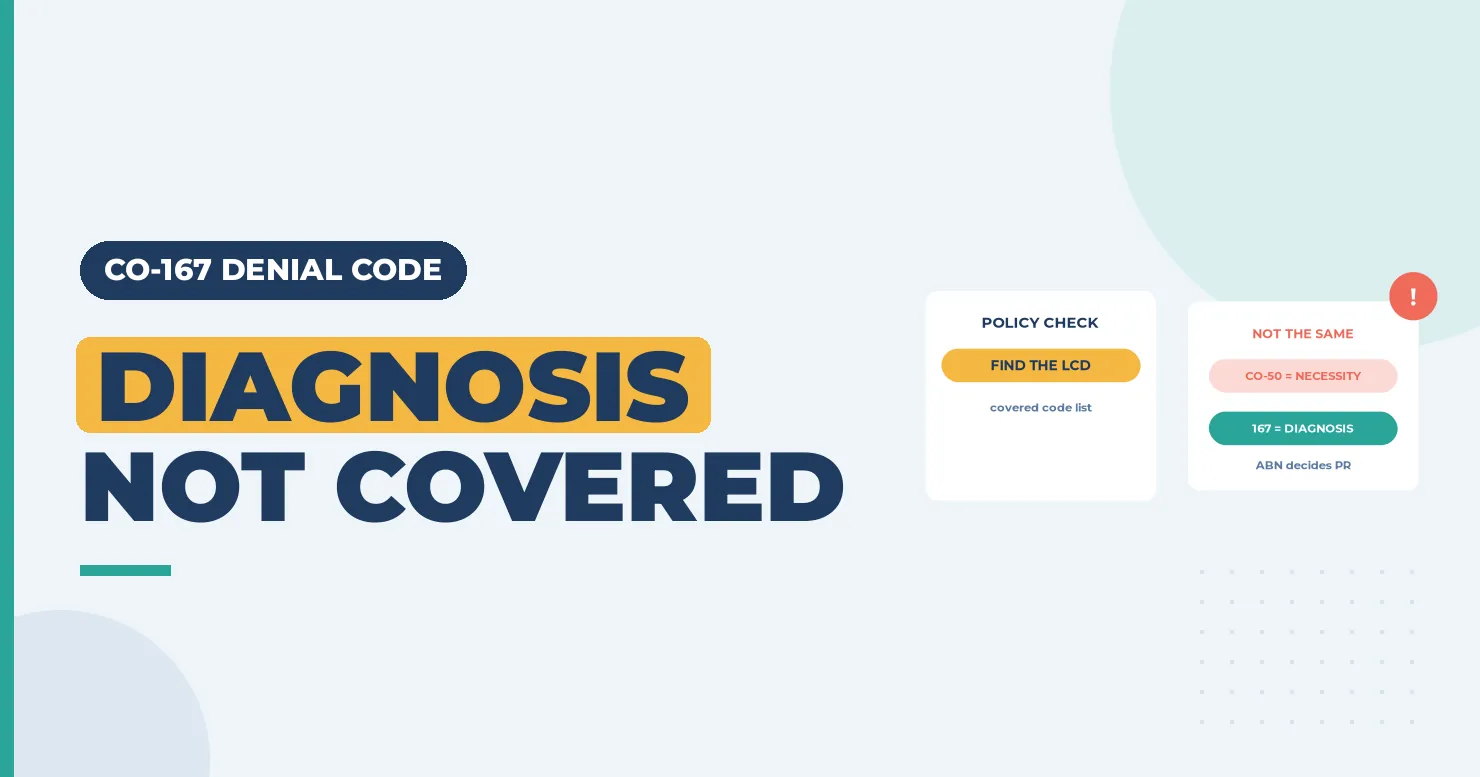
CO-167 says the payer reviewed the diagnosis codes on the claim and found none that its coverage rules accept for this service. It’s a coverage decision tied to the reason for the visit or test, not to the procedure code itself. On Medicare claims it usually means the diagnosis isn’t on the covered list in a Local or National Coverage Determination. The CO group means you can’t bill the patient unless proper advance notice was given. (Primary sources: X12 Claim Adjustment Reason Codes · CMS Medicare Coverage Database · CMS ABN guidance).
In brief: CO-167 means “this (these) diagnosis(es) is (are) not covered.” Open the coverage policy the payer used and compare its covered diagnosis list with the record. If a more accurate covered code was documented but not billed, send a corrected claim. If the policy was applied wrongly, appeal. If the service truly wasn’t covered and no valid ABN or waiver was signed, write off the CO amount.
Part of our denial codes library. Written by Manikandan J, CPC, CRCR, who has more than 10 years of US medical billing and revenue cycle experience. Published 20 October 2026. Last updated: 20 October 2026. Code wording is quoted word for word from X12.
Exact X12 wording of CARC 167
| Field | Official X12 text |
|---|---|
| Description | “This (these) diagnosis(es) is (are) not covered.” |
| Usage | “Refer to the 835 Healthcare Policy Identification Segment (loop 2110 Service Payment Information REF), if present.” |
Source: X12 Claim Adjustment Reason Codes, checked 20 October 2026. Start: 06/30/2005. Last Modified: 07/01/2017.
The usage note matters a lot for 167. When the payer fills the 835 REF segment, it often names the exact LCD, NCD or plan policy number. That tells you which covered-diagnosis list to check.
Denial code 167, CARC 167 and reason code 167
These are one code. Denial code 167 is the everyday name, CARC 167 is the formal X12 name, and reason code 167 is what many remits and portals print. The group code in front, such as CO or PR, decides who pays.
Group code table: CO-167 vs PR-167
| Group + CARC | Who carries it | When you see it |
|---|---|---|
| CO-167 | Provider | No valid advance notice. The provider absorbs the amount. |
| PR-167 | Patient | Medicare: a valid ABN was signed and the line carried modifier GA. Commercial: the patient’s plan makes them liable. |
| OA-167 | Not assigned | Secondary or informational line. Read the remark. |
| PI-167 | Provider (non-Medicare) | Treat like CO. |
An ABN is the Advance Beneficiary Notice of Non-coverage, the Medicare form that lets you bill a patient for a service Medicare may deny. Without a valid ABN, Medicare usually assigns the liability to the provider, which is why CO-167 is the common form.
Common causes of CO-167
Remark codes vary by payer. These are frequent matches, with wording from the X12 RARC list.
| Cause | Typical RARC | Fix |
|---|---|---|
| Diagnosis not on the LCD’s covered list | N115 | Check the LCD and its billing article. Recode if the record supports a covered code. Appeal if it already does. |
| Diagnosis not covered under an NCD | N386 | Check the NCD list in the Medicare Coverage Database. |
| Service not covered for the reported diagnosis | N569 | Review the diagnosis linked to the line. A screening code on a diagnostic test is a classic trigger. |
| Plan excludes the condition | N130 | Read the plan documents. Bill the patient only if the contract and a signed waiver allow it. |
| Covered diagnosis documented but not billed, or not listed first | N569 | Reorder or add the supported diagnosis and send a corrected claim. |
| Unspecified code where the policy needs a specific one | N115 | Code to the highest specificity the record supports. |
How to fix CO-167
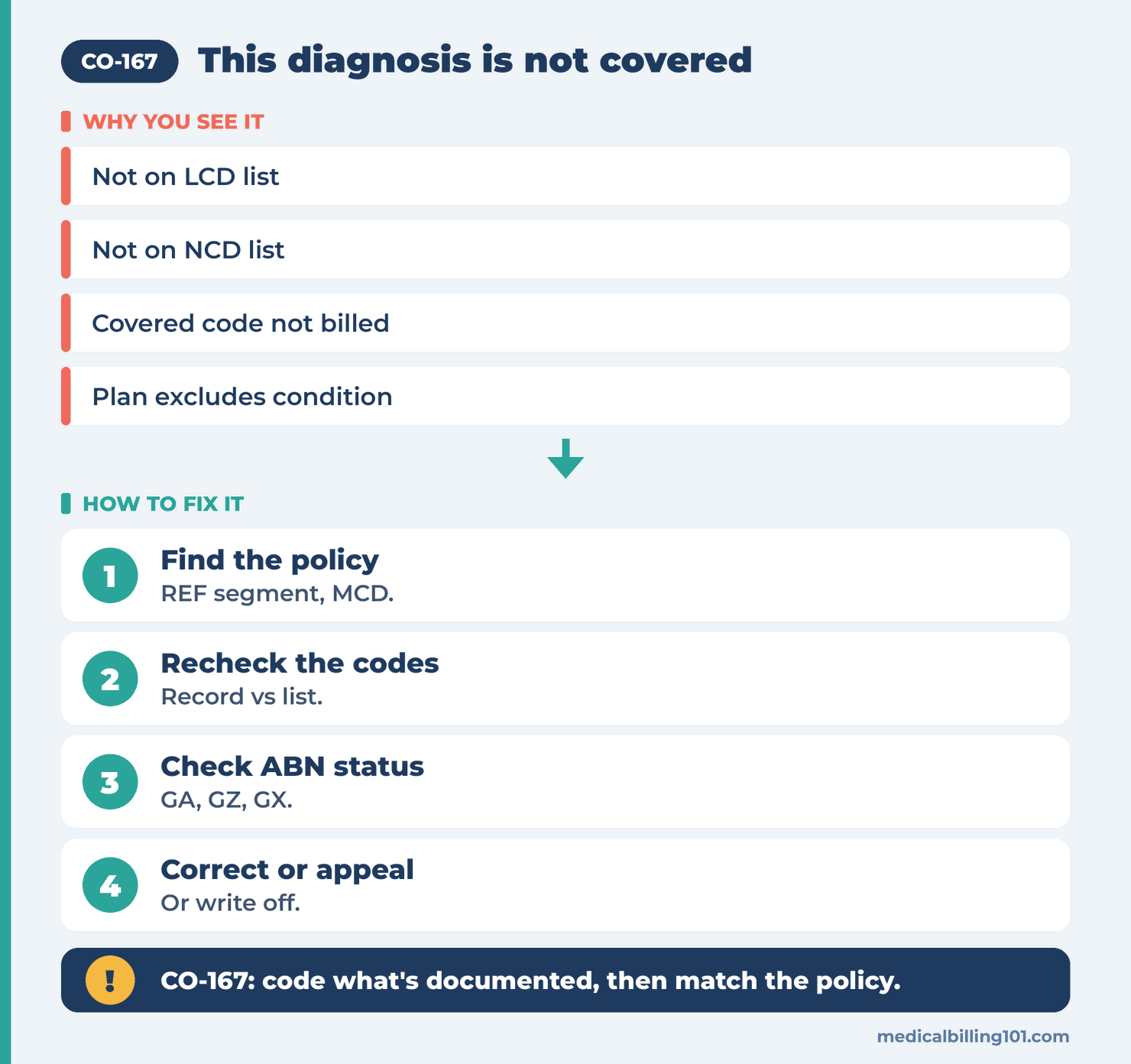
- Find the policy. Use the 835 REF segment or the payer’s policy search. For Medicare, search the Medicare Coverage Database.
- Read the covered diagnosis list. For many LCDs it lives in the linked billing and coding article, not the LCD itself.
- Compare with the record. Did the provider document a covered condition that wasn’t coded, or was coded but not pointed to the line?
- Decide. Coding miss: corrected claim. Policy misapplied: appeal. Truly not covered: write off, unless a valid ABN or waiver lets you bill the patient.
- Check modifiers. For Medicare, GA means a valid ABN is on file, GZ means one was expected but not obtained, and GX marks a voluntary ABN for excluded services.
- Close the loop. Feed the result back to coders and to the front desk so ABNs are offered next time.
Don’t upcode to a covered diagnosis
It’s tempting to swap in a diagnosis from the covered list. Only code what the provider documented. If the record doesn’t support a covered diagnosis, the right answer is a write-off or a patient bill with a valid notice, not a new code.
Appeal approach
Appeal CO-167 when the record already supports a covered diagnosis, or when the payer applied the wrong policy or the wrong version of it. Include:
- the remit line, remark code and policy number;
- the page of the policy listing the covered diagnosis;
- the visit note or order that documents that diagnosis;
- a short letter linking the three.
For Medicare, the first level is a redetermination by the Medicare Administrative Contractor, generally within 120 days of the initial determination.
Questions to ask the payer about a CO-167
- Which policy number and version did you apply?
- Which diagnosis codes on the claim did you consider?
- Is there a covered-diagnosis list I can download?
- Is a corrected claim or an appeal the right route here?
- Can the member be billed if they signed a waiver?
Worked example (illustrative)
A primary care office orders a vitamin D level for a patient with fatigue. The claim lists only the fatigue code. The remit returns CAS*CO*167*48.00 with remark N115. The coder checks the LCD billing article and finds fatigue isn’t on its covered list. The visit note documents chronic kidney disease, which is on the list but wasn’t coded. The coder adds it, points the lab line to it, and the corrected claim pays. Had the record not supported a covered code, the office would have needed an ABN before the draw to bill the patient.
Prevention checklist
- [ ] Build LCD and NCD diagnosis checks into the order entry screen for high-volume tests.
- [ ] Offer an ABN whenever a Medicare test may not meet the policy.
- [ ] Code every documented condition that relates to the service.
- [ ] Review policy changes each quarter for your top services.
- [ ] Track CO-167 by test and payer to spot repeat gaps.
Related denial codes
- CO-50: not deemed a medical necessity.
- CO-96: non-covered charges, a broader coverage denial.
- CO-11: the diagnosis is inconsistent with the procedure.
- CO-146: the diagnosis was invalid for the date of service.
- PR-204: not covered under the patient’s current benefit plan.
- Denial codes hub for the full library.
Key takeaways
CO-167 means none of the billed diagnoses are covered for the service. Find the policy, compare its list with the record and code only what’s documented. Correct, appeal or write off based on what you find. Use ABNs to protect the practice when coverage is in doubt.
FAQ
What does denial code CO-167 mean?
It means the diagnosis or diagnoses on the claim aren’t covered for the service billed, and the provider carries the amount under the CO group.
What’s the difference between CO-167 and CO-50?
CO-50 says the service wasn’t medically necessary. CO-167 says the diagnosis itself isn’t covered. In practice both can come from an LCD, and the fix steps are similar.
Can I bill the patient for CO-167?
Not under CO. For Medicare, you need a valid ABN signed before the service and modifier GA on the line, which turns it into PR-167.
How do I find which diagnoses are covered?
Look up the LCD or NCD in the Medicare Coverage Database. Many LCDs list covered codes in a linked billing and coding article.
Should I change the diagnosis to get paid?
Only if the provider documented a different, more accurate diagnosis. Never code a condition the record doesn’t support.
How long do I have to appeal a Medicare CO-167?
A Medicare redetermination request is generally due within 120 days of receiving the initial determination.
Sources
How we checked: every code quote on this page was compared word for word with the X12 CARC and RARC lists on 20 October 2026.
- X12, Claim Adjustment Reason Codes (CARC 167). Accessed 20 Oct 2026.
- X12, Remittance Advice Remark Codes (N115, N386, N569, N130). Accessed 20 Oct 2026.
- CMS, Medicare Coverage Database. Accessed 20 Oct 2026.
- CMS, Advance Beneficiary Notice of Non-coverage (ABN). Accessed 20 Oct 2026.
- CMS, Medicare Claims Processing Manual, Ch. 22, §60.1 Group Codes. Accessed 20 Oct 2026.
Last updated: 20 October 2026 · This page is educational and doesn’t replace payer contracts or coding rules.