
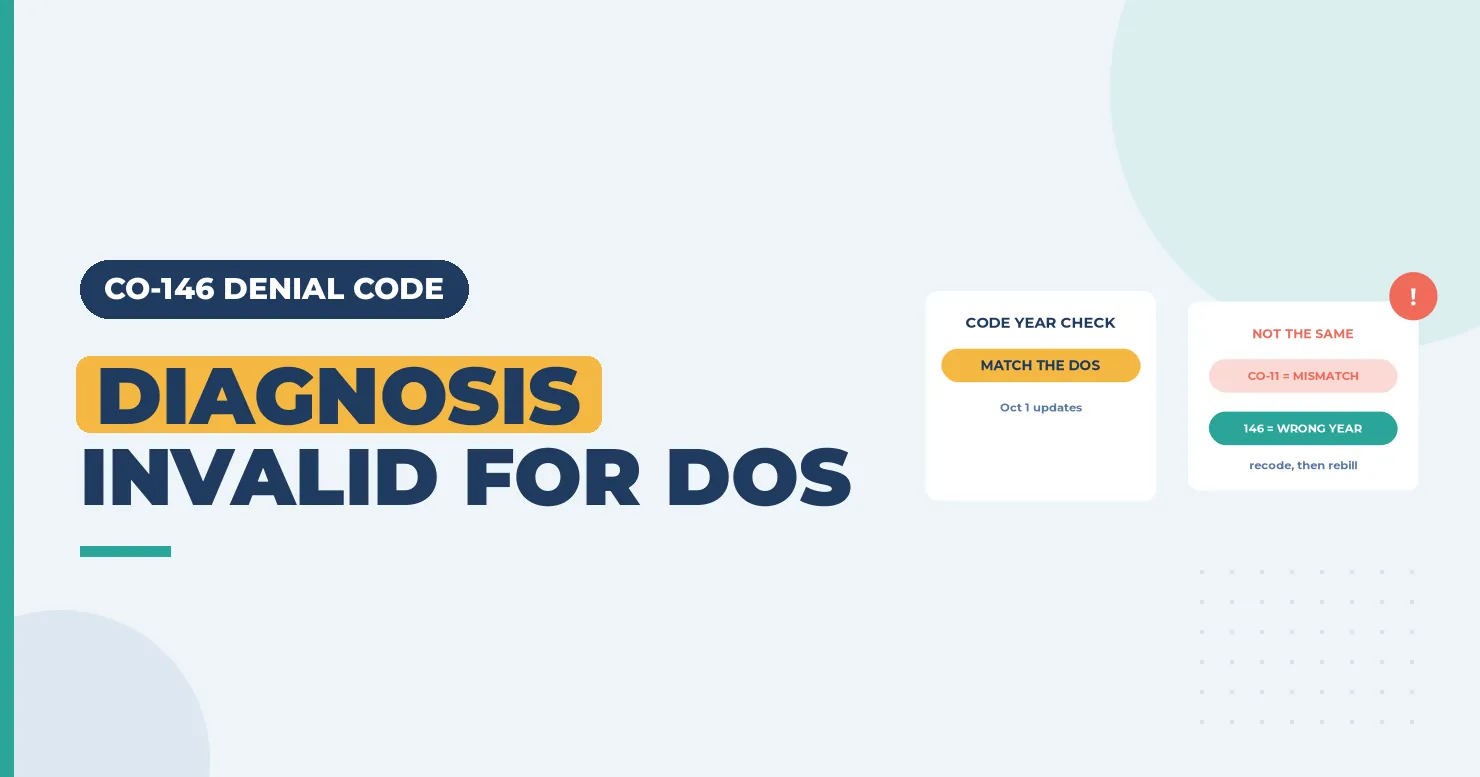
CO-146 is a code-calendar problem. Every ICD-10-CM code has a life span, and the payer checks whether the diagnosis on your claim was valid on the date the service took place. If the code had been deleted, expanded into more specific codes, or didn’t exist yet on that date, the line is denied with CARC 146. Because the group is CO, the patient isn’t billed, and in most cases a corrected claim fixes it. (Primary sources: X12 Claim Adjustment Reason Codes · CMS ICD-10 code files · CDC ICD-10-CM).
In brief: CO-146 means “diagnosis was invalid for the date(s) of service reported.” Check the date of service, then look the code up in the ICD-10-CM version that was in force on that date. Replace it with the valid, fully specific code supported by the record, and send a corrected claim. Don’t appeal unless the code really was valid on that date.
Part of our denial codes library. Written by Manikandan J, CPC, CRCR, who has more than 10 years of US medical billing and revenue cycle experience. Published 20 October 2026. Last updated: 20 October 2026. Code wording is quoted word for word from X12.
What X12 says about CARC 146
| Field | Official X12 text |
|---|---|
| Description | “Diagnosis was invalid for the date(s) of service reported.” |
| Start | 06/30/2002 |
| Last modified | 09/30/2007 |
Source: X12 Claim Adjustment Reason Codes, checked 20 October 2026.
Unlike several other coding-related CARCs, 146 carries no usage note and no mandatory remark code requirement. The message is narrow: the diagnosis code and the service date don’t fit together. It isn’t saying the diagnosis is wrong for the patient, or that it doesn’t support the procedure. That would be a different code.
Denial code 146 = CARC 146 = reason code 146
You’ll encounter all three names in correspondence and on payer calls. Denial code 146 and reason code 146 are everyday terms for the same X12 Claim Adjustment Reason Code. The two letters in front, such as CO or PR, are the group code, which assigns the balance to the provider or the patient.
Why the date matters so much
ICD-10-CM is updated every year, with new codes effective on October 1. CMS can also release an April 1 update. A code version is the set of codes valid during one of those periods. Payers apply the version in force on the date of service, not on the date you billed.
That timing causes most CO-146 denials. For example, a visit on September 28 billed on October 3 must use the old code set, while a visit on October 2 must use the new one. Inpatient claims that span the update usually follow the discharge date, so check your payer’s rules for those.
Group code table for CARC 146
| Group + CARC | Who carries it | Your next step |
|---|---|---|
| CO-146 | Provider | Recode and send a corrected claim. No patient bill. |
| PR-146 | Patient | Very rare for a coding error. Confirm with the payer before billing anyone. |
| OA-146 | Not assigned | Often on a secondary or crossover line. Fix the primary claim first. |
| PI-146 | Provider (non-Medicare) | Treat like CO. |
CMS describes CO amounts as “generally… considered a write off for the provider and are not billed to the patient” (Medicare Claims Processing Manual, Ch. 22, §60.1).
Common causes, likely remark codes and fixes
Remark codes are optional with 146, but payers often add one. RARC wording is from the X12 RARC list.
| Cause | Typical RARC | Fix |
|---|---|---|
| Code deleted in the October 1 update but still used after it | M76 | Look up the replacement code in the new tabular list and recode. |
| Code expanded into more specific child codes | M76 | Pick the child code that matches the record, down to the last character. |
| New code used for a service before its effective date | M76 | Use the code valid on the date of service. |
| Principal diagnosis invalid on a facility claim | MA63 | Correct the principal diagnosis on the UB-04 and rebill. |
| Code set mismatch on a claim that spans the update | M76 | Split the claim or follow the payer’s rule for spanning dates. |
| Old code list stuck in the EHR or scrubber | M76 | Load the current files and re-run the claims held since October 1. |
Fixing a CO-146 denial, step by step
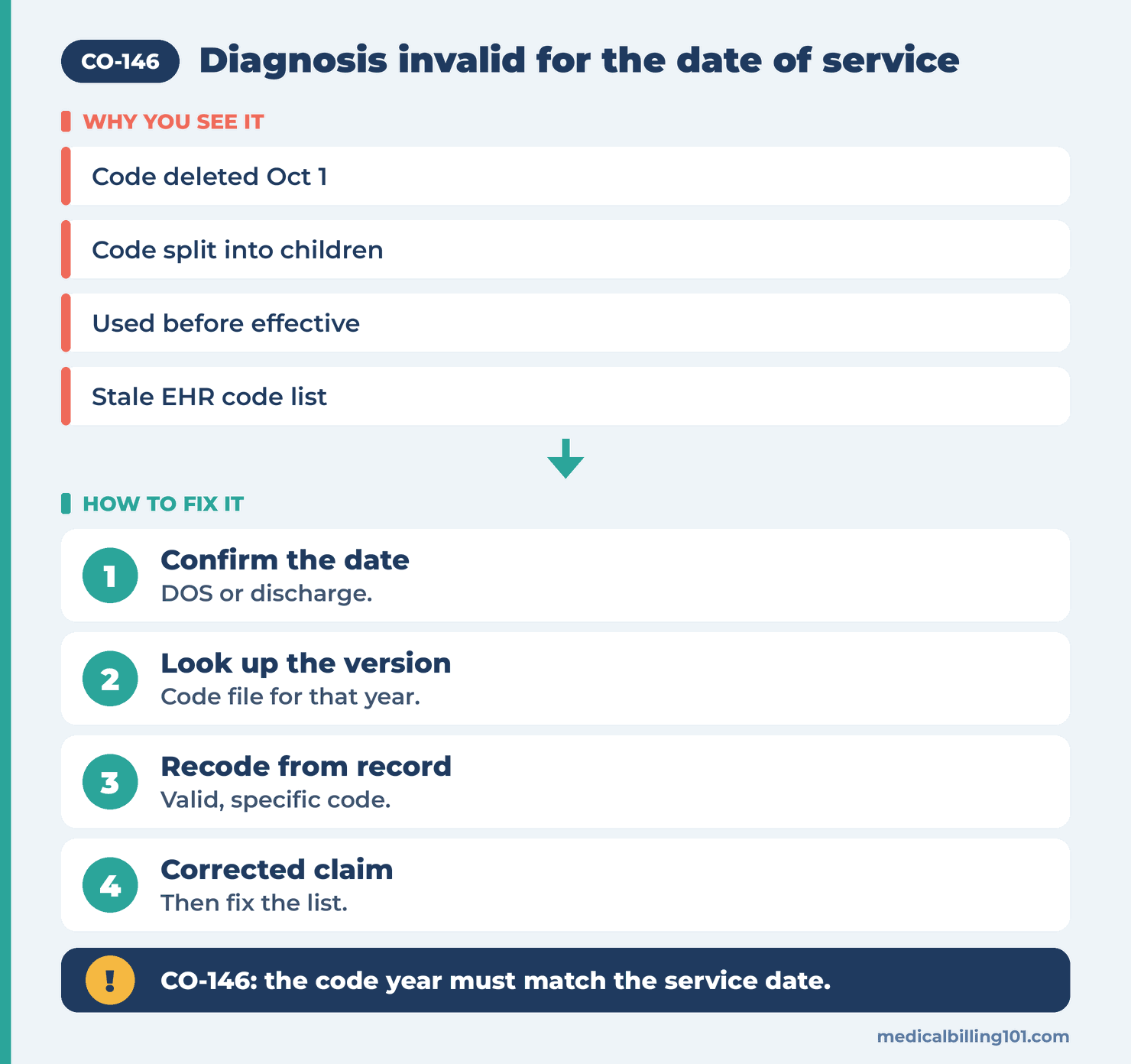
- Confirm the date of service on the denied line, and the discharge date for an inpatient stay.
- Look up the code in the ICD-10-CM release that was in force on that date. CMS and the CDC post each year’s files.
- Check what changed. Was the code deleted, split, or not yet effective?
- Read the record again and choose the valid code that the documentation supports. Don’t guess at a more specific code.
- Send a corrected claim with frequency code 7 if the payer wants a replacement, or a new claim if the line was rejected outright.
- Fix the source. Update the code list in your EHR, charge master or scrubber so the same code isn’t sent again.
Should you appeal?
Rarely. A formal appeal is appropriate only when the diagnosis code was genuinely valid on the date of service and the payer applied the wrong classification version. In that case, include the date of service, the code, and a copy of the official code file entry for that fiscal year. Ask the payer to reprocess under the correct version. In every other case, a corrected claim is faster.
Questions to ask the payer about a CO-146
- Which ICD-10-CM version did you apply to this claim?
- Do you use the date of service or the discharge date for inpatient claims?
- Do you want a corrected claim or a brand-new claim for this fix?
- Did any other lines on the claim fail for the same reason?
- What is your time limit for corrected claims?
Worked example (illustrative)
A clinic sees a patient on October 6. The coder picks a diagnosis code from a favorites list built the year before. That code was split into two more specific codes in the October 1 update. The remit returns CAS*CO*146*160.00 with remark M76. The coder checks the new tabular list, reads the note, and picks the child code that matches the documented side and type. The corrected claim pays. The practice then rebuilds its favorites list from the new release.
Prevention checklist
- [ ] Load the new ICD-10-CM files into the EHR and scrubber before October 1 each year.
- [ ] Rebuild favorites lists and order sets after every update.
- [ ] Hold claims that span October 1 until the coder checks them.
- [ ] Train staff on the year’s biggest code changes in their specialty.
- [ ] Track CO-146 in the weeks after each update to catch stale code lists.
Related denial codes
- CO-11: the diagnosis is inconsistent with the procedure.
- CO-9: the diagnosis is inconsistent with the patient’s age.
- CO-10: the diagnosis is inconsistent with the patient’s gender.
- CO-16: the claim lacks information or has billing errors.
- CO-4: the procedure code is inconsistent with the modifier.
- CARC and RARC guide for how codes combine on a remit.
Key takeaways
CO-146 is about timing. The diagnosis wasn’t valid on the date of service, usually because of the yearly October 1 update. Recode with the version in force on that date, send a corrected claim, and update your code lists. The patient isn’t billed under CO.
FAQ
What does the CO-146 denial code mean?
It means the diagnosis code on the claim wasn’t valid for the date of service, and the provider carries the amount under the CO group.
Why do CO-146 denials spike in October?
New ICD-10-CM codes take effect on October 1 each year. Codes that were deleted or expanded stop being valid for services on or after that date.
Is CO-146 the same as CO-11?
No. CO-11 means the diagnosis doesn’t support the procedure. CO-146 means the code itself wasn’t valid on that date.
Can I bill the patient for CO-146?
No. It’s a coding error under the CO group, so the provider carries it. Correct and rebill.
Do I need a new claim or a corrected claim?
Follow the payer’s rule. Many want a corrected claim with frequency code 7. If the line was rejected rather than denied, send a new claim.
Which date counts on inpatient claims?
Many payers use the discharge date for inpatient stays. Ask your payer to confirm.
Sources
How we checked: every code quote on this page was compared word for word with the X12 CARC and RARC lists on 20 October 2026.
- X12, Claim Adjustment Reason Codes (CARC 146). Accessed 20 Oct 2026.
- X12, Remittance Advice Remark Codes (M76, MA63). Accessed 20 Oct 2026.
- CMS, ICD-10 codes and files. Accessed 20 Oct 2026.
- CDC NCHS, ICD-10-CM. Accessed 20 Oct 2026.
- CMS, Medicare Claims Processing Manual, Ch. 22, §60.1 Group Codes. Accessed 20 Oct 2026.
Last updated: 20 October 2026 · This page is educational and doesn’t replace payer contracts or coding rules.