
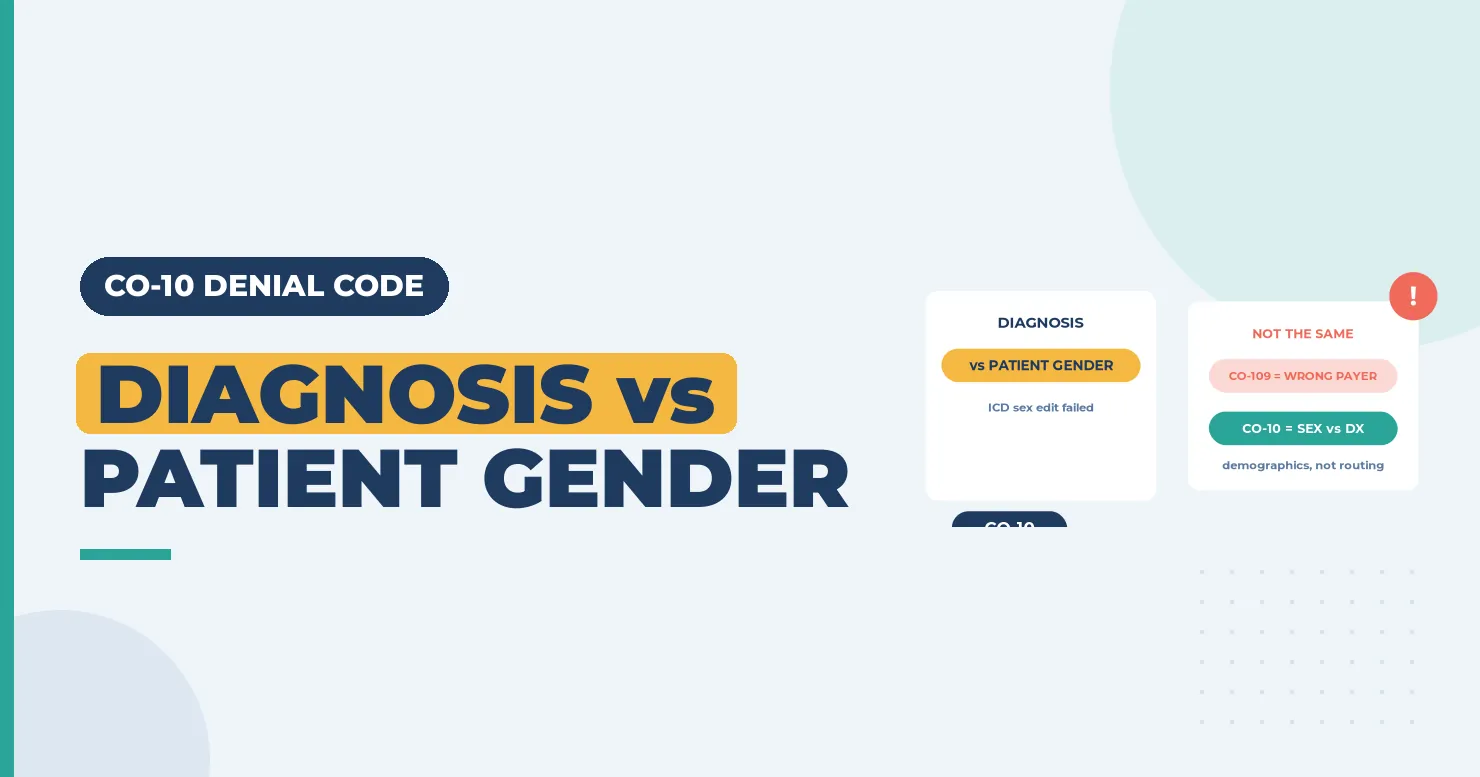
CO-10 is Claim Adjustment Reason Code 10 with group code CO. CARC 10 means the dx is does not match the patient sex. Sex edits are payer checks that compare ICD-10-CM codes to the sex on the claim. Obstetric, prostate, and other sex-specific codes often trigger these edits. Before this page existed, a WordPress 404 guess sent /denial-codes/co-10/ to CO-109. CO-109 means the claim is not covered by this payer and must go to the correct payer. That is a different problem. Many people search for “co 10 denial code”, and that is the phrase this page answers. (Primary sources: X12 Claim Adjustment Reason Codes · CMS Claims Processing Manual, Ch. 22, §60.1 · our CO-11 and CO-109 guides)
Quick answer: Compare every diagnosis to the patient’s sex on the claim and in the chart. Correct a wrong ICD code, fix a wrong sex/demographic field, or appeal with clinical documentation when the diagnosis is valid for that patient (including gender-affirming care or intersex conditions where policy allows). Do not treat CO-10 as a wrong-payer denial like CO-109.
Part of our denial codes library. Written by Manikandan, a revenue cycle management specialist with more than 10 years of US medical billing experience. Last reviewed: 14 October 2026. Official code wording is quoted word for word from X12; Medicare rules link to their CMS source.
CO-10 denial code description (official X12 wording)
X12 Claim Adjustment Reason Code 10, verbatim:
“The diagnosis is inconsistent with the patient\’s gender. Usage: Refer to the 835 Healthcare Policy Identification Segment (loop 2110 Service Payment Information REF), if present.”
Source: X12 Claim Adjustment Reason Codes, checked 14 October 2026. Start: 01/01/1995. Last Modified: 07/01/2017.
The CARC is 10. The group code is usually CO. Read any health-policy ID REF on the 835 when present.
What CO-10 means in plain English
- The payer compared dx code(s) to the patient’s gender/sex value on the claim.
- A sex edit is a system rule that flags sex-specific ICD codes against the claim sex.
- CO-10 is a coding and patient data denial. It does not mean you billed the wrong carrier.
- CO-7 means the service or revenue code failed a sex edit. That is different from a dx sex edit.
- CO-109 means wrong payer. That is a routing issue, not a sex-vs-dx match.
- CO-11 means dx vs service. CO-9 means dx vs age.
CO-10 vs CO-7, CO-9, CO-11, CO-109 and lookalikes
| Code | Official X12 idea | What it tells you |
|---|---|---|
| CO-10 | Dx does not match patient’s gender | ICD vs sex mismatch — this page |
| 7 | Service/revenue code does not match patient’s gender | CPT/HCPCS or revenue code failed a sex edit |
| CO-9 | Dx does not match patient’s age | ICD vs age — CO-9 |
| CO-11 | Dx does not match the service | Dx does not support the service — CO-11 |
| 109 | Not covered by this payer; send to correct payer | Wrong carrier — CO-109 |
| 96 | Non-covered charge(s) | Benefit / coverage — CO-96 |
Before this page existed, WordPress’s 404 guess sent /denial-codes/co-10/ to CO-109. Wrong-payer routing and dx-vs-sex edits are not the same denial.
Common triggers for CO-10
CO-10 means the dx code and the patient sex flag do not match. For example:
- Sex-specific ICD-10-CM codes billed with the opposite sex flag. For example: obstetric, gynecologic, prostate, or sex-specific screening codes.
- Wrong sex on the claim after a registration error, benefit check overwrite, or chart merge.
- Copy-forward problem lists that keep another patient’s or an outdated dx.
- Gender-diverse / transgender patients when the claim sex, legal sex, and clinical dx conflict under a payer’s rigid edit — handle with records and payer policy, not with silent code changes that misstate care.
- Secondary dx codes that trip the editor even when the principal dx is fine.
Where CO-10 shows up in the 835
CLP*PCN33110*1*310.00*0*310.00*12*CLAIM556677~
SVC*HC:99214*310.00*0**1~
CAS*CO*10*310.00~
REF*HPI*SEX-DX-EDIT~
- Line paid $0.
- CAS*CO*10 applied the dx–gender inconsistency adjustment.
- Optional REF*HPI may identify the payer’s sex-dx edit.
- Sample only. Save the full CAS, remarks, and benefit check sex value.
How to fix CO-10: decision path
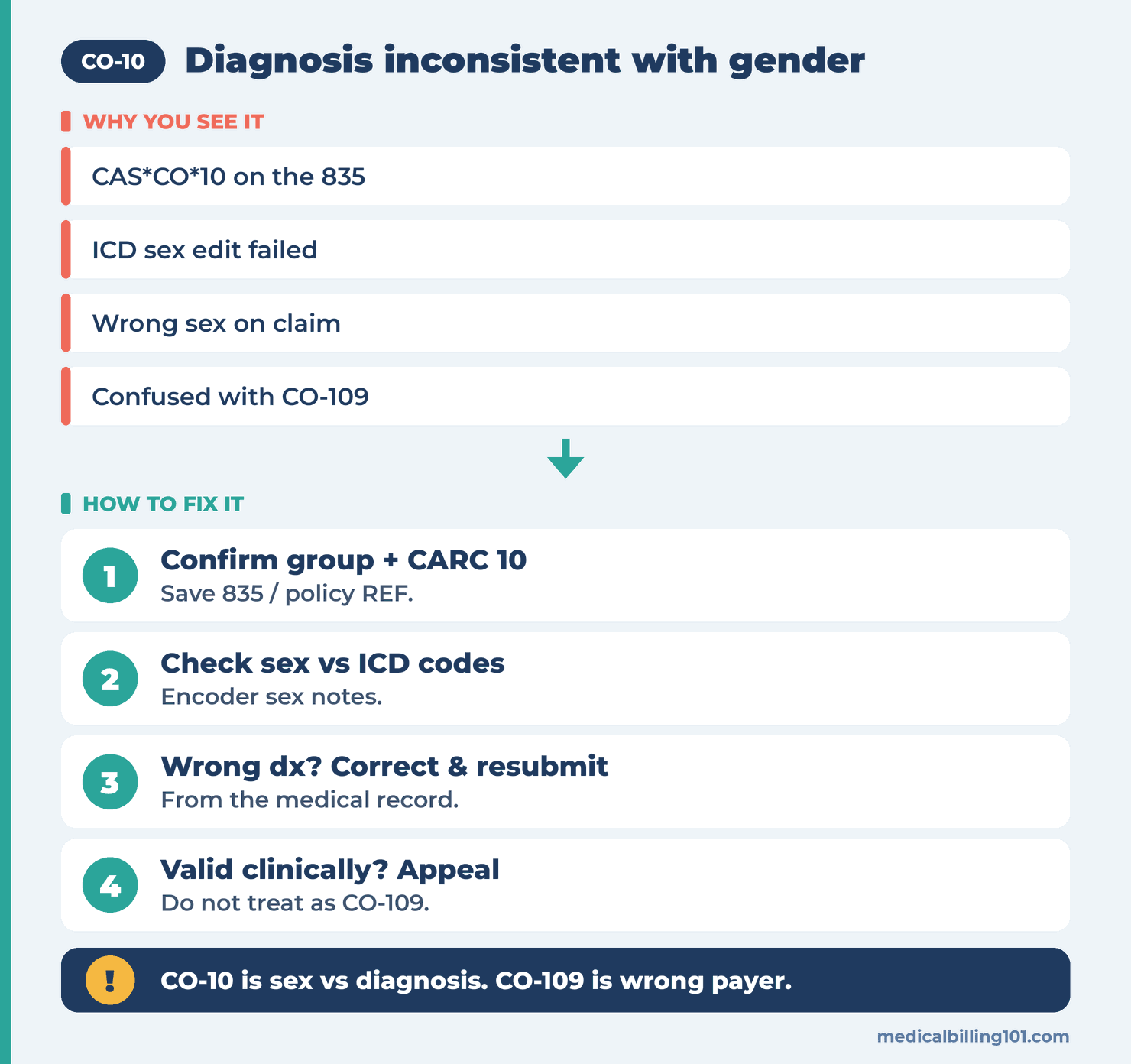
- Confirm CAS*CO*10 and capture any RARC or policy REF.
- Verify patient data. Claim sex, benefit check sex, and chart sex/gender identity fields — note where they differ.
- Review every ICD-10-CM code for sex edits in your encoder and ICD-10-CM notes.
- If the dx is wrong, correct it from the records and submit a corrected claim.
- If the sex flag is wrong, fix registration/benefit check and resubmit.
- If the dx is clinically correct for that patient but the payer edit is blunt, appeal with records, coding guidance, and (when relevant) medical necessity for gender-affirming or intersex-related care per plan policy.
- Do not “fix” CO-10 by sending the claim to another payer as if it were CO-109.
- Protect patients: never change clinical codes solely to pass an edit when that would misrepresent the encounter; escalate to coding leadership and the clinician.
Medicare, commercial and Medicaid notes
Medicare. Sex-linked dx edits appear in claim editing. Use any health-policy ID segment on the 835 to locate the edit. Corrected claims must meet timely filing.
Commercial. Clearinghouse sex edits are common. For gender-diverse members, follow the plan’s published coding and gender-marker policies; many payers accept documented exceptions on appeal.
Medicaid. State systems vary. Some still use binary sex edits only. Document thoroughly before writing off care that the state covers under separate gender-affirming or specialty policies.
Worked example
Here is an example from a registration error:
A claim for a male patient includes an obstetric dx left on the problem list from a sibling’s chart merge. The remit returns CAS*CO*10.
Prevention checklist
- [ ] Run encoder sex-vs-dx edits before filing.
- [ ] Audit registration sex vs clinical gender identity fields on intake.
- [ ] Scrub problem lists after chart merges and newborn discharges.
- [ ] Separate CARC 10 (dx vs gender) from CARC 7 (service vs gender) in workqueues.
- [ ] Do not confuse CO-10 with CO-109 (wrong payer) or CO-9 (dx vs age).
- [ ] Keep the CARC and RARC guide for training.
Related denial codes
- CO-9: dx does not match the patient age.
- CO-11: dx does not match the service.
- CO-109: not covered by this payer; send to the correct payer (old wrong redirect).
- CO-16: missing or invalid information.
- CARC and RARC guide.
Key takeaways
CARC 10 means the dx does not fit the patient sex flag on the claim. Fix the ICD code or the demographic sex value. Appeal with clinical support when the dx is valid. CO-10 is not CO-109. Wrong-payer routing is a different workflow.
FAQ
What is the CO-10 denial code description?
X12 describes CARC 10 as: the dx is does not match the patient sex, with usage pointing to the 835 health-policy ID segment when present. CO-10 is that reason with group code CO.
Is CO-10 the same as CO-7?
No. CO-10 is about the dx vs gender. CARC 7 is about the service or revenue code vs gender.
Why did /denial-codes/co-10/ used to open CO-109?
WordPress guessed a nearby slug when the CO-10 page did not exist and sent visitors to CO-109 (wrong payer). This page is the real CO-10 guide.
Can I bill the patient for CO-10?
Usually no while the line is denied under group CO. Correct or appeal the claim first. Patient cost-sharing appears only after a payable remit shows PR amounts.
How should we handle CO-10 for transgender or intersex patients?
Follow the medical record and the payer’s written policy. Appeal with records when the dx is clinically appropriate. Do not change accurate codes only to silence an edit.
Does CO-10 mean we sent the claim to the wrong payer?
No. That is CO-109. CO-10 is a dx–gender consistency edit on this payer’s remit.
Quick facts
| Item | Value |
|---|---|
| X12 code | 10 |
| X12 start | 01/01/1995 |
| Last modified | 07/01/2017 |
| Official wording | The dx is does not match the patient sex |
| Usual group | CO |
| Common confusions | CO-7 (service vs gender), CO-109 (wrong payer) |
| Last reviewed | 14 October 2026 |
Sources
- X12, Claim Adjustment Reason Codes (CARC 7, 9, 10, 11, 96, 109). CARC 10 Start 01/01/1995; Last Modified 07/01/2017. Accessed 14 Oct 2026.
- CMS, Medicare Claims Processing Manual (IOM 100-04), Ch. 22, §60.1 Group Codes. Accessed 14 Oct 2026.
- Medical Billing 101, CO-11 guide.
- Medical Billing 101, CO-109 guide.
- CMS, ICD-10 page (coding & billing). Accessed 14 Oct 2026.
- Medical Billing 101, CO-9 guide.
Code wording and Medicare rules on this page were checked on 14 October 2026 against X12 and CMS sources.
Last reviewed: 14 October 2026 · This page is educational and doesn’t replace payer-specific contracts or coding rules.