GJ tube conversion in ICD-10-PCS is coded as Insertion of a feeding device into the jejunum, not as Change. The code family is 0DHA_UZ, and the old tube removal is usually not coded separately.
Change fails here because the new tube reaches a different body part. One Insertion code captures the conversion.
TL;DR: The ICD-10-PCS Index has an entry for this exact procedure. Conversion, gastrostomy to jejunostomy feeding device, points to Insertion of device in jejunum, table 0DHA. Change needs the same body part, and a GJ tube moves the feeding tip from the stomach into the jejunum. Many facilities report the fluoroscopic conversion as 0DHA3UZ. Taking out the old tube over a guidewire is the access step, so it usually gets no separate Removal code. Physician claims use CPT 49446 instead.
Written by Manikandan J, CPC, CRCR, a certified coder and revenue cycle specialist. Published 27 November 2026. Last updated: 27 November 2026.
Table of Contents
What is a GJ tube conversion in ICD-10-PCS terms?
A GJ tube conversion swaps a G-tube for a GJ tube through the same hole. The new tube has a stomach port and a long limb that ends in the jejunum. In ICD-10-PCS, both tubes are a Feeding Device, device value U, in the Gastrointestinal System.
A gastrostomy tube is a feeding tube that ends in the stomach. A gastrojejunostomy (GJ) tube is a feeding tube that enters through the gastrostomy and ends in the jejunum. A root operation is the third character of a PCS code. It names the goal of the procedure.
The CMS ICD-10 code files hold the FY 2027 PCS tables, index and definitions used below. Those files settle every character.
Example scenario (fictional names), part 1
GJ conversion example: what happened
Cedar Hollow Medical Center is a fictional hospital in Iowa. Philippa Ardenne codes its inpatient charts. Dr. Osric Valtieri works in its interventional radiology suite.
An inpatient’s G-tube broke and was swapped for a Foley at the bedside. Two days later, Dr. Valtieri converted the tract to a GJ tube under fluoroscopy.
The abstract went out with 0D20XUZ and 0DP0XUZ. A DRG validation review flagged both codes.
What went wrong? Keep reading, or jump to how the case was resolved.
Is a G-tube to GJ tube conversion coded as Change?
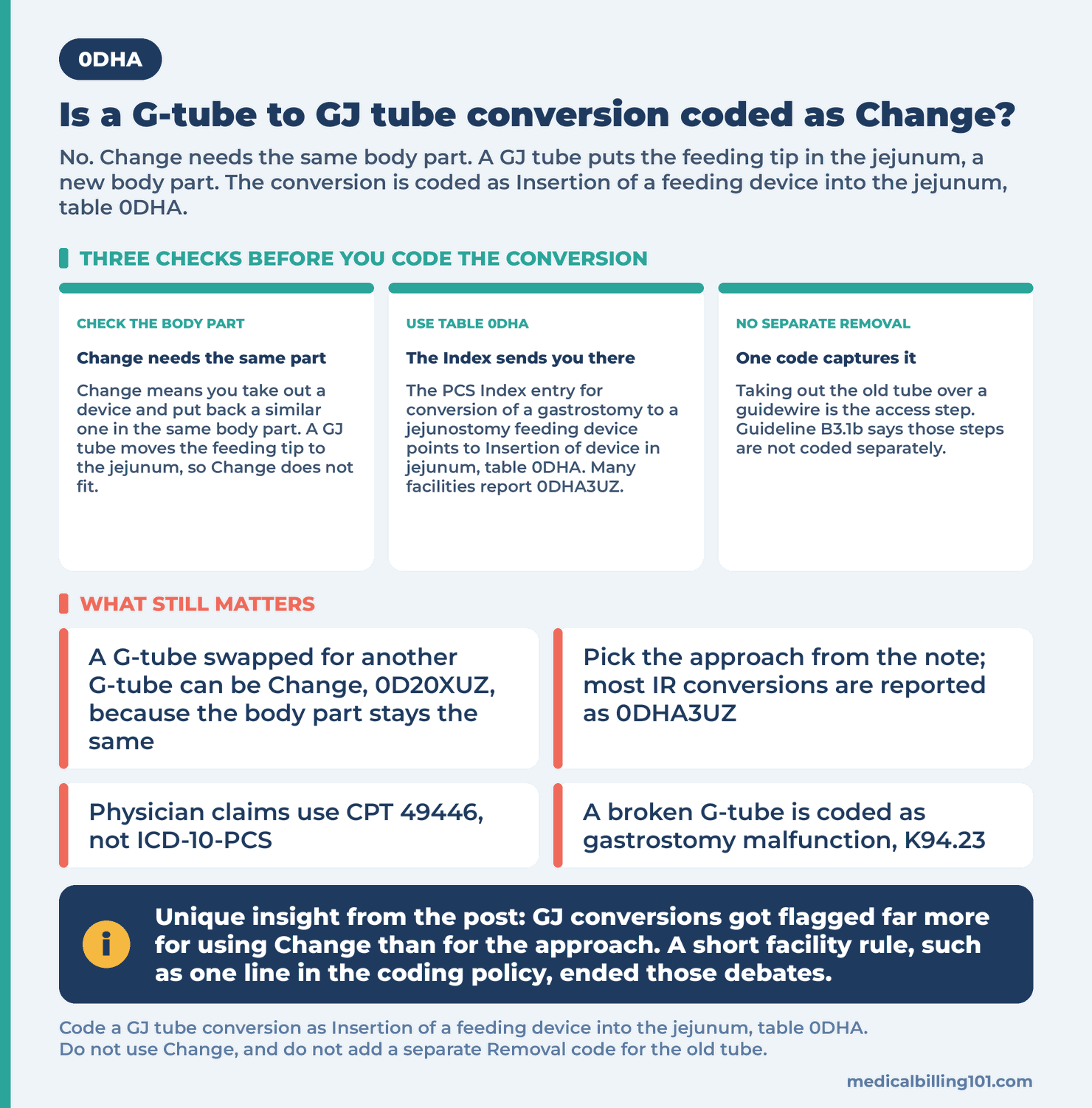
No. Change means you take out a device and put back a similar one in the same body part. No cut or puncture is made. A GJ tube puts the feeding tip in the jejunum, a new body part. So Change does not fit the conversion.
The FY 2027 ICD-10-PCS Official Guidelines make the body part split clear. Guideline B4.8 puts the stomach in Upper Intestinal Tract. It also says a device change in the jejunum uses Lower Intestinal Tract.
Change also has only one approach, External. That fits a simple bedside G-tube swap, which is 0D20XUZ, Change Feeding Device in Upper Intestinal Tract. It does not fit a tube steered on a wire past the stomach outlet.
Which ICD-10-PCS code do you use for a GJ tube conversion?
Use Insertion of Feeding Device into Jejunum, table 0DHA, with device U. The PCS Index entry under Conversion, gastrostomy to jejunostomy feeding device, sends you straight to 0DHA. Insertion means putting in a device that does a job in the body, such as feeding.
| Code. | FY 2027 title. | When it fits. |
|---|---|---|
| 0DHA3UZ. | Insertion of Feeding Device into Jejunum, Percutaneous Approach. | GJ conversion most facilities report for IR work. |
| 0DHA7UZ. | Insertion of Feeding Device into Jejunum, Via Natural or Artificial Opening. | Argued when the record stresses the existing stoma. |
| 0D20XUZ. | Change Feeding Device in Upper Intestinal Tract, External Approach. | G-tube swapped for a G-tube, no conversion. |
| 0D2DXUZ. | Change Feeding Device in Lower Intestinal Tract, External Approach. | Existing GJ tube swapped for another GJ tube. |
| 0DP0XUZ. | Removal of Feeding Device from Upper Intestinal Tract, External Approach. | Tube pulled with nothing new placed. |
What approach character goes on a GJ conversion?
The fifth character comes from how the note describes reaching the jejunum. Percutaneous means entry by a puncture or small cut in the skin. Via Natural or Artificial Opening means entry through an opening, such as a stoma. Read the note before you pick.
Most IR conversions I see coded use 0DHA3UZ, the percutaneous code. Some coders argue for 0DHA7UZ, because the wire passes through the mature gastrostomy tract. Follow the AHA Coding Clinic advice your facility uses, and apply it the same way on every chart.
In my 10+ years of billing and coding review, GJ conversions got flagged far more for using Change than for the approach. A short facility rule, such as one line in the coding policy, ended those debates.
Do you code removal of the old G-tube separately?
Usually not. Guideline B3.1b says steps needed to reach the operative site are not coded separately. The old tube comes out over a wire. That wire keeps the path open for the new tube, so it is the access step. The Insertion code already tells the story.
Guideline B3.2 lists when multiple procedures are coded, such as distinct objectives on the same body part. Taking out a broken tube just to place the new one is not a separate goal. Code Removal, 0DP0XUZ, when the tube comes out and nothing new goes in.
The temporary Foley follows the same logic. It is taken out to make room for the GJ tube, so it needs no code. For a related device-and-wound question, see home health coding for a traumatic wound graft.
Which CPT code does the physician bill for a GJ tube conversion?
The physician bills CPT 49446 for a G-tube to GJ tube conversion done through the skin with x-ray guidance. ICD-10-PCS is for inpatient hospital claims only. Outpatient and physician claims use CPT for the same work.
The October 2026 CMS PFS relative value file lists 49446 with a 000 global and 2.98 work RVUs. Compare it with 49450, G-tube replacement, and 49452, GJ tube replacement, in our RVU calculator.
The Medicare MUE for 49446 is 1 per date, MAI 2, for practitioner and outpatient hospital claims. Confirm it in our MUE lookup, and check the global days with our global period calculator.
What diagnosis code goes with a broken G-tube conversion?
A broken G-tube is a gastrostomy malfunction, ICD-10-CM K94.23. Use K94.22 for infection or K94.21 for hemorrhage instead. Z43.1, encounter for attention to gastrostomy, is for routine care with no complication documented.
If the note says the patient could not keep down stomach feeds, code that reason too. Our ICD-10-CM guidelines cheat sheet covers sequencing basics. For another diagnosis question, see whether perineural invasion of the prostate adds C79.89.
Example scenario (fictional names), part 2
How the GJ conversion case was resolved
- Philippa reread the IR note. The tip of the new tube sat in the jejunum, so Change did not fit.
- She looked up Conversion in the PCS Index. It pointed her to Insertion, jejunum, 0DHA.
- She dropped 0DP0XUZ, because pulling the Foley over the wire was the access step.
Fix: the hospital rebilled with 0DHA3UZ and K94.23. Dr. Valtieri’s professional claim already showed 49446.
Outcome: the review closed with no DRG change, and the coding policy gained a GJ conversion line.
Names and details are illustrative; no real patient data.
To fix a code on a sent bill, follow our corrected claim guide. For another inpatient billing question, see how inpatient outlier claims are billed.
3-step checklist
- Find where the new tube tip ends; jejunum means Insertion, table 0DHA, not Change.
- Pick the approach from the note, using your facility’s Coding Clinic rule.
- Skip Removal for the old tube; bill CPT 49446 on the physician claim.
FAQ
Is a GJ tube conversion coded as Change in ICD-10-PCS?
No. Change requires the same body part. A GJ tube puts the feeding tip in the jejunum, so the conversion is coded as Insertion of a feeding device into the jejunum, table 0DHA.
What is the ICD-10-PCS code for G-tube to GJ tube conversion?
Use table 0DHA with device U. Many facilities report the fluoroscopic conversion as 0DHA3UZ, Insertion of Feeding Device into Jejunum, Percutaneous Approach.
Is the old G-tube removal coded on a GJ conversion?
Usually not. Pulling the old tube over a guidewire is the access step for the new tube, and guideline B3.1b says access steps are not coded separately.
What CPT code is used for G-tube to GJ tube conversion?
CPT 49446 covers percutaneous conversion of a gastrostomy tube to a gastro-jejunostomy tube under fluoroscopic guidance. It has a 000 global and an MUE of 1.
What diagnosis code is used for a broken G-tube?
A broken gastrostomy tube is coded as gastrostomy malfunction, ICD-10-CM K94.23.
Sources
My methodology was simple. I checked the FY 2027 ICD-10-PCS tables, index, definitions and guidelines, the FY 2027 ICD-10-CM code file, and the October 2026 CMS PFS and MUE files.
- CMS, FY 2027 ICD-10-PCS code tables, index and definitions, and FY 2027 ICD-10-CM code descriptions (linked above). Accessed 27 Nov 2026.
- CMS, FY 2027 ICD-10-PCS Official Guidelines for Coding and Reporting, B3.1b, B3.2 and B4.8 (linked above). Accessed 27 Nov 2026.
- CMS, PFS relative value file, October 2026 (linked above). Accessed 27 Nov 2026.
- CMS, Practitioner and Outpatient Hospital MUE files effective 10-01-2026. Accessed 27 Nov 2026.
Read about the author, or contact us with a question. See our editorial policy.
Last updated: 27 November 2026 · Educational content for U.S. coding and billing teams. ICD-10-PCS and CPT descriptions are plain-language summaries; check the current code set and your facility’s coding policy for full wording.