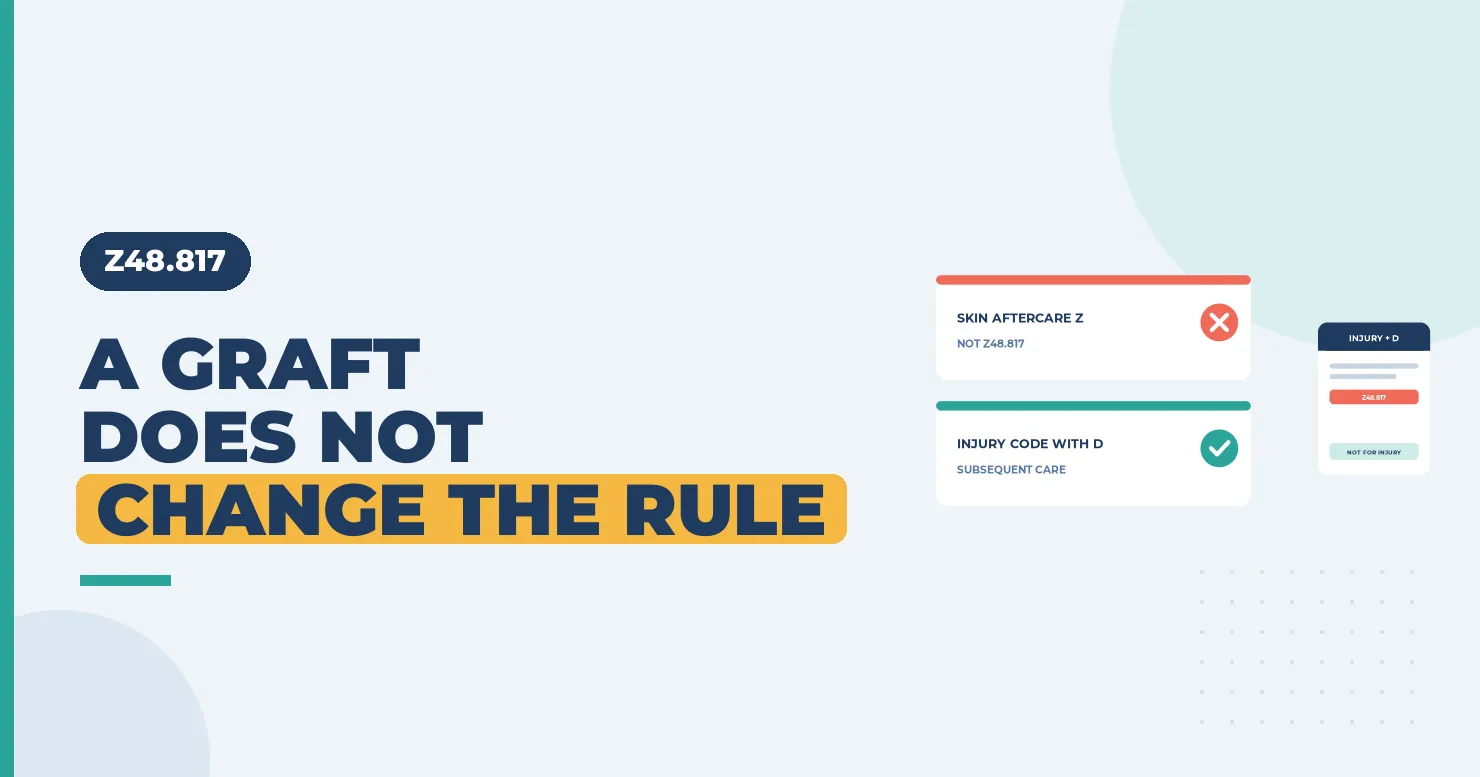
Home health coding traumatic wound graft cases follow one rule: code the injury with 7th character D, not Z48.817. The graft and the fracture repair do not turn injury aftercare into surgical aftercare.
The fix: put the injury being treated first, add status codes only when the record supports them, and drop Z48.298 and Z96.698.
TL;DR: For home health care of a traumatic wound closed with a graft or flap, report the injury code with 7th character D. Do not use Z48.817 or other aftercare Z codes for injuries. Z48.298 is for organ transplant aftercare, and Z96.698 describes a joint implant. Add Z94.5 or Z96.81 only when the operative note names the graft material.
Written by Manikandan J, CPC, CRCR, a certified coder and revenue cycle specialist. Published 25 November 2026. Last updated: 25 November 2026.
Table of Contents
Can you use Z48.817 for a traumatic wound closed with a graft?
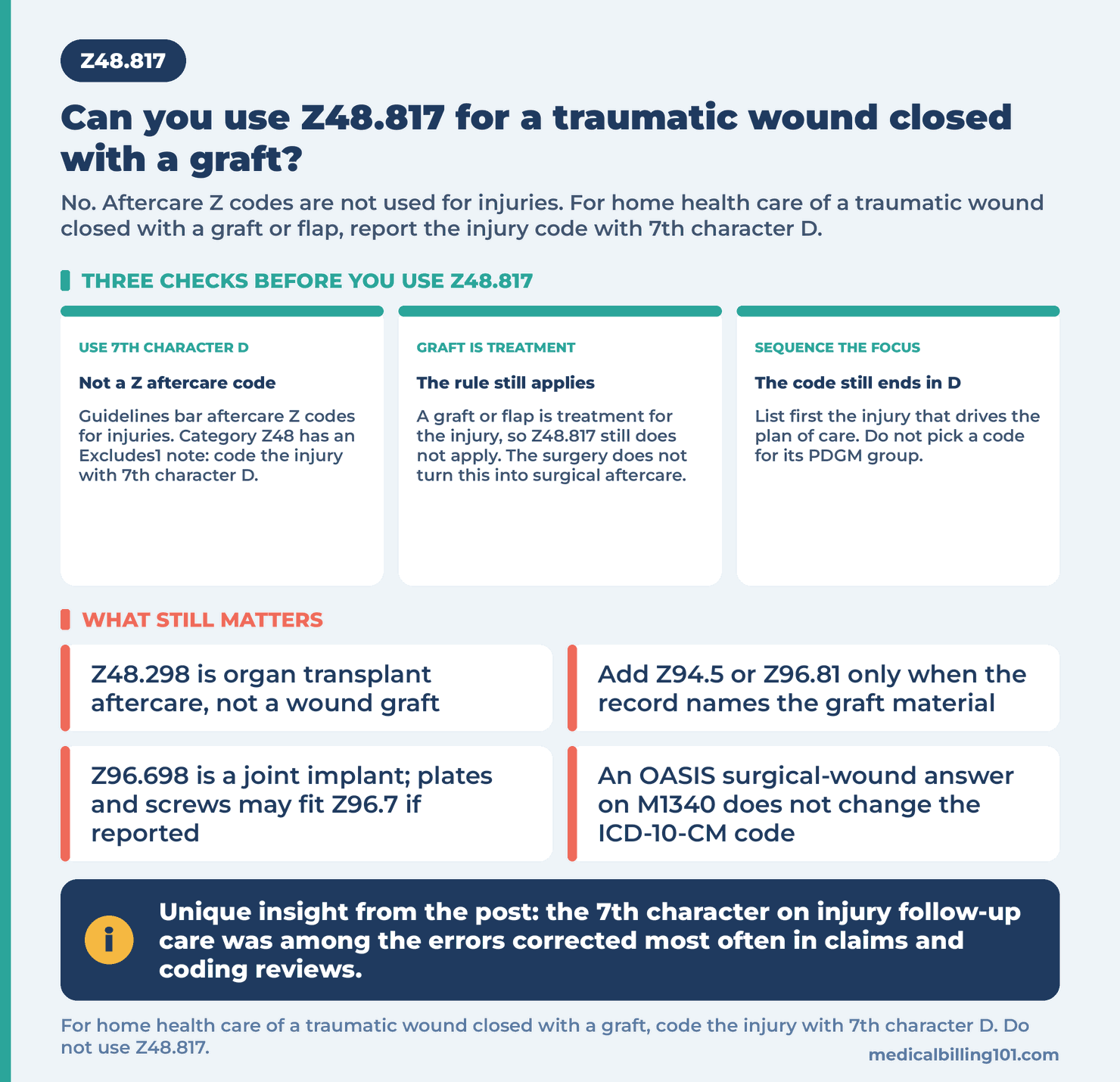
No. Z48.817 is surgical aftercare following surgery on the skin and subcutaneous tissue. The guidelines bar aftercare Z codes for injuries. For aftercare of an injury, you assign the acute injury code with the 7th character for a subsequent encounter.
The FY 2027 ICD-10-CM Official Guidelines say this twice. Section I.C.19.a covers injury 7th characters, and Section I.C.21.c.7 covers aftercare. Both point to the injury code with D.
Aftercare means continued care in the healing or recovery phase after the first treatment. 7th character D is the subsequent encounter value for routine care while an injury heals. A flap is tissue moved with its own blood supply to close a wound.
The Tabular List agrees. Category Z48 has an Excludes1 note for aftercare following injury. Subcategory Z48.81 repeats it: code the injury with 7th character D. A graft or flap is treatment for the injury, so this rule still applies.
Example scenario (fictional names), part 1
Traumatic wound graft example: what happened
- Agency: Prairie Lantern Home Health, a fictional agency in Kansas. Odessa Marchetti codes its start-of-care charts.
- Patient: a farmer, 68, caught his left forearm between moving parts of a hay baler. Dr. Bram Okonkwo repaired torn forearm muscles and closed the wound with a flap and an acellular dermal matrix.
- Referral: skilled nursing for negative pressure wound therapy and dressing care, plus physical therapy.
- First draft code list: Z48.817 first, then Z48.298, Z94.5 and W23.0XXD.
The internal audit flagged the chart before the claim went out. Three of the four codes had problems.
Which codes would you change first? Keep reading, or jump to how the case was resolved.
Which code goes first for home health after a traumatic wound graft?
List first the injury that drives the plan of care. If nurses mainly treat the grafted wound, list the injury that created it. If therapy for a healing fracture drives the visits, the fracture code with D may come first. Either way, the code ends in D.
The OASIS-E2 Guidance Manual defines the primary diagnosis as the chief reason for home care. It is the diagnosis most related to the current plan of care. It also requires the ICD-10-CM Official Guidelines under HIPAA.
In a fasciotomy case, the wound came from treating traumatic compartment syndrome. So wound care is aftercare of that injury, coded with the T79.A2- code and D. A bicondylar tibial plateau fracture of the right leg in healing is S82.141D.
The CMS home health grouper tables for October 2026 show the PDGM effect. T79.A21D maps to MMTA – Other. S82.141D maps to Musculoskeletal Rehabilitation. Open wound D codes, such as S81.811D, map to the Wound group.
Do not choose a code for its PDGM group. Choose it from the documentation, then let the group follow. Our ICD-10-CM guidelines cheat sheet lists the sequencing rules in one place.
Is Z48.298 correct when an allograft was used?
No. Z48.298 is aftercare following other organ transplant. It belongs to Z48.2-, which covers organ transplant aftercare. A skin or tissue graft placed during wound surgery is not an organ transplant visit, and the injury exclusion still applies.
Also, this kind of mix shows a common slip. Coders reach for an aftercare code because the patient had surgery. For injuries, the surgery is part of injury treatment, so the injury code with D carries the story.
Should you add Z94.5 or Z96.81 for the graft?
Only when the record names the graft material. Z94.5 is skin transplant status, used for transplanted human skin. Z96.81 is presence of artificial skin. A product listed only as a “biological graft” needs the op note or a query.
Category Z94 includes tissue replaced by a heterogenous or homogenous transplant. Z94.5 also includes autogenous skin transplant status. So a human skin allograft or an autograft fits Z94.5.
The Alphabetic Index treats dermal substitutes apart. Under complications of a skin graft, “artificial skin or decellularized allodermis” sends you to T85 codes. Presence, implanted device, skin leads to Z96.81. Use the product name in the op note to choose.
Status codes are informative only, per Section I.C.21.c.3. In the CMS grouper tables they carry no clinical group. They cannot drive the period, so list them as other diagnoses. If the documentation is unclear, send a short, non-leading query, as in our answer on matching codes to documentation.
Is Z96.698 correct for ORIF plates and screws?
No. Z96.698 is presence of other orthopedic joint implants, which means a joint prosthesis. Plates and screws from a fracture repair are not a joint implant. The Index entry Presence, bone, implant (functional) NEC leads to Z96.7.
Z96.7 is presence of other bone and tendon implants. It is optional and informative. Consider it when the hardware affects care, such as weight-bearing limits that therapy must follow.
Do not use Z47.89 for the fracture. Category Z47 tells you to code a healing fracture to the fracture with 7th character D.
Do you still code W17.89XD and the cellulitis?
You can keep W17.89XD as an other diagnosis. Section I.C.20.a.2 says the external cause 7th character should match the injury code. OASIS bars external cause codes from M1021 but allows them in M1023. Code the cellulitis only if it is still being treated.
Place of occurrence and activity codes are generally assigned only once, at the initial encounter. So leave Y92 and Y93 codes off home health claims for later care.
The OASIS manual says only current diagnoses are reported. If the cellulitis cleared in the hospital, leave L03.115 off. If antibiotics or wound checks continue for it, it is current and should be coded.
In my years working claims and coding reviews, the 7th character on injury follow-up care was among the errors I corrected most often.
| Code on the draft list. | Keep it? |
|---|---|
| Z48.817, skin surgical aftercare. | No. Use the injury code with D instead. |
| Z48.298, other organ transplant aftercare. | No. A wound graft is not an organ transplant. |
| T79.A21D, traumatic compartment syndrome, right leg. | Yes, when the fasciotomy wound is the care focus. |
| S82.141D and S82.831D, healing right leg fractures. | Yes, sequenced by the plan of care. |
| W17.89XD, fall from one level to another. | Yes, as an other diagnosis only. |
| Z94.5 or Z96.81, graft status. | Only one, and only when the graft material is documented. |
| Z96.698, joint implant. | No. For plates and screws, Z96.7 fits if you report it. |
Is a grafted traumatic wound a surgical wound on OASIS?
Yes, for item M1340 in most cases. CMS OASIS Q&As say a traumatic wound that needed surgery to repair, such as a torn tendon, is a surgical wound. A fasciotomy incision is also a surgical wound. Simple suturing of a laceration is not.
The same Q&As treat any ulcer or burn closed with a graft or flap as a surgical wound. It stays one until about 30 days after full re-epithelialization.
That OASIS answer does not change the ICD-10-CM code. M1340 describes the wound type for the assessment. The diagnosis still follows the coding guidelines, so the injury code with D stays.
How do you fix a home health claim coded with Z48.817 for an injury?
Recode the chart, then correct the claim if it was already billed. A changed primary diagnosis can change the PDGM clinical group, so the payment can change too. Follow your agency’s OASIS correction policy as well.
- Read the hospital discharge summary and op note. Find the injury, the procedures and the graft material.
- Replace the aftercare Z codes with injury codes ending in D, and check status codes against the Index.
- Send a corrected claim with frequency code 7 if the period already billed.
If a payer denies the code as not matching the service, see our CO-11 denial guide. Wound visits in a global period raise other questions, as in our answer on suture removal visits in the global period.
Example scenario (fictional names), part 2
How the traumatic wound graft case was resolved
- Odessa read the op note. Dr. Okonkwo repaired a crush laceration of the left forearm muscles, so the injury was the care focus.
- She replaced Z48.817 with the left forearm muscle laceration code ending in D, and dropped Z48.298.
- The op note named an acellular dermal matrix, so she swapped Z94.5 for Z96.81. W23.0XXD stayed as an other diagnosis.
Fix: the clinician confirmed the new primary diagnosis on the OASIS, and the claim went out with the injury code first.
Outcome: the claim processed with no edits. The agency added an audit check for aftercare Z codes on injury referrals.
Names and details are illustrative; no real patient data.
3-step checklist
- Code the injury being cared for with 7th character D, never an aftercare Z code.
- Sequence first the injury that drives the plan of care, and keep external cause codes secondary.
- Add Z94.5, Z96.81 or Z96.7 only when the record names the graft or hardware.
FAQ
Can Z48.817 be used for a traumatic wound in home health?
No. Aftercare Z codes are not used for injuries. Assign the injury code with 7th character D for home health care of a healing traumatic wound.
What 7th character does home health use for injuries?
Usually D, subsequent encounter. Home health care after active treatment is routine care during healing or recovery.
Is a skin graft a transplant status code?
It can be. Z94.5 covers transplanted human skin, including autografts. Artificial skin or a dermal substitute points to Z96.81 instead.
Can an external cause code be the primary diagnosis in home health?
No. OASIS bars V, W, X and Y codes from M1021. Report them in M1023 with the same 7th character as the injury.
Is a fasciotomy wound a surgical wound on OASIS?
Yes. CMS OASIS Q&As say a fasciotomy incision is a surgical wound for M1340. The ICD-10-CM code still follows the injury rules.
Sources
My methodology was simple. I checked the official guidelines, the FY 2027 code set, the CMS home health grouper tables and the OASIS guidance.
- CMS and NCHS, ICD-10-CM Official Guidelines for Coding and Reporting FY 2027, Sections I.C.19.a, I.C.20.a, I.C.21.c.3 and I.C.21.c.7 (linked above). Accessed 25 Nov 2026.
- CMS and NCHS, FY 2027 ICD-10-CM Tabular List and Alphabetic Index, categories Z47, Z48, Z94 and Z96, from the CMS ICD-10 code files. Accessed 25 Nov 2026.
- CMS, Home Health Grouper Software HH PDGM v07.2.26, October 2026 diagnosis tables (linked above). Accessed 25 Nov 2026.
- CMS, OASIS-E2 Guidance Manual effective 1 April 2026, items M1021, M1023 and M1340, and OASIS-E2 Q&As Category 4b (linked above). Accessed 25 Nov 2026.
Read about the author, or contact us with a question. See our editorial policy.
Last updated: 25 November 2026 · Educational content for U.S. coding and billing teams. Code descriptions are plain-language summaries; check the current ICD-10-CM code set for full wording.