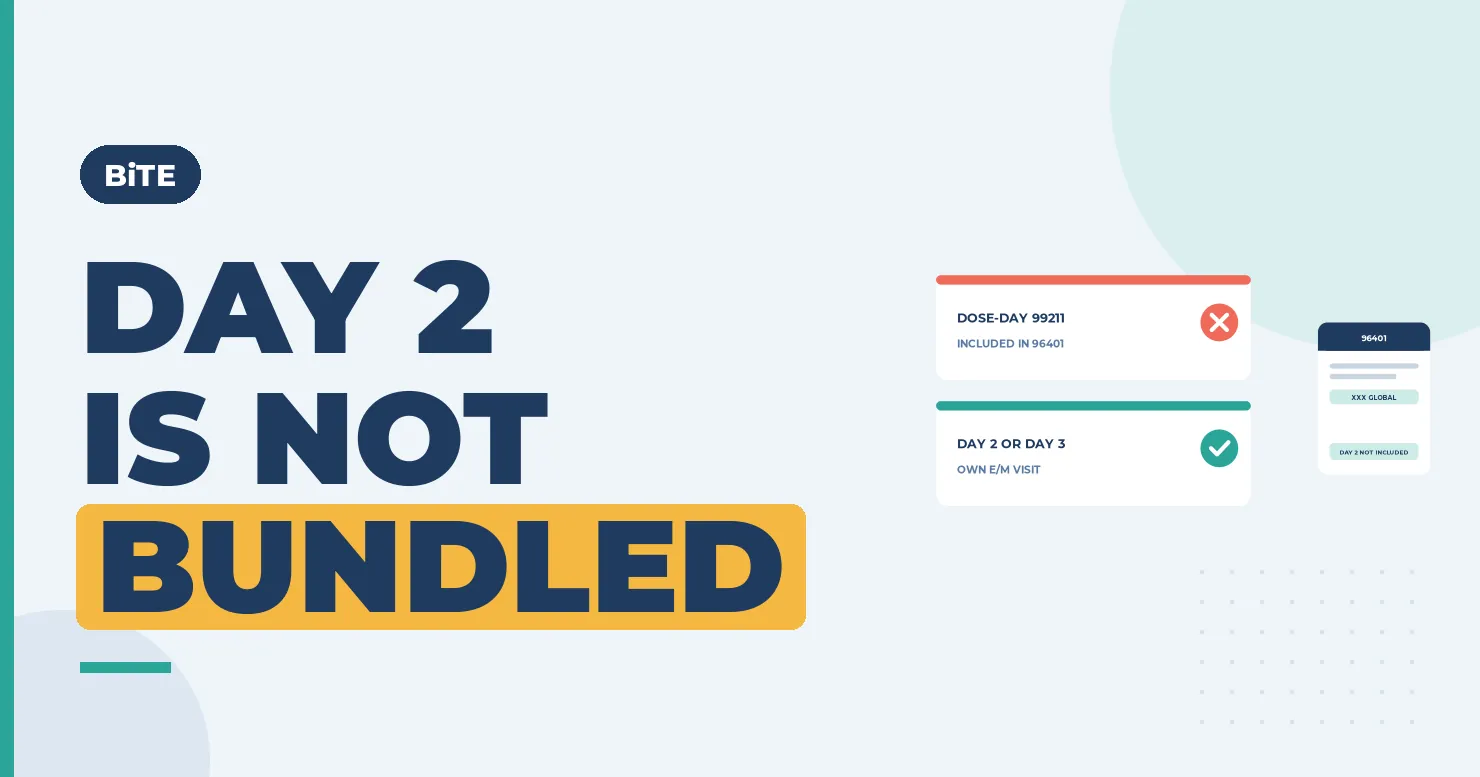
BiTE therapy billing for Day 2 and Day 3 visits is simple: those visits are not bundled. Drug administration codes carry no global period.
Bill each separate-day visit as its own E/M service when it is medically necessary and documented. Only services on the dose day itself can be folded in.
TL;DR: Day 2 and Day 3 visits after a BiTE (bispecific T-cell engager) dose are separately billable. CPT 96401, 96409 and 96413 have a XXX global, so no follow-up days are included. Use 99211 for a supervised nurse check or 99212-99215 for a provider visit. On the dose day itself, 99211 is never billable with chemotherapy administration.
Written by Manikandan J, CPC, CRCR, a certified coder and revenue cycle specialist. Published 25 November 2026. Last updated: 25 November 2026.
Table of Contents
Are Day 2 and Day 3 visits after a BiTE dose bundled?
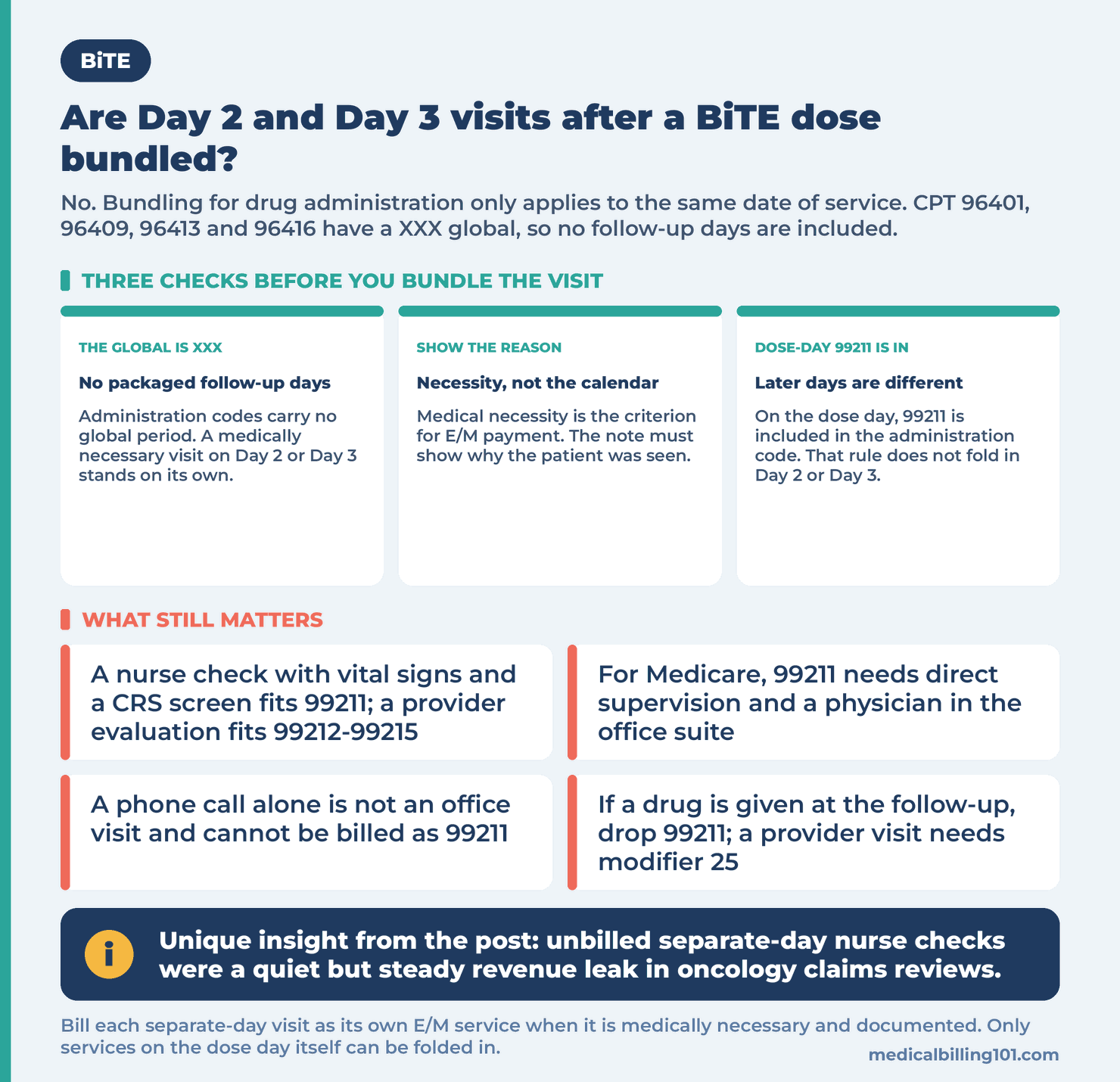
No. Bundling for drug administration only applies to the same date of service. The CMS physician fee schedule lists 96401, 96409, 96413 and 96416 with a XXX global indicator. That means no pre-dose or post-dose days are packaged into the payment.
The CMS PFS relative value file for October 2026 shows that XXX global for each administration code. Office visits 99211-99215 are also XXX. So a visit on Day 2 stands on its own.
What makes a separate-day visit payable is medical necessity, not the calendar. The Medicare Claims Processing Manual, Chapter 12, Section 30.6.1, calls medical necessity the overarching criterion for E/M payment. The note must show why the patient was seen.
A BiTE is a bispecific antibody that links a T cell to a cancer cell. Cytokine release syndrome (CRS) is an immune reaction with fever, low blood pressure or low oxygen. ICANS is immune effector cell-associated neurotoxicity syndrome. Step-up dosing means small first doses that rise to the full dose.
Example scenario (fictional names), part 1
BiTE therapy billing example: what happened
Birch Hollow Cancer Center is a fictional community oncology practice in Ohio. Marisol Vandeventer handles its infusion charges. Dr. Desmond Arakawa gave a myeloma patient the first full teclistamab dose in the office, after inpatient step-up doses.
The dose-day claim had 96401, J9380 with modifier JZ, and 99211 for the nurse pre-check. A fictional commercial plan that follows NCCI edits denied 99211 with CO-97 (CAS*CO*97).
The patient came back on Day 2 for a nurse check and on Day 3 with a low fever. The practice charged neither visit. Its protocol sheet said follow-up checks were “bundled.”
Was the protocol sheet right? Keep reading, or jump to how the case was resolved.
Why do community oncology practices see BiTE patients on Day 2 and Day 3?
Because several FDA labels call for close monitoring after certain doses. CRS and ICANS usually show up in the first days after dosing. Daily checks catch fever, low blood pressure or confusion early, before the patient needs the emergency room.
The Tecvayli (teclistamab) label calls for 48-hour hospital stays after step-up doses 1 and 2. After the first treatment dose, patients stay near a healthcare facility and are monitored daily for 48 hours. That daily check is the Day 2 and Day 3 visit.
The Elrexfio (elranatamab) label asks for daily monitoring for 48 hours after the next dose when a patient had grade 2 CRS or ICANS. The Imdelltra (tarlatamab) label recommends staying within one hour of care for 48 hours after the Cycle 1 Day 1 and Day 8 doses.
Tecvayli, Talvey and Elrexfio are also sold only through REMS programs. A REMS (risk evaluation and mitigation strategy) sets safety steps for prescribers and sites. It is not a billable service, so the visit note carries the claim.
Inpatient step-up days are billed by the hospital, not your office. Your office claims start with doses and visits given in your clinic.
Which E/M code fits a Day 2 or Day 3 check?
It depends on who sees the patient. A nurse check with vital signs and a CRS screen fits 99211. A visit where the physician or NP evaluates symptoms fits 99212-99215, chosen by medical decision making or total time.
For Medicare, 99211 must meet incident-to rules. The Medicare Benefit Policy Manual, Chapter 15, Section 60, requires direct supervision and an active course of treatment by the physician. If no physician is in the office suite, do not bill the nurse visit.
A provider visit for new symptoms often reaches a higher level. Fever after a BiTE dose is an acute problem, and the provider weighs drug risks. Our answer on choosing an E/M level for a cancer patient by MDM walks through that scoring.
A phone call alone is not an office visit. If a nurse only calls the patient on Day 2, there is no 99211 to bill.
Can you bill 99211 on the day of a BiTE injection?
No. The NCCI Policy Manual for 2026, Chapter XI, says drug administration codes already include the work of 99211. So 99211 is not reportable with 96360-96379 or 96401-96425 on the same date.
A higher office visit can still be billed that day. Codes 99212-99215 are separately reportable with modifier 25 when the provider performs a significant, separately identifiable E/M service. A different diagnosis is not required, per Chapter 12, Section 30.5.
A routine “okay to treat” review usually belongs to the dose. A full workup of a new problem may support 99213 or 99214 with modifier 25. See our answer on modifier 25 for a same-day sick visit for the documentation pattern.
What if the patient needs CRS treatment at the Day 2 visit?
Bill the treatment as well as the visit. Drugs given in the office get their own HCPCS code and an administration code. Because a drug was given that day, 99211 drops off, and a provider visit needs modifier 25.
Tocilizumab is billed as J3262, per 1 mg. Dexamethasone sodium phosphate is J1100, per 1 mg. Medically necessary IV fluids for low blood pressure use 96360 and 96361, but fluids used only to run a drug are not billed.
Chapter 12, Section 30.5, lets each MAC say which biologics count as chemotherapy-level drugs. So check your MAC before choosing 96413 or 96365 for tocilizumab.
For the diagnosis, the FY 2027 ICD-10-CM code set has D89.831 to D89.835 for CRS grades 1 to 5. ICANS codes sit at G92.00 to G92.05. If the drug caused the reaction, add the adverse effect code. For an antineoplastic NEC in the Table of Drugs, that is T45.1X5A.
Which J-codes and units apply to BiTE drugs?
Each BiTE drug has its own HCPCS code and billing unit. Units equal the dose divided by the unit size. The CMS October 2026 ASP payment limit file lists these codes and dosage descriptors.
| Drug (brand). | HCPCS and unit. | Usual office administration code. |
|---|---|---|
| Teclistamab-cqyv (Tecvayli). | J9380, per 0.5 mg. | 96401, subcutaneous. |
| Talquetamab-tgvs (Talvey). | J3055, per 0.25 mg. | 96401, subcutaneous. |
| Elranatamab-bcmm (Elrexfio). | J1323, per 1 mg. | 96401, subcutaneous. |
| Epcoritamab-bysp (Epkinly). | J9321, per 0.16 mg. | 96401, subcutaneous. |
| Glofitamab-gxbm (Columvi). | J9286, per 2.5 mg. | 96413 and 96415, IV infusion. |
| Mosunetuzumab-axgb (Lunsumio IV). | J9350, per 1 mg. | 96413 and 96415, IV infusion. |
| Tarlatamab-dlle (Imdelltra). | J9026, per 1 mg. | 96413, one-hour IV infusion. |
| Blinatumomab (Blincyto). | J9039, per 1 mcg. | 96416 to start the pump, 96521 for refills. |
Some quick math helps. A 76 mg Elrexfio dose is 76 units of J1323. A 48 mg Epkinly dose is 300 units of J9321. A 30 mg Columvi dose is 12 units of J9286. An 80 kg patient on 1.5 mg/kg Tecvayli gets 120 mg, or 240 units of J9380.
For Medicare, add JW on a separate line for discarded drug from a single-dose vial. Use JZ when nothing was discarded. The Medicare Claims Processing Manual, Chapter 17, Section 40, sets both rules. Our MUE lookup checks unit limits before you submit.
Which administration code fits each BiTE drug?
Match the code to the route. Subcutaneous BiTE doses use 96401, chemotherapy administration by subcutaneous or intramuscular injection. IV infusions use 96413 for the first hour and 96415 for each additional hour. Most BiTE drugs are given as one dose per visit.
Blinatumomab is different. It runs as a continuous infusion through a portable pump, with bags lasting 24 hours to 7 days per the Blincyto label. Starting the pump is 96416. A later bag change on Day 2 or Day 3 is 96521.
NCCI Chapter XI bars 96521 with 96416 at the same start, since 96416 includes the first fill. Flushing a port is also included in the administration code. You can test any pair in our NCCI edit checker.
These office codes apply in a physician office. A hospital outpatient clinic bills facility codes, such as G0463 for the visit, under OPPS rules.
In my years reviewing oncology claims, unbilled separate-day nurse checks were a quiet but steady revenue leak.
How should a practice set up BiTE follow-up visits so they get paid?
Build the charge capture into the protocol. Each follow-up visit needs its own note, its own date of service and a clear reason. The reason is usually label-required monitoring after a dose, or a new symptom.
- Record vital signs, a CRS and ICANS screen, and the drug and dose date in every follow-up note.
- Confirm a physician is in the suite for nurse visits billed as 99211 to Medicare.
- Charge any drug given at the follow-up, and drop 99211 if an administration code is billed that day.
If a payer folds a visit into another service anyway, our CO-97 denial guide explains when to appeal.
Example scenario (fictional names), part 2
How the BiTE therapy billing case was resolved
- Marisol read NCCI Chapter XI. The 99211 on the dose day was included in 96401, so she posted the CO-97 as a write-off.
- She checked the Day 2 note. The nurse recorded vital signs and a CRS screen with Dr. Arakawa in the suite, so she billed 99211.
- Day 3 showed grade 1 CRS managed by Dr. Arakawa. She billed 99214 with D89.831, T45.1X5A and C90.00.
Fix: both late charges went out within the plan’s filing limit, with separate dates of service.
Outcome: the plan paid both visits. The protocol sheet now says follow-up visits are separately billable.
Names and details are illustrative; no real patient data.
3-step checklist
- Treat Day 2 and Day 3 visits as separate encounters, since BiTE administration codes have no global period.
- Bill 99211 only on days with no drug administration, and use 99212-99215 with modifier 25 on dose days.
- Match each J-code’s units to its dosage descriptor, and add JW or JZ on Medicare drug lines.
FAQ
Is a Day 2 visit after a BiTE injection bundled into 96401?
No. CPT 96401 has a XXX global, so no later days are included. A medically necessary Day 2 visit is billed as its own E/M service.
Can a nurse visit after BiTE therapy be billed as 99211?
Yes, on a day with no drug administration. For Medicare, the visit must meet incident-to rules, including direct supervision by a physician in the office suite.
Can 99211 be billed with chemotherapy administration?
No. NCCI says drug and chemotherapy administration codes include the work of 99211. Use 99212-99215 with modifier 25 for a significant, separate visit.
What is the J-code for teclistamab?
J9380, injection, teclistamab-cqyv, per 0.5 mg. Divide the dose in milligrams by 0.5 to get the units.
How do you code cytokine release syndrome after a bispecific drug?
Use D89.831 to D89.835 by grade. Add the adverse effect code, such as T45.1X5A for an antineoplastic NEC, and the cancer code.
Sources
My methodology was simple. I checked the CMS manuals, the 2026 NCCI manual, the CMS fee schedule and drug pricing files, and the current FDA labels.
- CMS, NCCI Policy Manual for Medicare Services 2026, Chapter XI, Sections B and N (linked above). Accessed 25 Nov 2026.
- CMS, Medicare Claims Processing Manual, Chapter 12, Sections 30.5 and 30.6.1, and Chapter 17, Section 40 (linked above). Accessed 25 Nov 2026.
- CMS, Medicare Benefit Policy Manual, Chapter 15, Section 60 (linked above). Accessed 25 Nov 2026.
- CMS, PFS Relative Value File October 2026 and ASP Payment Limit File October 2026 (linked above). Accessed 25 Nov 2026.
- CMS and NCHS, FY 2027 ICD-10-CM Tabular List and Table of Drugs, D89.83-, G92.0- and T45.1X5-, from the CMS ICD-10 code files. Accessed 25 Nov 2026.
- FDA prescribing information for Tecvayli, Elrexfio, Imdelltra and Blincyto on DailyMed (linked above), plus the Talvey label for its REMS and step-up rules. Accessed 25 Nov 2026.
Read about the author, or contact us with a question. See our editorial policy.
Last updated: 25 November 2026 · Educational content for U.S. coding and billing teams. Code descriptions are plain-language summaries; check the current CPT and HCPCS code sets for full wording.