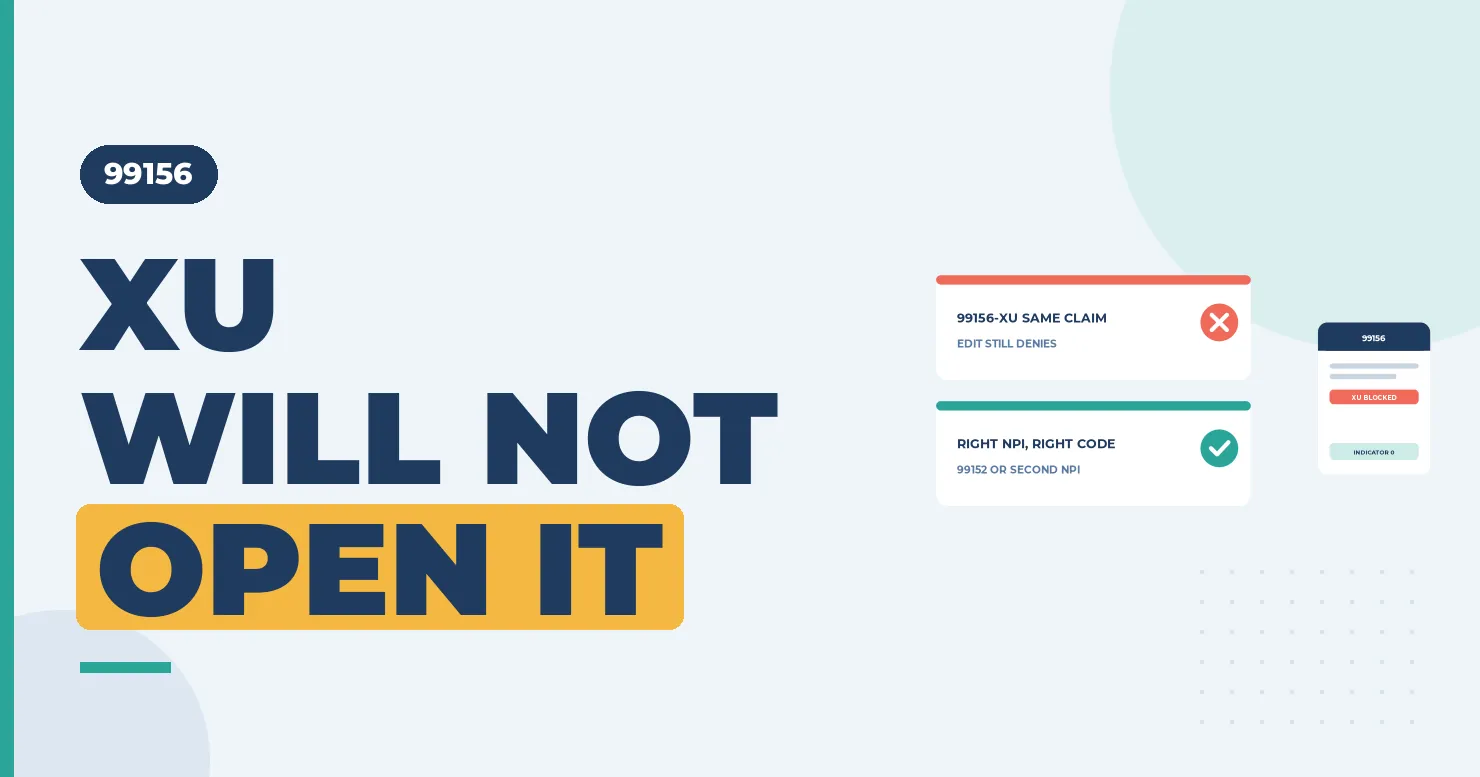
Billing 99156 and 99157 with modifier XU usually fails because XU cannot bypass these edits. Most NCCI edits that pair a procedure with 99156 or 99157 allow no modifier at all.
The fix is to bill the right sedation code for the right person. A second provider bills 99156 and 99157 on their own claim. The surgeon who also sedates bills 99152 and 99153.
TL;DR: CPT 99155-99157 describe moderate sedation by a provider other than the one doing the procedure. If they sit on the same provider’s claim as the procedure, the NCCI edit has a modifier indicator of 0. Modifier XU will not open it. Move the sedation to the sedating provider’s NPI, or switch to 99151-99153 if the proceduralist gave the sedation.
Written by Manikandan J, CPC, CRCR, a certified coder and revenue cycle specialist. Published 25 November 2026. Last updated: 25 November 2026.
Table of Contents
Does modifier XU make 99156 and 99157 payable with the procedure?
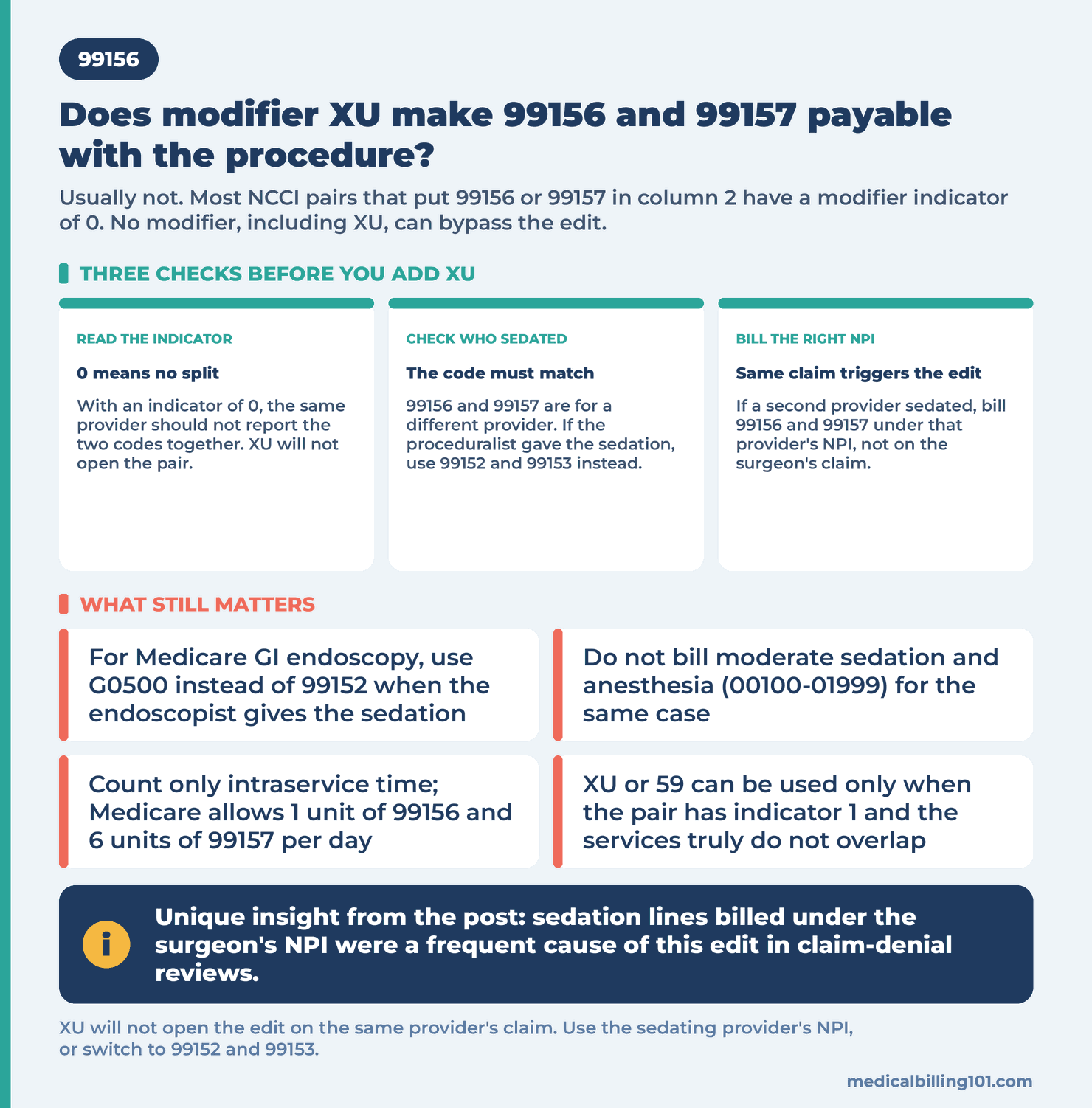
Usually not. In the October 2026 Medicare NCCI practitioner PTP edits, 99156 is the column 2 code in about 6,050 active procedure pairs. Almost all of them carry a modifier indicator of 0. That means no modifier, including XU, can bypass the edit.
The CMS booklet on proper use of modifiers 59, XE, XP, XS and XU explains the rule. With an indicator of 0, the same provider should not report the two codes together. Medicare pays the column 1 code and denies the column 2 code.
The edit rationale for most pairs is “HCPCS/CPT procedure code definition.” The code itself says another provider gave the sedation. So the denial is a coding signal, not a missing modifier.
Moderate sedation is a drug-induced drop in awareness where the patient still responds to voice or light touch. Modifier XU means an unusual non-overlapping service. A modifier indicator is the NCCI flag that tells you whether a code pair can ever be split.
We analyzed the October 2026 practitioner PTP file, version 32.3, for every active pair with 99156 or 99157 in column 2. The pattern was the same for 99157, with only 21 pairs open to a modifier.
Example scenario (fictional names), part 1
99156 modifier XU example: what happened
Copper Mesa Endoscopy Center is a fictional multispecialty group in New Mexico. Teodora Lindqvist posts its charges. Dr. Anselm Okafor performed a colonoscopy with polyp removal, 45385, on a 58-year-old patient.
The claim went out under Dr. Okafor’s NPI with 45385, 99156-XU and 99157-XU. The sedation note showed 31 minutes of intraservice time. Medicare denied both sedation lines with CO-97.
Teodora added a 59 modifier on a corrected claim. It denied again for the same reason.
Who actually gave the sedation? Keep reading, or jump to how the case was resolved.
What do CPT 99155, 99156 and 99157 mean?
They are moderate sedation codes for a provider who is not doing the procedure. 99155 covers the first 15 minutes for a patient under age 5. 99156 covers the first 15 minutes for a patient age 5 or older. 99157 adds each extra 15 minutes.
The same-provider set is different. 99151 and 99152 cover the first 15 minutes when the proceduralist also sedates, with a trained observer present. 99153 is the add-on for each extra 15 minutes.
| Code. | Who gives the sedation. | Time covered. |
|---|---|---|
| 99151. | Same provider as the procedure, patient under 5. | First 15 minutes. |
| 99152. | Same provider as the procedure, patient 5 or older. | First 15 minutes. |
| 99153. | Same provider as the procedure. | Each extra 15 minutes. |
| G0500. | Same provider, Medicare GI endoscopy, patient 5 or older. | First 15 minutes. |
| 99155. | A different provider, patient under 5. | First 15 minutes. |
| 99156. | A different provider, patient 5 or older. | First 15 minutes. |
| 99157. | A different provider. | Each extra 15 minutes. |
The NCCI Policy Manual for 2026, Chapter II, lists 99151-99157 as moderate sedation services. It says Medicare generally allows the proceduralist to report 99151-99153 separately, except when sedation is bundled into the procedure.
Why do 99156 and 99157 deny with the surgical procedure code?
NCCI edits apply to one provider, one patient and one date of service. When 99156 sits on the surgeon’s claim, the edit treats it as the surgeon sedating. That conflicts with the code’s definition, so the line denies.
Three causes come up most often, for example in GI and pain clinics. The surgeon gave the sedation, so 99152 was the right code. A second provider gave it, but the charge went under the surgeon’s NPI. Or an anesthesia code from 00100-01999 was also billed for the same case.
Anesthesia codes and 99156 also clash. NCCI pairs anesthesia codes such as 00100 with 99156 at a 0 indicator. A case gets either moderate sedation or anesthesia care, not both. Our NCCI edit checker shows the indicator for any pair. GI cases bring their own modifier traps, as in our answer on incomplete colonoscopy coding.
In my years working claim denials, sedation lines billed under the surgeon’s NPI were a frequent cause of this edit.
Are 99156 and 99157 billed in anesthesia time units?
No. Moderate sedation codes use 15-minute CPT time blocks, counted as units of 99157. Anesthesia codes 00100-01999 use base units plus time units, paid with an anesthesia conversion factor.
The Medicare Claims Processing Manual, Chapter 12, Section 50, sets that anesthesia formula. It allows one time unit per 15 minutes of anesthesia time. Anesthesia time runs while the anesthesia practitioner is present with the patient.
For sedation, count intraservice time only. It starts with the first sedating drug and ends when the sedating provider’s face-to-face time ends. Medicare’s October 2026 MUE file allows 1 unit of 99156 and 6 units of 99157 per day. Check claims in our MUE lookup.
When can modifier XU or 59 be used with sedation codes?
Only when the NCCI pair has a modifier indicator of 1. Only about 20 active pairs for each code carry that indicator. For those, XU fits only if the services truly do not overlap.
The CMS booklet says not to use these modifiers to bypass an edit unless the criteria are met. The documentation must support a distinct service. Sedation for the same procedure is never distinct from that procedure.
CMS says to use XE, XP, XS or XU instead of 59 whenever possible. Our modifier 25 and 59 helper walks through the choice. Blocks for pain control raise a related question, covered in our answer on nerve block codes denied as bundled.
How do you fix a 99156 or 99157 denial?
Read the sedation note first. Confirm who gave the drugs and who monitored the patient. Then rebill under the right NPI with the right code family.
- If the surgeon sedated with a trained observer, replace 99156 with 99152 and 99157 with 99153. For Medicare GI endoscopy, use G0500 instead of 99152.
- If a second provider sedated, remove the lines from the surgeon’s claim. Bill 99156 and 99157 under the sedating provider’s NPI.
- If an anesthesia practitioner gave anesthesia care, bill the anesthesia code and drop the sedation codes.
Send the change as a corrected claim, not an appeal. Our CO-97 denial guide covers bundling denials, explains when an appeal makes sense. If an outside anesthesiologist billed the case, see out-of-network anesthesiologist at an in-network hospital.
Example scenario (fictional names), part 2
How the 99156 modifier XU case was resolved
- Teodora read the sedation note. Dr. Okafor ordered and gave the midazolam and fentanyl himself, with a GI nurse as the trained observer.
- That made it same-provider sedation. Medicare uses G0500 for that in GI endoscopy. She replaced 99156 with G0500 and 99157 with 99153, one unit each, for 31 minutes.
- She removed every XU and 59 modifier from the sedation lines.
Fix: a corrected claim with 45385, G0500 and 99153 under Dr. Okafor’s NPI.
Outcome: Medicare paid the corrected claim. The center added a charge rule that blocks 99156 on the proceduralist’s NPI.
Names and details are illustrative; no real patient data.
3-step checklist
- Check who gave the sedation before you pick 99151-99153 or 99155-99157.
- Look up the NCCI pair and its modifier indicator before adding XU or 59.
- Count only intraservice time, and bill 99157 units within the MUE limit.
FAQ
Can 99156 be billed with modifier XU?
Usually not. Most NCCI pairs with 99156 in column 2 have a modifier indicator of 0, so no modifier bypasses the edit. Bill it under the sedating provider’s NPI.
What is the difference between 99152 and 99156?
99152 is moderate sedation by the same provider doing the procedure, with a trained observer. 99156 is moderate sedation by a different provider. Both cover the first 15 minutes for patients age 5 or older.
How many units of 99157 can be billed?
Medicare’s October 2026 MUE for 99157 is 6 units per day. Each unit is an extra 15 minutes of intraservice time after the first 15 minutes.
Can moderate sedation and anesthesia be billed for the same case?
No. NCCI pairs anesthesia codes such as 00100 with 99156 at a 0 indicator. Bill one or the other, based on the service given.
What code is used for moderate sedation during GI endoscopy for Medicare?
When the endoscopist gives the sedation, Medicare uses G0500 for the first 15 minutes instead of 99152. Add 99153 for each extra 15 minutes.
Sources
My methodology was simple. I checked the CMS manuals, the 2026 NCCI manual, the CMS modifier booklet and the October 2026 NCCI PTP and MUE files.
- CMS, NCCI Policy Manual for Medicare Services 2026, Chapter II, Anesthesia Services (linked above). Accessed 25 Nov 2026.
- CMS, Medicare Claims Processing Manual, Chapter 12, Section 50 (linked above). Accessed 25 Nov 2026.
- CMS MLN booklet, Proper Use of Modifiers 59, XE, XP, XS and XU (linked above). Accessed 25 Nov 2026.
- CMS, Medicare NCCI practitioner PTP edits version 32.3 and practitioner MUE file effective 10-01-2026 (linked above). Accessed 25 Nov 2026.
Read about the author, or contact us with a question. See our editorial policy.
Last updated: 25 November 2026 · Educational content for U.S. coding and billing teams. Code descriptions are plain-language summaries; check the current CPT and HCPCS code sets for full wording.