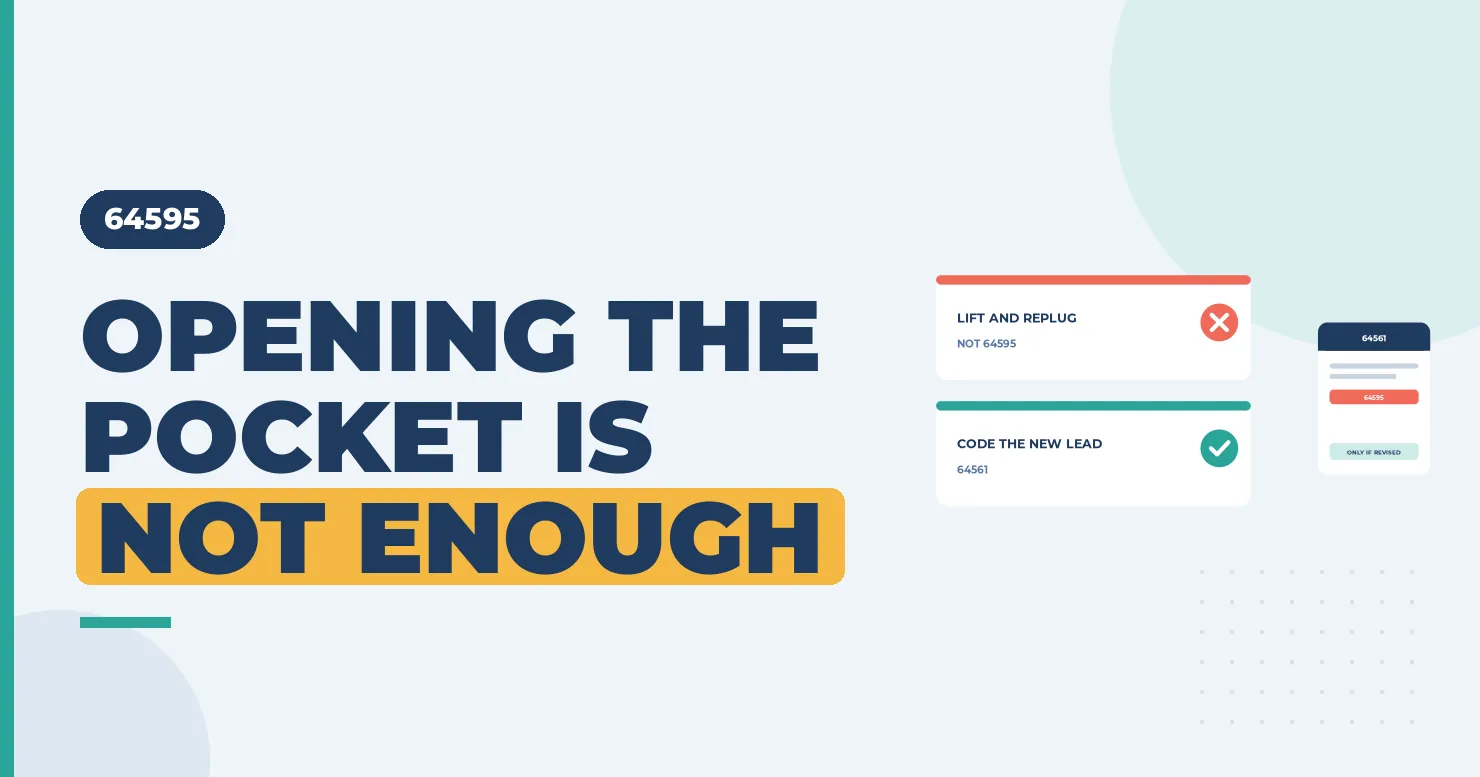
64595 billing needs a real revision or removal of the pulse generator. Opening the pocket only to swap the lead does not usually qualify.
The fix: for a sacral lead replacement, bill 64561 for the new percutaneous lead. Add 64595 only when the note shows separate generator or pocket revision work.
TL;DR: CPT 64595 is revision or removal of a peripheral, sacral or gastric neurostimulator pulse generator. Lifting the generator out to disconnect an old lead and connect a new one is part of the lead exchange. Code the new lead with 64561. Do not add 64585 for the old lead, and do not add 64595 unless the generator or pocket was actually revised.
Written by Manikandan J, CPC, CRCR, a certified coder and revenue cycle specialist. Published 24 November 2026. Last updated: 24 November 2026.
Table of Contents
Can you bill CPT 64595 when only the sacral lead is replaced?
Usually not. CPT 64595 pays for work on the pulse generator itself, such as fixing a pocket problem or taking the generator out. If the surgeon only lifts the generator to change the lead connection, then returns it, that step belongs to the lead replacement.
CPT 64595 is revision or removal of a peripheral, sacral or gastric neurostimulator pulse generator or receiver, with detachable connection to the electrode array. CPT 64561 is percutaneous implantation of a sacral neurostimulator electrode array, including image guidance if performed. CPT 64585 is revision or removal of a peripheral neurostimulator electrode array.
The pulse generator, or IPG, is the battery unit in a skin pocket. The electrode array is the lead that sits in the sacral foramen. A tined lead has small barbs that hold it in place.
Example scenario (fictional names), part 1
64595 billing example: what happened
Priya Lindqvist codes for Harbor Bend Urology, a fictional practice in Maine. Dr. Tomas Achterberg replaced a migrated sacral lead for a patient with overactive bladder.
He opened the old generator pocket, lifted the generator and unplugged the old lead. He pulled the old lead, placed a new tined lead through the S3 foramen and plugged it into the same generator. The pocket looked clean, so he closed it.
Priya billed 64561, 64585 and 64595 to Medicare. The 64561 line came back denied, and 64595 paid. Was the claim right?
Which lines did the surgery really support? Keep reading, or jump to how the case was resolved.
What work does CPT 64595 describe?
CPT 64595 describes a procedure aimed at the generator or its pocket. The AMA example shows the surgeon opening the pocket, finding the cause of a pocket problem, cleaning it and then revising or removing the generator. The generator is the target of the surgery.
You can read that description in the AMA CPT Assistant article on neurostimulator codes. It also explains that 64590 and 64595 were revised for 2024 to include sacral generators.
Now compare a lead exchange. The note says the pocket showed no infection, seroma or erosion. The generator was not repaired, moved or changed. It was only unplugged and plugged back in.
In my years on payer and provider billing teams, 64595 on a lead-only case was one of the most common add-ons that failed a records review.
Which code do you bill for a sacral lead replacement?
Bill 64561 when the new lead goes in percutaneously through the foramen. Bill 64581 only when the surgeon places the lead through an open incision down to the sacrum. The approach decides the code, not the lead type.
Removal of the old lead is part of the replacement. The 2026 Q4 Medicare NCCI practitioner edits pair 64585 as column 1 with 64561 as column 2 as mutually exclusive procedures. So if you bill both, the new lead line is the one at risk, as in the example.
Check the pair on the CMS NCCI PTP edits page. Our guide to searching NCCI PTP tables shows how to read the columns.
| Step in the note. | Code. | Bill it? |
|---|---|---|
| New tined lead placed through the S3 foramen. | 64561. | Yes. |
| Old lead pulled out during the same exchange. | 64585. | No, part of the replacement. |
| Generator lifted, lead swapped, generator returned. | 64595. | No, unless the generator or pocket was revised. |
| Fluoroscopy to guide the lead. | 76000 or 77002. | No, 64561 includes image guidance. |
| Impedance check by the device rep. | 95970. | No, not a physician service. |
When can 64595 be billed with 64561?
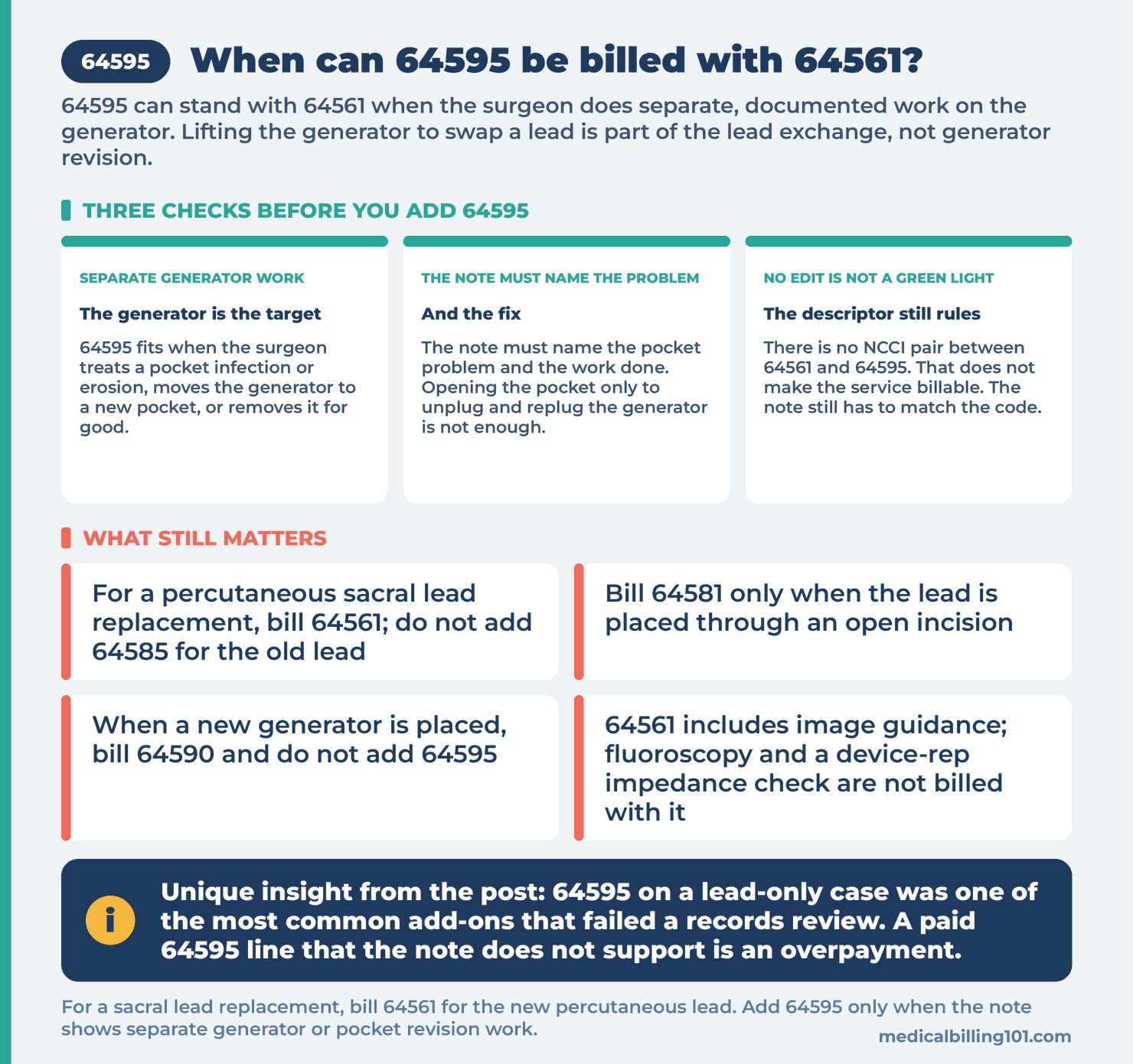
64595 can stand with 64561 when the surgeon does separate, documented work on the generator. For example, the surgeon may treat a pocket infection or erosion, move the generator to a new pocket, or remove it for good. The note must name the pocket problem and the fix.
The 2026 Q4 NCCI file has no pair between 64561 and 64595. That only means a claim scrubber will not stop you. It does not make the service billable. The note still has to match the code descriptor.
The NCCI Policy Manual, Chapter VIII, item 16, covers cranial and spinal generators. When the same generator is removed and put back, only the revision code applies, not the replacement code. That rule separates revision from replacement. It does not turn a lead-only exchange into generator work. Item 35 adds that the test lead kit, A4290, is not billed with 64561.
What if a new generator is placed too?
Bill 64590 for the new generator. Do not add 64595 for taking out the old one. The CPT note under 64590 says not to report it with 64595, and NCCI carries a 64590 and 64595 edit.
A full system replacement is 64561 or 64581 plus 64590. Medicare covers sacral nerve stimulation for urinary urge incontinence, urgency-frequency and retention under the conditions in NCD 230.18.
Can you bill fluoroscopy or device testing with 64561?
No for fluoroscopy. The 64561 descriptor includes image guidance, and NCCI pairs 64561 with 76000 and 77002. Device checks by a manufacturer rep are not physician services, so 95970 does not apply to that work.
Programming done personally by the physician is a different service. Even then, NCCI pairs 64561 with 95970, 95971 and 95972. Bill programming only when it is distinct and fully documented.
How do you fix a claim that billed 64561, 64585 and 64595?
Start with the op note, not the denial. If the case was a lead exchange with no generator work, the right claim is 64561 alone. A paid 64595 line that the note does not support is an overpayment.
- Read the CARC and RARC on the denied line. A CO-97 denial often means one code was bundled into another.
- Match each step in the note to a code using the table above. Query the surgeon if the pocket work is unclear.
- Send a corrected claim (frequency code 7) with only the supported codes. Use our appeal letter generator only when the note truly supports a denied line.
A lead exchange may also fall inside the global period of an earlier implant. Our global surgical package guide covers modifiers for a return to the OR.
Example scenario (fictional names), part 2
How the 64595 billing case was resolved
Priya checked the NCCI file. 64585 sat in column 1 over 64561 as mutually exclusive, which explained the denied lead line.
Then she reread the pocket section. It showed no infection, no erosion and no new pocket. The generator was only unplugged and plugged back in, so 64595 had no support.
Fix: she sent a corrected claim (frequency code 7) with 64561 alone. The fluoroscopy and the rep’s impedance check stayed unbilled.
Outcome: Medicare paid 64561 and took back the 64595 payment. The claim now matched the surgery.
Names and details are illustrative; no real patient data.
3-step checklist
- Code the new lead by approach: 64561 for percutaneous, 64581 for open.
- Leave off 64585 for the old lead when a new lead goes in.
- Add 64595 only when the note documents real generator or pocket revision, or removal.
FAQ
What is CPT 64595?
CPT 64595 is revision or removal of a peripheral, sacral or gastric neurostimulator pulse generator or receiver, with detachable connection to the electrode array.
Can 64595 be billed with a sacral lead replacement?
Usually not. Lifting the generator to swap the lead is part of the lead exchange. Bill 64595 only when the note shows real generator or pocket revision, or removal.
Is 64585 billed when the old sacral lead is removed and replaced?
No. Removal of the old lead is part of the replacement. NCCI pairs 64585 and 64561 as mutually exclusive.
Can 64590 and 64595 be billed together?
No. When a new generator replaces the old one, bill 64590 only. CPT and NCCI both bar 64595 with 64590.
Is fluoroscopy billed with 64561?
No. The 64561 descriptor includes image guidance, and NCCI pairs 64561 with 76000 and 77002.
Sources
My methodology was simple. I checked the AMA CPT Assistant neurostimulator article, the 2026 NCCI Policy Manual, the 2026 Q4 Medicare PTP edit file and the CMS coverage decision.
- AMA, CPT Assistant, December 2023, New and Revised Neurostimulator Codes (linked above). Accessed 24 Nov 2026.
- CMS, Medicare NCCI Policy Manual 2026, Chapter VIII, items 16 and 35 (linked above). Accessed 24 Nov 2026.
- CMS, Medicare NCCI practitioner PTP edits, 2026 Q4 file v323r0, pairs 64585/64561, 64590/64595, 64561/76000, 64561/77002 and 64561/95970 (linked above). Accessed 24 Nov 2026.
- CMS, NCD 230.18, Sacral Nerve Stimulation for Urinary Incontinence (linked above). Accessed 24 Nov 2026.
Read about the author, or contact us with a question. See our editorial policy.
Last updated: 24 November 2026 · Educational content for U.S. coding and billing teams. Code descriptions are plain-language summaries; check the current CPT code set for full wording.