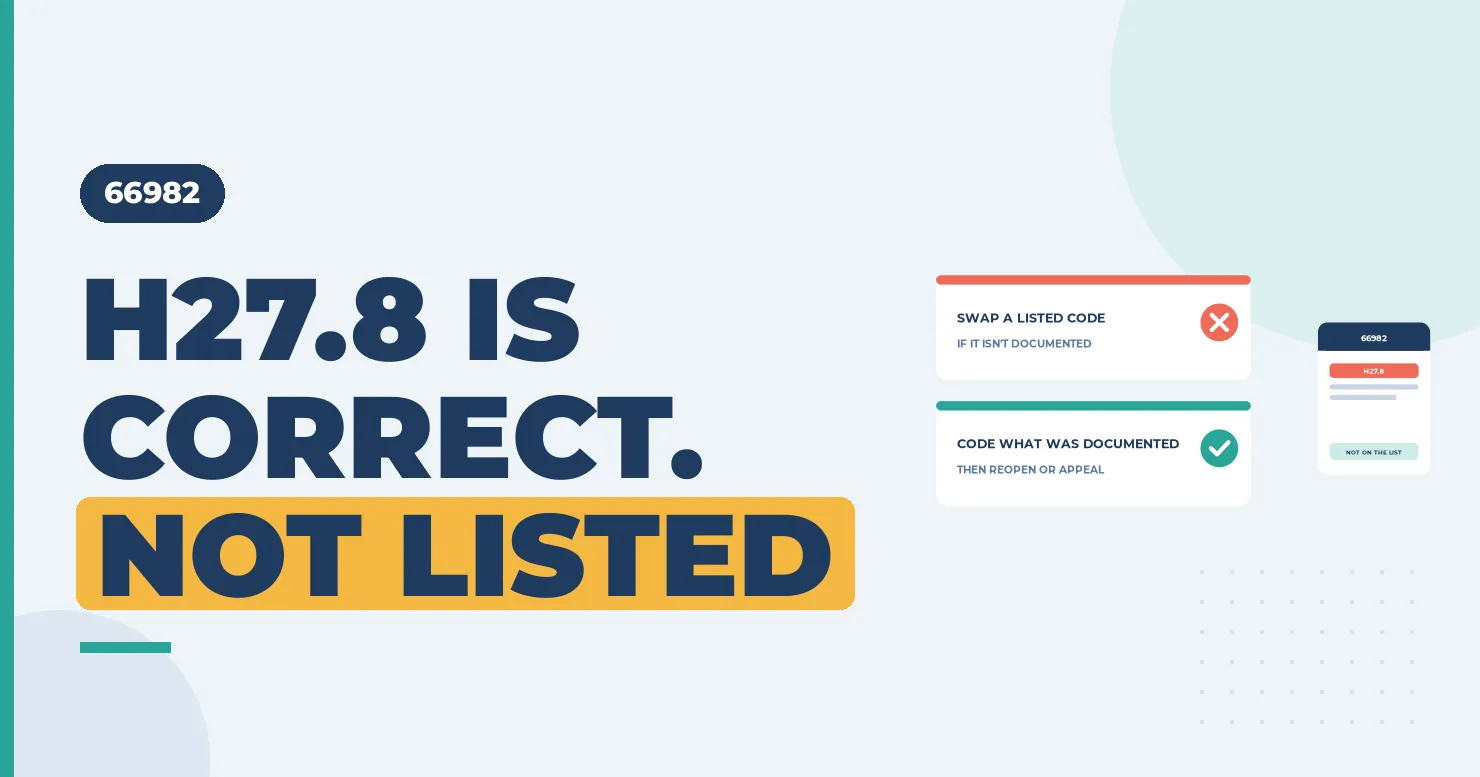
There is no zonular weakness ICD-10 code of its own, so coders use H27.8. But Medicare cataract LCDs do not list H27.8 for 66982. That gap causes the denial, not the capsular tension ring.
The fix: read the whole chart for a listed condition the surgeon actually documented, such as lens subluxation or pseudoexfoliation. Query the surgeon if it is unclear, and never pick a covered code the record does not support.
TL;DR: A capsular tension ring placed for pre-existing zonular weakness can support 66982. But H27.8 is not on the 66982 diagnosis lists. Code a listed condition only when the surgeon documents it. If none fits, bill what is true and be ready to appeal with the operative note.
Written by Manikandan J, CPC, CRCR, a certified coder and revenue cycle specialist. Published 24 November 2026. Last updated: 24 November 2026.
Table of Contents
What should you do when H27.8 isn’t covered for zonular weakness with a capsular tension ring?
Do not drop 66982 or swap in a random covered code. First, check whether the surgeon documented a listed condition, such as lens subluxation or pseudoexfoliation. If yes, code it. If not, query the surgeon. If nothing listed applies, bill the true codes and appeal with records.
A capsular tension ring is a small open ring placed inside the lens capsule. It spreads support when the zonules are weak or torn. Zonules are the thin fibers that hold the lens in place. Zonular dialysis is a tear or separation of those fibers.
The ring itself is a covered reason for complex surgery. The problem is purely the diagnosis code on the claim.
Example scenario (fictional names), part 1
Zonular weakness 66982 example: what happened
Tomasz Bielski codes for Allegheny Ridge Eye Surgeons, a fictional practice in Pennsylvania. Dr. Adaeze Okafor is the cataract surgeon.
Her operative note for a right eye cataract said “zonular weakness noted, capsular tension ring placed for lens stability.” Tomasz billed 66982-RT with H25.11 and H27.8 to Medicare.
The 835 came back with CO-50 and remark N115, a local coverage decision. The ring was real and clearly documented. So why did the claim fail?
What would you check first? Keep reading, or jump to how the case was resolved.
Is there an ICD-10 code for zonular weakness?
No. ICD-10-CM has no code named zonular weakness or zonular dialysis. The index path is Disorder, lens, specified type NEC, which leads to H27.8, “Other specified disorders of lens.” That is why coders pick it.
H27.8 is an “other specified” code. The FY2027 ICD-10-CM Official Guidelines say these codes fit when the record has detail with no specific code. So H27.8 is a correct code, just not a listed one.
Two related index entries matter more for coverage:
- Dislocation, lens, partial (subluxation) leads to H27.11-, with a sixth character for the eye.
- Pseudoexfoliation, capsule leads to Cataract, specified NEC, which is H26.8, “Other specified cataract.”
Do not confuse zonular cataract with zonular weakness. Zonular cataract indexes to Q12.0, a congenital cataract, and means something else.
Does a capsular tension ring qualify cataract surgery for 66982?
Yes, when the ring was needed. Novitas LCD L35091 lists “pre-existing zonular weakness requiring use of capsular tension rings or segments” as a covered reason for complex cataract surgery. A ring used only as a habit does not qualify.
The rule is in LCD L35091. First Coast uses the same indications. The other complex reasons are a small pupil that needs an iris expansion device, pediatric surgery, and dye for a mature cataract.
Palmetto GBA’s article A53047 adds a key point. 66982 is not about how hard the surgeon felt the case was. Pseudoexfoliation alone does not qualify if the zonules held and no special device was used.
So the question splits in two. Was 66982 earned by a needed device? And does the claim carry a diagnosis your contractor lists? This post is about the second part.
Which diagnosis codes do Medicare contractors list for 66982?
None of the six contractor articles I checked list H27.8. Most list lens subluxation or dislocation (H27.11- to H27.13-), H26.8 and some congenital lens codes. WPS is the exception, with a narrower secondary list.
| Contractor and article | How the 66982 diagnosis rule works | H27.8 listed? |
|---|---|---|
| Novitas A56615 and First Coast A58592 | Separate Group 2 list for 66982 and 66987. It includes H26.8, H27.111 to H27.133 and Q12.1, Q12.2, Q12.4, Q12.8. | No |
| CGS A56453 | Secondary list for 66982. H27.10 to H27.133 and Q12 codes count when the op note shows a capsular support ring or permanent lens sutures. | No |
| Noridian A57195 | One list for all cataract codes, including H26.8 and H27.111 to H27.133. | No |
| Palmetto GBA A56613 | One list for all cataract codes, including H26.8 and H27.10 to H27.133. Documentation rules are in A53047. | No |
| WPS A59805 | A Group 2 code is required for 66982, except with H25.21 to H25.23 or H25.89. Its Group 2 list holds iris, pupil and other eye codes, with no H26 or H27 codes. | No |
Lists change with each article revision. Always open the current version for your contractor before you code. For a similar list problem with another service, see our answer on 93306 denied for a diagnosis not covered by the LCD.
Can you change H27.8 to a covered code?
Only if the surgeon documented that condition. Code assignment rests on the provider’s diagnostic statement. If the record conflicts or is unclear, the guidelines say to query the provider. A coder cannot turn “weak zonules” into “subluxation” alone.
Look past the operative note first. The pre-op exam often holds the answer. Slit-lamp notes may already state pseudoexfoliation, lens subluxation, phacodonesis or a history of eye trauma.
Then send a short, non-leading query. Ask the surgeon to name the condition behind the weak zonules, if one is known. Offer real choices, plus “other” and “unable to determine.”
In my years on payer and provider billing teams, many 66982 denials came from coding only the op note and missing a diagnosis already written in the pre-op exam.
What should the operative note show for 66982 with a tension ring?
The note should show that zonular weakness existed, where and how bad it was, and why the ring was needed for a stable lens. A plain line saying a ring was placed is weak support on review.
- Pre-op finding: phacodonesis, lens shift or pseudoexfoliation, if seen.
- Intra-op finding: loose or torn zonules, with clock hours if known.
- Device and reason: ring or segment placed because capsular support was not adequate.
- Lens result: lens placed and centered with the ring in place.
Palmetto strongly recommends an opening line such as “Indication for complex cataract surgery,” followed by the reason. Our guide on medical necessity documentation covers the same habit for other services.
How do you fix a 66982 claim denied for H27.8?
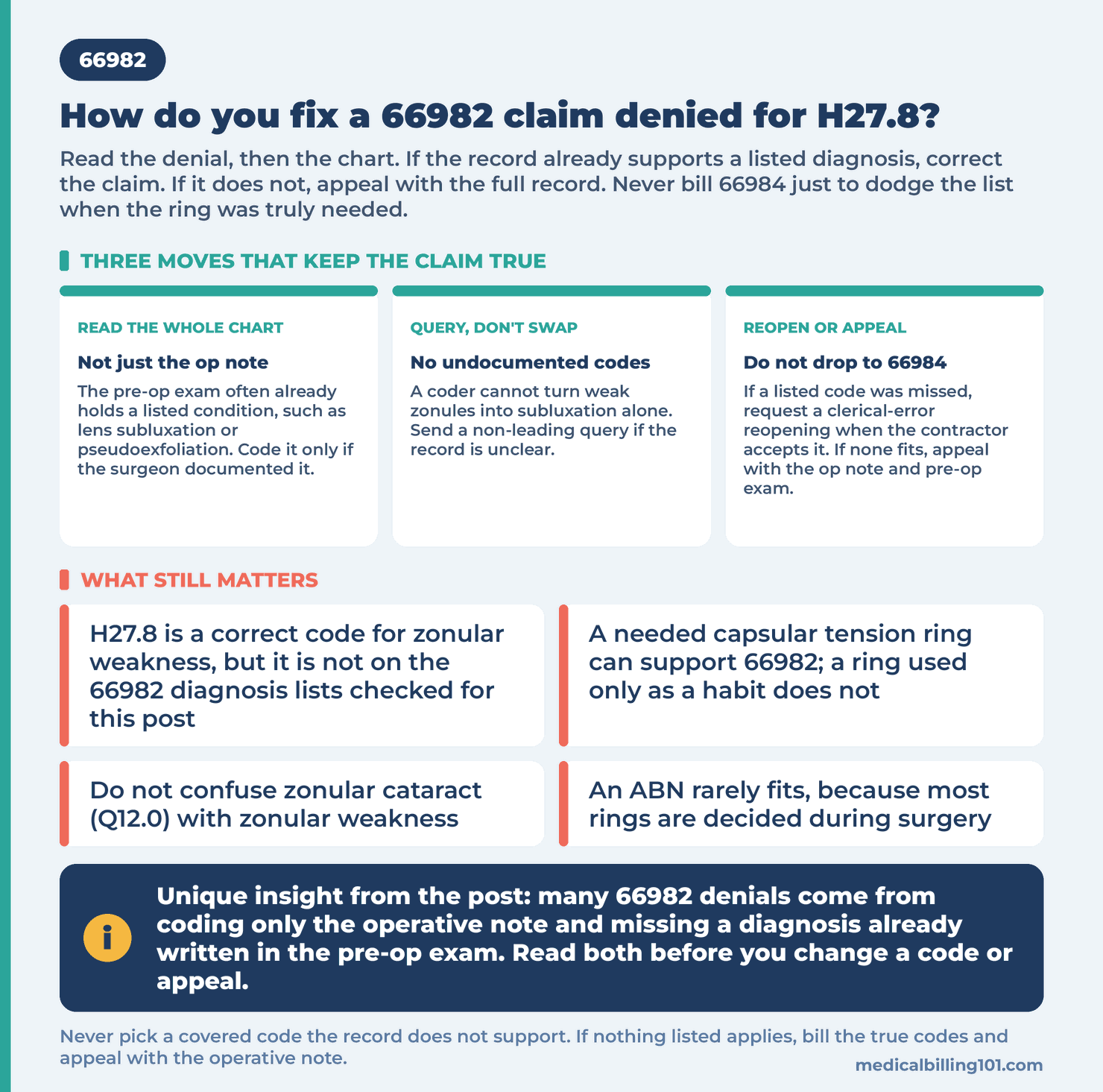
Read the denial, then the chart. If the record already supports a listed diagnosis, correct the claim. If it does not, appeal with the full record. Never bill 66984 just to dodge the list when the ring was truly needed.
A Medicare denial here usually shows CARC 50 with remark N115, which points to a local coverage decision. Our CO-50 denial guide explains the code itself.
- Listed code was documented but missed: ask for a clerical-error reopening if your contractor accepts it. If not, file a redetermination.
- No listed code fits: file a redetermination with the op note, pre-op exam and a short cover letter. Our Medicare appeal guide walks through the levels.
- Weak zonules known before surgery: if a specific denial is expected, discuss a proper ABN with your compliance lead.
Chapter 34 of the Medicare Claims Processing Manual says clerical errors, such as transposed diagnosis codes, go through reopenings, not appeals. The contractor decides what counts.
For ABNs, Chapter 30 of the same manual bans routine or generic notices. The notice must give a genuine reason to expect denial. Most rings are decided during surgery, so an ABN rarely fits.
Example scenario (fictional names), part 2
How the zonular weakness 66982 case was resolved
Tomasz opened the Novitas article. H27.8 was not on the Group 2 list for 66982, so the denial matched the policy.
He then read the pre-op exam Dr. Okafor had signed two weeks earlier. It stated pseudoexfoliation of the lens capsule in both eyes, with mild phacodonesis on the right.
Pseudoexfoliation of the capsule indexes to H26.8, which is on the list. Tomasz requested a clerical-error reopening with H25.11 and H26.8, and kept H27.8 for the weak zonules.
Outcome: the claim was reprocessed and paid. The practice now codes cataract cases from the op note and the pre-op exam together.
Names and details are illustrative; no real patient data.
Do commercial payers use the same diagnosis lists?
Not always. Many commercial and Medicare Advantage plans write their own cataract policies, and some may require prior authorization for cataract surgery. Check the plan’s current policy instead of assuming the Medicare list applies.
The same coding rules still hold everywhere. Code what the surgeon documented, keep the ring reason in the op note, and query when the chart is unclear.
3-step checklist
- Confirm the op note shows weak zonules and why the ring was needed.
- Read the pre-op exam for a listed diagnosis, and query the surgeon if unclear.
- Check your contractor’s current 66982 list, then bill, reopen or appeal.
FAQ
What is the ICD-10 code for zonular weakness?
There is no specific code. The index path Disorder, lens, specified type NEC leads to H27.8, Other specified disorders of lens.
Is H27.8 covered for 66982 by Medicare?
Not in the Novitas, First Coast, CGS, Noridian, Palmetto or WPS cataract articles checked for this post. Each lists other lens codes instead.
Does a capsular tension ring always mean 66982?
No. The ring must be needed because of pre-existing zonular weakness. A ring placed only as routine practice does not make the case complex.
Can I code pseudoexfoliation instead of H27.8?
Only if the surgeon documented it. Pseudoexfoliation of the lens capsule indexes to H26.8, which several contractors list for 66982.
Should I bill 66984 if H27.8 will deny?
No, not when the ring was truly needed. The code must describe the service performed. Bill 66982 and appeal with the operative note.
Sources
My methodology was simple. I checked the FY2027 ICD-10-CM index, tabular and guidelines, one LCD, six Medicare contractor billing articles and two CMS manual chapters.
- CDC/NCHS, ICD-10-CM FY2027 Alphabetic Index and Tabular List (H27.8, H27.11-, H26.8, Q12.0) and Official Guidelines, Sections I.A.9 and I.A.19 (guidelines linked above). Accessed 24 Nov 2026.
- Novitas, LCD L35091, Cataract Extraction (including Complex Cataract Surgery) (linked above). Accessed 24 Nov 2026.
- Palmetto GBA, article A53047, Complex Cataract Surgery: Appropriate Use and Documentation, and article A56613 v17 (linked above). Accessed 24 Nov 2026.
- Novitas A56615 v36, First Coast A58592 v19, CGS A56453 v12, Noridian A57195 v29 and WPS A59805 v20, cataract billing and coding articles (linked above). Accessed 24 Nov 2026.
- CMS, Medicare Claims Processing Manual, Chapter 34, Section 10.4, and Chapter 30, Section 40.2.2 (linked above). Accessed 24 Nov 2026.
- X12, Remittance Advice Remark Code N115 and Claim Adjustment Reason Code 50 (code lists). Accessed 24 Nov 2026.
Read about the author, or contact us with a question. See our editorial policy.
Last updated: 24 November 2026 · Educational content for U.S. coding and billing teams. Code descriptions are plain-language summaries; check the current CPT code set for full wording.