
Brachytherapy documentation must include a signed procedure note for the applicator insertion. Images and a treatment record do not show who placed the applicator or how.
The fix: hold the insertion code until the physician who placed the applicator signs a note. Then match every other brachytherapy code to its own record.
TL;DR: Applicator insertion is a separate surgical service with its own CPT code, such as 57155. A code is billable only when the record shows every part of it was done. A procedure note does that. Images support the note but do not replace it.
Written by Manikandan J, CPC, CRCR, a certified coder and revenue cycle specialist. Published 23 November 2026. Last updated: 23 November 2026.
Table of Contents
Is a separate procedure note needed for brachytherapy applicators?
Yes. If you bill an insertion code, the physician who placed the applicator needs a signed procedure note. The note shows the service was done, by whom, and how. Without it, the insertion line has no support.
Brachytherapy is radiation given from a source placed inside or next to the tumor. An applicator is the device that holds the path for that source, such as a tandem, ovoids or a cylinder.
The work has two separate parts. First, a physician places the applicator, needles or catheters. Then the team loads the radiation source and delivers the dose.
Each part has its own codes. So each part needs its own documentation. The 2026 Medicare NCCI Policy Manual, Chapter 9 states the basic rule. A code is reported only if all services in that code are performed.
Example scenario (fictional names), part 1
Brachytherapy documentation example: what happened
Renee Castillo codes for Harbor Point Cancer Center, a fictional hospital outpatient department in Georgia. Dr. Anika Varga is the radiation oncologist.
A patient with cervical cancer had her first HDR session. The charge sheet listed 57155, a complex simulation, a brachytherapy isodose plan and 77771.
The chart had CT images that clearly showed a tandem and ovoids in place. It also had the HDR treatment record with dwell times and channels.
But Renee could not find a single note saying who inserted the applicator. Keep reading, or jump to how the case was resolved.
What CPT codes describe brachytherapy applicator insertion?
Insertion codes sit in the surgery section, not the 77000 radiation codes. The right one depends on the body site and the device. Each is billed by the physician who placed it.
| CPT code | What it covers (plain words) | Medicare global days (2026) |
|---|---|---|
| 57155 | Uterine tandem and/or vaginal ovoids for brachytherapy | 000 |
| 57156 | Vaginal afterloading device, such as a cylinder | 000 |
| 55920 | Needles or catheters into pelvic organs or genitalia, except prostate | 000 |
| 58346 | Heyman capsules into the uterus | 090 |
| 55875 | Transperineal needles or catheters into the prostate | 090 |
| 19296 / 19298 | Breast balloon or catheters for later brachytherapy | 000 |
| 31643 | Bronchoscopy with catheter placement for brachytherapy | 000 |
Global days come from the CMS physician fee schedule relative value file (RVU26D). You can check any code with our global period calculator.
What should a brachytherapy insertion procedure note include?
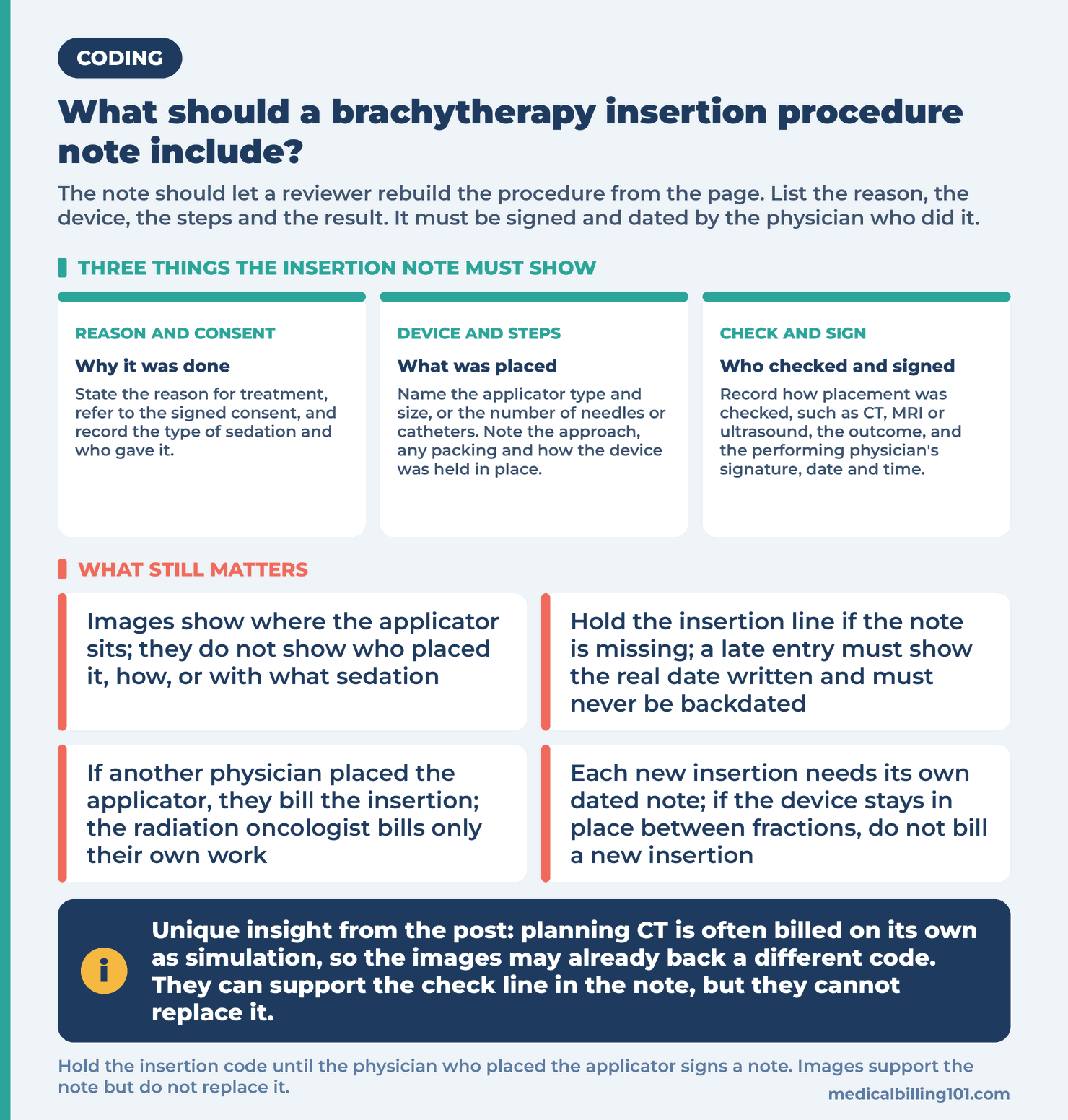
The note should let a reviewer rebuild the procedure from the page. List the reason, the device, the steps and the result. It must be signed and dated by the physician who did it.
- Reason: the cancer and why the patient needs this treatment.
- Consent: a reference to the signed consent form.
- Sedation: the type and who gave it.
- Device: applicator type and size, or the number of needles or catheters.
- Steps: the approach, any packing and how the device was held in place.
- Check: how the placement was checked, such as CT, MRI or ultrasound.
- Outcome: complications or “none,” and the patient’s condition after.
- Author: the performing physician’s signature, date and time.
Treat this list as best practice, not a federal form. Your payer or staff rules may add more. Our guide on medical necessity documentation covers what reviewers read in the rest of the chart.
In my years on payer and provider billing teams, procedure lines with images but no note were the first lines lost on record review.
Do hospital rules require an operative report for applicator placement?
Yes, when the hospital treats the insertion as surgery. Medicare hospital rules require an operative report right after surgery, signed by the surgeon. They also require a signed consent form in the chart before the procedure, except in emergencies.
Both rules are in 42 CFR 482.51, the surgical services condition of participation. The report must describe the techniques and findings.
The medical records rule at 42 CFR 482.24 adds more. Every entry must be legible, complete, dated, timed and authenticated by the person who gave the service.
Are images enough to support the insertion code?
No. Images show where the applicator sits. They do not show who placed it, how, or with what sedation. They also cannot tell a new device from one placed the day before.
Use images to back up the check line in the note. Planning CT is often billed on its own, as simulation (77280 to 77290). So the images may already back a different code.
What records support the other brachytherapy codes?
Each later step needs its own record. The scan, the plan, the dose and any devices each need a dated entry. Some codes are bundled, so check before you add them.
HDR brachytherapy is high-dose-rate treatment. A machine sends one tiny source through each channel for a set time, then pulls it back.
- Isodose plan (77316 to 77318): the signed plan with sources or dwell positions.
- HDR delivery (77770 to 77772): the treatment record with the number of channels, dose and time. Basic dosimetry (77300) is included, per NCCI.
- LDR source application (77761 to 77763, 77778): the number of sources applied.
- Source handling (77790): not billable with 77770 to 77772 or 77778.
- Treatment management (77427, 77431) and physics consult (77336): generally bundled into brachytherapy, with narrow exceptions.
NCCI also warns about split work. A radiation oncologist should not bill 77778 for intraoperative work when another surgeon places the catheters, unless they also apply the source at that encounter. Run your code pairs through our NCCI edit checker before you release the claim.
What if the insertion note is missing after the procedure?
Hold the insertion line and ask the physician who did the procedure. If they performed it, they can add a late entry. It must show the real date it was written and who wrote it.
The Medicare Program Integrity Manual, Chapter 3 covers this in Section 3.3.2.5. Amendments and delayed entries need an identifiable date and author. Never backdate a note.
If a different physician placed the applicator, they bill the insertion. Your radiation oncologist bills only the work they did.
Example scenario (fictional names), part 2
How the brachytherapy case was resolved
Renee held the claim and sent Dr. Varga a short query. She asked who placed the applicator and whether a note existed.
Dr. Varga had placed it herself in the procedure suite. Her dictation never reached the chart. She wrote a late-entry procedure note, dated the day she wrote it, with the device size, sedation and CT check.
Renee then released 57155 with the other codes. The clinic added a hard stop: no insertion code drops until a signed insertion note is linked to the session.
Names and details are illustrative; no real patient data.
Does every brachytherapy session need its own insertion note?
Yes, when the applicator is placed again for that session. HDR is often given as a series. Each new insertion is a new procedure, so it needs its own dated note.
If the device stays in place between fractions, do not bill a new insertion. The delivery record for each fraction still needs its own entry. For a similar documentation question, see our post on urodynamic documentation requirements.
3-step checklist
- Confirm a signed, dated insertion note from the physician who placed the applicator.
- Match each brachytherapy code to its own record, and drop the bundled ones.
- Hold the insertion line if the note is missing, and query the right physician.
FAQ
Is applicator insertion billed separately from brachytherapy delivery?
Yes. Insertion uses a surgery code such as 57155 or 55920. Source delivery uses the 77000 brachytherapy codes, such as 77770 to 77772.
Can CT images replace a brachytherapy procedure note?
No. Images show placement but not who placed the device or how. Use them to back up the check step in the note.
Who bills 57155 if a gynecologist places the applicator?
The physician who performed the insertion bills it. The radiation oncologist bills only the planning and delivery work they did.
Can we bill 77300 with HDR brachytherapy?
No. NCCI says basic dosimetry is integral to codes such as 77770 to 77772 and 77778, so 77300 is not reported with them.
Can a physician add a missing insertion note later?
Yes, if they did the procedure. The late entry must show the actual date written and the author. It must never be backdated.
Sources
My methodology was simple. I checked the CMS coding manual, the 2026 fee schedule file, two federal hospital rules and the Medicare review manual.
- CMS, Medicare NCCI Policy Manual 2026, Chapter 9, Section F (radiation oncology), items 4, 6, 10 and 13 (linked above). Accessed 23 Nov 2026.
- CMS, Physician Fee Schedule Relative Value File RVU26D, global days for the insertion codes (linked above). Accessed 23 Nov 2026.
- eCFR, 42 CFR 482.51(b)(2) and (b)(6), consent and operative report (linked above). Accessed 23 Nov 2026.
- eCFR, 42 CFR 482.24(c)(1), authenticated medical record entries (linked above). Accessed 23 Nov 2026.
- CMS, Medicare Program Integrity Manual, Chapter 3, Section 3.3.2.5, amendments and delayed entries (linked above). Accessed 23 Nov 2026.
Read about the author, or contact us with a question. See our editorial policy.
Last updated: 23 November 2026 · Educational content for U.S. coding and billing teams. Code descriptions are plain-language summaries; check the current CPT code set for full wording.