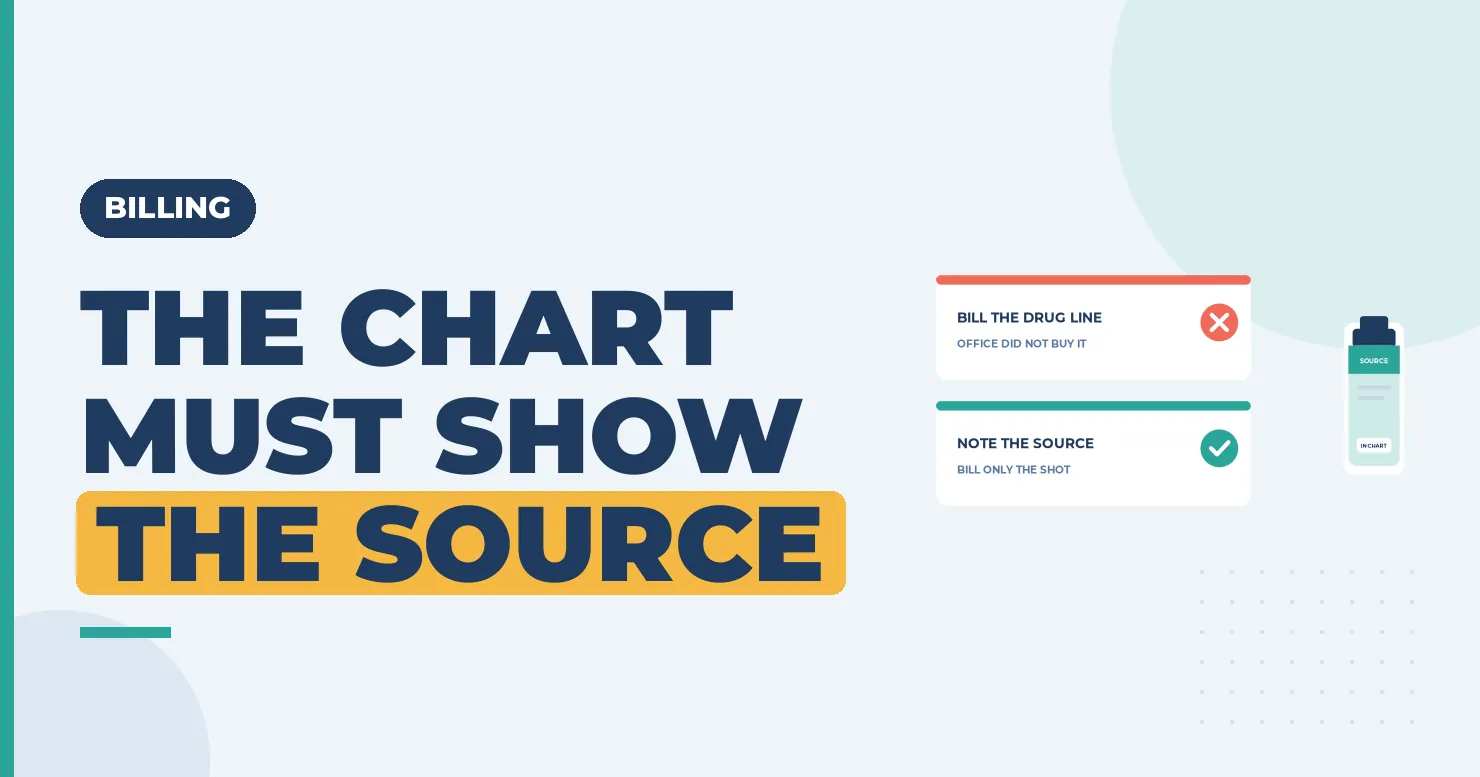
Brown bagging documentation matters because the record must show who supplied the drug. No single federal rule names it, but Medicare will not pay for a drug the office did not buy.
The fix: note the drug’s source in the chart, bill only the injection, and check DEA rules first when the drug is a controlled substance like testosterone.
TL;DR: Write down who dispensed the drug, who paid and when it arrived. Then bill the administration code, not the drug code. Testosterone is a Schedule III drug, so a pharmacy delivery to the office needs a DEA pathway. That pathway is narrow.
Written by Manikandan J, CPC, CRCR, a certified coder and revenue cycle specialist. Published 23 November 2026. Last updated: 23 November 2026.
Table of Contents
Does a provider have to document a brown-bagged drug in the record?
Yes, in practice. No federal rule spells out a “brown bag note.” But Medicare payment rules and DEA rules both depend on the drug’s source. The chart is the only proof of that source.
Brown bagging means the patient brings a drug from a pharmacy to the office. White bagging means a pharmacy ships a drug for one named patient straight to the office. The office in this question has the second setup.
Either way, the office did not buy the drug. That one fact changes how you bill it. It also changes which drug laws apply.
Example scenario (fictional names), part 1
Brown bagging example: what happened
Marisol Ortega runs billing for Juniper Flats Men’s Health, a fictional clinic in Arizona. Nurse Kevin Albrecht gives testosterone cypionate shots twice a month.
A nearby hospital pharmacy fills each patient’s prescription. The patient pays the pharmacy. A courier then drops the vial at the clinic’s front desk.
The clinic billed 96372 and J1071 for every shot. The chart said only “testosterone 200 mg IM, left glute.” Nothing showed where the vial came from.
Then a payer asked for invoices for the J1071 lines. Keep reading, or jump to how the case was resolved.
Can you bill Medicare for a drug the patient already paid for?
No. Medicare covers a drug given incident to a physician’s service only when the drug is an expense to the physician. If the patient bought it, Medicare does not pay for the drug.
The Medicare Benefit Policy Manual, Chapter 15 says this in Section 50.3. It also gives the exact example in Section 60.1. Where a patient buys a drug and the physician gives it, the drug cost is not covered.
The injection is a different story. Section 60.1 says giving the drug is still an expense to the physician. So the administration is payable if the drug would have been covered when bought by the office.
That is why the chart needs the source. Without it, an auditor cannot tell a paid drug line from a free one.
What should the note say about a patient-supplied drug?
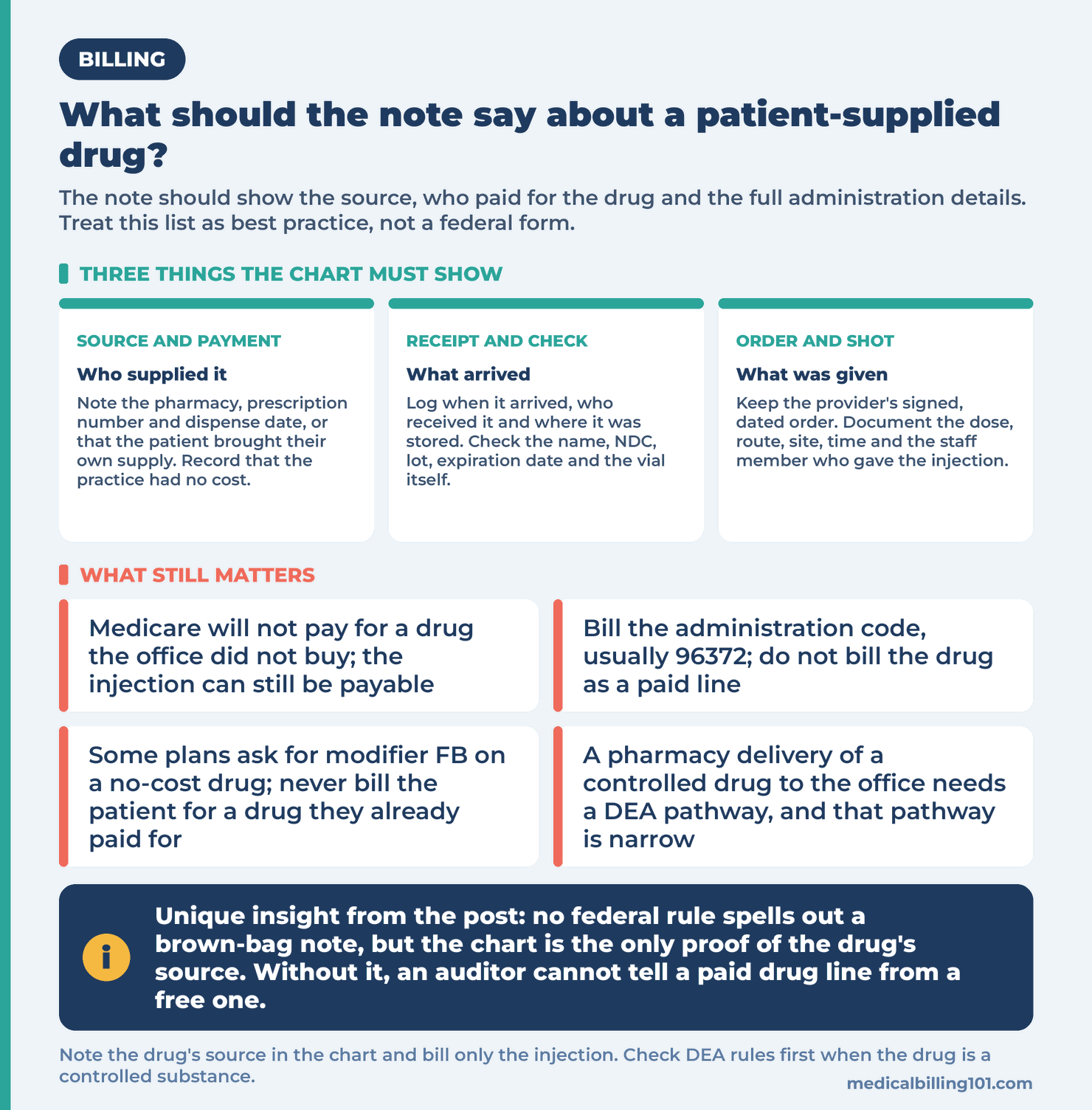
The note should show the source, the payer of the drug and the full administration details. Keep it short and the same every time. A smart phrase in the EHR works well.
- Source: pharmacy name, prescription number and dispense date, or “patient brought own supply.”
- Payment: “Drug paid by patient to the pharmacy; no cost to the practice.”
- Receipt: date and time it arrived, who received it and where it was stored.
- Drug check: name, NDC, lot, expiration date and a visual check of the vial.
- Administration: dose, route, site, time and the staff member who gave it.
- Order: the provider’s order for the injection, signed and dated.
Treat this list as best practice, not a federal form. Your state board of pharmacy or nursing may require more. Our guide on medical necessity documentation explains what reviewers look for in the rest of the note.
When I worked AR follow-up, drug lines billed for vials the office never bought were a repeat cause of refund requests.
Can a pharmacy deliver a patient’s testosterone to the office?
Only in narrow cases. Testosterone is a Schedule III controlled substance. Under federal law, a pharmacy must dispense a controlled substance to the ultimate user, meaning the patient or a household member.
The DEA Schedule III list at 21 CFR 1308.13 names testosterone under anabolic steroids. So the delivery itself is a legal question, not only a billing one.
Congress made two exceptions in 21 U.S.C. 829a. One covers injected or implanted drugs for maintenance or detox treatment. The other covers drugs whose REMS requires monitoring by a provider after the dose. Routine testosterone shots usually fit neither.
In October 2026, the DEA added a third option. Its power of attorney guidance (EO-DEA315) lets a patient name the practitioner as agent to accept delivery. It applies only to drugs that must or should be given in a health care setting.
What records does the DEA power of attorney option expect?
The DEA expects a named-patient dose, separate storage and a kept copy of the power of attorney. The guidance is non-binding, but it lists clear best practices for the office.
- The prescription is for one dose to be given to a named patient. It is not office stock or a take-home supply.
- The office keeps the patient’s drug apart from its own DEA-registered stock.
- The drug goes only to the patient named on the prescription.
- The office keeps the power of attorney for at least two years after the last delivery or dose.
- Unused or wasted drug cannot go back to a registrant. The patient disposes of it through a take-back option.
The DEA also notes two other routes. The office can buy testosterone as its own stock, if registered and allowed by state law. Or the pharmacy can deliver while the patient is in the office.
How do you bill the injection when the drug was supplied?
Bill the administration code, usually 96372 for an IM or subcutaneous shot. Do not bill the drug as a paid line. Then follow each payer’s rule for showing the drug at no cost.
| Payer | Drug line (for example J1071) | Injection (96372) |
|---|---|---|
| Medicare Part B | Not payable when the patient bought the drug | Payable if the drug would be covered when bought by the office |
| Anthem Blue Cross commercial (policy C-22003) | Report with modifier FB; not reimbursed | Bill per contract |
| Other commercial or Medicaid plans | Check the plan’s free-drug or specialty pharmacy policy | Bill per contract |
Modifier FB means “item provided without cost to provider, supplier or practitioner.” The Anthem modifier FB policy asks for it on drugs obtained at no cost. Never bill the patient for a drug they already paid for.
The same no-cost logic shows up with state vaccine stock. Our post on Florida Medicaid VFC vaccine denials walks through billing the shot, not the free vaccine.
How do you fix past claims that billed a supplied drug?
Find every drug line billed for a supplied vial, correct or void it, and refund any drug payment. Then fix the template so the source is captured at intake.
- Pull every claim with the drug’s J code and match it to purchase invoices.
- Flag lines with no invoice. Confirm the source in the chart or with the pharmacy.
- Send corrected claims that drop the drug line or add the payer’s no-cost modifier.
- Refund any drug payment, following your overpayment process.
- Add a required “drug source” field to the injection template.
- Ask compliance to confirm the DEA and state pathway for each controlled drug.
For the corrected-claim steps by payer, see our corrected claim resubmission guide.
Example scenario (fictional names), part 2
How the brown bagging case was resolved
Marisol had no invoices, because the clinic never bought the vials. She pulled six months of J1071 lines and matched them to pharmacy delivery slips.
She sent corrected claims. Medicare lines kept 96372 only. The commercial lines followed each plan’s policy, with modifier FB where the plan asked for it. The clinic refunded the drug payments.
Compliance then reviewed the courier setup. The clinic chose to buy testosterone as its own stock under its DEA registration. Kevin’s template now has a required “drug source” field.
Names and details are illustrative; no real patient data.
Do the same rules apply to non-controlled drugs?
The billing rule is the same, but the DEA part drops away. A supplied biologic or antibiotic still is not a paid drug line for Medicare. The note still needs the source.
State pharmacy law and payer specialty-drug programs may still limit white bagging. Some plans require it, and some states restrict it. For a related home-supplied drug case, read our post on hemophilia factor home use billing.
3-step checklist
- Document the drug source, who paid and the full administration details every time.
- Bill 96372 and leave out the paid drug line, or use the payer’s no-cost modifier.
- Confirm a DEA pathway before a pharmacy delivers any controlled drug to the office.
FAQ
What is brown bagging in medical billing?
Brown bagging is when a patient brings a drug from a pharmacy to the office for staff to give. The office did not buy it, so it does not bill the drug as a paid line.
Is there a federal rule requiring brown bagging documentation?
No single rule names it. But Medicare pays for a drug only when it is an expense to the physician, so the record must show the source.
Can we bill 96372 for a patient-supplied drug?
Yes, for Medicare, if the drug would have been covered had the office bought it. Commercial plans follow their own contract rules.
What modifier shows a drug was free to the provider?
Modifier FB means the item was provided without cost to the provider. Some plans, such as Anthem Blue Cross commercial, ask for it on no-cost drugs.
Can a pharmacy deliver testosterone to a doctor’s office?
Only in narrow cases. Testosterone is Schedule III. Check 21 U.S.C. 829a, the October 2026 DEA power of attorney guidance and state law first.
Sources
My methodology was simple. I checked the CMS benefit manual, the DEA schedule and guidance, the federal statute text and one payer modifier policy.
- CMS, Medicare Benefit Policy Manual, Chapter 15, Sections 50.3 and 60.1 (linked above). Accessed 23 Nov 2026.
- eCFR, 21 CFR 1308.13(f), Schedule III anabolic steroids (linked above). Accessed 23 Nov 2026.
- DEA Diversion Control Division, Guidance EO-DEA315, October 14, 2026, delivery under power of attorney (linked above). Accessed 23 Nov 2026.
- 21 U.S.C. 829a, delivery of a controlled substance by a pharmacy to an administering practitioner, as amended December 1, 2025. Accessed 23 Nov 2026.
- Anthem Blue Cross, Commercial Reimbursement Policy C-22003, Modifier FB, reviewed 09/28/2026 (linked above). Accessed 23 Nov 2026.
Read about the author, or contact us with a question. See our editorial policy.
Last updated: 23 November 2026 · Educational content for U.S. coding and billing teams. This is not legal advice; confirm DEA and state pharmacy rules with your compliance team.