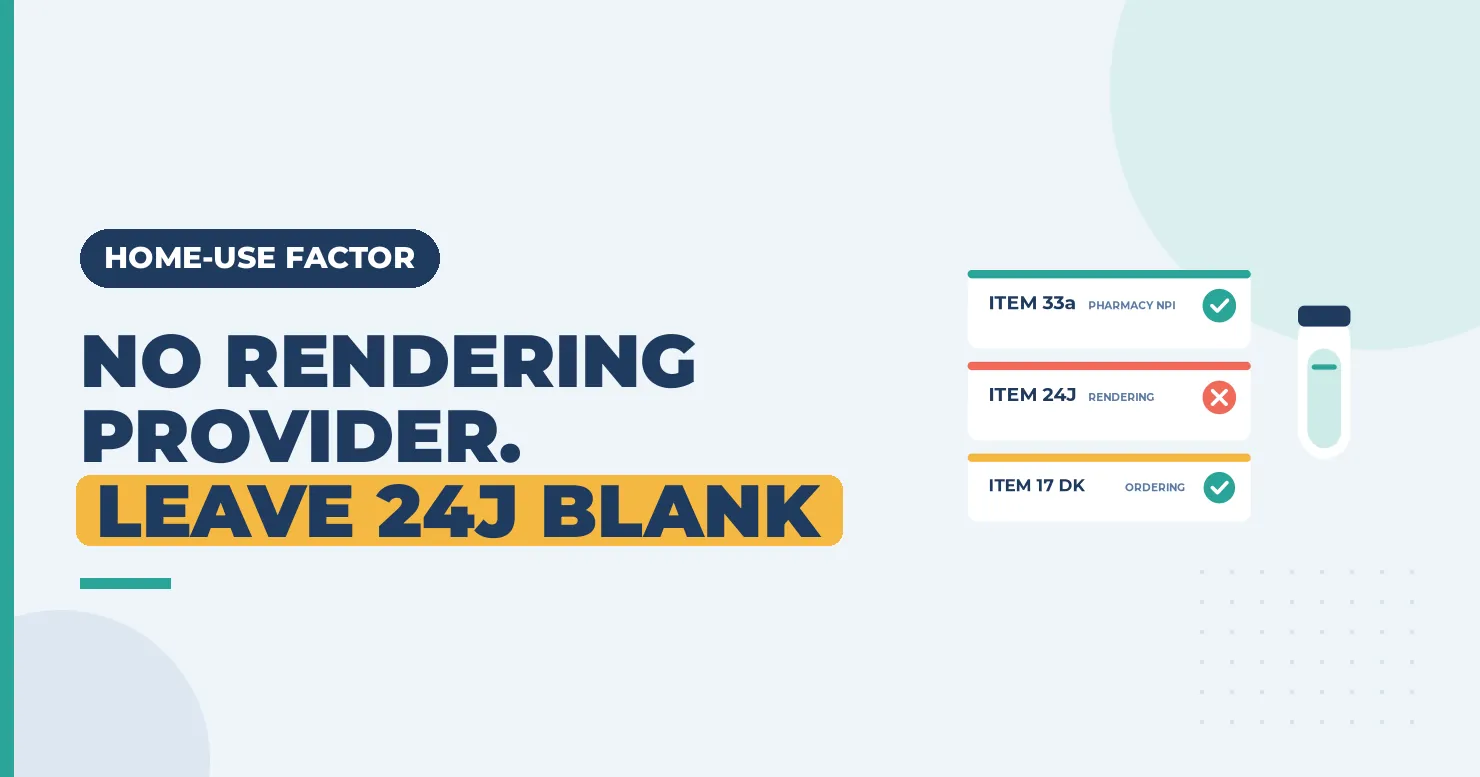
For hemophilia clotting factor home use billing, the pharmacy that dispenses the factor bills Medicare as a supplier. That claim needs no rendering provider when the pharmacy is also the billing provider. Put the prescriber in item 17 as the ordering provider, and use the delivery date as the date of service.
So the advice the center received is mostly right. A supplier claim names who billed and who ordered. It does not name a clinician who “rendered” the infusion, because the patient infuses at home.
TL;DR: Bill home-use clotting factor to the A/B MAC (B) under the pharmacy’s own NPI in item 33a. Leave item 24J blank when the billing and rendering NPI are the same. Report the ordering physician in item 17 with qualifier DK. Bill units per the HCPCS descriptor, and date each line by delivery.
Written by Manikandan J, CPC, CRCR, a certified coder and revenue cycle specialist. Published 14 November 2026. Last updated: 14 November 2026.
Table of Contents
Does a home-use clotting factor claim need a rendering provider?
No, a home-use clotting factor claim usually needs no separate rendering provider. The 837P rendering provider loop is required only when the rendering NPI differs from the billing NPI. When your in-house pharmacy bills under its own NPI, the billing provider and the supplier are the same entity.
A rendering provider is the person or entity that performed the service. An ordering provider is the practitioner who prescribed the item. On a home supply claim, the pharmacy furnishes the factor and the prescriber orders it.
On paper, that means item 33a holds the pharmacy’s NPI. Item 24J stays blank. The physician or nurse practitioner who wrote the prescription goes in item 17, with qualifier DK for ordering provider and the NPI in item 17b.
The CMS-1500 rules sit in the Medicare Claims Processing Manual, Chapter 26. Payer guides that restate the X12 rule, such as Anthem’s professional claim tips, say not to send loop 2310B unless it is required.
| CMS-1500 field | Home-use clotting factor claim |
|---|---|
| Item 17 / 17b | Prescribing physician or NPP, qualifier DK, with NPI. |
| Item 24A | Date the factor was delivered (no date range). |
| Item 24D | Factor HCPCS code, such as J7192 or J7193. |
| Item 24G | Units per the HCPCS long descriptor (IU, mg or mcg). |
| Item 24J | Blank when the pharmacy is the billing provider. |
| Item 33 / 33a | Pharmacy name, address and NPI. |
If your system forces a rendering NPI, check the edit before you add a clinician. A wrong rendering NPI can trigger enrollment or CO-16 missing information denials. Verify each NPI with our NPI lookup tool.
Does Medicare Part B cover clotting factor for home self-infusion?
Yes, Medicare Part B covers clotting factor for home self-infusion. The patient must have hemophilia and be able to use the factor without medical supervision. Covered conditions are factor VIII deficiency, factor IX deficiency and von Willebrand disease. Related administration items are covered too.
This rule is in the Medicare Benefit Policy Manual, Chapter 15, section 50.5.5. Note the reference: it is Chapter 15, section 50.5.5, not “chapter 50.5.5.” Cite it that way in appeals.
Quantity is limited too. The MAC builds a usage profile for each patient from past use. Your treatment center should keep that history. Big changes, such as surgery or a bleed after an accident, need notes that explain the higher amount.
Which Medicare contractor processes clotting factor claims?
The A/B MAC (B) processes clotting factor claims from Part B suppliers, such as a pharmacy. DME MACs do not process blood clotting factor claims. A hospital-based hemophilia center billing as a Part A provider sends an institutional claim to the hospital’s A/B MAC (A).
Both rules are in the Medicare Claims Processing Manual, Chapter 17, sections 10 and 80.4. So first confirm how your pharmacy is enrolled. A pharmacy enrolled as a Part B supplier files a professional claim. A provider-based hospital department files a UB-04.
How do you bill units and dates for a monthly factor supply?
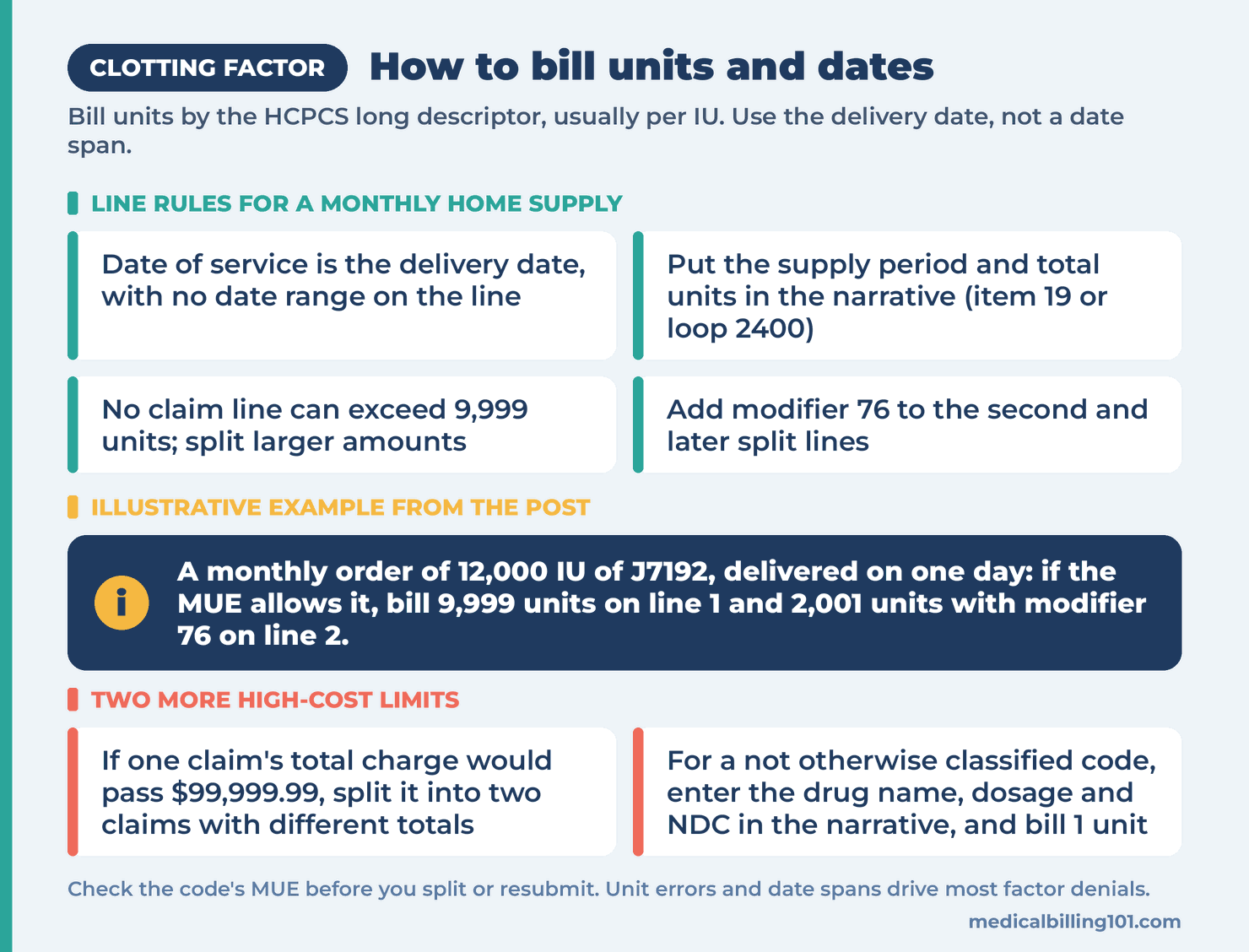
Bill clotting factor units by the HCPCS long descriptor, usually per IU. Use the delivery date as the date of service, not a date span. No claim line can exceed 9,999 units, so split larger amounts. Add modifier 76 to the second and later lines.
Noridian’s hemophilia clotting factor billing page gives these rules. It also says to put the date span and total units in the narrative. On paper, that is item 19. Electronic claims use the loop 2400 note segment.
Here is an illustrative example. A patient’s monthly order is 12,000 IU of J7192, delivered on one day. Check the code’s MUE in our MUE lookup tool first. If the MUE allows it, bill 9,999 units on line 1 and 2,001 units with modifier 76 on line 2.
Two more claim limits matter for high-cost factor:
- If one claim’s total charge would pass $99,999.99, split it into two claims with different totals.
- For a not otherwise classified code, enter the drug name, dosage and NDC in the narrative, and bill 1 unit.
Unit errors drive most factor denials. Our J1010 units denial answer shows the same per-unit math for another drug code.
When I review pharmacy-billed drug claims, the rejections I see most often come from units and date spans. The rendering field is rarely the real problem.
How is the clotting factor furnishing fee paid?
The clotting factor furnishing fee is a per-unit add-on Medicare pays to entities that furnish factor. Medicare pays clotting factor at ASP plus 6 percent, plus a furnishing fee per unit. For calendar year 2026, the furnishing fee is $0.265 per unit. CMS builds that fee into the published payment limit for each factor code. You do not bill it on a separate line.
So 12,000 IU carries about $3,180 of furnishing fee inside the allowed amount. The fee table is in Chapter 17, section 80.4.1. If a code is not on the ASP or NOC pricing file, the MAC pays the factor and the fee separately.
Does a 340B hemophilia treatment center need the TB modifier?
Yes, if the factor was bought through the 340B program, add modifier TB to the Part B claim line. Since January 1, 2025, CMS requires TB from all 340B covered entities, including non-hospital entities. Modifier JG is no longer used on Medicare claims.
Many hemophilia treatment centers are 340B entities, so check this before you rebill. The rule is in CMS’s MLN guidance on the 340B modifier. If a claim was denied after you fix these fields, our appeal letter generator drafts the reconsideration.
3-step checklist
- Bill under the pharmacy’s NPI in item 33a, leave item 24J blank, and put the prescriber in item 17 with DK.
- Date each line by delivery, bill units per the HCPCS descriptor, and split lines over 9,999 with modifier 76.
- Add modifier TB for 340B factor, and keep the prescription and usage history ready for review.
FAQ
Who is the rendering provider on a home-use clotting factor claim?
Usually no separate rendering provider is reported. When the pharmacy bills under its own NPI, the billing and rendering provider are the same, so item 24J and loop 2310B stay empty. The prescriber goes in item 17 as the ordering provider with qualifier DK.
What date of service is used for clotting factor delivered to the home?
Use the date the factor was delivered to the patient. Do not report a date range on the claim line. Put the supply period and total units in the claim narrative instead, such as item 19 on a paper claim.
Can a DME MAC process clotting factor claims?
No. Per the Medicare Claims Processing Manual, Chapter 17, DME MACs do not process blood clotting factor claims. Part B supplier claims go to the A/B MAC (B), and institutional claims go to the A/B MAC (A).
What is the 2026 clotting factor furnishing fee?
The calendar year 2026 clotting factor furnishing fee is $0.265 per unit, per Chapter 17, section 80.4.1. CMS includes it in the published payment limit for clotting factor codes, so it is not billed separately.
Which hemophilia conditions does Medicare cover for home clotting factor?
Medicare Part B covers factor VIII deficiency, factor IX deficiency and von Willebrand disease. The patient must be competent to use the factor without medical supervision, per the Benefit Policy Manual, Chapter 15, section 50.5.5.
Sources
My methodology was simple. I read the CMS manual sections on clotting factor coverage, claim routing and claim fields, a MAC billing page, and the CMS 340B modifier guidance. MAC edits differ, so confirm details with your own MAC.
- CMS, Medicare Benefit Policy Manual, Chapter 15, section 50.5.5 (Hemophilia Clotting Factors). Accessed 14 Nov 2026.
- CMS, Medicare Claims Processing Manual, Chapter 17, sections 10, 80.4 and 80.4.1. Accessed 14 Nov 2026.
- CMS, Medicare Claims Processing Manual, Chapter 26 (CMS-1500 items 17, 24J and 33a). Accessed 14 Nov 2026.
- Noridian JF Part B, Hemophilia Clotting Factor Billing. Accessed 14 Nov 2026.
- CMS MLN4800856, Part B Inflation Rebate Guidance: Use of the 340B Modifier. Accessed 14 Nov 2026.
- Anthem, Quick tips to filing a complete and correct professional claim (loop 2310 rule). Accessed 14 Nov 2026.
Read about the author, or contact us with a question. See our editorial policy.
Last updated: 14 November 2026 · Educational content for U.S. billers. Check your MAC’s current rules.