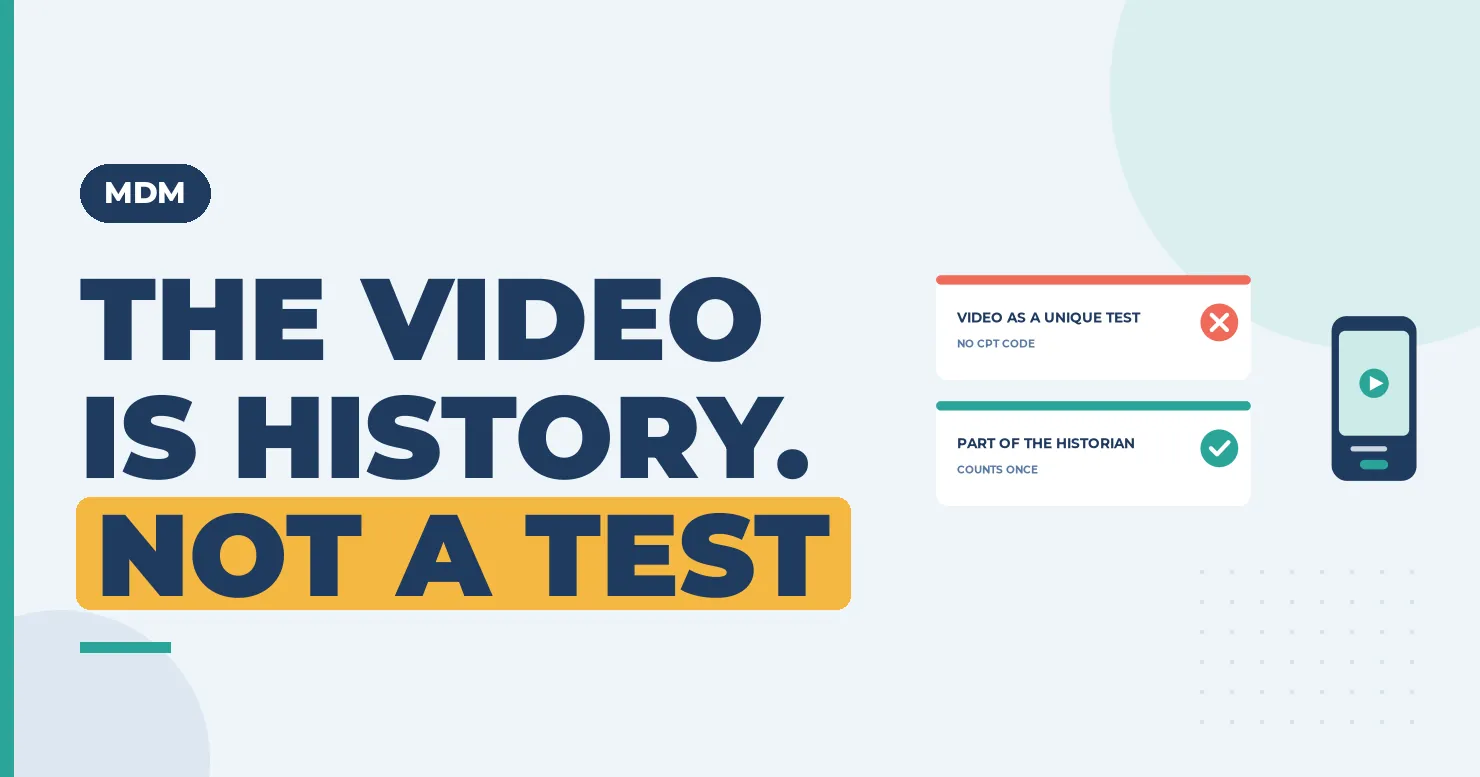
Reviewing a parent’s seizure video in MDM does not count as its own data element. It is not a unique test, and it is not an external record. It belongs with the parent’s history.
The fix: credit the independent historian once, document what the provider saw and how it changed the plan, and use total time if the review took real minutes.
TL;DR: Under the AMA E/M rules, a unique test is defined by the CPT code set. A home phone video has no CPT code, so it is not a test reviewed or independently interpreted. The parent who shot it is the historian. The video adds detail to that story. It does not add a second data point.
Written by Manikandan J, CPC, CRCR, a certified coder and revenue cycle specialist. Published 22 November 2026. Last updated: 22 November 2026.
Table of Contents
Can a provider count a parent’s seizure video as data in MDM?
No, not as a separate data element. A parent’s video is history from the parent. It fits the historian item, which counts once. It is not a test, a test read or an outside note.
MDM means medical decision making. It has three parts: problems addressed, data reviewed and analyzed, and risk of patient management. A visit level needs two of the three.
The data part is the one coders argue about most. The AMA CPT E/M guidelines list only a few things that count. Those include outside notes, tests, a historian, test reads and talks about the plan with other professionals.
A home video does not fit any slot except the historian. That is where it lives.
Example scenario (fictional names), part 1
Seizure video MDM example: what happened
Priya Nandakumar audits E/M visits for Cedar Hollow Pediatric Neurology, a fictional clinic. Dr. Lucas Whitfield saw a 6-year-old with new staring spells. He billed 99214.
The mother described three episodes at school. She also showed a 40-second phone video. Dr. Whitfield wrote what he saw: brief staring, eyelid fluttering and no response to his name.
He ordered a routine EEG. His data section listed “independent historian, video review, EEG ordered.” That made three data items, so moderate data looked met.
Did the video really add a third data point? Keep reading, or jump to how the case was resolved.
Is a home video a unique test for E/M coding?
No. A home video is not a unique test for E/M coding. A unique test is a test defined by the CPT code set, per the AMA. No CPT code describes watching a video a family recorded at home.
The AMA says tests are imaging, lab, mental testing or body function data. A phone video is none of those. It is what a family member saw, caught on camera.
Video EEG is a different thing. It has its own CPT codes. It is a set study with set gear and a formal report. A phone clip may show the same spells, but it is not that study.
So “review of the result of each unique test” does not apply. Neither does “ordering of each unique test.”
Does watching the video count as independent interpretation?
No. Independent interpretation applies only to a test that has a CPT code and a customary report. A home video has neither, so it cannot meet Category 2 of the data element.
The AMA wording is direct. Independent interpretation is “the interpretation of a test for which there is a CPT code, and an interpretation or report is customary.” That rules out a parent’s video, even when the provider describes it in detail.
Compare that with a provider who reads an outside EEG tracing himself. That EEG has a CPT code and a customary report, so his own read can count as independent interpretation.
Does a parent’s video count as an independent historian?
Yes, the video is part of the historian item. The parent tells a story the child cannot tell. The video is just how the parent shows what happened.
An independent historian is a person, such as a parent or witness, who gives history when the patient cannot, per the AMA. A child’s age is one listed reason. The history must come directly from that person, but it need not be in person.
The element is “assessment requiring an independent historian(s).” It counts once per visit, even with more than one historian. So the parent’s story and the video add up to one item.
When I worked AR follow-up on pediatric E/M denials, the level drops almost always came from counting one source twice.
How should the video be documented in the note?
Document who recorded the video, when, what the provider saw and how it changed the plan. That shows the provider truly weighed it. It also backs up the problem and risk parts of MDM.
- Source: “Mother provided a phone video of today’s event.”
- Findings: what the provider saw, in clinical terms, with the length of the clip.
- Use: how the video changed the likely cause, the tests or the treatment.
- Time: minutes spent reviewing it, if the visit may be billed on time.
Our E/M coding cheat sheet shows the full MDM table. It helps when you check which data category each item fits.
Which MDM data category does each item fit?
Each data item fits one slot, and the video fits only the historian line. This table maps the items from the visit above to the AMA list.
| Item in the note | AMA data element | Counts? |
|---|---|---|
| Mother’s account of the spells | Assessment requiring an independent historian | Yes, one item |
| Phone video from the mother | Same historian item | No extra credit |
| Routine EEG ordered | Ordering of each unique test | Yes, one item |
| Talk with the mother about next steps | Not discussion of management (family is not an appropriate source) | No |
| Outside neurologist’s notes | Review of prior external notes from each unique source | Yes, one item |
The last two rows trip people up. The AMA says external records come from an external physician, other qualified health care professional, facility or health care organization. It also says a talk about the plan with family does not count as discussion.
Can the time spent reviewing a seizure video count toward the visit?
Yes, if the visit is billed on total time. The AMA time list includes “obtaining and/or reviewing separately obtained history.” Watching a parent’s video on the date of the encounter fits that activity.
Office visits can be leveled by MDM or by total time on the date of the encounter. The CMS E/M Services booklet (MLN006764) confirms that choice for Medicare. When time is used, the full time for the level must be met.
For example, a long video review may favor time over MDM. Pick the method that the note supports best, never both.
How do you fix an E/M level that counted the video twice?
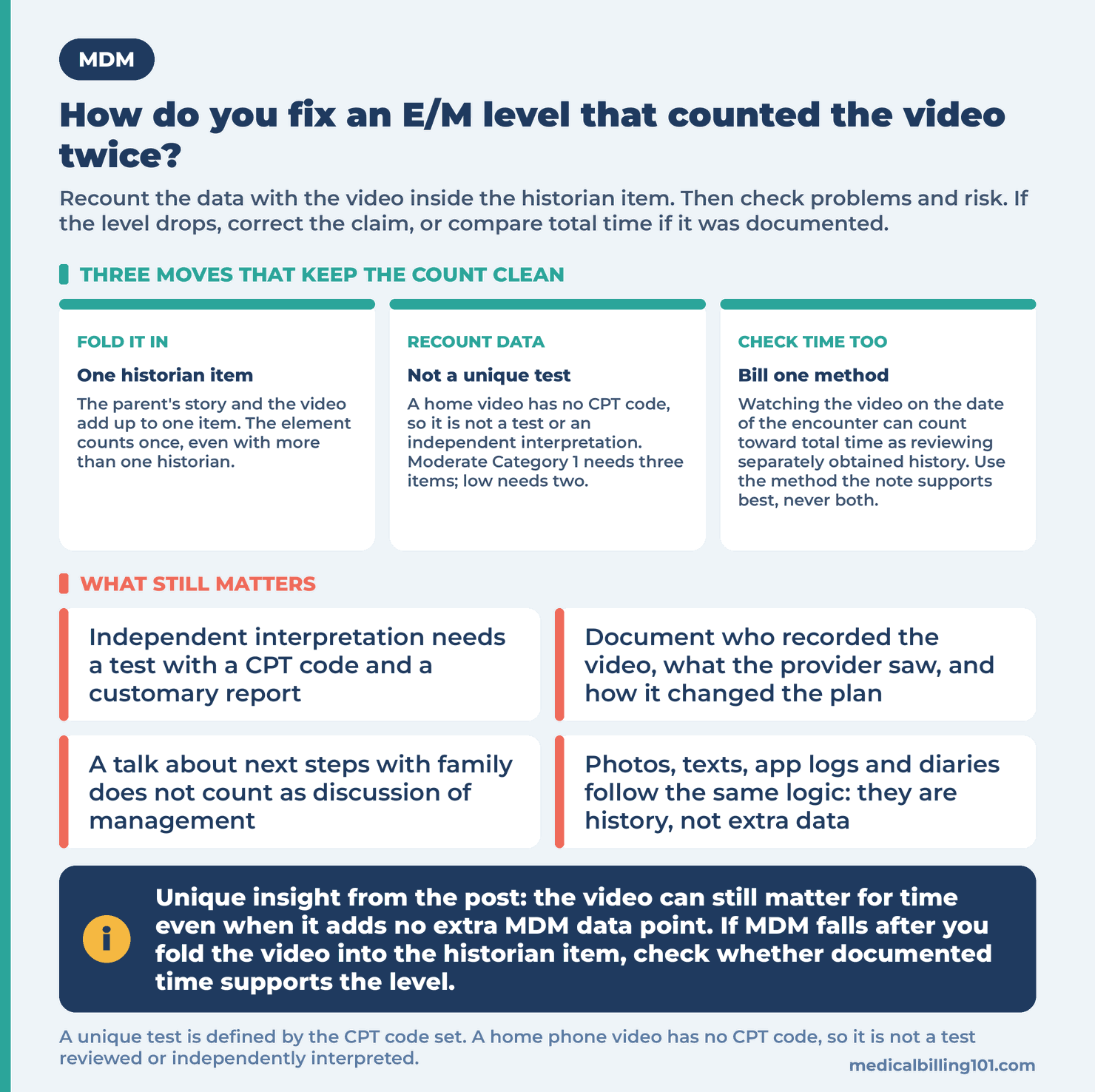
Recount the data with the video inside the historian item. Then check problems and risk. If the level drops, correct the claim before it goes out, or follow your corrected-claim process.
- List every data item the provider credited for the visit.
- Fold the video into the historian item.
- Recount Category 1. Moderate needs three items. Low needs two.
- Check problems and risk. Two of three MDM elements set the level.
- Compare total time if it was documented. Use the stronger supported method.
- Give the provider short feedback with the AMA definition attached.
CMS puts it plainly. The Medicare Claims Processing Manual, Chapter 12 says medical need is the main test for payment. It also says the note should support the level billed.
Example scenario (fictional names), part 2
How the seizure video case was resolved
Priya folded the video into the historian item. That left two data items: the historian and the EEG order. Data dropped to limited.
She then checked the other parts. New staring spells with an uncertain cause met a moderate problem level. Ordering a routine EEG was low risk, so MDM fell to 99213.
Next she checked time. Dr. Whitfield had written down 34 minutes, which took in the video and the talk with the mother. That met the time for 99214, so the level stayed, now billed on time.
The clinic updated its template. Providers now log a video under history. They also log total time when they watch one.
Names and details are illustrative; no real patient data.
Do parent photos, texts or app logs count the same way?
Yes, they follow the same logic. Photos, symptom diaries, seizure apps and text messages from family are history. They feed the historian item. They do not add extra data credit.
The answer changes only when the item is a real test or external record. A home glucose log reviewed with a lab result is one example. The lab result can count, while the log stays history.
Want a quick level check? Try the E/M level calculator. For a harder MDM case, read our breakdown of E/M levels for a cancer patient visit. Teaching settings add their own rules, covered in our teaching physician guidelines post.
3-step checklist
- Count a parent’s seizure video inside the historian item, never as a test.
- Document who recorded it, what the provider saw and how it changed the plan.
- Compare MDM with total time, and bill the level the note supports best.
FAQ
Does reviewing a patient video count as data in MDM?
Not as a separate item. A family video is history. It fits the historian item, which counts once per visit.
Is a home seizure video a unique test?
No. The AMA says a unique test is defined by the CPT code set. No CPT code describes reviewing a home video.
Can a provider bill independent interpretation for a parent’s video?
No. Independent interpretation needs a test with a CPT code and a customary report. A phone video has neither.
Does time spent watching the video count?
Yes, when the visit is billed on total time. Reviewing separately obtained history on the date of the encounter is a countable activity.
Can two historians count as two data items?
No. Assessment requiring an independent historian is one element, even when more than one person gives history.
Sources
My methodology was simple. I checked the AMA CPT E/M guideline definitions, the AMA E/M FAQ, the CMS E/M booklet and the Medicare Claims Processing Manual.
- American Medical Association, CPT E/M Services Guidelines: definitions of Test, Unique, External, Independent historian and Independent interpretation, and the time activity list (linked above; wording unchanged in the 2026 guidelines). Accessed 22 Nov 2026.
- American Medical Association, CPT E/M revisions FAQs, updated January 2026 (unique source guidance). Accessed 22 Nov 2026.
- CMS, Evaluation and Management Services, MLN006764, May 2026 (linked above). Accessed 22 Nov 2026.
- CMS, Medicare Claims Processing Manual, Chapter 12, Section 30.6.1 (linked above). Accessed 22 Nov 2026.
Read about the author, or contact us with a question. See our editorial policy.
Last updated: 22 November 2026 · Educational content for U.S. coding and billing teams. Payer policies and internal audit rules may add stricter counting rules.