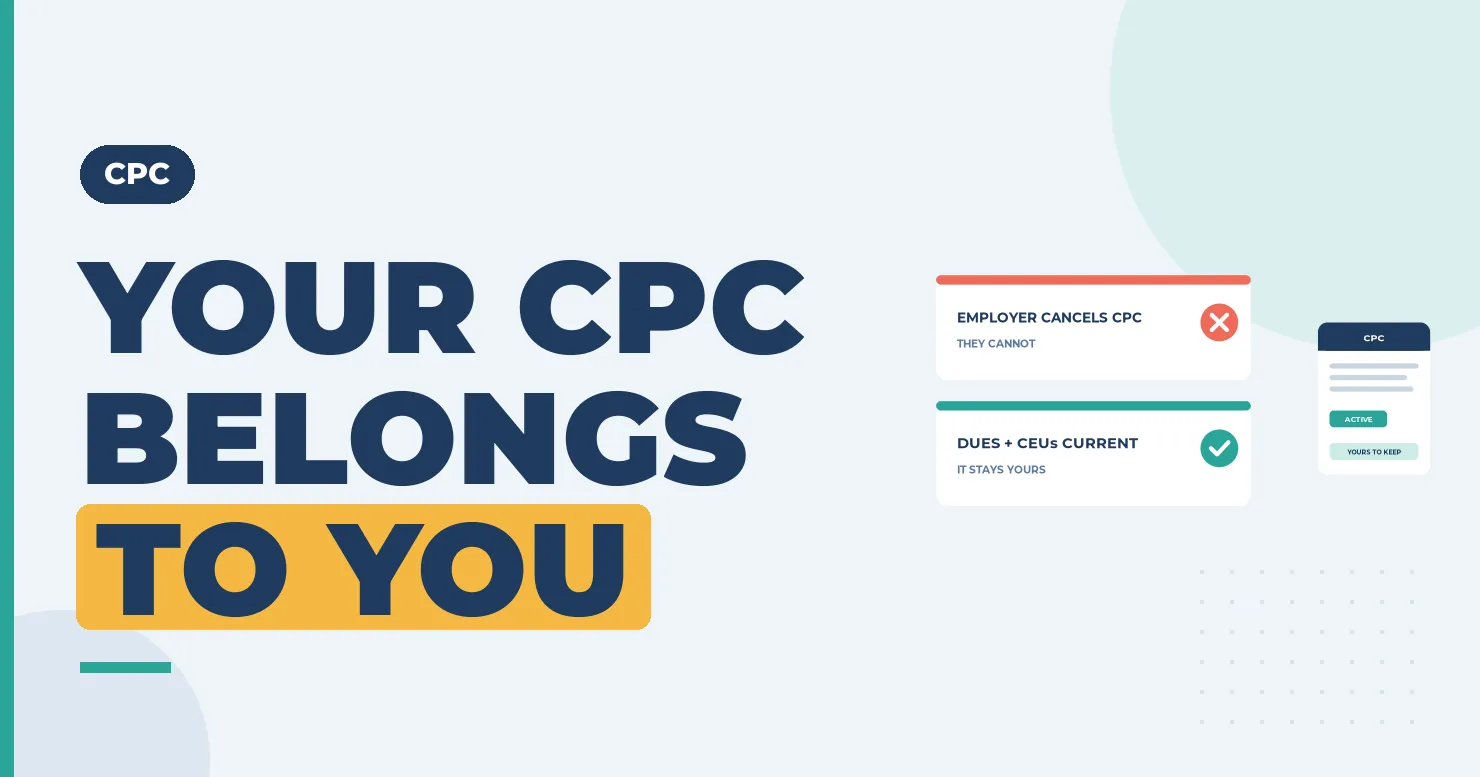
Can employer cancel CPC certification after paying for it? No. Your CPC belongs to you, and only AAPC can cancel it, for unpaid dues, missing CEUs or an ethics finding.
The fix: when you leave, move from the company’s corporate membership to an individual membership. Then keep paying dues and reporting CEUs on time.
TL;DR: A sponsoring employer can stop paying your AAPC dues and remove you from its corporate account. It cannot erase your exam pass or your CPC record. A training bond is a separate money contract between you and the company. Read it, plan for it, and keep your AAPC membership active on your own.
Written by Manikandan J, CPC, CRCR, a certified coder and revenue cycle specialist. Published 21 November 2026. Last updated: 21 November 2026.
Table of Contents
Can a company that sponsored my CPC cancel it if I leave?
No. A company that paid for your CPC exam or training cannot cancel the credential. AAPC says your certifications and earned CEUs stay tied to your own AAPC account. That stays true after you leave a corporate membership program.
AAPC explains this in its help article on leaving a corporate membership program. Keeping your membership active and finishing your CEUs becomes your job after you leave.
A sponsored CPC means the employer paid some or all of your costs. That can cover the course, the exam fee or the yearly dues. Paying the bill does not make the company the owner of the credential.
Example scenario (fictional names), part 1
Cancel CPC certification example: what happened
Leena Varghese passed her CPC exam with help from Brightpath Coding Services, a fictional coding company. Brightpath paid for her course and exam. It also added her to its AAPC corporate membership.
Before training, Leena signed a service bond. It asked her to stay for a set time. Months later, she wanted to leave because of a hard team setting. Her manager, Rohan Mehta, told her that leaving early would cancel her CPC.
Could Brightpath really cancel her credential? Keep reading, or jump to how the case was resolved.
Who can revoke a CPC certification?
Only AAPC can revoke a CPC certification. It happens for three main reasons. You stop paying dues, you miss your CEU deadline, or the AAPC Ethics Committee finds a conduct problem.
AAPC’s support page on when a credential is revoked gives the timeline. If dues or CEUs are not in within 90 days of your renewal date, the credential is revoked.
The membership FAQ adds the notice steps. A final notice goes out 75 days after the due date. You then have 15 days to pay or submit CEUs before cancellation.
What happens to a corporate AAPC membership when you quit?
The employer removes you from its corporate account, and you become an individual member. Your certification and CEU history move with your account. Only the party paying the dues changes.
A corporate membership is an AAPC account that an employer pays for on behalf of its staff. The corporate contact manages that account. AAPC’s membership FAQ says the contact can remove a member online or by form. You can also renew on your own by your renewal date.
AAPC’s guide to moving from corporate to individual membership notes one catch. Your membership dates may shift during the switch. Call AAPC customer service if your renewal date looks wrong.
In billing teams I have worked on, coders changed employers often. Their CPC went with them each time. Only the name on the dues invoice changed.
Can a training bond take away your CPC?
No. A training bond is a contract between you and the employer. It may ask you to repay training costs or give notice if you leave early. It has no power over AAPC’s credential records.
That does not mean you can ignore the bond. If you signed it, the company may still try to collect money under its terms. Whether that clause holds up depends on your country or state law.
- Read the exact clause: the amount, the time period and any notice rule.
- Ask for the repayment figure in writing before you resign.
- Get advice from a local labor lawyer if the amount seems unfair.
- Keep copies of your exam receipt, offer letter and bond.
Here is who controls each piece when you leave a sponsored job:
| Item | Who controls it | What leaving changes |
|---|---|---|
| Your CPC credential | AAPC | Nothing, if dues and CEUs stay current |
| Your CEU record | You, in your AAPC account | Nothing; the tracker stays with you |
| Corporate membership seat | The employer | The employer removes you |
| Yearly dues | Whoever pays them | You pay as an individual member |
| Training bond | Your contract and local law | Repayment may be owed under its terms |
Never let a threat about your credential rush you into paying. Check your status with AAPC first. If a job offer or training deal feels off, our guide to medical coding scams to avoid lists common warning signs.
Can an employer file an ethics complaint to get your CPC pulled?
Anyone can file an ethics complaint, but leaving a job is not an ethics violation. AAPC says complaints should have a basis in law or in AAPC rules. Its examples include a fraud conviction, Medicare exclusion or fake CEUs.
The AAPC Code of Ethics also says the Ethics Committee is not a court. A contract dispute over a bond is a matter for the employer and the courts, not AAPC.
What can hurt your CPC is real misconduct. For example, coding to inflate payment can lead to a complaint. So can sharing exam content or using a credential you do not hold. Our post on OIG audit triggers in medical billing shows the coding habits that create real risk.
How do you keep your CPC active after leaving a sponsored job?
Pay your AAPC dues every year and report 36 CEUs every two years. Those are the two rules for one credential. Do both on time and no employer can affect your CPC.
AAPC’s page on how to maintain your certification lists three duties. Pay dues yearly, follow the Code of Ethics and earn the required CEUs.
The AAPC CEU policy sets the count. One certification needs 36 CEUs every two years. Two need 40, and three need 44.
- CEUs must come from AAPC-approved vendors.
- Extra CEUs do not carry over to the next period.
- Your due year depends on your membership month.
- Corporate additions can prorate your CEUs, so recheck your tracker after you leave.
What if your CPC lapses after you leave?
You can usually reinstate it without retesting if it lapsed within the last three years. You pay missed dues, submit missed CEUs and pay a $200 reinstatement fee.
AAPC’s certification cancellation and reinstatement policy spells this out. Membership cannot have gaps. After three years, you would need to retake the exam.
If you do face a retest, our CPC exam retake guide walks through the steps. A CPC study plan helps you prepare faster the second time.
How do you leave a sponsored coding job without losing your CPC?
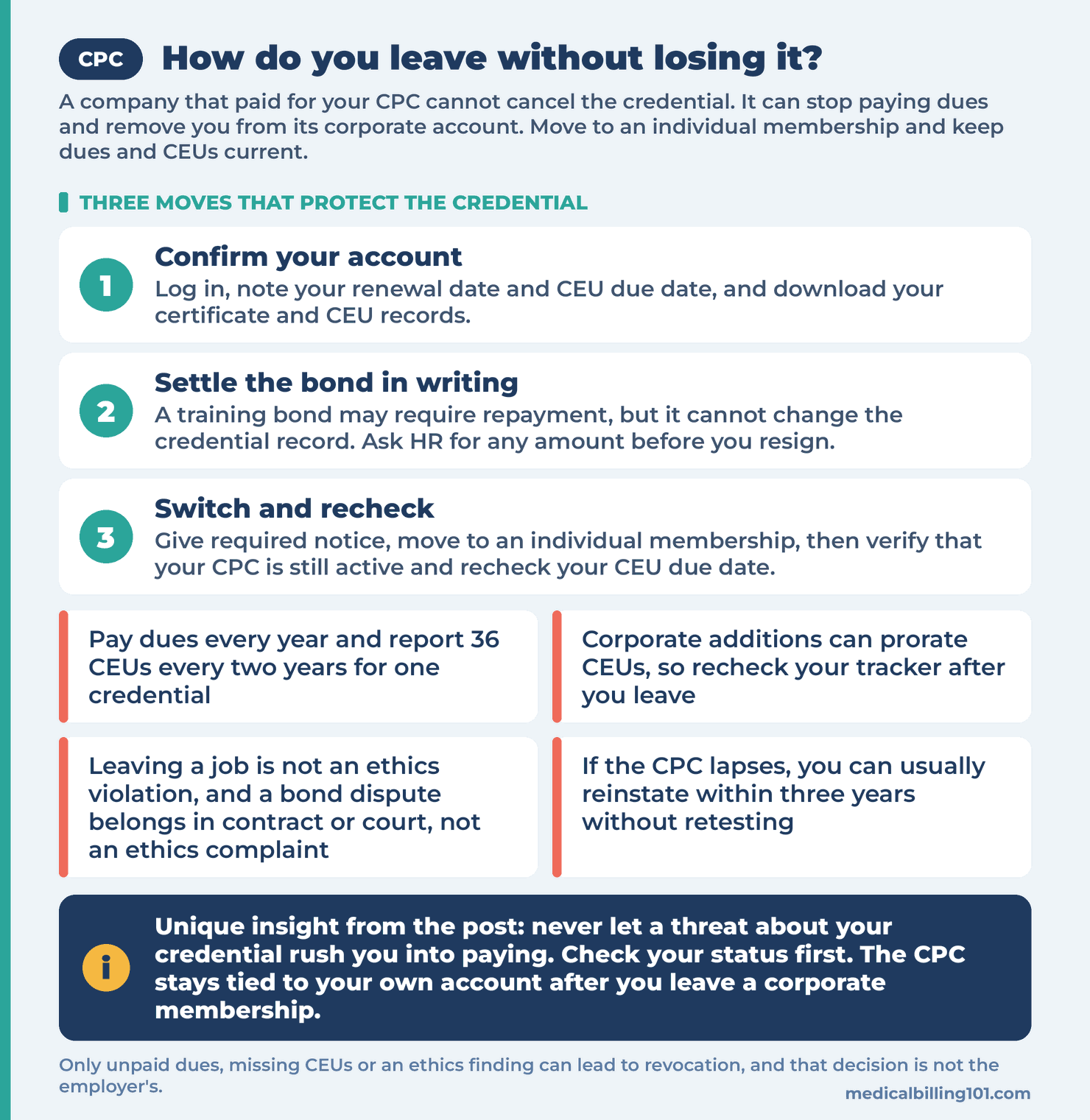
Check your AAPC account, settle the bond terms in writing and set up your own renewal. Those three moves protect the credential and your money.
- Log in to AAPC and note your renewal date and CEU due date.
- Download your certificate and CEU records for your files.
- Read your bond and ask HR for any repayment amount in writing.
- Give notice as your contract and offer letter require.
- Ask the corporate contact to remove you, or renew on your own.
- Look up your name on AAPC’s credential verification page after the switch.
Example scenario (fictional names), part 2
How the cancel CPC certification case was resolved
Leena logged in to her AAPC account first. Her CPC showed as active, with her own CEU tracker. She then read the bond. It covered repayment of training costs, not her credential.
She asked HR for the repayment amount in writing and gave notice. Brightpath removed her from its corporate account. Leena renewed as an individual member and checked her new CEU due date.
Her CPC stayed active the whole time. She settled the bond amount separately and started a new coding job.
Names and details are illustrative; no real patient data.
Will a new employer see that your CPC is still valid?
Yes. Employers can check your status on AAPC’s credential verification tool. As long as your dues and CEUs are current, your CPC shows as active there.
That matters because the U.S. Bureau of Labor Statistics says certification may be required or preferred for medical records specialists, the group that includes coders. Hiring managers look for active credentials such as the CPC.
Your old employer’s opinion does not change that record. If you are job hunting, see our guide to entry-level medical coding jobs. Our medical coder salary guide helps you compare offers.
3-step checklist
- Confirm in your AAPC account that your CPC is active and note your renewal date.
- Get any bond repayment amount in writing before you resign.
- Switch to an individual membership and keep dues and CEUs current.
FAQ
Can my employer cancel my CPC certification?
No. Your CPC belongs to you. Only AAPC can revoke it, for unpaid dues, missing CEUs or an ethics finding.
What happens to my AAPC membership if I leave a company that paid for it?
The company removes you from its corporate account. You then renew as an individual member, and your certification and CEU records stay with you.
Can a training bond take away my CPC?
No. A bond is a money contract with the employer. It may require repayment, but it cannot change AAPC’s credential records.
How long before an unpaid CPC is revoked?
AAPC revokes a credential if dues or CEUs are not in within 90 days of the renewal date.
Can I reinstate a lapsed CPC?
Yes, within three years. Pay missed dues, submit missed CEUs and pay the $200 reinstatement fee.
Sources
My methodology was simple. I checked AAPC’s own policy pages, help articles and Code of Ethics, plus BLS career data.
- AAPC Help Center, Leaving a Corporate Membership Program, August 2026 (linked above). Accessed 21 Nov 2026.
- AAPC Help Center, Transitioning from Corporate to Individual Membership, August 2026 (linked above). Accessed 21 Nov 2026.
- AAPC, When will my credential(s) be revoked? (linked above). Accessed 21 Nov 2026.
- AAPC, Membership FAQs (linked above). Accessed 21 Nov 2026.
- AAPC, Code of Ethics (linked above). Accessed 21 Nov 2026.
- AAPC, How to Maintain Your Certification and CEU Policy (linked above). Accessed 21 Nov 2026.
- AAPC, Certification Cancellation and Reinstatement Policy (linked above). Accessed 21 Nov 2026.
- U.S. Bureau of Labor Statistics, Occupational Outlook Handbook, Medical Records Specialists (linked above). Accessed 21 Nov 2026.
Read about the author, or contact us with a question. See our editorial policy. Compare credentials in which medical coding certification is best.
Last updated: 21 November 2026 · Educational content for U.S. coders. Contract and labor rules vary. Check local law for any bond.