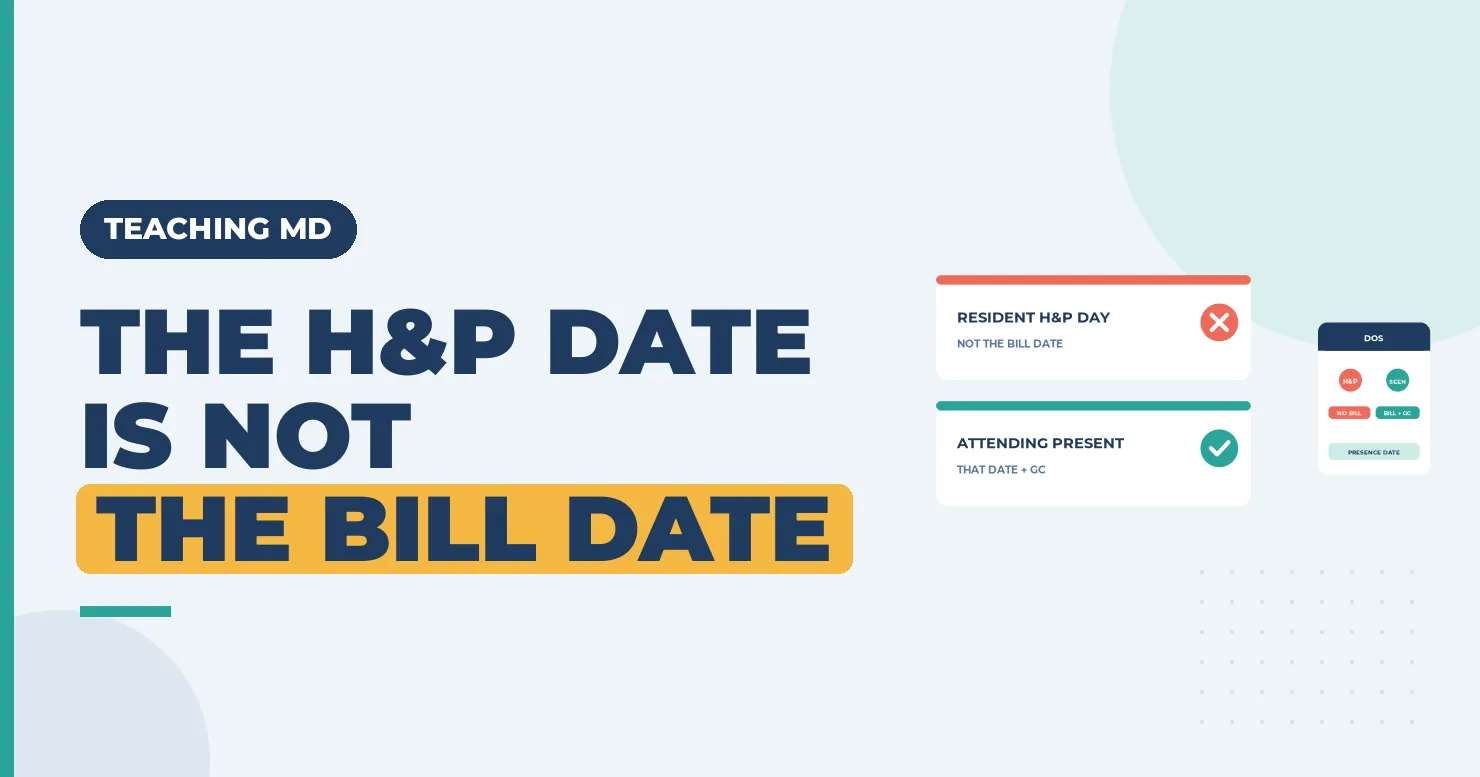
Teaching physician guidelines say the attending bills the date they personally saw the patient. A resident’s H&P from the day before does not set the teaching physician’s date of service.
The fix: bill nothing for the resident-only day. Bill the teaching physician’s visit on the day they were present, with modifier GC.
TL;DR: Medicare pays the teaching physician only for work they did or saw in person. A “reviewed and agree” note on a day they never saw the patient does not count. Bill their first face-to-face visit as the hospital E/M for that date. Medicare does not pay consult codes.
Written by Manikandan J, CPC, CRCR, a certified coder and revenue cycle specialist. Published 21 November 2026. Last updated: 21 November 2026.
Table of Contents
Which date does the teaching physician bill after a resident H&P?
The teaching physician bills the date they saw the patient. If the resident did the H&P on one day and the attending saw the patient the next day, the claim uses the second date. The date they signed the note does not matter.
CMS spelled out this exact case in Transmittal 2303. A resident admits a patient late at night. The teaching physician sees the patient the next day. The teaching physician’s bill must show the date they saw the patient.
A teaching physician is the attending who supervises residents and bills for the care. A resident is a doctor in an approved training program. Medicare pays for resident work through hospital training funds, not the fee schedule.
Example scenario (fictional names), part 1
Teaching physician guidelines example: what happened
Desmond Okafor codes for Riverbend University Hospitalists, a fictional teaching group. A resident admitted a Medicare patient with pneumonia late on a Monday. The resident wrote the full H&P that night.
On Tuesday, Dr. Priya Vandermeer signed an attestation on Monday’s note. It said she reviewed the data and discussed the case. Later that morning she saw the patient with the resident. Her Tuesday note was a template that listed every role from scribe to fellow.
Which day can Dr. Vandermeer bill, and with what code? Keep reading, or jump to how it was resolved.
Does a “reviewed and agree” attestation count as teaching physician presence?
No. A note that says the attending reviewed the chart and agrees does not show they saw the patient. Medicare needs proof the teaching physician was there for the key part of the visit. Without that, nobody can bill the fee schedule for that day.
The rule comes from 42 CFR 415.172. The note must name the service, the teaching physician’s part in it, and whether they were present. A resident’s note that says the attending was there is not enough on its own.
The same CMS transmittal lists notes that fail. They include “Agree with above,” “Rounded, reviewed, agree,” “Discussed with resident. Agree,” and a bare signature. A note that says the attending “discussed the case” fits that list.
Is the teaching physician’s next-day visit a consultation?
Not for Medicare. CMS stopped paying consultation codes 99241-99255 in 2010. Bill the hospital visit code that fits instead. For the attending’s first visit of the stay, that is usually initial hospital care, 99221-99223, with GC.
Section 30.6.10 of the Medicare Claims Processing Manual, Chapter 12 sets the no-consult rule. Section 30.6.9.1 lets each physician who does an initial evaluation bill 99221-99223. The admitting physician of record adds modifier AI. Later visits use 99231-99233.
Check whether a colleague in the same group and specialty already billed initial care for this stay. If so, the attending bills a subsequent visit. Our 99221 observation or inpatient answer covers the code set. Commercial payers may still pay consult codes, so check the contract.
What must the teaching physician document for an E/M visit?
The teaching physician must show they did the visit or were present for its key parts. They must also show they took part in the patient’s care. They can point to the resident’s note instead of rewriting it. Together, both notes set the E/M level.
Chapter 12, Section 100.1.1 holds these rules. The current CMS teaching physician booklet (MLN006347) repeats them. A good next-day note says the attending saw and examined the patient. It adds any change since the resident’s H&P.
- Good: “I saw and examined the patient. I agree with the resident’s note, except the cough is worse. Adding a chest CT.”
- Good: “I was present for the history and exam. I agree with the plan in the resident’s note.”
- Weak: “Seen and agree,” or a signature alone.
Use the E/M level calculator to test the level from the combined notes. Our E/M coding cheat sheet lists the MDM elements.
Can teaching physicians use EHR macros for attestations?
Yes, if the attending adds the macro in a secure, password-protected system. But the note still needs facts about this patient on this date. If both the resident and the attending use only macros, the record is not enough.
A catch-all line like “I agree with the CRNP, PA, resident, fellow, student and scribe notes” is risky. It does not say who did what. Name the resident and add one patient-specific fact. That one line often saves the claim on audit.
In my AR work, teaching hospital E/M claims failed audits most often when the attending’s note was a bare “agree” template.
See our OIG audit triggers guide for other red flags.
When do you use modifier GC or GE?
Use GC on each service where a resident took part and the teaching physician met the presence rules. Use GE only under the primary care exception. By adding GC, the biller certifies the teaching physician rules were met.
Modifier GC means a resident did part of the service under a teaching physician. Modifier GE means a resident did it under the primary care exception.
The primary care exception covers lower-level office visits in qualifying centers. Residents need at least 6 months of training. One teaching physician can direct up to 4 residents. Since 2022, these visits are leveled by MDM only.
| Situation | Modifier | Codes |
|---|---|---|
| Attending present for key portion, resident involved | GC | Any service, such as 99221-99223, 99231-99233 |
| Primary care exception, attending not in the room | GE | 99202-99203, 99211-99213, G0402, G0438, G0439 |
| Attending did the whole visit alone | None | Bill as in a non-teaching setting |
The annual wellness visit codes fall under this exception, as our Medicare AWV billing guide explains.
How does time count under teaching physician rules?
Only the time the teaching physician is present counts. Do not add the resident’s time alone with the patient. This rule hits critical care codes 99291 and 99292 and psychotherapy codes 90832-90838 hardest.
The same rule applies when total time sets an office visit level. Count only the minutes the attending was there. For example, if the attending joined for 15 of 45 minutes, only 15 minutes count. If the time falls short, level the visit by MDM instead.
Can a teaching physician be present by video?
Only in one case. Since January 1, 2026, CMS allows virtual presence in all teaching settings when the whole visit is telehealth. The patient, the resident and the attending must each be in a different place.
For an in-person hospital visit, the attending must be in the room. Video from the hallway or home does not count. The note must say which part of the visit the attending joined by video.
What about notes written by medical students?
Students may write in the chart. But the teaching physician must do or redo the exam and the decision-making for the visit. The attending then verifies the student’s note. Medicare never pays for a student’s service.
How do you fix a teaching physician claim with the wrong date?
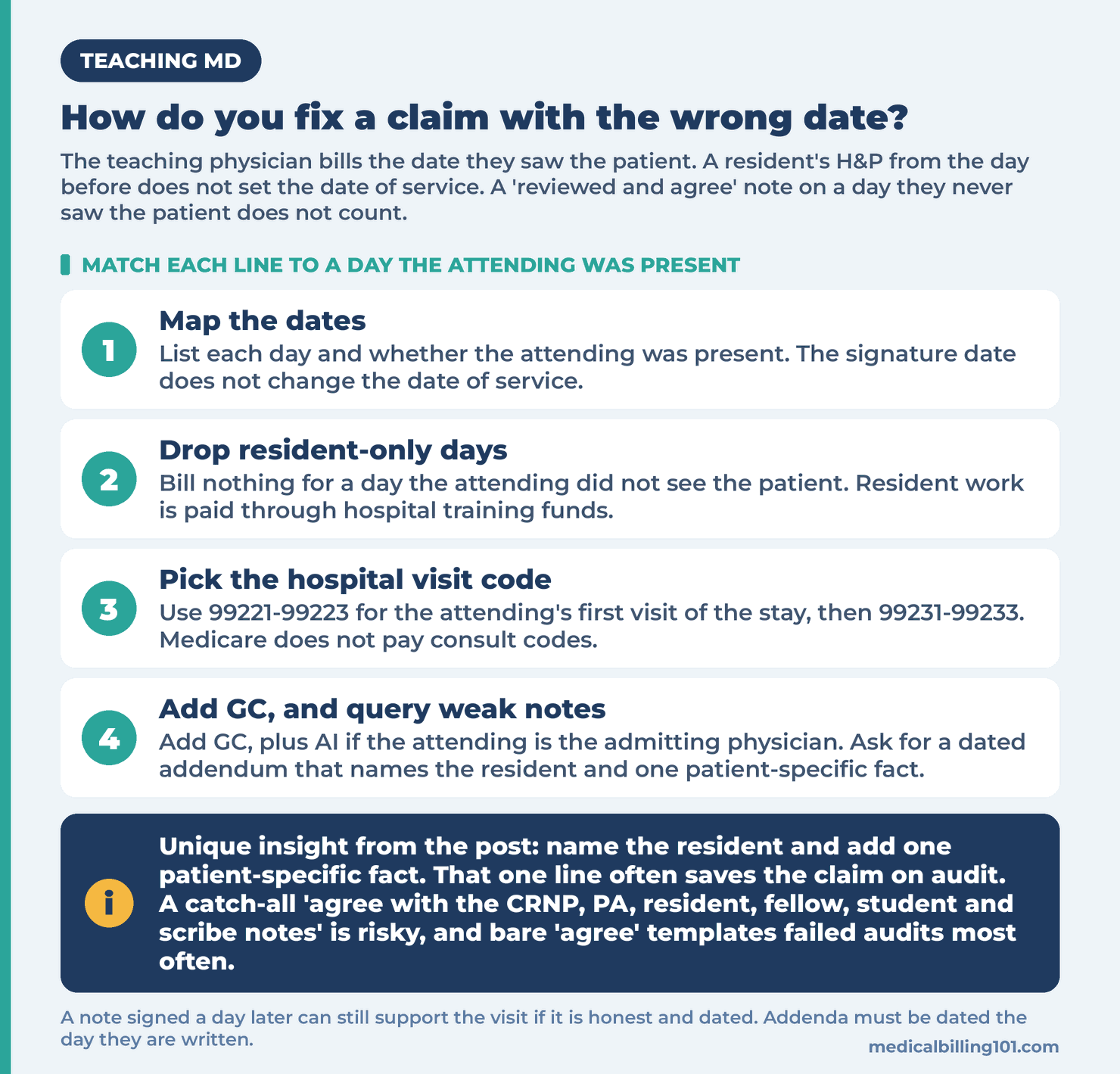
Match each claim line to a day the attending saw the patient. Remove any line for a resident-only day. Move the visit to the right date with the right code. Then send a corrected claim or respond to the denial.
- Map the dates: list each day and whether the attending was present.
- Drop resident-only days: they are paid through hospital training funds.
- Pick the code: 99221-99223 for the first visit, 99231-99233 after that.
- Add GC: and AI if the attending is the admitting physician.
- Query weak notes: ask the attending to add a dated addendum about what they did.
Addenda must be honest and dated the day they are written. If a payer denies for missing support, our CO-50 guide can help. For records requests, see our MAC prepayment review guide.
Example scenario (fictional names), part 2
How the teaching physician guidelines case was resolved
- Desmond found no proof Dr. Vandermeer saw the patient on Monday. He billed nothing for that day.
- Her Tuesday visit was her first visit of the stay. No one else in her group had billed initial care.
- He asked her to name the resident and note what she found. She added a dated addendum about worse breathing and a new chest CT.
Desmond then billed 99223-GC-AI for Tuesday. The level came from both notes together.
Names and details are illustrative; no real patient data.
Does the attestation signature date change the date of service?
No. The date of service is the day the attending saw the patient. The signature shows who wrote the note and when. A note signed a day later still supports the earlier visit if it is honest and dated.
3-step checklist
- Bill only the days the teaching physician saw the patient in person.
- Code the first attending visit as 99221-99223, never a consult code for Medicare.
- Add GC, and confirm the note shows presence and a patient-specific fact.
FAQ
What are the teaching physician guidelines for E/M billing?
The teaching physician must perform the service or be present for its key portion, and document that presence and their part in the care.
What date does the teaching physician bill?
The date they personally saw the patient, not the date of the resident’s H&P or the signature date.
Is ‘reviewed and agree’ enough?
No. CMS lists notes like ‘Agree with above’ and ‘Discussed with resident. Agree’ as unacceptable because they do not show presence.
Does Medicare pay consult codes for teaching physicians?
No. Medicare stopped paying consultation codes in 2010. Use initial or subsequent hospital care codes.
What is the difference between GC and GE?
GC means the attending met the presence rules with a resident. GE is used only under the primary care exception.
Sources
My methodology was simple. I checked the CMS manual, the federal regulation, the CMS booklet and a CMS transmittal.
- CMS, Medicare Claims Processing Manual, Chapter 12, Sections 30.6.9.1, 30.6.10 and 100.1-100.1.6 (linked above). Accessed 21 Nov 2026.
- eCFR, 42 CFR 415.172 (linked above). Accessed 21 Nov 2026.
- CMS, MLN006347 Guidelines for Teaching Physicians, Interns & Residents, August 2026 (linked above). Accessed 21 Nov 2026.
- CMS, Transmittal 2303, Teaching Physician Services (linked above). Accessed 21 Nov 2026.
- AMA, CPT code set, E/M codes 99221-99239.
Read about the author, or contact us with a question. See our editorial policy.
Last updated: 21 November 2026 · Educational content for U.S. billers. Check each payer’s current rules.