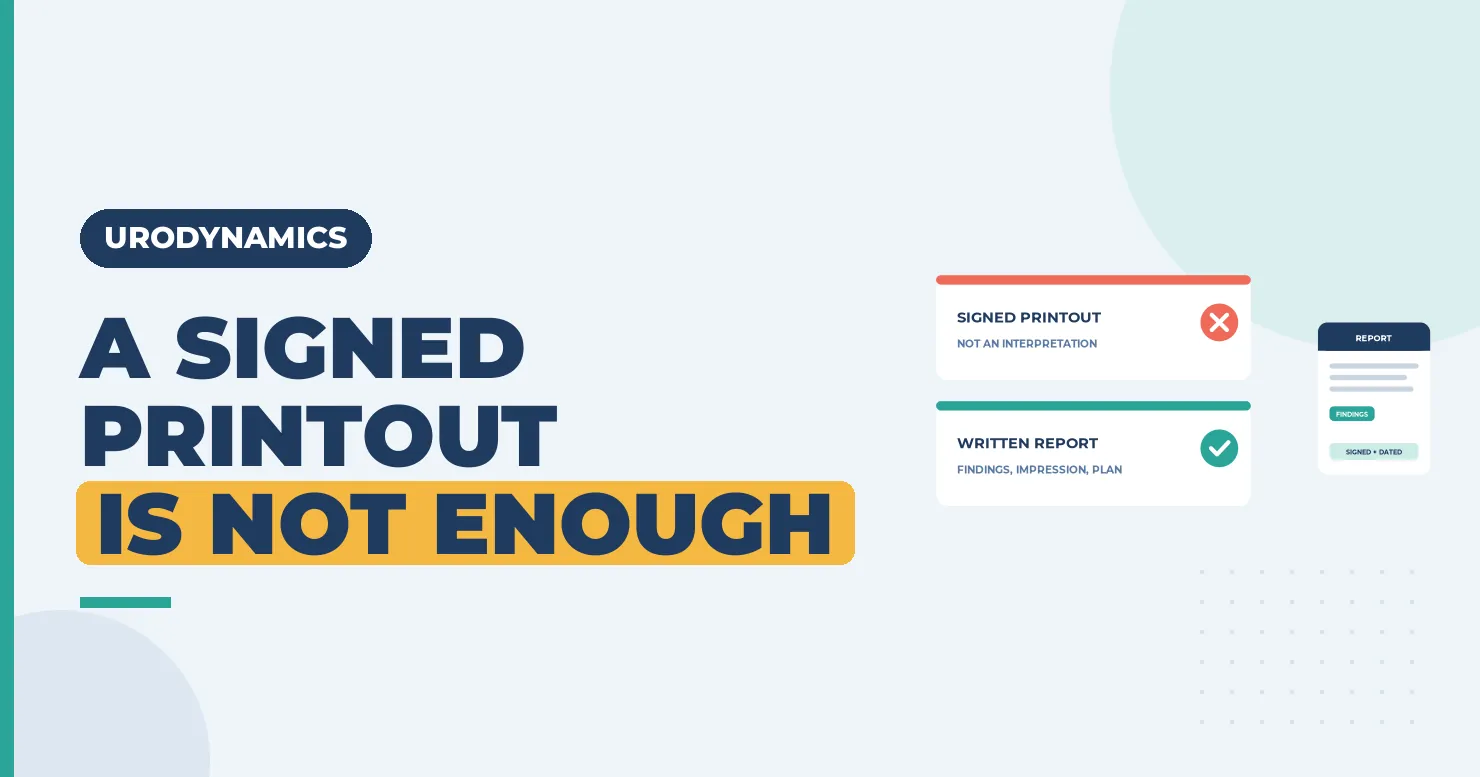
Urodynamic documentation requirements come down to one point: a signed computer printout alone is usually not an interpretation. The provider needs a written report. It should say what the results show.
The fix: keep the tracings and printout as test data. Then have the provider sign a short report. It should give the findings, the impression and the plan for each test.
TL;DR: Medicare pays the doctor’s part of a test for a read and report, not a quick look. A signature on the machine summary looks like a quick look. Write a separate, signed report that names each study, the key values, the impression and the next step.
Written by Manikandan J, CPC, CRCR, a certified coder and revenue cycle specialist. Published 20 November 2026. Last updated: 20 November 2026.
Table of Contents
Is a signed urodynamics printout enough as the interpretation?
Usually not. Medicare treats a quick look at test results as a review. That review is part of the visit. To bill the read, the provider needs a full written report. A bare signature on the printout does not show what the doctor found.
The rule is in Section 100.1 of the Medicare Claims Processing Manual, Chapter 13. It says a review with no full written report does not earn its own payment. The report should look like one a specialist would write.
Urodynamics is a group of tests that show how the bladder stores and releases urine. A cystometrogram (CMG) is the test that measures bladder pressure and volume during filling. Uroflowmetry is the measure of urine flow rate during voiding.
The same section says a note like “EKG normal” counts only as a review. CMS uses x-rays and EKGs as examples. Payers use the same idea for other tests, such as urodynamics.
Example scenario (fictional names), part 1
Urodynamic documentation example: what happened
Marisol Quintero codes for Harbor Point Urogynecology, a fictional practice in Oregon. Dr. Leah Whitcomb ran office urodynamics on a Medicare patient with mixed incontinence. The charge ticket listed 51729, 51741, 51784 and 51797.
Marisol opened the chart before billing. She found the tracings and a twelve-page machine summary with Dr. Whitcomb’s e-signature on page one. There was no narrative and no impression. Should she bill all four codes as they were?
What would you check first? Keep reading, or jump to how it was resolved.
Does the provider need a separate written report for urodynamics?
Yes, for clean billing. The report can live in the EHR or on its own page. But it must stand apart from the raw data. It should name each study done, the key results, the impression and the plan. The provider then signs and dates it.
For hospital patients, the doctor’s part includes a read and a written report for the chart. That comes from 42 CFR 415.120(a). In the office, the global code pays for the test and the read. So you still need the same report.
The signature must also meet Medicare’s rules. Section 3.3.2.4 of the Medicare Program Integrity Manual, Chapter 3 requires a handwritten or electronic signature. Stamped signatures are not typically acceptable.
What should a urodynamics interpretation report include?
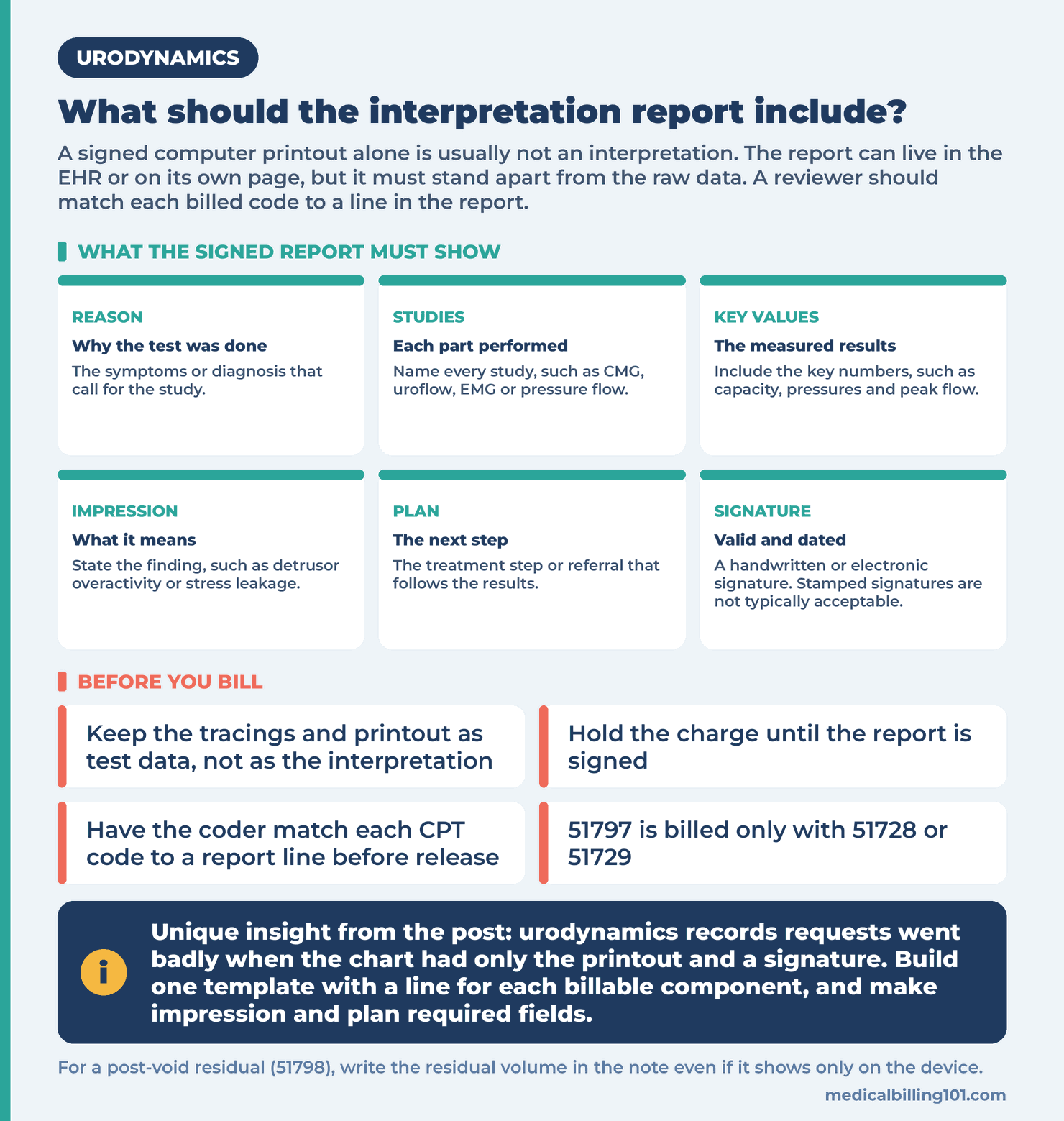
A good report gives the reason for the test, each part done and the key values. It ends with an impression and a plan. A reviewer should match each billed code to a line in the report. They should not need the tracings.
- Reason: the symptoms or diagnosis that call for the test.
- Studies done: CMG, pressure flow, UPP, EMG, uroflow or post-void residual.
- Key values: fill rate, first sensation, capacity, detrusor pressure, peak flow and leak point.
- Impression: what the findings mean, such as detrusor overactivity or stress leakage.
- Plan: the next treatment step or referral.
- Signature and date: the interpreting provider’s valid signature.
Which CPT codes cover urodynamic studies?
Urodynamic tests use CPT codes 51725 through 51798. The complex CMG codes build on each other. Code only the top one the report backs up. The add-on 51797 goes only with 51728 or 51729.
| CPT code | Study | What the report must show |
|---|---|---|
| 51725 / 51726 | Simple / complex cystometrogram | Fill method, sensations, capacity, pressures |
| 51727 | Complex CMG with urethral pressure profile | CMG data plus urethral closure pressure |
| 51728 | Complex CMG with voiding pressure studies | CMG data plus pressure-flow during voiding |
| 51729 | Complex CMG with voiding pressure and UPP | All three components |
| 51736 / 51741 | Simple / complex uroflowmetry | Voided volume and flow rate |
| 51784 / 51785 | Sphincter EMG, non-needle / needle | EMG method and activity during fill and void |
| 51792 | Stimulus evoked response | Reflex latency result |
| +51797 | Intra-abdominal voiding pressure (add-on) | Abdominal pressure catheter during voiding |
| 51798 | Post-void residual by ultrasound, non-imaging | Residual volume |
Check pairs with our NCCI edit checker and units with the MUE lookup tool.
What do Medicare contractors require for urodynamics?
MAC billing articles ask for a diagnosis that shows need and records that back it up. Records include history, exam and test results. You must send them when asked.
For one, the Wellpoint Billing and Coding: Urodynamics article (A57455) lists the ICD-10-CM codes that support coverage. It also says to use the test result as the diagnosis if known. If not, use the symptoms that led to the test. A penile pressure cuff for voiding pressure goes to 55899 with a narrative.
Other MACs post their own urodynamics articles. Search the Medicare Coverage Database for your state before you build a form.
How do modifier 26 and TC work for urodynamics?
Bill the global code when your office owns the machine and your provider reads the test. Use modifier 26 when the provider only interprets, such as in a hospital. Use TC when you bill only the machine and staff part.
The 26 claim needs that signed interpretation report. Confirm each code’s PC/TC indicator in the Medicare PFS relative value files before you split it. Our modifier 26 denial answer shows how split billing goes wrong.
How do offices document the urodynamic interpretation?
Most offices use an EHR form for the report. Staff attach the tracings. The provider fills in the impression and plan, then signs. This keeps the data and the doctor’s view apart but linked.
- Build one template with a line for each billable component.
- Make impression and plan required fields.
- Hold the charge until the report is signed.
- Have the coder match each CPT code to a report line before release.
In my AR work, urodynamics records requests went badly when the chart had only the printout and a signature.
For more on what reviewers look for, read our medical necessity documentation guide.
How do you fix a urodynamics claim with weak documentation?
Before billing, hold the claim and ask the provider for a full report. Bill only the parts the report backs up. After a denial, find the reason code first. Then pick a fixed claim or an appeal.
- Compare codes to the report: drop any component the report does not describe.
- Get the narrative: ask the provider to complete and sign the interpretation.
- Check the diagnosis: use the test result if known, or the symptoms if not.
- Check edits: confirm 51797 rides with 51728 or 51729.
- Respond to denials: fix data errors, or appeal with the full record.
A missing-information rejection is often CO-16, covered in our CO-16 denial guide. A medical necessity denial is usually CO-50, explained in our CO-50 guide. To appeal, use the appeal letter generator and the Medicare appeal guide.
Example scenario (fictional names), part 2
How the urodynamic documentation case was resolved
Marisol held the claim and sent Dr. Whitcomb a query. The signed printout showed data, but no interpretation. She asked for a report that covers each billed test.
Dr. Whitcomb filled out the practice form that week. It listed the CMG values, the urethral pressure profile, pressure-flow with an abdominal catheter, EMG and uroflow. Her impression was stress incontinence with normal voiding function. Marisol matched each code to a line and released the claim.
Names and details are illustrative; no real patient data.
Do you need a report for a post-void residual check?
Yes. Record the residual volume and who measured it. 51798 covers a non-imaging ultrasound bladder scan. If the volume shows only on the device, write it in the note so the record supports the charge.
3-step checklist
- Keep the tracings and printout as test data in the chart.
- Get a signed report with indication, each study, key values, impression and plan.
- Match every urodynamics code and modifier to that report before you bill.
FAQ
What are urodynamic documentation requirements?
A signed written report naming each study, the key values, the impression and the plan, plus the tracings and a diagnosis that supports medical necessity.
Is a signed computer printout an interpretation?
Usually not. Medicare treats a review without a complete written report as part of the visit, not a separately payable interpretation.
Can the urodynamics report be in the EHR?
Yes. It can be an EHR template or a separate page, as long as it is distinct from the raw data and validly signed.
When is 51797 billed?
51797 is an add-on for intra-abdominal voiding pressure and is reported only with 51728 or 51729.
When do you use modifier 26 for urodynamics?
Use 26 when the provider only interprets the study and another entity owns the equipment, such as a hospital.
Sources
My methodology was simple. I checked the CMS manuals, the federal regulation, a MAC billing article and the PFS files.
- CMS, Medicare Claims Processing Manual, Chapter 13, Section 100.1 (linked above). Accessed 20 Nov 2026.
- eCFR, 42 CFR 415.120(a) (linked above). Accessed 20 Nov 2026.
- CMS, Medicare Program Integrity Manual, Chapter 3, Section 3.3.2.4 (linked above). Accessed 20 Nov 2026.
- Wellpoint Federal MAC, Billing and Coding: Urodynamics, A57455 (linked above). Accessed 20 Nov 2026.
- CMS, PFS Relative Value Files (linked above). Accessed 20 Nov 2026.
- AMA, CPT code set, urodynamics codes 51725-51798.
Read about the author, or contact us with a question. See our editorial policy.
Last updated: 20 November 2026 · Educational content for U.S. billers. Check each payer’s current rules.