Chiropractic maintenance care is not covered by Medicare, so those visits are the patient’s cost. The billing path depends on the ABN option the patient picks.
The fix: give an ABN before maintenance visits. If the patient picks Option 1, bill 98940-98942 with the GA modifier and no AT modifier. If the patient picks Option 2, do not bill Medicare.
TL;DR: Medicare pays only for active or corrective spinal manipulation, billed with the AT modifier. Maintenance therapy is not medically necessary under Medicare. A signed ABN lets you collect from the patient. The ABN option box decides whether a claim goes to Medicare.
Written by Manikandan J, CPC, CRCR, a certified coder and revenue cycle specialist. Published 20 November 2026. Last updated: 20 November 2026.
Table of Contents
Is chiropractic maintenance care covered by Medicare?
No. Medicare does not pay for chiropractic maintenance therapy. CMS treats it as not reasonable or necessary. Medicare pays only when spinal manipulation corrects a subluxation and the patient is expected to improve.
The rule is in the Medicare Benefit Policy Manual, Chapter 15, section 240. Section 240.1.3 defines maintenance therapy. It is care that is supportive rather than corrective. It starts once the condition is stable and no more real gains are expected.
Maintenance therapy means care that prevents disease, promotes health or keeps a chronic condition from getting worse. Active or corrective treatment means care for a subluxation that is still getting better.
Example scenario (fictional names), part 1
Chiropractic maintenance care Medicare example: what happened
Marisol Greene bills for Cedar Ridge Chiropractic in Ohio. Dr. Owen Pratt treats a 72-year-old Medicare patient for chronic low back subluxation. After 10 weeks, his notes say the patient is stable and further gains are not expected. The patient still wants monthly adjustments.
Dr. Pratt tells the front desk to keep billing 98940-AT. A second doctor in the group says maintenance patients should just pay cash. Marisol has two doctors with two different answers. Which one follows Medicare’s rules?
What would you check first? Keep reading, or jump to how it was resolved.
What is the AT modifier for chiropractic claims?
The AT modifier tells Medicare the manipulation is active or corrective treatment. Medicare requires it to pay 98940, 98941 and 98942. Claims for these codes without the AT modifier are treated as maintenance therapy and denied.
The CMS MLN documentation checklist for chiropractors says the same. The AT modifier does not prove medical necessity. A MAC can still deny after review if the record does not show active care. Our MAC prepayment review guide covers that process.
| Modifier | When to use it on chiropractic claims |
|---|---|
| AT | Active or corrective spinal manipulation (98940-98942) |
| GA | Maintenance manipulation, signed ABN on file |
| GZ | Maintenance manipulation expected to deny, no signed ABN |
| GY | Statutorily excluded services, such as exams, x-rays and therapy by a chiropractor |
Do we have to bill Medicare for maintenance care if we are in network?
Only if the patient asks. Once the patient signs an ABN and picks Option 1, you must send the claim. If the patient picks Option 2, you do not send a claim. That choice does not break mandatory claim submission rules.
The rule comes from Medicare Claims Processing Manual, Chapter 30, section 50.17. So both doctors can be right. Cash pay works when the patient picks Option 2. Billing for a denial works when the patient picks Option 1.
Without a signed ABN, you cannot bill the patient for a maintenance visit that Medicare denies. The practice carries that loss. For example, each maintenance visit billed with GZ becomes a write-off.
Which ABN option should the patient pick for maintenance care?
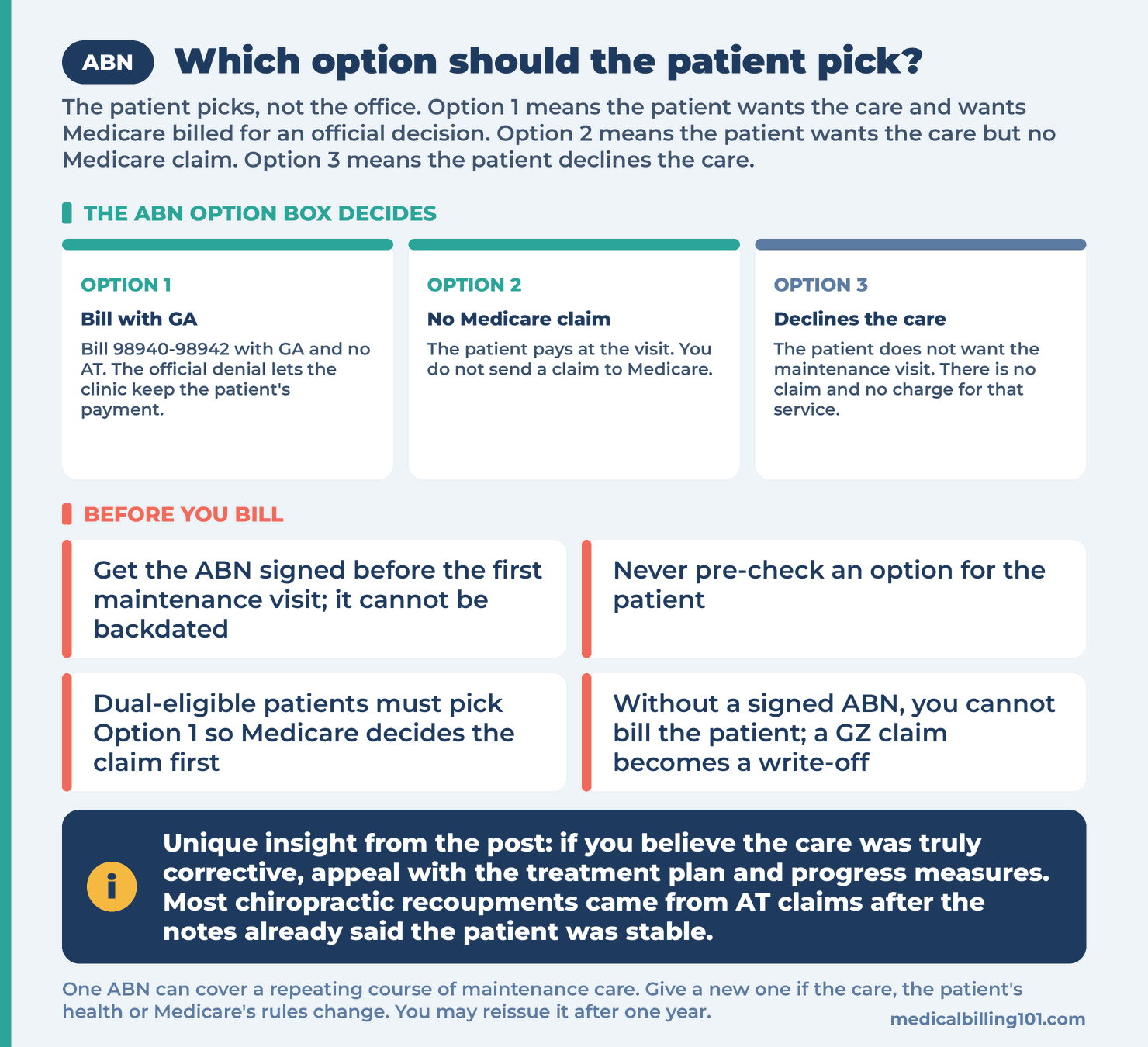
The patient picks, not the office. Option 1 means the patient wants the care and wants Medicare billed for an official decision. Option 2 means the patient wants the care but no Medicare claim. Option 3 means the patient declines the care.
Use the current ABN form (CMS-R-131) from the CMS FFS ABN page. List the adjustment, why Medicare may not pay and a fair cost estimate. Never pre-check an option for the patient.
One ABN can cover a repeating course of maintenance care. Give a new one if the care, the patient’s health or Medicare’s rules change. You may reissue it after one year, per Chapter 30, section 50.
How do you bill chiropractic maintenance care to Medicare?
Bill 98940, 98941 or 98942 without the AT modifier. Add the GA modifier when a signed ABN is on file. Add GZ only if you expect a denial and have no signed ABN. The claim will deny, and the remit sets liability.
- Chart the change: note the date the patient became stable and why care is now maintenance.
- Get the ABN signed: before the first maintenance visit, not after. An ABN cannot be backdated.
- Follow the option box: Option 1 means bill with GA. Option 2 means no claim.
- Keep the diagnosis rules: list the subluxation level as primary and the date of initial treatment in Item 14.
Noridian JF Part B gives the same steps in its chiropractic claim submission requirements. A missing Item 14 date returns CO-16 with remark MA122, per Claims Processing Manual Chapter 12, section 220. See our CO-16 denial guide for that fix.
Example scenario (fictional names), part 2
How the chiropractic maintenance case was resolved
Marisol stops the 98940-AT claims. Dr. Pratt’s own note says the patient is stable, so AT no longer fits. Before the next visit, the front desk gives the patient an ABN for monthly maintenance adjustments at the clinic’s cash fee.
The patient picks Option 2 and pays at each visit. No Medicare claim is sent. A second patient picks Option 1, so Marisol bills 98940-GA. The denial lets the clinic keep that patient’s payment. Both doctors were right, once the ABN drove the choice.
This example is illustrative only. Names and details are fictional.
How much can you charge a Medicare patient for maintenance care?
You may charge your usual and customary fee. With a valid ABN, the amount is not limited to the Medicare fee schedule. You may also collect right after the ABN is signed, unless state law or other Medicare policy says otherwise.
Chapter 30, section 50.15 adds one catch. If Medicare or a secondary payer later pays, you must refund the patient promptly. Our patient cost estimator helps you set the estimate on the ABN.
Are exams and x-rays by a chiropractor covered by Medicare?
No. Medicare Part B pays a chiropractor only for manual manipulation of the spine to correct a subluxation. Exams, x-rays, therapy and other chiropractor services are barred by law under 42 CFR 410.21(b).
Those services do not need an ABN to bill the patient. If the patient wants a claim for a secondary plan, append the GY modifier. Our GY modifier guide explains it. Extraspinal manipulation (98943) falls in the same excluded group.
What about dual-eligible patients on maintenance care?
Dual-eligible patients must pick Option 1 so Medicare decides the claim first. You cannot bill a Medicare and Medicaid patient while the claim is pending at both payers. After Medicare denies, the claim crosses over to Medicaid for its decision.
Chapter 30, section 50.17 sets this rule. It applies to Qualified Medicare Beneficiary and Medicaid patients. Medicare Advantage plans differ. They follow their own coverage rules, so check the plan before using an ABN. See our 2027 Medicare Advantage changes answer.
Which denials hit chiropractic maintenance claims?
The most common denials are maintenance care billed with AT, missing Item 14 dates and care outside the spine. Each one has a clear fix. Read the remit before you rebill or appeal.
- Not medically necessary: CO-50 when the record does not support active care. See our CO-50 denial guide.
- No AT modifier: the claim is treated as maintenance and denied. For instance, a corrective visit sent without AT still denies.
- GZ on the claim: the practice is liable because no ABN was signed.
In my AR work, most chiropractic recoupments came from AT claims after the notes already said the patient was stable.
If you believe the care was truly corrective, appeal with the treatment plan and progress measures. Our Medicare appeal guide walks through redetermination, and the appeal letter generator drafts the letter.
3-step checklist
- Chart when care turns from corrective to maintenance, and stop using the AT modifier.
- Get a signed ABN before maintenance visits, and let the patient pick the option.
- Bill 98940-98942 with GA for Option 1, and send no claim for Option 2.
FAQ
Does Medicare cover chiropractic maintenance care?
No. Medicare pays only for active or corrective spinal manipulation of a subluxation. Maintenance therapy is not considered reasonable or necessary.
What modifier is used for chiropractic maintenance care?
Bill 98940-98942 without the AT modifier. Add GA if a signed ABN is on file, or GZ if no ABN was signed.
Do I have to bill Medicare for maintenance visits?
Only if the patient picks ABN Option 1. If the patient picks Option 2, you do not submit a claim.
Can a chiropractor charge cash to a Medicare patient for maintenance?
Yes, with a signed ABN. You may charge your usual fee and collect it after the ABN is signed.
Does Medicare pay for chiropractic x-rays or exams?
No. Medicare pays a chiropractor only for manual manipulation of the spine. Other chiropractor services are excluded and can carry the GY modifier.
Sources
My methodology was simple. I checked the CMS manuals, the CMS chiropractic checklist, the federal rule and one MAC’s claim instructions.
- CMS, Medicare Benefit Policy Manual, Chapter 15, sections 240.1.1 to 240.1.3 (linked above). Accessed 20 Nov 2026.
- CMS, Medicare Claims Processing Manual, Chapter 30, sections 50.8, 50.15 and 50.17 (linked above). Accessed 20 Nov 2026.
- CMS, Medicare Claims Processing Manual, Chapter 12, section 220 (linked above). Accessed 20 Nov 2026.
- CMS MLN1232664, Medicare Documentation Checklist and Guidelines for Chiropractic Doctors (linked above). Accessed 20 Nov 2026.
- CMS, FFS ABN form and instructions (linked above). Accessed 20 Nov 2026.
- eCFR, 42 CFR 410.21(b) (linked above). Accessed 20 Nov 2026.
- Noridian JF Part B, chiropractic claim submission requirements (linked above). Accessed 20 Nov 2026.
Read about the author, or contact us with a question. See our editorial policy.
Last updated: 20 November 2026 · Educational content for U.S. billers. Check each payer’s current rules.