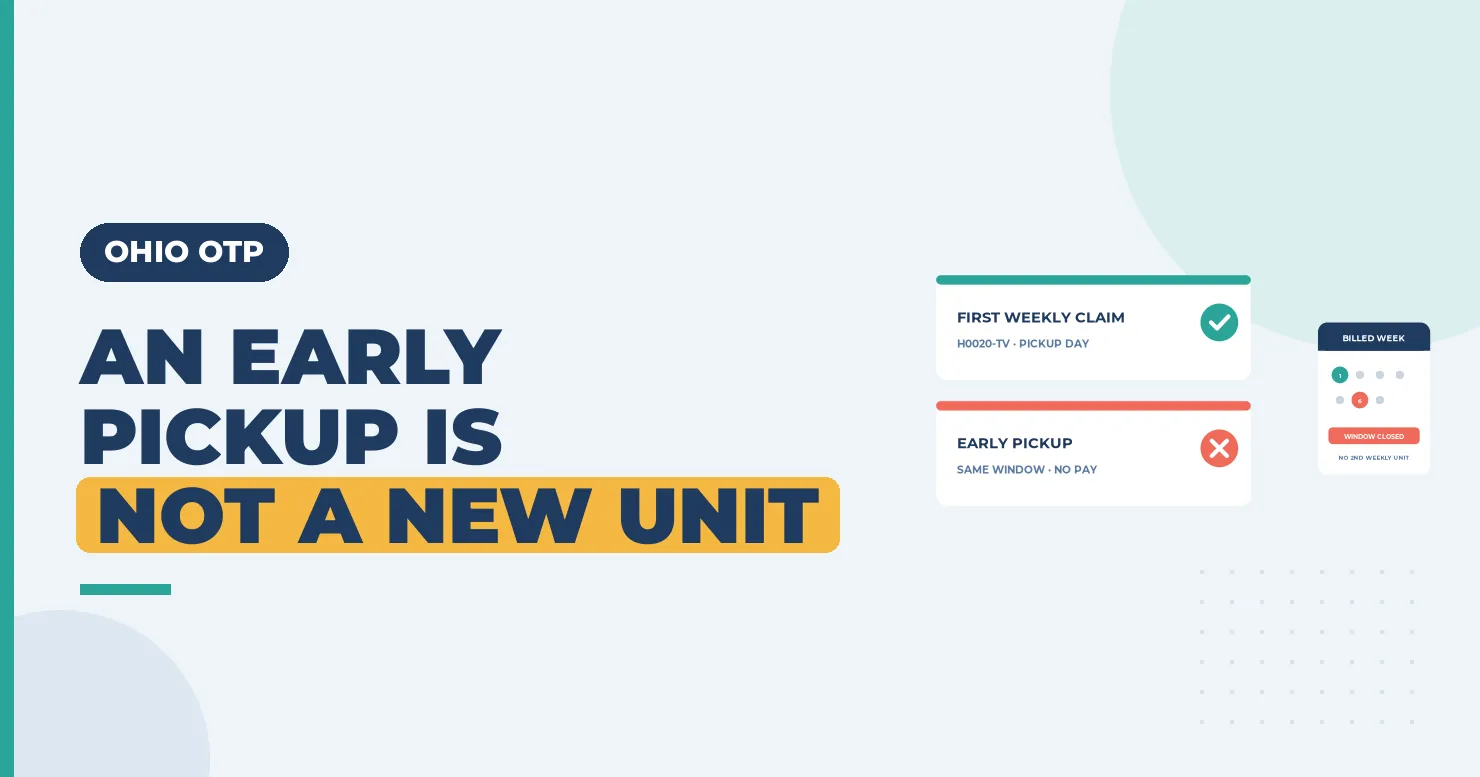
Opioid treatment program billing for Medicaid depends on the visit date, not the dose date. In Ohio, one weekly take-home claim blocks any other H0020 or T1502 claim for that week.
The fix: when a second batch goes out early, do not bill a second weekly unit inside the first window. Plan closure doses into one claim with the right modifier, or get the payer’s written direction first.
TL;DR: Ohio Medicaid OTPs bill H0020 for methadone and T1502 for buprenorphine. HF means daily administration. TV, UB, TS and HG mean 1, 2, 3 or 4 weeks of take-home doses. The date of service is the day the patient picked up the doses. Early pickups inside a billed week have no separate payment in the manual.
Written by Manikandan J, CPC, CRCR, a certified coder and revenue cycle specialist. Published 20 November 2026. Last updated: 20 November 2026.
Table of Contents
How do opioid treatment programs bill Medicaid?
Opioid treatment programs bill Medicaid with state-specific codes for medication administration. Ohio uses H0020 for methadone and T1502 for buprenorphine. A modifier tells the payer whether the dose was daily or a 1 to 4 week take-home supply.
The rules come from the Ohio Medicaid Behavioral Health Provider Manual, version 1.28.1. Section 6 covers OTPs. It took effect March 24, 2026. Ohio managed care plans also cover these services, so check each plan’s billing manual too.
An opioid treatment program (OTP) is a certified clinic that treats opioid use disorder with medications such as methadone or buprenorphine. H0020 is the HCPCS code for methadone administration by a licensed program. T1502 is the HCPCS code for medication administration per visit, which Ohio uses for buprenorphine.
Other states set their own codes and rules. Use your own state’s Medicaid manual before you copy Ohio’s setup.
Which codes and modifiers do Ohio OTPs use?
Ohio OTPs use H0020 or T1502 with one of five modifiers. The modifier must match the number of take-home days given at that visit. Each code pays a flat rate under the fee-for-service schedule in the manual.
| Modifier | Meaning | Ohio FFS rate (H0020 or T1502) |
|---|---|---|
| HF | Daily administration | $18.47 |
| TV | One week of take-home doses (2 to 7 days) | $129.28 |
| UB | Two weeks (8 to 14 days) | $258.56 |
| TS | Three weeks (15 to 21 days) | $387.84 |
| HG | Four weeks (22 to 28 days) | $517.12 |
Enrollment matters too. OTPs enroll as provider type 95. Methadone programs add specialty 951, and buprenorphine programs add specialty 953. Buprenorphine drugs bill with J0571 to J0575, and take-home buprenorphine drugs can bill with S5000 or S5001.
What is the Ohio weekly take-home billing rule?
Once you bill a weekly modifier, you cannot bill H0020 or T1502 again for that 1, 2, 3 or 4 week period. The date of service must be the day the patient came in for the take-home doses. You must also document the number of doses given.
Daily doses work differently. For HF, the date of service is the day the dose was given. For a single daily take-home dose, it is the day the patient will take it.
Federal rules set the clinical side. Under 42 CFR 8.12(i), any patient may get take-home doses for days the clinic is closed, including holidays. Beyond that, methadone take-homes are capped at 7 days in the first 14 days of treatment. The cap rises to 14 days from day 15 and 28 days from day 31.
Example scenario (fictional, for illustration only)
OTP take-home billing example: what happened
Lakeshore Recovery Clinic bills Ohio Medicaid. Biller Dana Ruiz sends H0020-TV for patient “J.T.” on October 1 for 7 days of methadone. The clinic then closes on October 8, so J.T. picks up the next 7 days on October 6. Dana bills H0020-TV again for October 6. The plan denies it as a duplicate weekly claim.
Dana checks the manual. October 6 falls inside the week billed on October 1, so the second claim cannot pay. She does not move the date to October 8, because the date must be the pickup day. She sends the plan a written question with the closure notice, then sets a new rule. For known closures, the clinic now dispenses the closure day with the earlier batch and bills the matching modifier once.
How do you bill take-home doses dispensed early?
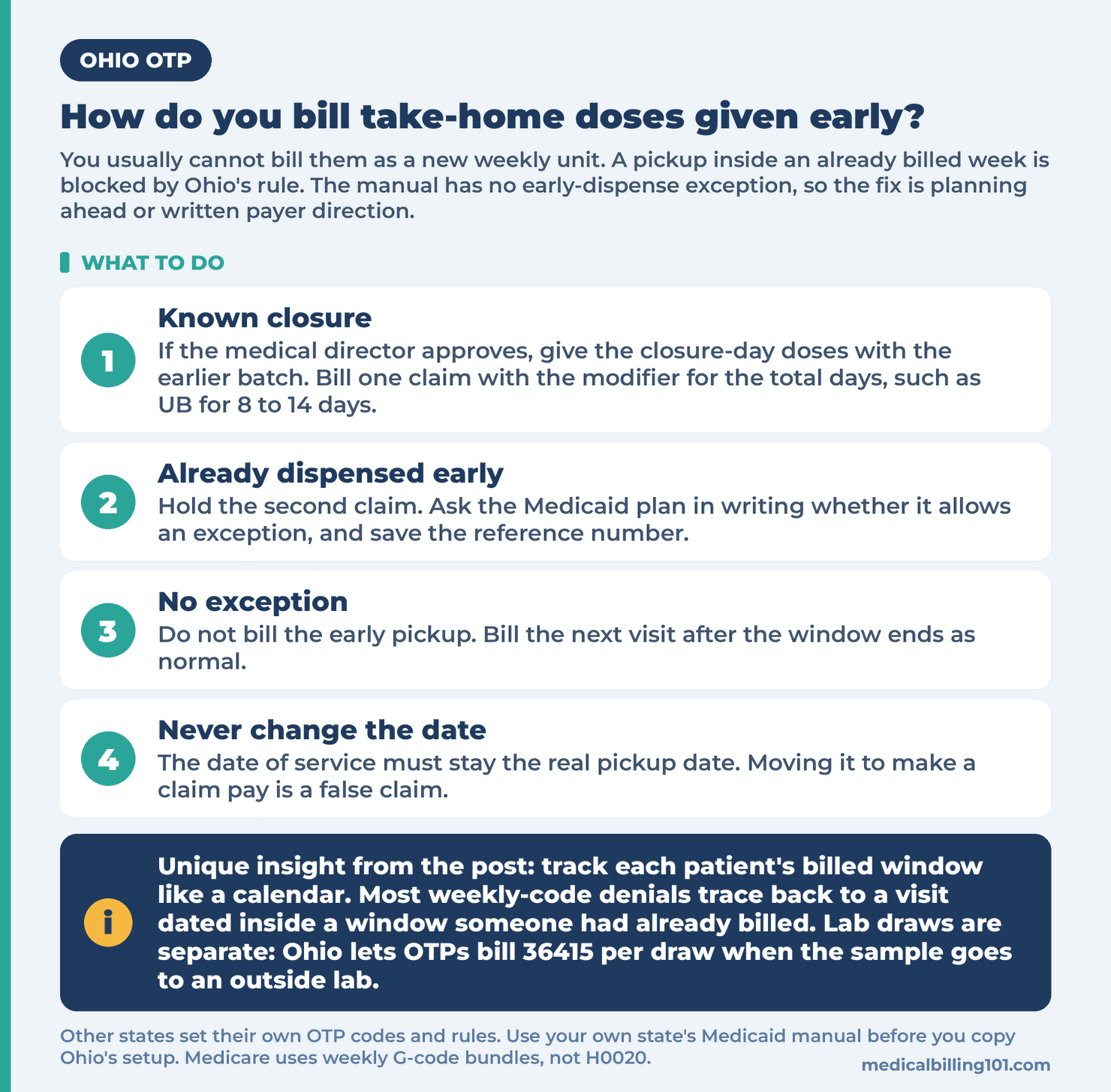
You usually cannot bill them as a new weekly unit. A pickup inside an already billed week is blocked by Ohio’s rule. The manual has no early-dispense exception, so the fix is planning ahead or written payer direction.
Use this order:
- Known closure: if the medical director approves, give the closure-day doses with the earlier batch. Bill one claim with the modifier for the total days, such as UB for 8 to 14 days.
- Already dispensed early: hold the second claim. Ask the Medicaid plan in writing whether it allows an exception. Save the reference number.
- No exception: do not bill the early pickup. Bill the next visit after the window ends as normal.
- Never change dates: the date of service must stay the real pickup date. Moving it to make a claim pay is a false claim.
Track each patient’s window like a calendar. Our CO-18 duplicate claim guide explains why overlapping weekly claims deny, and the timely filing calculator keeps held claims inside filing limits.
How is Medicare OTP billing different from Medicaid?
Medicare pays OTPs with weekly bundles, not state H codes. G2067 covers a 7-day methadone episode, and G2068 covers oral buprenorphine. You cannot bill the same bundle twice for one 7-day period.
Extra take-home supply uses add-on codes. G2078 adds up to 7 more days of methadone, and G2079 does the same for oral buprenorphine. Each is billable up to 3 units in a month. The dates cannot overlap the weekly bundle. See the CMS OTP billing and payment page for the full code list.
Which denials hit OTP Medicaid claims?
The most common OTP Medicaid denials are overlapping weekly claims, wrong modifiers and missing enrollment. Each one shows a clear pattern on the remit. Fix the cause before rebilling, or the same denial returns.
- Overlapping week: a second H0020 or T1502 inside a billed window. See our CO-151 frequency denial guide.
- Modifier mismatch: the modifier does not match the days dispensed, such as TV for 10 days.
- Specialty missing: the OTP lacks specialty 951 or 953 for the drug billed.
- 96372 on an administration day: Ohio bars it with H0020 or T1502 unless the J code is on the claim.
In my AR work, most weekly-code denials traced back to a visit dated inside a window someone had already billed.
Lab draws are separate. Ohio lets OTPs bill 36415 per draw when the sample goes to an outside lab. Our 36415 venipuncture billing answer covers who can bill the draw. For bundled behavioral health per diems, see our S9480 IOP billing answer.
3-step checklist
- Bill H0020 or T1502 with the modifier that matches the take-home days given.
- Date each claim on the real pickup day, and never bill twice inside one window.
- Plan closure doses ahead, and get written payer direction for early pickups.
FAQ
What is H0020 used for in Ohio Medicaid?
H0020 is methadone administration at a licensed opioid treatment program. Modifier HF means daily, and TV, UB, TS or HG mean 1 to 4 weeks of take-home doses.
What does modifier TV mean on an OTP claim?
In Ohio Medicaid, TV on H0020 or T1502 means one week of take-home doses, covering 2 to 7 days. The 2026 fee-for-service rate is $129.28.
Can I bill H0020 twice in the same week?
Not after a weekly modifier. Ohio’s manual says an OTP cannot bill H0020 or T1502 again during the billed 1, 2, 3 or 4 week period.
What date of service goes on a weekly take-home claim?
The date the patient came to the OTP to receive the take-home doses. Do not use the date the doses will be taken.
Does Medicare use H0020 for OTPs?
No. Medicare pays OTPs with weekly bundle G codes, such as G2067 for methadone, plus add-on codes like G2078 for extra take-home days.
Sources
My methodology was simple. I checked Section 6 of the Ohio Medicaid Behavioral Health Provider Manual, the federal take-home rules in 42 CFR 8.12 and the CMS OTP billing page.
- Ohio Department of Medicaid, Behavioral Health Provider Requirements and Reimbursement Manual, version 1.28.1, Section 6 and Tables 6-1 and 6-2 (linked above). Accessed 20 Nov 2026.
- eCFR, 42 CFR 8.12(i), take-home medication doses (linked above). Accessed 20 Nov 2026.
- CMS, Opioid Treatment Program billing and payment (linked above). Accessed 20 Nov 2026.
Read about the author, or contact us with a question. See our editorial policy.
Last updated: 20 November 2026 · Educational content for U.S. billers. Check each payer’s current rules.