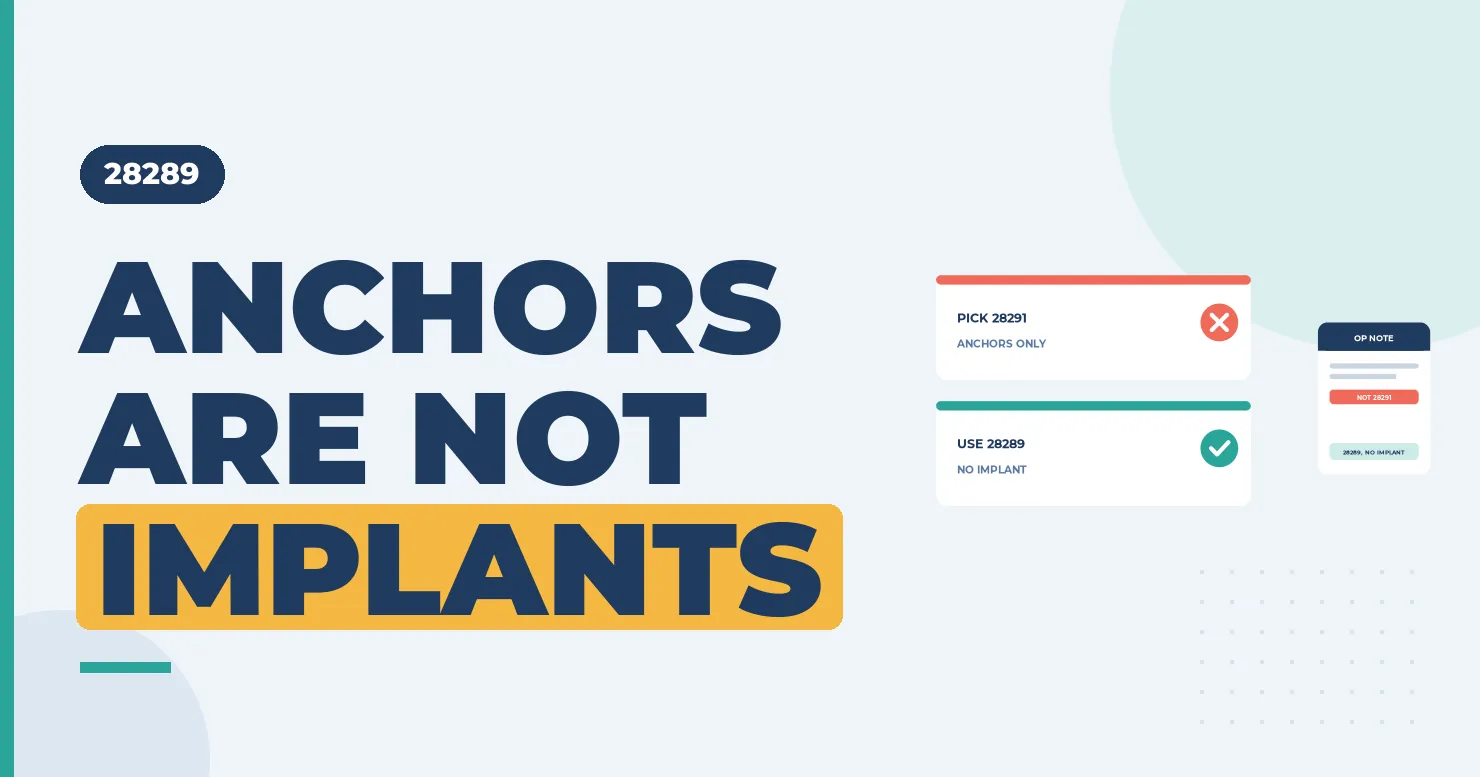
Cheilectomy CPT 28289 usually fits this case. Code 28291 only applies when the surgeon places an implant.
The phalanx osteotomy and the EHB flap are usually part of the same hallux rigidus repair. Bill one code for the joint and check the NCCI edits before adding lines.
TL;DR: Report 28289 for a cheilectomy with debridement and capsular release when no implant is placed. Suture anchors that only hold a soft tissue flap do not, in my reading, make it 28291. NCCI bundles 28310 into 28289 as a separate procedure, so it is not billed through the same incision. The EHB and capsular interposition is part of the repair, not 27691. Use M20.21 for right hallux rigidus and add RT.
Written by Manikandan J, CPC, CRCR, a certified coder and revenue cycle specialist. Published 28 November 2026. Last updated: 28 November 2026.
Table of Contents
What is the CPT code for a cheilectomy with capsular interposition?
CPT 28289 reports hallux rigidus correction with cheilectomy, debridement and capsular release of the first toe joint, without an implant. CPT 28291 reports the same repair with an implant. The choice depends on whether an implant was placed in the joint.
The CMS fee schedule lists them as “Corrj halux rigdus w/o implt” and “Corrj halux rigdus w/implt.” Those short labels show the only difference between the two codes.
Hallux rigidus means arthritis and stiffness of the big toe joint. Cheilectomy means removing bone spurs and part of the metatarsal head to restore motion. Capsular interposition means folding soft tissue, such as capsule and the EHB tendon, into the joint as a cushion.
CPT descriptor wording belongs to the AMA. I describe the codes in my own words, so check the full text in your current CPT book. AMA CPT Assistant guidance on this exact case is subscription content that I could not verify.
Example scenario (fictional names), part 1
Cheilectomy coding example: what happened
Ridgeway Foot and Ankle Center is a fictional podiatry group in Ohio. Corinne Vasquez-Hollis codes its surgeries. Dr. Leopold Andrich is one of its foot surgeons.
Dr. Andrich revised a failed cheilectomy on a right big toe. He removed dorsal bone, cut part of the proximal phalanx and folded an EHB and capsule flap into the joint. Two suture anchors held the flap.
The surgeon asked for 28291-RT, 28310-59-RT and 27691-51-RT. The payer paid only the first line and denied the other two as bundled.
Were the extra lines billable? Keep reading, or jump to how the case was resolved.
Do suture anchors turn 28289 into 28291?
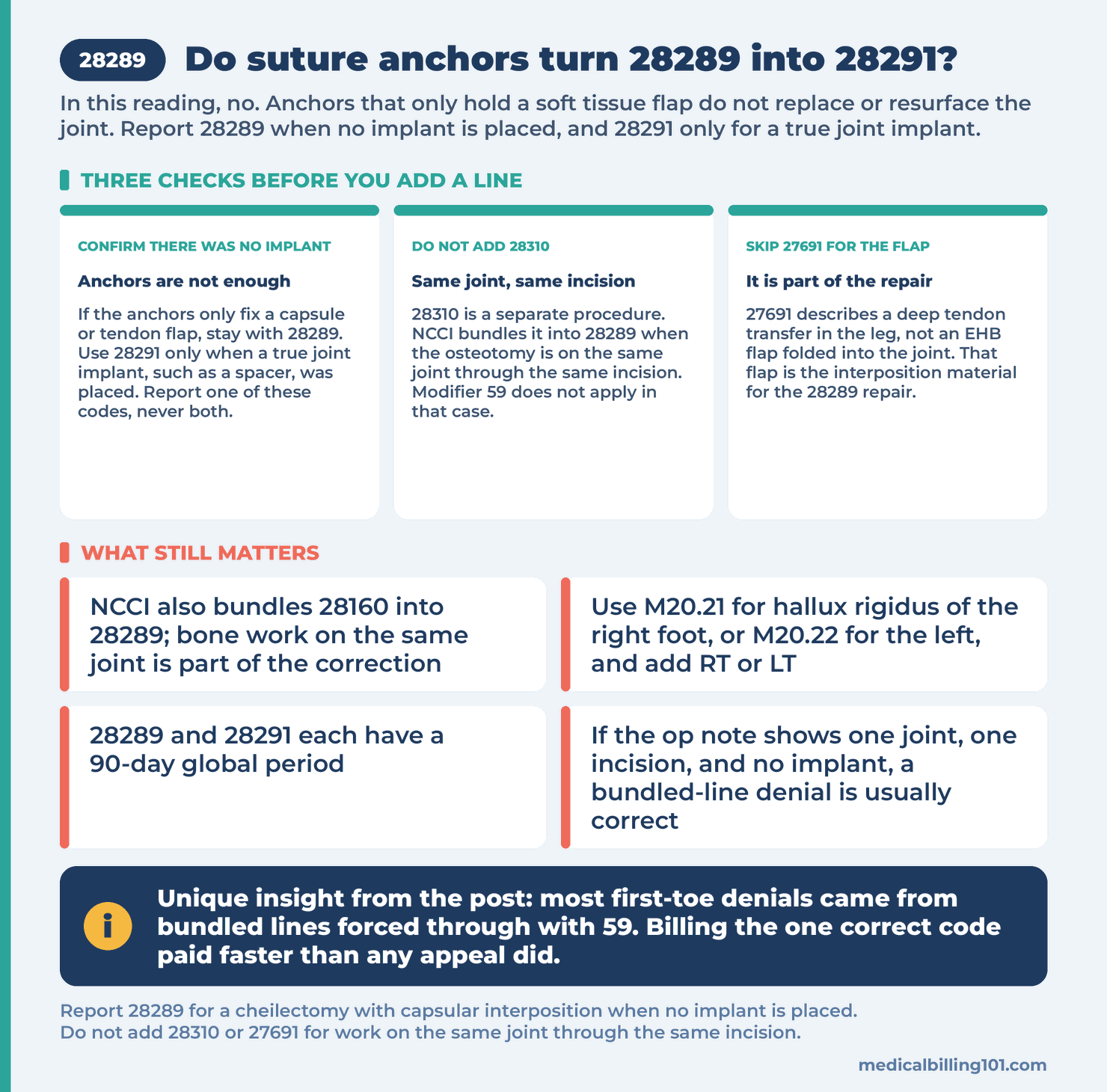
In my reading, no. The anchors in this op note only fix the capsule and EHB flap to the metatarsal head. They do not replace or resurface the joint, which is what an implant does.
The NCCI edit file shows that the two codes are alternatives. 28291 bundles 28289 with the rationale “HCPCS/CPT procedure code definition.” You report one of them, never both.
If the surgeon placed a true joint implant, such as a spacer or hemi-implant, 28291 fits. If only soft tissue was used, stay with 28289. Our 29884 vs 29876 answer uses the same op-note-first method for two close codes.
| CPT code. | CMS short descriptor. | NCCI status with 28289. | Work RVU / global. |
|---|---|---|---|
| 28289 | Corrj halux rigdus w/o implt. | Primary code. | 6.73 / 090 |
| 28291 | Corrj halux rigdus w/implt. | 28291 bundles 28289. | 7.81 / 090 |
| 28310 | Revision of big toe. | Bundled, separate procedure. | 5.43 / 090 |
| 28160 | Partial removal of toe. | Bundled, standards of practice. | 3.78 / 090 |
| 27691 | Revise lower leg tendon. | No pair, but not the right code. | 10.23 / 090 |
Short descriptors and RVUs come from the CMS PFS relative value files, file PPRRVU2026_Oct.
Can you bill 28310 with 28289 for a proximal phalanx osteotomy?
Usually not. CPT 28310 is an osteotomy of the proximal phalanx of the first toe, and it carries the “separate procedure” label. NCCI bundles it into 28289 and into 28291 with the rationale “CPT separate procedure definition.”
Chapter IV, section I.26 of the NCCI Policy Manual explains the rule. CMS does not allow a separate procedure code at the same encounter in a related area through the same incision.
The edit has a modifier indicator of 1. That only helps when the osteotomy is on a different toe or through a separate incision. Here it was the same toe and the same incision, so 59 does not apply. Read NCCI Policy Manual Chapter IV, or test the pair in our NCCI edit checker.
Section I.14 of the same chapter says 28310 is not reported with the bunion codes on the same first toe. Those codes already include a phalanx osteotomy. Our modifier 59 helper walks through when a distinct site is real.
Is 27691 the right code for an EHB capsular interposition transfer?
No. CPT 27691 describes a deep tendon transfer in the leg, such as moving the posterior tibial tendon to the midfoot or hindfoot. Moving an EHB flap into the big toe joint is a different service.
In this case, the EHB and capsule are the interposition material for the joint repair. They are part of the arthroplasty that 28289 describes. No national NCCI edit pairs 28289 with 27691, but a missing edit does not make a code correct.
If the surgeon insists on more codes, ask what separate work was done. Our modifier 59 bundling answer shows how payers respond when a bundled line is forced through.
Which ICD-10-CM code supports a hallux rigidus cheilectomy?
Use M20.21 for hallux rigidus of the right foot and M20.22 for the left foot. Both codes appear in the FY 2027 ICD-10-CM code file. This revision case still codes the same condition.
The patient had a prior cheilectomy by another surgeon. That history does not change the diagnosis code, because the arthritis is still present. Add RT to the CPT line for the right foot.
What global period and modifiers apply to 28289?
28289 and 28291 each have a 90-day global period in the CMS fee schedule. Post-op visits inside that window are included. Add RT or LT for the side.
Modifier 51 is not needed on a single line. Our global period calculator gives you the end date for the follow-up visits.
In my 10+ years in medical billing, most first toe denials I worked came from bundled lines forced through with 59. Billing the one correct code paid faster than any appeal did.
What should you do when the payer denies the extra toe lines?
Check the denial reason first. Bundled lines often come back as denial code CO-97, which means the service is included in another paid service.
If the op note shows one joint, one incision and no implant, the denial is correct. Write it off or send a corrected claim. Appeal only when the note shows a truly separate site, and quote the NCCI rule. For a similar global and edit review, see our medial malleolus nonunion answer.
Example scenario (fictional names), part 2
How the cheilectomy case was resolved
- Corinne reread the op note. The anchors only held soft tissue, and no joint implant was placed, so she changed 28291 to 28289.
- She checked the NCCI edit for 28289 and 28310. The osteotomy was on the same toe through the same incision, so modifier 59 did not apply.
- She dropped 27691. The EHB flap was part of the interposition arthroplasty, not a leg tendon transfer to the midfoot.
Fix: a corrected claim went out with 28289-RT and M20.21. The team wrote off the denied lines instead of appealing them.
Outcome: the claim closed clean. The group now reviews every first toe case against the NCCI edits before it is billed.
Names and details are illustrative; no real patient data.
3-step checklist
- Read the op note for an implant, then pick 28289 or 28291.
- Check NCCI edits for 28310 and 28160, and use 59 only for a separate toe or incision.
- Code M20.21 or M20.22, add RT or LT, and skip 27691 for an EHB flap.
FAQ
Does a suture anchor make a cheilectomy 28291?
Not by itself, in my reading. The anchors in this case only hold the soft tissue flap down. 28291 is meant for a joint implant, so confirm the wording in your CPT book before you use it.
Can 28291 and 28289 be billed together?
No. The NCCI edit file bundles 28289 into 28291 with the rationale “HCPCS/CPT procedure code definition.” You pick one hallux rigidus code for the joint, based on whether an implant was placed.
What ICD-10-CM code goes with a right hallux rigidus cheilectomy?
Use M20.21, hallux rigidus, right foot. Use M20.22 for the left foot. Both codes are in the FY 2027 ICD-10-CM code file.
Is 28160 a better code for the phalanx bone removal?
No. 28160 is a partial phalanx removal code, and NCCI bundles it into 28289 and 28291. Bone work on the same joint is part of the hallux rigidus correction.
What global period applies to 28289 and 28291?
Both codes carry a 90-day global period in the CMS fee schedule. Follow-up visits for the surgery inside those 90 days are part of the payment.
Sources
My methodology was simple. I checked the CMS fee schedule file, the NCCI edit file, the NCCI Policy Manual and the FY 2027 ICD-10-CM code file.
- CMS, Physician Fee Schedule relative value file PPRRVU2026_Oct, codes 28160, 28289, 28291, 28310 and 27691 (linked above). Accessed 28 Nov 2026.
- CMS, NCCI procedure-to-procedure edits, practitioner version 32.3. Accessed 28 Nov 2026.
- CMS, NCCI Policy Manual for Medicare Services 2026, Chapter IV, section I.14 and I.26 (linked above). Accessed 28 Nov 2026.
- CMS, ICD-10-CM FY 2027 code files, codes M20.21 and M20.22. Accessed 28 Nov 2026.
Read about the author, or contact us with a question. See our editorial policy.
Last updated: 28 November 2026 · Educational content for U.S. coding and billing teams. Payer policies may be stricter than the national rules shown here.