
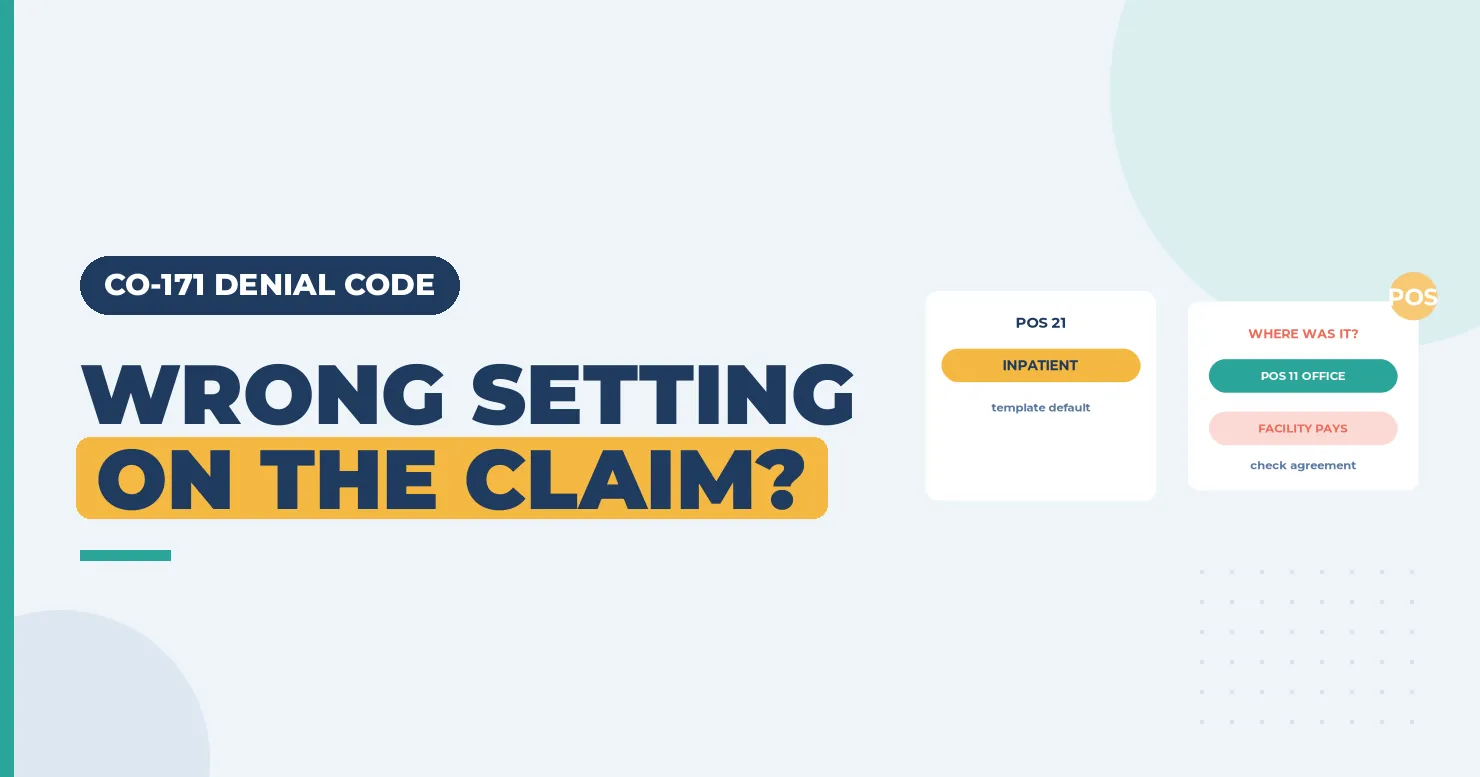
CO-171 adds a second condition to CO-170. It’s not just who performed the service, but where. The payer will pay this type of provider in some settings and not in others. A therapist may be payable in an office but not in an inpatient hospital, where the facility’s payment already covers that care. A home health aide may be payable at home but not in a skilled nursing facility. The place of service on the claim is usually what triggers it, so that’s where you start. (Primary source: X12 Claim Adjustment Reason Codes)
In brief: CARC 171 reads “Payment is denied when performed/billed by this type of provider in this type of facility.” Check the place of service code and the facility on the claim against where the service really happened. If the setting was coded wrong, correct it. If it was right, find out whether the facility is the one that should be paid.
Part of our denial codes library. Written by Manikandan J, CPC, CRCR, who has untangled place-of-service and facility billing denials for behavioral health and therapy groups. Published 22 October 2026. Last updated: 22 October 2026. Code wording quoted word for word from X12.
Official CARC 171 description
| Field | X12 text |
|---|---|
| Code | 171 |
| Description | “Payment is denied when performed/billed by this type of provider in this type of facility.” |
| X12 usage note | Refer to the 835 Healthcare Policy Identification Segment (loop 2110 Service Payment Information REF), if present. |
| Start | 06/30/2005 |
| Last modified | 07/01/2017 |
Source: X12 Claim Adjustment Reason Codes, checked 22 October 2026.
Key terms behind CARC 171
A place of service (POS) code is the two-digit code in Box 24B of the CMS-1500 that tells the payer where the service happened. CMS keeps the official POS code set. A facility type is the kind of setting, such as an inpatient hospital, skilled nursing facility or office. Consolidated billing is a rule under which the facility, not each outside provider, bills for certain services to its patients.
Common causes of CO-171
- Wrong POS on the claim. For example, a template defaults to POS 21 (inpatient hospital) for a visit that happened in the office.
- Service bundled into the facility payment. The plan pays the facility for that care, so an outside provider type can’t bill it separately.
- Provider type not allowed in that setting. A plan may pay a license type in outpatient settings only.
- Facility address mismatch. The service facility in Box 32 doesn’t match the POS.
Example scenario (fictional names), part 1
CO-171 Denial Example: What Happened
Jamal Carter bills for Brightwater Counseling Group. A licensed clinical social worker saw an established patient for depression (F33.1) in Brightwater’s office and billed 90837. The claim to Silverline Health, a fictional commercial plan, carried POS 21 in Box 24B.
The 835 showed CAS*CO*171 with remark LQ*HE*N95, “This provider type/provider specialty may not bill this service.” Silverline’s policy, named in the REF segment, said social workers weren’t paid separately for inpatient hospital services. The patient hadn’t been in a hospital.
Where did the inpatient setting come from, and what did Jamal need to change? Keep reading, or jump to how the CO-171 denial was resolved.
Remark codes often paired with CARC 171
| RARC | X12 wording | What it tells you |
|---|---|---|
| N95 | “This provider type/provider specialty may not bill this service.” | Provider type blocked in that setting |
| N79 | “Service billed is not compatible with patient location information.” | The POS and the service don’t fit |
| N538 | “A facility is responsible for payment to outside providers who furnish these services/supplies/drugs to its patients/residents.” | The facility must pay the outside provider |
See the X12 RARC list for the full set.
How to fix a CO-171 denial
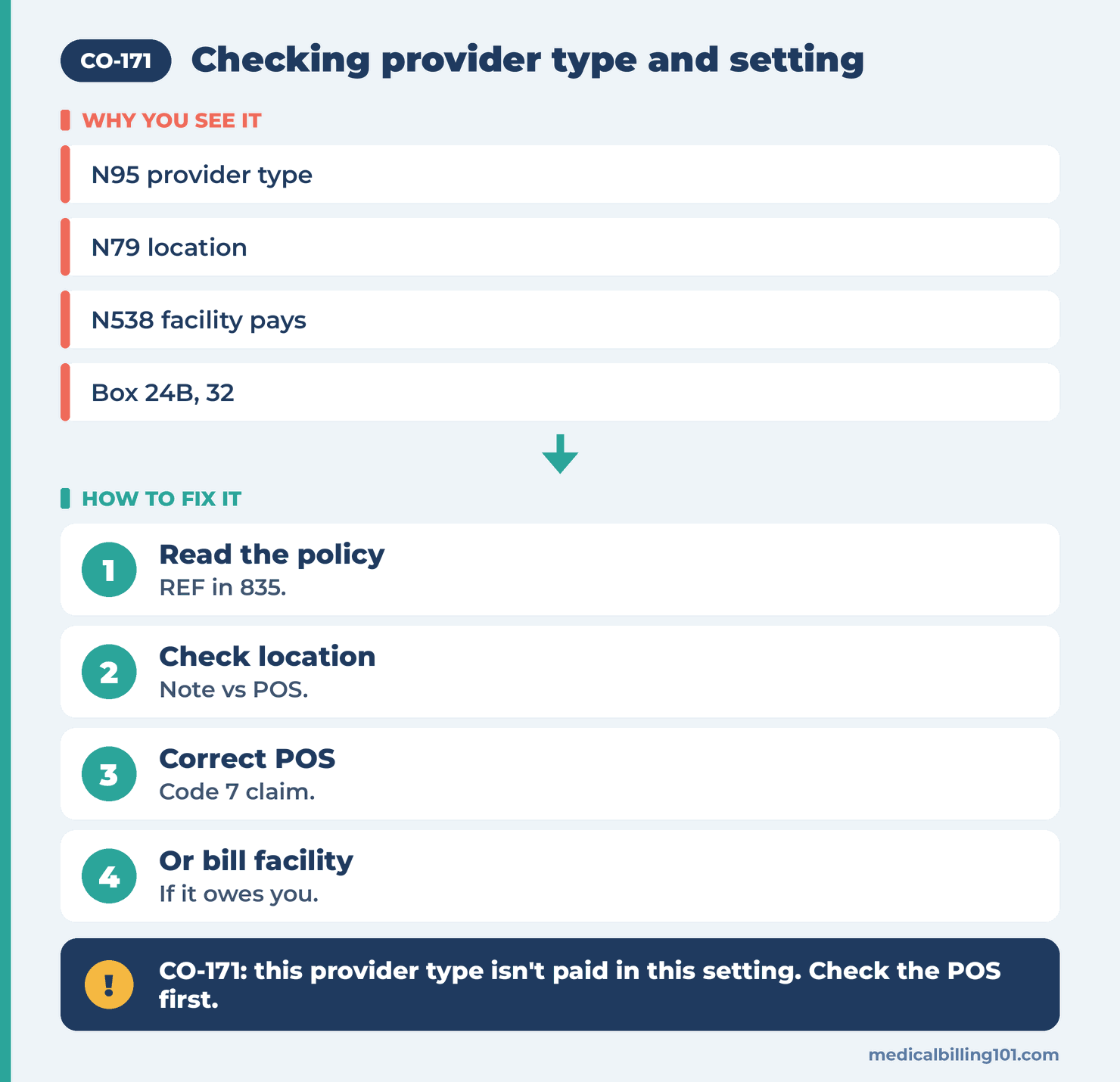
- Read the policy reference. The REF segment in the 835 service loop may name the policy.
- Check where the service happened. Compare the note’s location with Box 24B (POS) and Box 32 (service facility).
- If the POS was wrong, correct it and send a corrected claim with frequency code 7 and the original claim number.
- If the patient was in a facility, check whether the facility must pay you under its agreement or consolidated billing rules.
- If neither applies, the plan’s rule stands. Write off the CO amount and don’t bill the patient.
- Fix the template. Make sure POS defaults match each location and provider.
Example scenario (fictional names), part 2
How the CO-171 Denial Was Resolved
Jamal looked at the scheduling template. Brightwater’s providers also see patients at a partner hospital one day a week, and that template set POS 21. The social worker had been booked from the hospital template by mistake, even though the session was in the office.
Fix: he sent a corrected claim with Box 22 resubmission code 7, the original claim number and POS 11 (office) in Box 24B, with Brightwater’s office address in Box 32.
Outcome: Silverline paid the session at the office rate. Jamal locked POS to the location in the scheduling system, so a booking at the office can’t carry the hospital’s POS again.
Names and details are illustrative; no real patient data.


- Box 24B: POS 21 (inpatient hospital, from the wrong scheduling template) corrected to POS 11 (office).
- Box 32: service facility changed to the office address where the session happened.
- Box 22: resubmission code 7 with the original claim number.
- Box 24D / 21A: 90837 with F33.1 (entered as F331) is unchanged.
- UB-04 (facility): no place-of-service field; the inpatient bill (TOB 0111) is voided with 0118 and rebilled as outpatient TOB 0131 in FL 4.
Worked example (illustrative)
An outpatient physical therapy group treats a patient who, unknown to the group, is a resident in a skilled nursing facility under a Part A stay. The group bills POS 11 and the payer, seeing the SNF stay, denies with CO-171 and N538. The SNF is responsible for paying the outside provider under its arrangement, so the group bills the SNF directly under their agreement. The patient isn’t billed.
CO-171 vs similar codes
| Code | What it means | Main difference |
|---|---|---|
| CO-171 | Denied for this provider type in this facility type | Provider type plus setting |
| CO-170 | Denied for this type of provider | Provider type alone |
| CO-5 | Procedure code or bill type inconsistent with place of service | Code and setting don’t fit |
| CO-58 | Treatment deemed rendered in an inappropriate or invalid place of service | Setting itself is invalid |
Checklist
- POS codes match the real location in the note.
- Box 32 shows the address where the service happened.
- Scheduling templates set POS by location.
- Facility stays are checked before billing outpatient services.
Recap
CO-171 means the payer won’t pay this provider type in this kind of facility. Start with the place of service: if it was wrong, correct it. If it was right, check whether the facility owes you under its agreement. Otherwise the plan’s rule stands and the CO amount is a write-off.
FAQ
What does denial code CO-171 mean?
The payer won’t pay this service when this type of provider performs it in this type of facility.
Is CO-171 usually a place of service problem?
Often. A wrong POS code in Box 24B is a common trigger.
How is CO-171 different from CO-170?
CO-170 is about provider type alone. CO-171 is about provider type in a specific kind of setting.
Can I bill the patient for CO-171?
No. It’s a CO denial.
What if the patient was in a skilled nursing facility?
The facility may be responsible for paying you. Check its agreement and consolidated billing rules.
Where do I find the payer’s policy?
Check the REF segment in the 835 service loop and the payer’s provider manual.
Sources
How we checked: each code quote on this page was matched word for word with the X12 CARC and RARC lists on 22 October 2026.
- X12, Claim Adjustment Reason Codes (CARC 171, 170, 5, 58). Accessed 22 Oct 2026.
- X12, Remittance Advice Remark Codes (N95, N79, N538). Accessed 22 Oct 2026.
- CMS, Place of Service Code Set. Accessed 22 Oct 2026.
Last updated: 22 October 2026 · Educational content; not legal advice.