
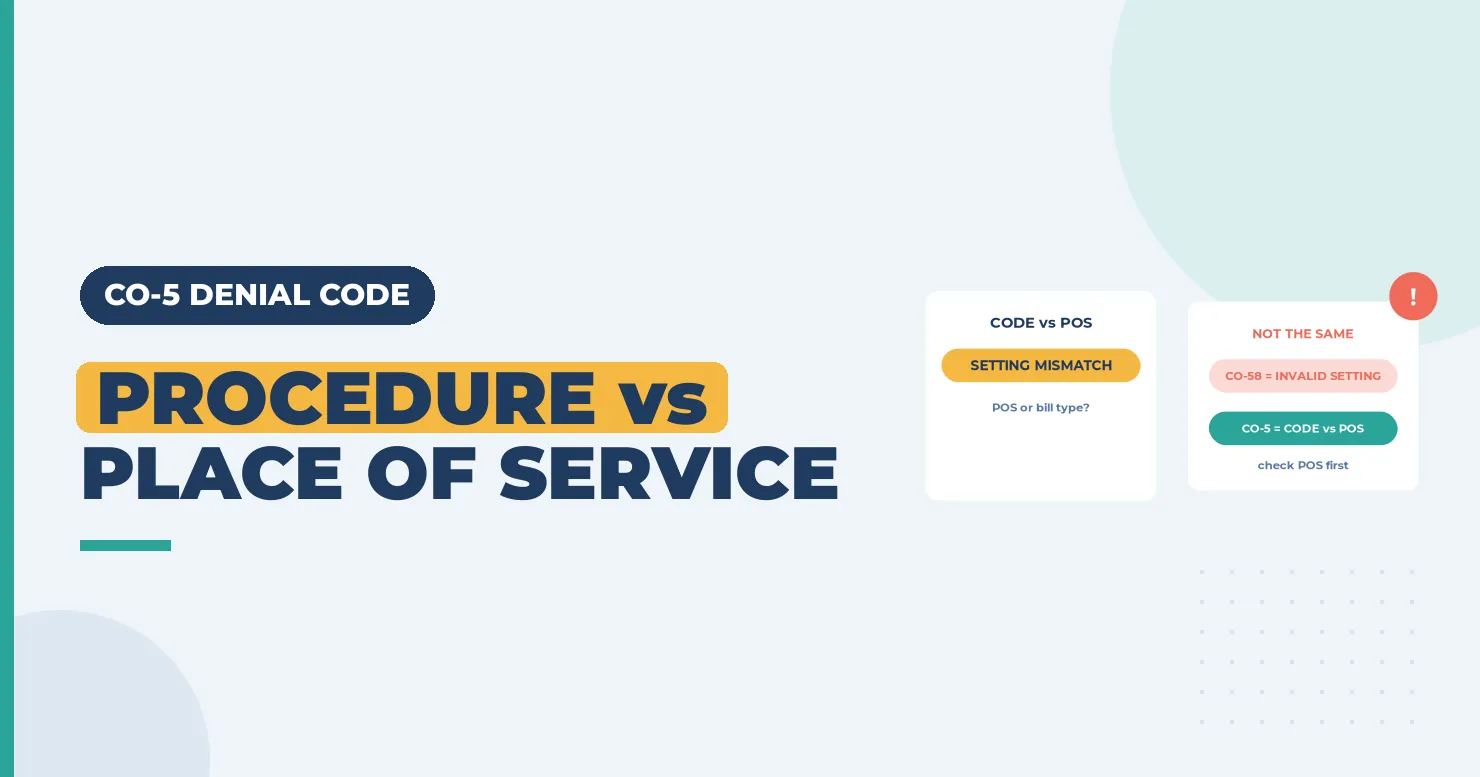
CO-5 is Claim Adjustment Reason Code 5 with group code CO. CARC 5 means the procedure code or type of bill is inconsistent with the place of service. Place of service (POS) is the two-digit code that tells the payer where the service happened. The payer compared the code you billed with the setting you reported. The two did not fit together. Many people search for “co 5 denial code”, and that is the phrase this page answers. (Primary sources: X12 Claim Adjustment Reason Codes · CMS Claims Processing Manual, Ch. 26 · CMS Claims Processing Manual, Ch. 22, §60.1)
Quick answer: Compare the POS code on the claim with where the service happened in the chart. Then compare the procedure code with that setting. Fix the wrong field and send a corrected claim. If both are right, appeal with the medical record and the payer’s policy.
Part of our denial codes library. Written by Manikandan, a revenue cycle management specialist with more than 10 years of US medical billing experience. Last reviewed: 16 October 2026. Official code wording is quoted word for word from X12; Medicare rules link to their CMS source.
CO-5 denial code description (official X12 wording)
X12 Claim Adjustment Reason Code 5, verbatim:
“The procedure code/type of bill is inconsistent with the place of service. Usage: Refer to the 835 Healthcare Policy Identification Segment (loop 2110 Service Payment Information REF), if present.”
Source: X12 Claim Adjustment Reason Codes, checked 16 October 2026. Start: 01/01/1995. Last Modified: 03/01/2018.
The CARC is 5. The group code is usually CO. CMS says CO adjustments are “generally… considered a write off for the provider and are not billed to the patient.”
What CO-5 means in plain English
- The payer ran a consistency edit. It compared the procedure code (or the type of bill on a facility claim) with the POS code.
- One of the two is probably wrong. Either the POS was keyed wrong, or the procedure code does not fit the setting.
- It is a claim data problem. It is not a statement that the plan excludes the service, and it is not a coverage determination about the patient’s benefits.
- The patient does not owe it. The CO group points to a provider-side fix.
- The 835 may help. X12 tells you to check the Healthcare Policy Identification Segment (a REF line) when it is present.
CO-5 vs CO-58, CO-4, CO-8, CO-6 and lookalikes
| Code | Official X12 idea | What it tells you |
|---|---|---|
| CO-5 | Procedure code/type of bill inconsistent with the place of service | Code vs setting mismatch. This page |
| 58 | Treatment deemed rendered in an inappropriate or invalid place of service | The payer says the setting itself is not valid for this treatment |
| 4 | Procedure code inconsistent with the modifier used | Modifier problem. See CO-4 |
| 8 | Procedure code inconsistent with the provider type/specialty (taxonomy) | Who billed, not where |
| 6 | Procedure/revenue code inconsistent with the patient’s age | Age edit. See CO-6 |
| 11 | Diagnosis inconsistent with the procedure | Dx vs service. See CO-11 |
| 50 | Not deemed a medical necessity by the payer | Necessity. See CO-50 |
Why the POS code matters
CMS keeps the place of service code set. Each code names a setting and carries a payment rate marker: F for facility, NF for non-facility. For example, CMS lists POS 11 as Office (NF), POS 21 as Inpatient Hospital (F), and POS 22 as On Campus-Outpatient Hospital (F). So the POS you pick can change how a payer prices the same procedure code.
CMS Claims Processing Manual, Ch. 26 says Item 24B on the CMS-1500 must identify “the setting, using a place of service code, for each item used or service performed.” It also says that for services paid under the Medicare Physician Fee Schedule (MPFS) and for anesthesia, only one POS may be submitted on the claim.
Common triggers for CO-5
- Wrong POS keyed. A hospital outpatient visit is billed with the office POS 11. CMS tells providers to use POS 19 or 22 for hospital outpatients and POS 21 for inpatients.
- Procedure code that does not fit the setting. Consider an office visit code billed with the inpatient hospital POS. CMS uses this very pair as its example of a valid POS that is inconsistent with the procedure.
- Template default. The practice management system fills in the same POS for every claim from a location, regardless of where the individual encounter occurred.
- Wrong type of bill on a facility claim. The bill type does not match the revenue codes or the service setting.
- Mixed settings on one claim. Services from two settings were placed on one claim.
Where CO-5 shows up in the 835
CLP*PCN61377*4*210.00*0.00*0.00*12*CLAIM552200~
SVC*HC:99213*210.00*0.00**1~
CAS*CO*5*210.00~
REF*0K*POLICY-ID-123~
- Status code 4 means the claim was denied.
- The line paid $0.
- CAS*CO*5*210.00 took the full charge as a procedure-vs-place-of-service adjustment.
- The optional REF may point to the payer policy behind the edit.
- This sample is illustrative only. Real remits vary. Save the full CAS and any remark codes.
How to fix CO-5: decision path
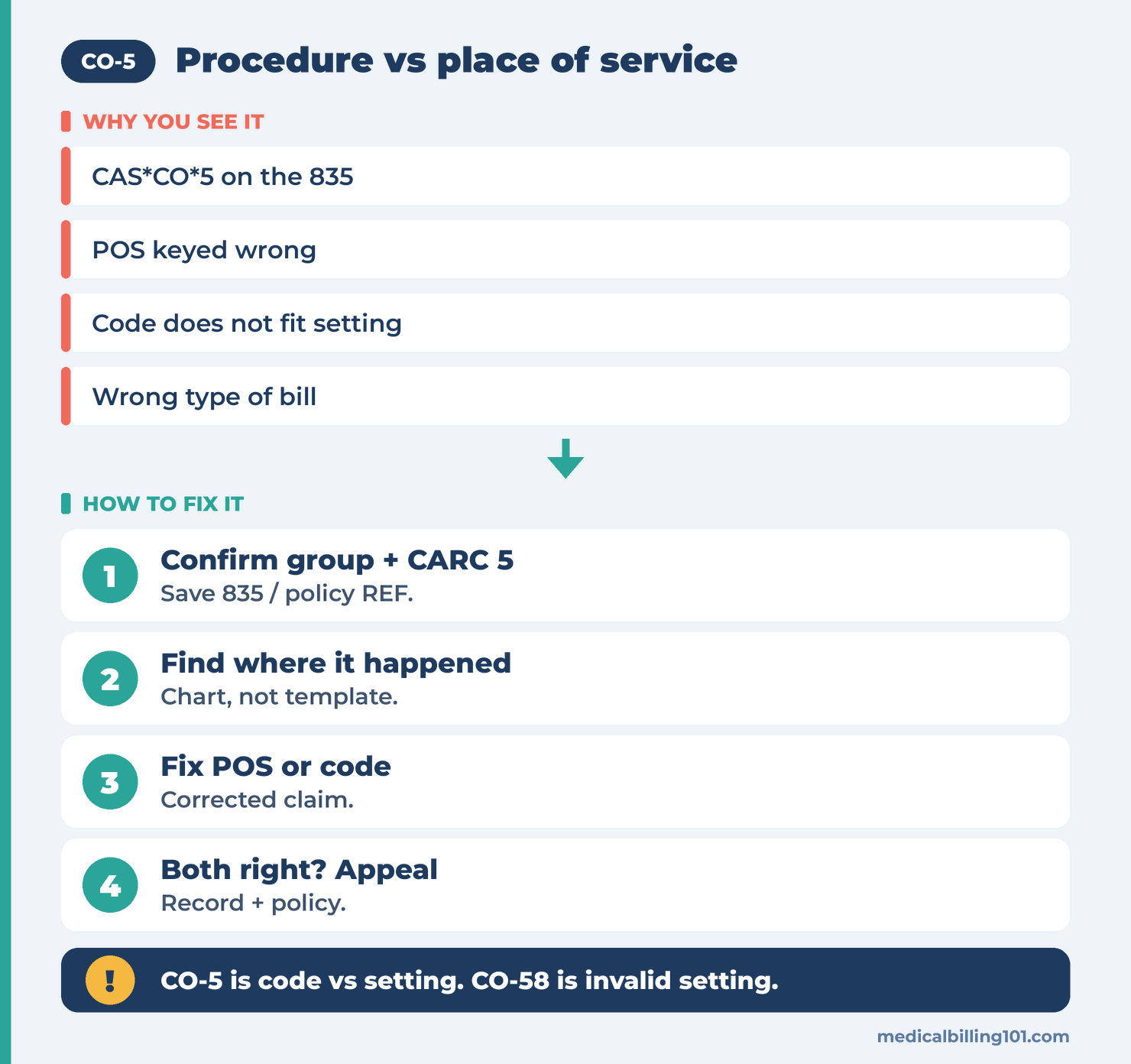
- Confirm the CAS segment. Check the group (CO), the reason (5), and the amount. Save the 835 and any policy REF.
- Find where the service happened. Use the chart, the schedule, and the facility record. Do not guess from the template.
- Read the POS on the claim. Check Item 24B on a CMS-1500 or the matching field on the 837P.
- Check the procedure code. Confirm the code is allowed in that setting under the payer’s policy.
- Check the bill type on a facility claim. Confirm it matches the revenue codes and the setting.
- If a field is wrong, fix it and send a corrected claim. Use the payer’s corrected-claim process.
- If both are right, appeal with the record and the policy. Ask the payer which edit fired.
- Fix the source. Update the template, the location setup, or the charge entry rule that created the mismatch.
Medicare, commercial and Medicaid notes
Medicare. CMS tells contractors to return a claim as unprocessable when the POS is missing or invalid. Ch. 26 §10.6 says to use group code CO, CARC 16 and RARC M77 in that case. When the POS is valid but inconsistent with the procedure, CMS says the contractor returns the service as unprocessable because it “typically will not know whether the procedure code or the place of service is incorrect.” So read the exact codes on a Medicare remit before you assume CO-5.
Commercial. Plans publish their own POS and site-of-service rules. Check the payer policy named in the REF line, if one is present.
Medicaid. State programs may limit some procedures to certain settings. Check the state fee schedule and provider manual.
Worked example (illustrative)
A physician sees a patient in a clinic suite that belongs to a hospital. The charge entry uses the default POS 11 (Office). The remit comes back with CAS*CO*5*210.00.
Reading it: The code and the POS did not fit the payer’s edit.
Check: The facility record shows the suite is a hospital outpatient department. Under CMS rules, that points to POS 19 or 22, not 11.
Fix: The biller changes the POS to the correct hospital outpatient code and sends a corrected claim. The biller also fixes the location default so the next claim is right.
Second scenario: The visit truly took place in a physician office. The POS 11 is right. The biller appeals with the visit note and the payer’s own policy, and asks which procedure and setting pair failed the edit.
Prevention checklist
- [ ] Set the POS from the actual service location, not from a template default.
- [ ] Review POS defaults for every location at least once a year.
- [ ] Run a claim scrubber edit for procedure code vs POS before filing.
- [ ] Keep one POS per claim where the payer requires it.
- [ ] Separate CARC 5 (code vs setting) from CARC 58 (invalid setting) in your workqueues.
- [ ] Keep the CARC and RARC guide handy for staff training.
Related denial codes
- CO-4: procedure code inconsistent with the modifier.
- CO-11: diagnosis inconsistent with the procedure.
- CO-50: not deemed medically necessary.
- CO-16: claim lacks information or has errors.
- CARC and RARC guide.
Key takeaways
CO-5 means the procedure code or type of bill does not fit the place of service. Check the POS first, then the code. Fix the field that is wrong and resubmit. Appeal only when both are right.
FAQ
What is the CO-5 denial code description?
X12 describes CARC 5 as “The procedure code/type of bill is inconsistent with the place of service.” CO-5 is that reason with group code CO.
Is CO-5 the same as CO-58?
No. CO-5 compares the code with the POS. CARC 58 says the treatment was rendered in an inappropriate or invalid place of service. Read the exact code on the remit.
Can I bill the patient for CO-5?
Usually no. The CO group means the amount is generally a provider write-off. Correct the claim first.
What does type of bill have to do with CO-5?
The type of bill is a code on facility claims that describes the kind of facility and bill. CARC 5 covers a mismatch between it and the place of service.
How do I fix CO-5 when the POS is correct?
Check the procedure code against the payer’s policy for that setting. If it is allowed, appeal with the record and ask which edit fired.
Does Medicare send CO-5 for a bad POS?
Not always. CMS tells contractors to return claims with a missing or invalid POS as unprocessable, using CO, CARC 16 and RARC M77. Read the exact codes on your remit.
Quick facts
| Item | Value |
|---|---|
| X12 code | 5 |
| X12 start | 01/01/1995 |
| Last modified | 03/01/2018 |
| Official wording | The procedure code/type of bill is inconsistent with the place of service |
| Usual group | CO |
| Common confusions | CO-58 (invalid setting), CO-4 (modifier) |
| Last reviewed | 16 October 2026 |
Sources
- X12, Claim Adjustment Reason Codes (CARC 4, 5, 6, 8, 11, 16, 50, 58). CARC 5 Start 01/01/1995; Last Modified 03/01/2018. Accessed 16 Oct 2026.
- CMS, Medicare Claims Processing Manual (IOM 100-04), Ch. 26, Item 24B, §10.5 and §10.6. Accessed 16 Oct 2026.
- CMS, Medicare Claims Processing Manual (IOM 100-04), Ch. 22, §60.1 Group Codes. Accessed 16 Oct 2026.
- Medical Billing 101, CO-4 guide.
- Medical Billing 101, CO-11 guide.
Code wording and Medicare rules on this page were checked on 16 October 2026 against X12 and CMS sources.
Last reviewed: 16 October 2026 · This page is educational and doesn’t replace payer-specific contracts or coding rules.