
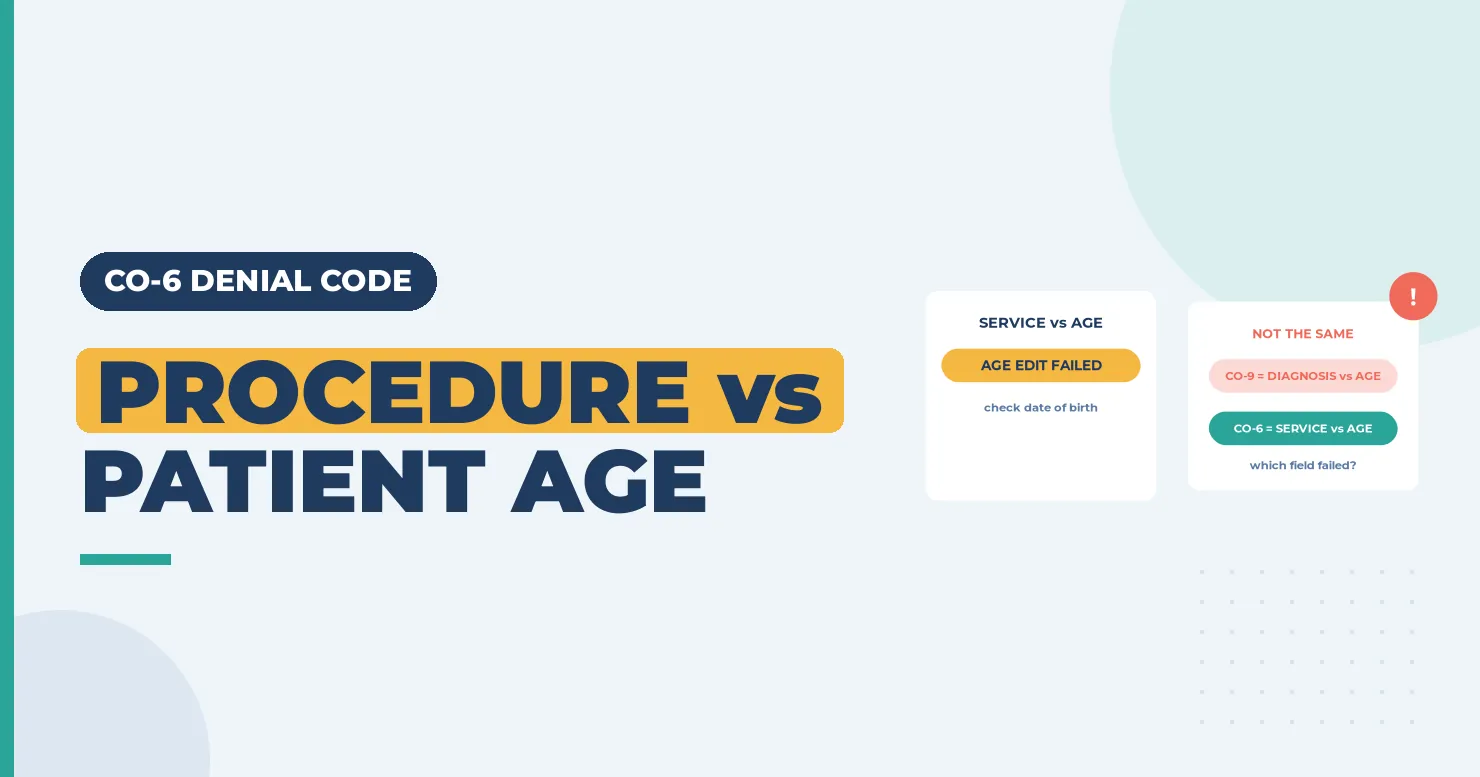
CO-6 is Claim Adjustment Reason Code 6 with group code CO. CARC 6 means the procedure or revenue code is inconsistent with the patient’s age. An age edit is a payer check that compares a billed service with the patient’s age on the date of service. The service was billed for a patient outside the age range the payer allows for that code. Many people search for “co 6 denial code”, and that is the phrase this page answers. (Primary sources: X12 Claim Adjustment Reason Codes · CMS Claims Processing Manual, Ch. 22, §60.1 · CMS Claims Processing Manual, Ch. 18, §20)
Quick answer: CO-6 is about the service code, not the diagnosis. Check the date of birth and date of service first. Then check the age rule for the procedure or revenue code. Fix a wrong date of birth or a wrong code and resubmit. If the service is right for that age, appeal with the record and the payer policy.
Part of our denial codes library. Written by Manikandan, a revenue cycle management specialist with more than 10 years of US medical billing experience. Last reviewed: 16 October 2026. Official code wording is quoted word for word from X12; Medicare rules link to their CMS source.
CO-6 denial code description (official X12 wording)
X12 Claim Adjustment Reason Code 6, verbatim:
“The procedure/revenue code is inconsistent with the patient’s age. Usage: Refer to the 835 Healthcare Policy Identification Segment (loop 2110 Service Payment Information REF), if present.”
Source: X12 Claim Adjustment Reason Codes, checked 16 October 2026. Start: 01/01/1995. Last Modified: 07/01/2017.
The CARC is 6. The group code is usually CO. CMS says CO adjustments are “generally… considered a write off for the provider and are not billed to the patient.”
What CO-6 means in plain English
- The payer compared the service with the patient’s age. The service is the CPT or HCPCS code, or the revenue code on a facility claim.
- The age did not fit. The patient was too young, too old, or outside a required age band on the date of service.
- It is a claim data and coding problem. It is not a statement that the plan excludes the benefit.
- The patient does not owe it. The CO group points to a provider-side fix.
- The 835 may name the edit. X12 points you to the policy REF line when it is present.
CO-6 vs CO-9, CO-7, CO-8 and lookalikes
| Code | Official X12 idea | What it tells you |
|---|---|---|
| CO-6 | Procedure/revenue code inconsistent with the patient’s age | Service vs age. This page |
| 9 | Diagnosis inconsistent with the patient’s age | Dx vs age. See CO-9 |
| 7 | Procedure/revenue code inconsistent with the patient’s gender | Service vs sex. See CO-7 |
| 10 | Diagnosis inconsistent with the patient’s gender | Dx vs sex. See CO-10 |
| 11 | Diagnosis inconsistent with the procedure | Dx vs service. See CO-11 |
| 8 | Procedure code inconsistent with the provider type/specialty (taxonomy) | Who billed the service |
| 96 | Non-covered charge(s) | Benefit exclusion. See CO-96 |
How age limits reach a claim
Some services carry age rules. Medicare screening mammography is a clear public example. CMS Claims Processing Manual, Ch. 18, §20 says:
- Under age 35: “No payment allowed for screening mammography.”
- Age 35 to 39: one baseline screening mammography between the woman’s 35th and 40th birthdays.
- Over age 39: annual screening, once 11 full months have passed after the month of the last screening.
A payer edit built on rules like these can compare the code with the date of birth. When the age falls outside the allowed band, the line can come back with CARC 6. The payer may use a different CARC for a frequency limit, so read the exact code on your remit. Other age rules come from payer policy, code descriptors, or program rules.
Common triggers for CO-6
- Wrong date of birth. A transposed digit or a wrong year makes the patient look too young or too old.
- Wrong patient selected. The charge was posted to a different family member.
- Age-restricted service billed outside its band. For example, a screening service billed before the age the policy allows.
- Wrong code chosen. A pediatric or adult version of a code was picked by mistake.
- Revenue code that does not fit the age group on a facility claim.
Where CO-6 shows up in the 835
CLP*PCN70122*4*95.00*0.00*0.00*12*CLAIM660100~
SVC*HC:77067*95.00*0.00**1~
CAS*CO*6*95.00~
REF*0K*AGE-EDIT-14~
- Status code 4 means the claim was denied.
- The line paid $0.
- CAS*CO*6*95.00 took the full charge as a service-vs-age adjustment.
- The optional REF may name the payer policy behind the edit.
- This sample is illustrative only. Real remits vary.
How to fix CO-6: decision path
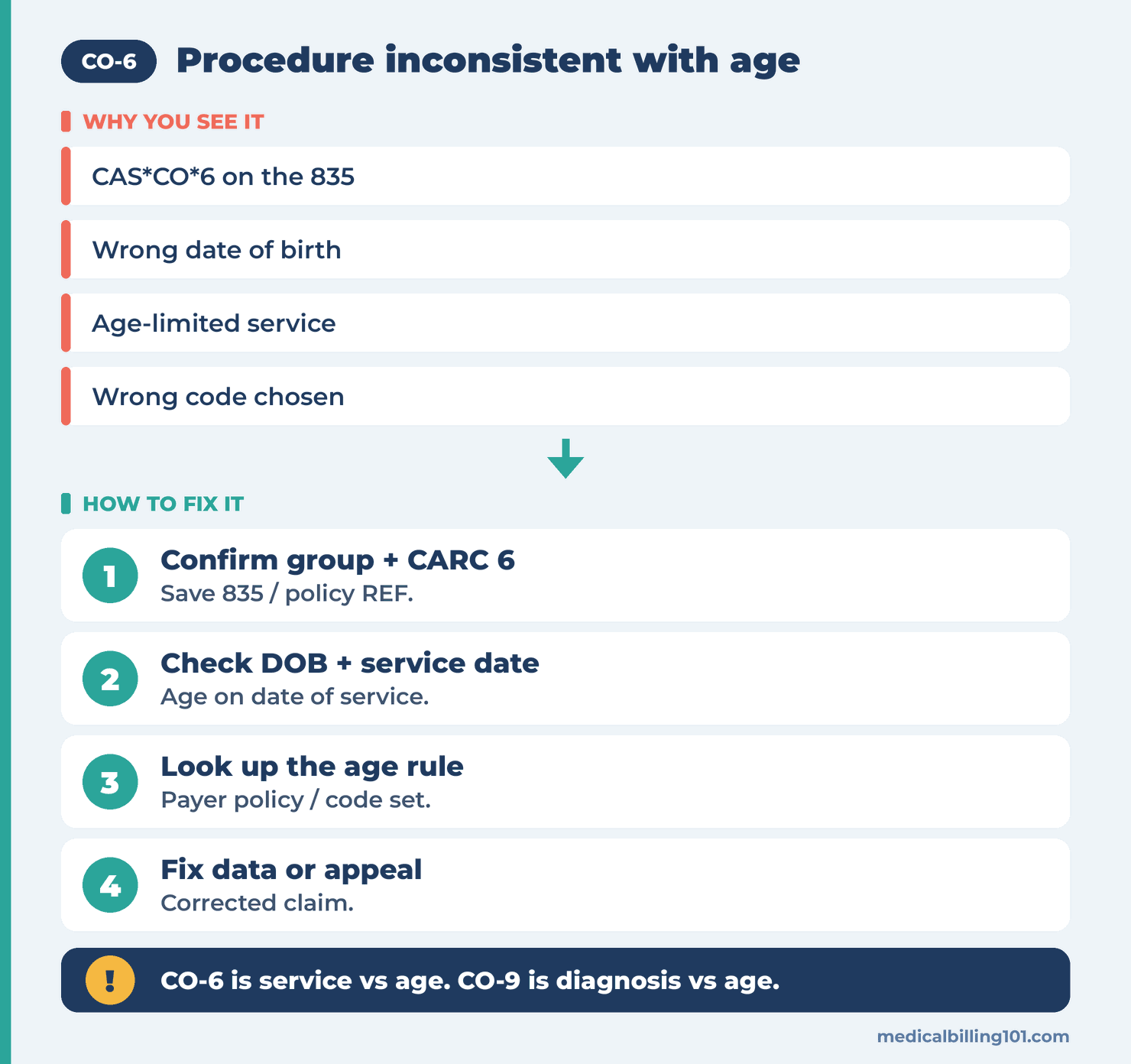
- Confirm the CAS segment. Check the group (CO), the reason (6), and the amount. Save the remit and any policy REF.
- Check the date of birth. Compare the claim with the patient record, the insurance card, and the eligibility response.
- Check the date of service. Age is measured on that date, not on the date you bill.
- Look up the age rule for the procedure or revenue code in the payer policy or the code set.
- If the data is wrong, fix the demographics or the code and send a corrected claim.
- If the data is right and the service was needed, appeal with the record and the policy. Ask the payer for the rule it applied.
- Do not move the line to the patient while the group is CO.
- Fix the source. Add an age check at charge entry for age-restricted codes.
Medicare, commercial and Medicaid notes
Medicare. Public rules such as the screening mammography age bands in Ch. 18 §20 are the source for many age limits. Check the National and Local Coverage Determination for the service.
Commercial. Many plans load age limits for preventive and pediatric services from policy documents. Ask the payer for the policy named in the REF line.
Medicaid. State programs may set age bands for screening and pediatric services. Check the state fee schedule and provider manual.
Worked example (illustrative)
A practice bills a screening mammography for a patient who was born in 1976. Charge entry keyed the birth year as 1996 by mistake. On the date of service the claim shows an age of 30. The remit shows CAS*CO*6*95.00.
Reading it: The date of birth on the claim put the patient under 35. CMS says no payment is allowed for screening mammography under age 35, so the edit fired.
Check: The insurance card and the eligibility response both show 1976. The claim has a keying error, so the registration record is the one that needs to be corrected.
Fix: The biller corrects the date of birth in the patient record and sends a corrected claim. The biller also adds a date-of-birth verification step at check-in so the same mistake is caught before the claim is created.
Second scenario: The card also shows 1996. The patient really is 30. The service is outside the CMS age band for screening mammography. The biller does not appeal, because the service is outside the age band, and the line stays a write-off under CO.
Prevention checklist
- [ ] Verify the date of birth at every check-in against the card.
- [ ] Add age checks for age-restricted codes at charge entry.
- [ ] Keep a short list of the age rules your top payers apply.
- [ ] Separate CARC 6 (service vs age) from CARC 9 (diagnosis vs age) in your workqueues.
- [ ] Review every CO-6 remit for a data-entry pattern.
- [ ] Keep the CARC and RARC guide handy for staff training.
Related denial codes
- CO-9: diagnosis inconsistent with the patient’s age.
- CO-7: procedure or revenue code inconsistent with the patient’s gender.
- CO-11: diagnosis inconsistent with the procedure.
- CO-96: non-covered charge(s).
- CARC and RARC guide.
Key takeaways
CO-6 means the billed service does not fit the patient’s age. Check the date of birth first, then the service’s age rule. Fix the data or the code and resubmit. Appeal only when the service is right for that age.
FAQ
What is the CO-6 denial code description?
X12 describes CARC 6 as “The procedure/revenue code is inconsistent with the patient’s age.” CO-6 is that reason with group code CO.
Is CO-6 the same as CO-9?
No. CO-6 compares the procedure or revenue code with age. CO-9 compares the diagnosis with age. Check which field failed.
Can I bill the patient for CO-6?
Usually no. The CO group means the amount is generally a provider write-off. Correct the claim first.
Which services have age limits?
Some preventive, pediatric, and screening services do. For example, Medicare pays screening mammography only for women age 35 and over, under CMS Ch. 18 §20. Check the payer policy for the code you billed.
How do I fix CO-6 when the age is correct?
Check the payer policy for the age rule. If the service is allowed at that age, appeal with the record and ask which rule the payer used.
Is CO-6 a denial for no coverage?
No. It is a consistency edit between the service and the age. Non-covered services usually come back as CARC 96.
Quick facts
| Item | Value |
|---|---|
| X12 code | 6 |
| X12 start | 01/01/1995 |
| Last modified | 07/01/2017 |
| Official wording | The procedure/revenue code is inconsistent with the patient’s age |
| Usual group | CO |
| Common confusions | CO-9 (diagnosis vs age), CO-96 (non-covered) |
| Last reviewed | 16 October 2026 |
Sources
- X12, Claim Adjustment Reason Codes (CARC 6, 7, 8, 9, 10, 11, 96). CARC 6 Start 01/01/1995; Last Modified 07/01/2017. Accessed 16 Oct 2026.
- CMS, Medicare Claims Processing Manual (IOM 100-04), Ch. 18, §20 Mammography Services. Accessed 16 Oct 2026.
- CMS, Medicare Claims Processing Manual (IOM 100-04), Ch. 22, §60.1 Group Codes. Accessed 16 Oct 2026.
- Medical Billing 101, CO-9 guide.
- Medical Billing 101, CO-11 guide.
Code wording and Medicare rules on this page were checked on 16 October 2026 against X12 and CMS sources.
Last reviewed: 16 October 2026 · This page is educational and doesn’t replace payer-specific contracts or coding rules.