

CO-172 is a payment change, not a flat denial. The payer paid the service but at a different rate because of the specialty it has on file for the provider. Some plans pay specialists and generalists differently for the same code. Others reduce payment when a code falls outside what they expect from that specialty. The problem is often not the specialty itself but a mismatch: the payer’s file, the NPI taxonomy and the claim all say different things. (Primary source: X12 Claim Adjustment Reason Codes)
In brief: CARC 172 reads “Payment is adjusted when performed/billed by a provider of this specialty.” Check the specialty the payer has on file, the taxonomy in NPPES and the taxonomy on the claim. If they disagree, fix the enrollment and send a corrected claim. If they agree, the adjustment follows the contract.
Part of our denial codes library. Written by Manikandan J, CPC, CRCR, who has cleaned up provider enrollment and taxonomy data for specialty groups. Published 22 October 2026. Last updated: 22 October 2026. Code wording quoted word for word from X12.
Official CARC 172 description
| Field | X12 text |
|---|---|
| Code | 172 |
| Description | “Payment is adjusted when performed/billed by a provider of this specialty.” |
| X12 usage note | Refer to the 835 Healthcare Policy Identification Segment (loop 2110 Service Payment Information REF), if present. |
| Start | 06/30/2005 |
| Last modified | 07/01/2017 |
Source: X12 Claim Adjustment Reason Codes, checked 22 October 2026.
Key terms behind CARC 172
A taxonomy code is a ten-character code that describes a provider’s type and specialty, such as 207RC0000X for cardiovascular disease. The NUCC taxonomy code set defines them. A specialty differential is a contract term that pays a different rate depending on specialty. Enrollment data is the specialty and taxonomy the payer stored when it credentialed the provider.
CMS’s NPPES NPI Registry shows the taxonomy each provider chose when getting an NPI. Many payers compare that with their own records.
Common causes of CO-172
- Old enrollment data. For example, a physician finished a fellowship and the payer still lists internal medicine instead of cardiology.
- Taxonomy not on the claim. Some payers need the taxonomy on the claim to apply the right specialty rate.
- Wrong primary taxonomy in NPPES. The NPI record lists a general specialty first.
- Contract terms. The plan really does pay that specialty less for the code.
Example scenario (fictional names), part 1
CO-172 Denial Example: What Happened
Sofia Lindqvist bills for Crestline Heart & Vascular. Dr. Ahmed Karimi joined after a cardiology fellowship and saw a new patient with chest pain (R07.9) and ordered tests. Crestline billed 99204 to Evergreen Plains Health, a fictional commercial plan, with no taxonomy on the claim.
The 835 paid less than Crestline’s cardiology rate. It showed CAS*CO*172 for the difference with remark LQ*HE*N95, “This provider type/provider specialty may not bill this service.” The REF segment pointed to Evergreen’s specialty rate policy.
Was the lower rate right, or was Evergreen paying Dr. Karimi as someone he no longer was? Keep reading, or jump to how the CO-172 denial was resolved.
Remark codes often paired with CARC 172
| RARC | X12 wording | What it tells you |
|---|---|---|
| N95 | “This provider type/provider specialty may not bill this service.” | The specialty on file drove the change |
| N381 | “Alert: Consult our contractual agreement for restrictions/billing/payment information related to these charges.” | Specialty rates are in the contract |
See the X12 RARC list for the full set.
How to fix a CO-172 adjustment
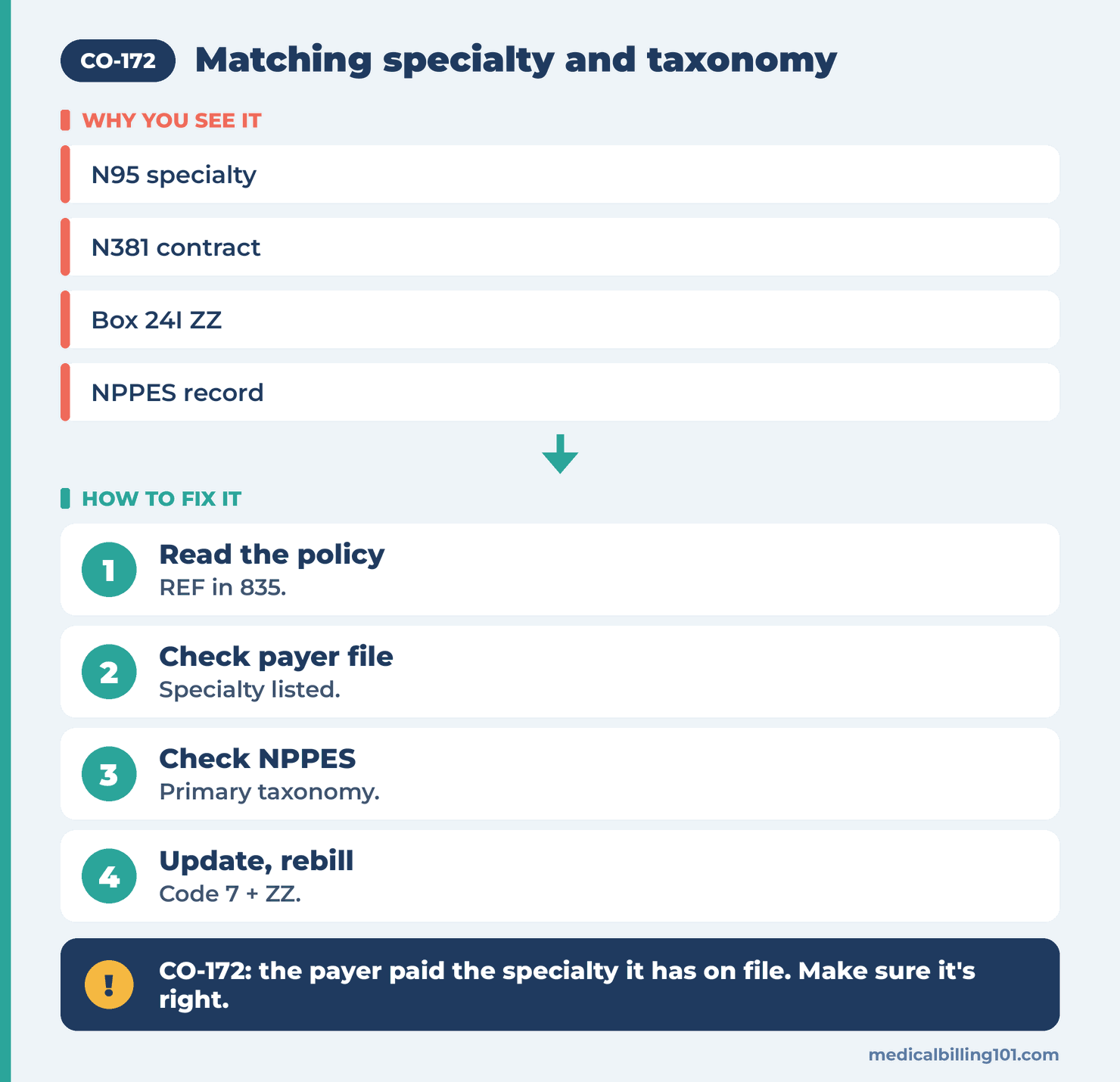
- Read the policy reference. The REF segment in the 835 service loop may name the specialty policy.
- Check the payer’s file. Ask provider relations or check the portal for the specialty on the provider’s record.
- Check NPPES. Make sure the primary taxonomy matches the provider’s real specialty.
- Add taxonomy to the claim if the payer needs it: qualifier ZZ in Box 24I and the code in the shaded part of Box 24J.
- Update enrollment if the payer’s file is wrong, then send a corrected claim with frequency code 7.
- If everything agrees, the adjustment follows the contract. Post it as a contractual adjustment.
Example scenario (fictional names), part 2
How the CO-172 Denial Was Resolved
Sofia checked Evergreen’s portal. Dr. Karimi was still listed as internal medicine from his residency enrollment. His NPPES record already showed 207RC0000X as primary, but Evergreen hadn’t updated its file. Its policy said claims needed the taxonomy to apply specialty rates.
Fix: Sofia sent Evergreen an enrollment update with his board certification. Once it posted, she sent a corrected claim with Box 22 resubmission code 7, the original claim number, ZZ in the shaded Box 24I and 207RC0000X in the shaded Box 24J.
Outcome: Evergreen paid the difference at the cardiology rate. Crestline now adds taxonomy to every claim for that payer and checks payer files whenever a provider finishes a fellowship.
Names and details are illustrative; no real patient data.
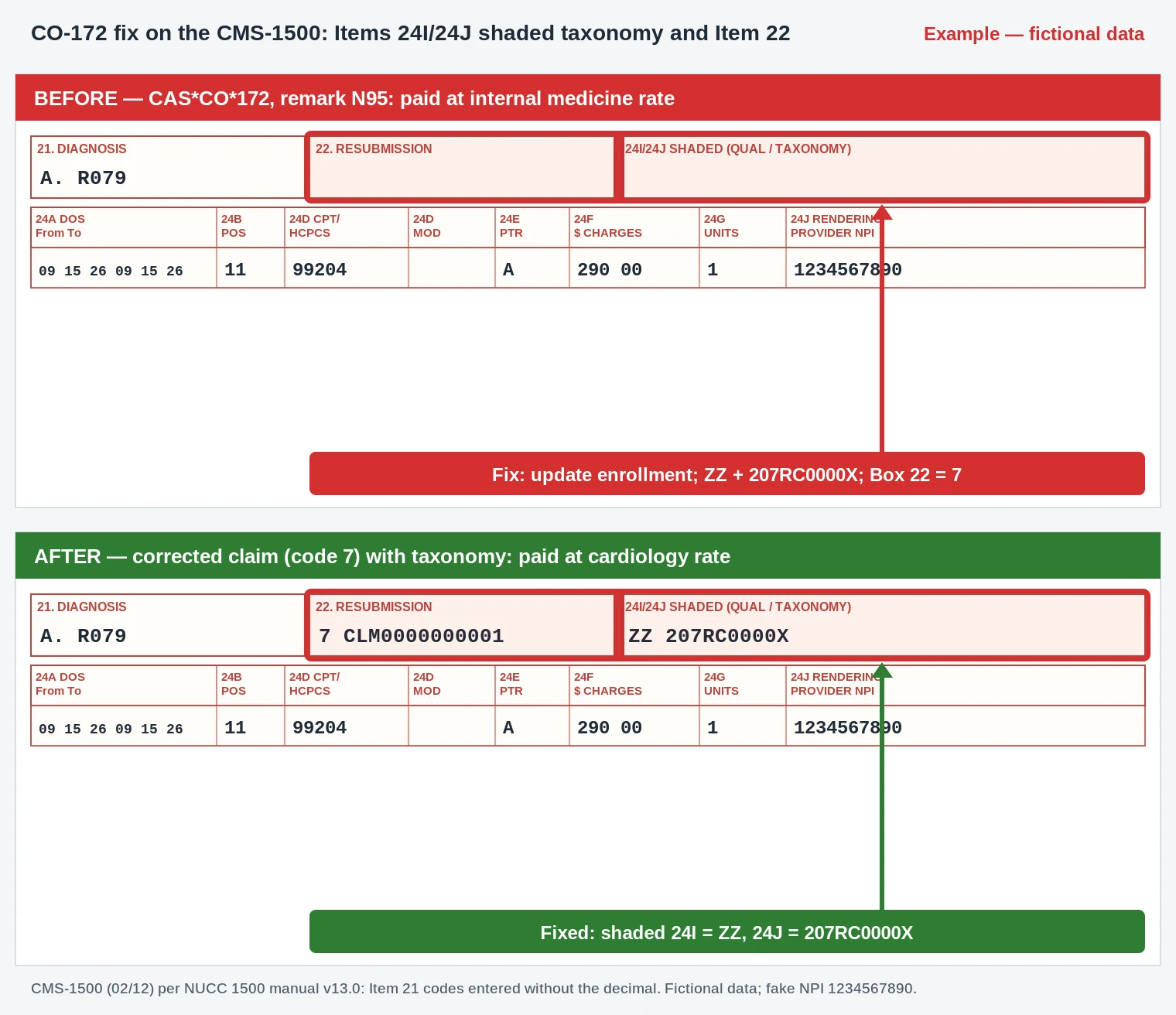
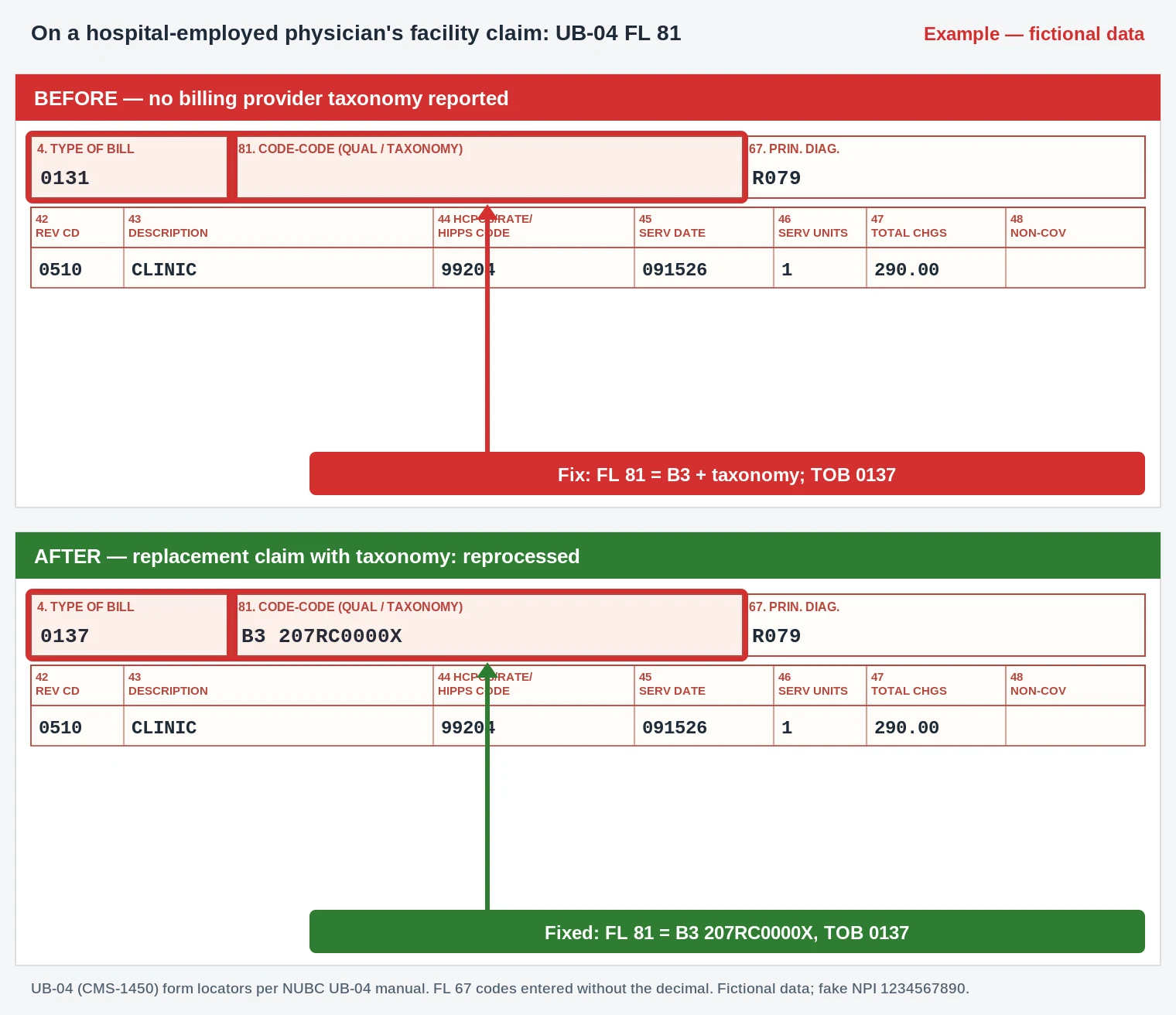
- Box 24I / 24J shaded / FL 81: taxonomy 207RC0000X (cardiovascular disease) added with qualifier ZZ on the CMS-1500, or B3 in FL 81 on the UB-04.
- Enrollment: payer specialty updated from internal medicine to cardiology before the corrected claim was sent.
- Box 22 / FL 4 + FL 64: resubmission code 7 with the original claim number (type of bill 0137).
- Box 24D / FL 44: 99204 with R07.9 (entered as R079) is unchanged.
Worked example (illustrative)
A family medicine physician performs a skin biopsy (11102). The plan pays dermatologists and family physicians the same for 11102, but it pays less to a provider listed as a nurse practitioner specialty. The claim gets CO-172 because the physician’s NPI was enrolled with the wrong specialty during a group merger. The group fixes the enrollment and sends a corrected claim. The plan reprocesses at the physician rate.
CO-172 vs similar codes
| Code | What it means | Main difference |
|---|---|---|
| CO-172 | Payment adjusted for this specialty | Reduced, not denied |
| CO-170 | Denied for this type of provider | Full denial for provider type |
| CO-8 | Procedure inconsistent with provider type or specialty | Code doesn’t fit the specialty |
| CO-45 | Charge exceeds contracted amount | Normal contract reduction |
Checklist
- Payer enrollment specialty matches board certification.
- NPPES primary taxonomy is current.
- Taxonomy is on claims for payers that need it.
- Enrollment updates go out when providers finish training or change roles.
Recap
CO-172 means the payer adjusted payment because of the provider’s specialty. Compare the payer’s file, NPPES and the claim. Fix enrollment and send a corrected claim with the taxonomy when they disagree. When they agree, the adjustment is a contract term.
FAQ
What does CO-172 mean?
The payer adjusted the payment because of the specialty it has on file for the provider.
Is CO-172 a denial?
Not usually. It’s a payment change. The service was paid, at a different rate.
Where does taxonomy go on the CMS-1500?
Qualifier ZZ in the shaded part of Box 24I and the taxonomy code in the shaded part of Box 24J for the rendering provider.
How do I fix a wrong specialty on file?
Send the payer an enrollment update with proof, such as board certification, then send a corrected claim.
Can I bill the patient for CO-172?
No. The CO amount isn’t the patient’s responsibility.
How is CO-172 different from CO-170?
CO-170 denies the service for that provider type. CO-172 adjusts the payment for that specialty.
Sources
How we checked: each code quote on this page was matched word for word with the X12 CARC and RARC lists on 22 October 2026.
- X12, Claim Adjustment Reason Codes (CARC 172, 170, 8, 45). Accessed 22 Oct 2026.
- X12, Remittance Advice Remark Codes (N95, N381). Accessed 22 Oct 2026.
- NUCC, Health Care Provider Taxonomy code set. Accessed 22 Oct 2026.
- CMS, NPPES NPI Registry. Accessed 22 Oct 2026.
Last updated: 22 October 2026 · Educational content; not legal advice.