
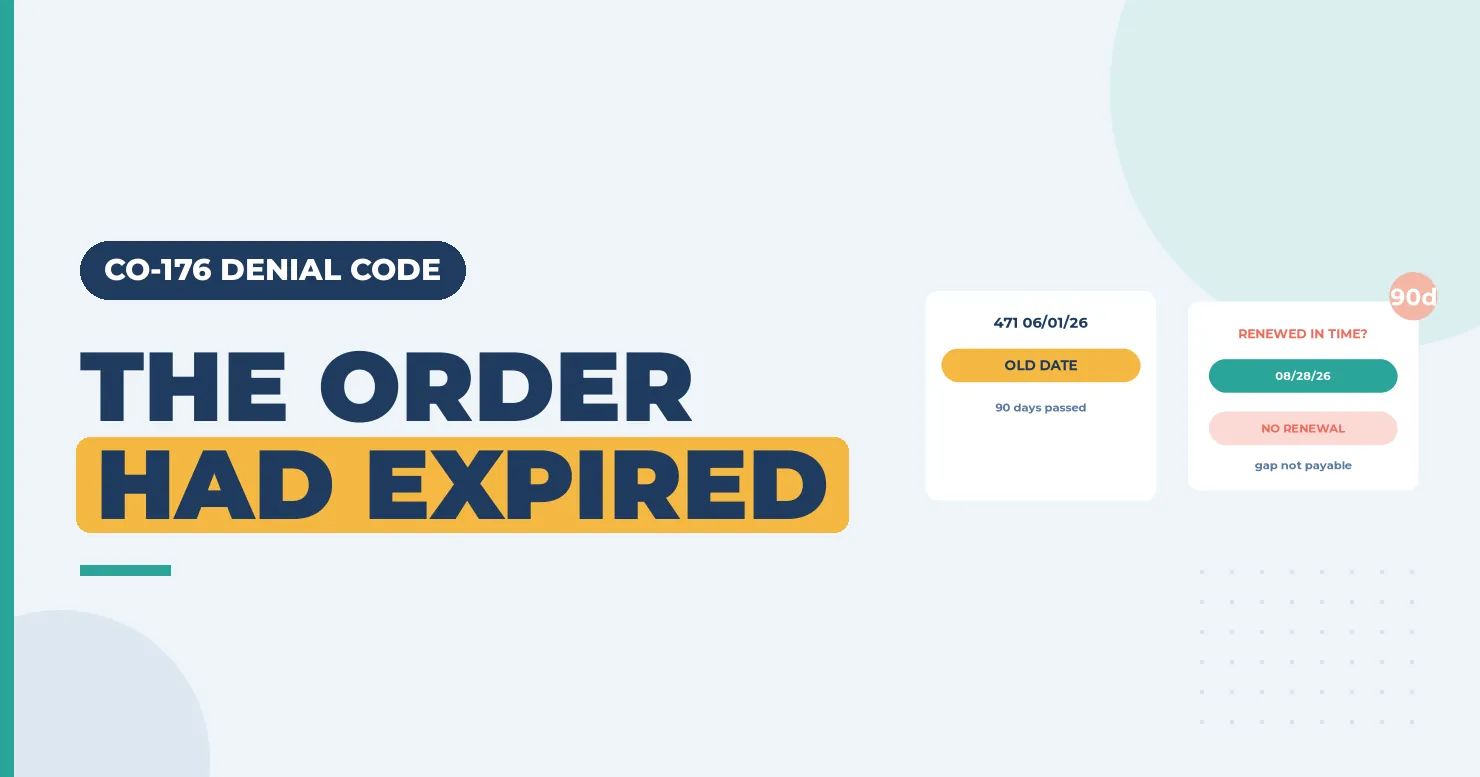
CO-176 means the order was valid once, but not on the date of service. Many plans put a shelf life on prescriptions for therapy, supplies and equipment. A therapy referral may be good for a set number of days or visits. A supply order may need renewing every year. When the claim shows a service after the order’s end, the plan denies it. Sometimes the renewal exists and the claim just reported the old date. Sometimes no one renewed it in time. (Primary source: X12 Claim Adjustment Reason Codes)
In brief: CARC 176 reads “Prescription is not current.” Find the plan’s renewal rule, check whether a renewed order was signed before the date of service, and make sure the claim reports it. If it was, correct the claim. If it wasn’t, services between the old order’s end and the renewal aren’t usually payable.
Part of our denial codes library. Written by Manikandan J, CPC, CRCR, who has managed referral and order tracking for outpatient therapy clinics. Published 22 October 2026. Last updated: 22 October 2026. Code wording quoted word for word from X12.
Official CARC 176 description
| Field | X12 text |
|---|---|
| Code | 176 |
| Description | “Prescription is not current.” |
| Start | 06/30/2005 |
| Last modified | 09/30/2007 |
Source: X12 Claim Adjustment Reason Codes, checked 22 October 2026.
Key terms behind CARC 176
A renewal rule is a plan’s limit on how long an order stays valid, by days, visits or both. A prescription date is the date the order was signed. On the CMS-1500, the NUCC instructions let you report it in Item 15 with qualifier 471 (prescription). A plan of care is the therapist’s treatment plan, which some plans also require the physician to certify on a schedule.
CMS explains certification and recertification of therapy plans of care for Medicare in its Medicare Benefit Policy Manual.
Common causes of CO-176
- The claim reported the old order. For example, Box 15 still showed the first prescription date after a renewal.
- No renewal before the visit. The clinic kept treating after the order expired.
- Visit cap reached. The order allowed 12 visits and the claim was the 13th.
- Annual supply orders lapsed. A resupply went out after the yearly order ended.
Example scenario (fictional names), part 1
CO-176 Denial Example: What Happened
Mateo Silva bills for Riverbend Physical Therapy. A patient with low back pain (M54.50) was in a course of therapy under a physician’s prescription signed 1 June. Harborview Health, a fictional plan, treats therapy prescriptions as good for 90 days.
The physician renewed the prescription on 28 August. On 15 September Riverbend billed 97110 and 97140, and Box 15 still showed qualifier 471 with 06/01/26. The 835 showed CAS*CO*176 on both lines with remark LQ*HE*N456, “Incomplete/invalid Physician Order.”
Did Riverbend need a new prescription, or just a corrected claim? Keep reading, or jump to how the CO-176 denial was resolved.
Remark codes often paired with CARC 176
| RARC | X12 wording | What it tells you |
|---|---|---|
| N456 | “Incomplete/invalid Physician Order.” | The order on file doesn’t cover the date |
| N57 | “Missing/incomplete/invalid prescribing date.” | The prescription date is missing or out of range |
| N455 | “Missing Physician Order.” | No current order on file |
See the X12 RARC list for the full set.
How to fix a CO-176 denial
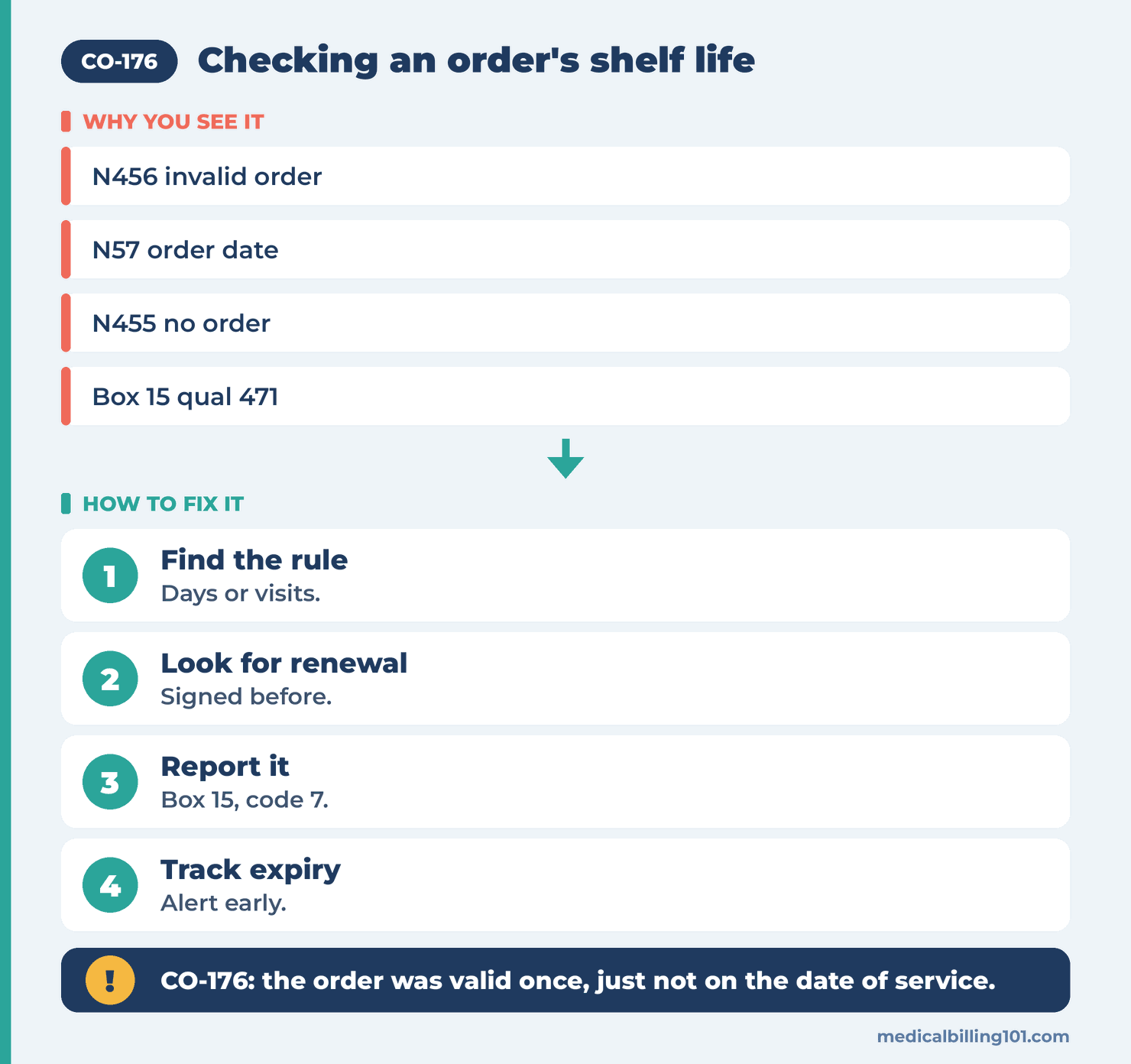
- Find the plan’s renewal rule. Days, visits or both, and whether it counts from the signature date.
- Check for a renewal. Look for an order signed before the date of service.
- If a renewal exists, report its date on the claim (Box 15, qualifier 471) and send a corrected claim with frequency code 7.
- If no renewal exists, get one before further visits. Services after the old order’s end and before the renewal usually aren’t payable.
- Don’t bill the patient for a CO amount.
- Track expiry. Set alerts at least two weeks before each order ends.
Example scenario (fictional names), part 2
How the CO-176 Denial Was Resolved
Mateo found the renewed prescription in the chart, signed on 28 August, well before the 15 September visit. Riverbend’s billing system had kept the first prescription date on the patient’s account and copied it onto every claim.
Fix: he sent a corrected claim with Box 22 resubmission code 7, the original claim number and Box 15 showing 471 with 08/28/26.
Outcome: Harborview paid both lines. Riverbend changed its system so a new prescription replaces the old date on the account, and added a 75-day alert on every therapy prescription so renewals come in before day 90.
Names and details are illustrative; no real patient data.
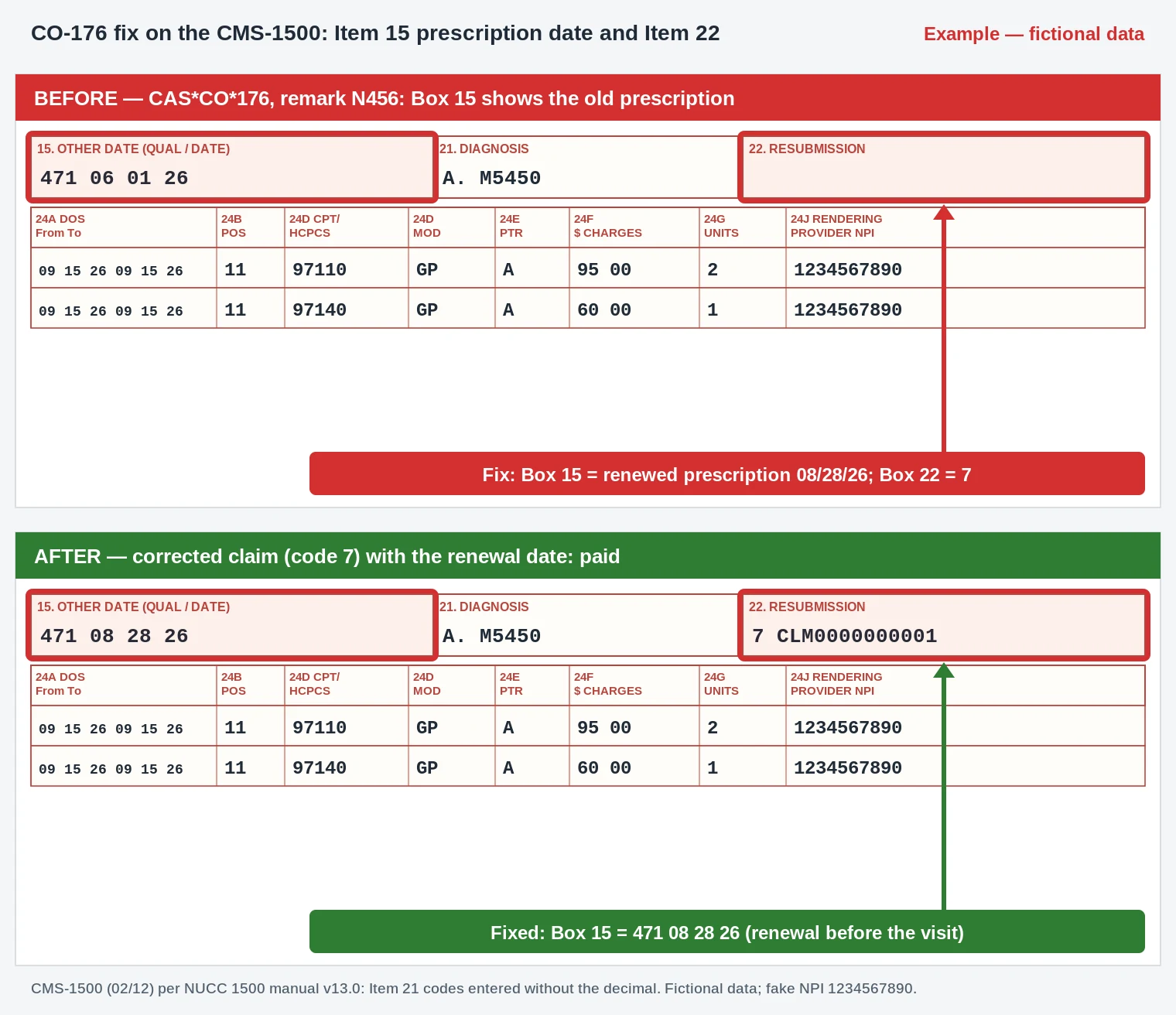
UB-04 not shown: the therapy was billed by a private physical therapy practice on the CMS-1500, so no facility claim applies.
- Box 15: qualifier 471 (prescription) date changed from 06/01/26 (expired after 90 days) to 08/28/26, the renewal signed before the 09/15/26 visit.
- Box 22: resubmission code 7 with the original claim number.
- Box 24D: 97110 x2 and 97140, both with modifier GP, and M54.50 (entered as M5450) are unchanged.
Worked example (illustrative)
A supplier ships diabetic testing supplies every three months under an order signed last October. The plan requires a new order every 12 months. The October shipment this year goes out before the renewal arrives and draws CO-176. The supplier gets a new order signed on 20 October. The shipment dated 18 October isn’t payable under the old order. The supplier writes it off and makes sure future shipments go out only after the renewal date.
CO-176 vs similar codes
| Code | What it means | Main difference |
|---|---|---|
| CO-176 | Prescription is not current | Order expired |
| CO-175 | Prescription is incomplete | Order missing elements |
| CO-174 | Not prescribed prior to delivery | Order dated after delivery |
| CO-173 | Not prescribed by a physician | Wrong or missing prescriber |
Order tracking checklist
- Each order’s end date and visit limit are in the system.
- Renewal requests go out before the end date.
- New order dates replace old ones on the account.
- Box 15 reports the current prescription date with qualifier 471 when the payer uses it.
Recap
CO-176 means the order had expired on the date of service. Check the plan’s renewal rule and whether a renewal was signed in time. If so, report it on a corrected claim. If not, get one now, and write off services that fell in the gap.
FAQ
What does denial code CO-176 mean?
The prescription behind the claim wasn’t current on the date of service.
How long are prescriptions valid?
It depends on the plan and the service. Check the plan’s renewal rule for days, visits or both.
Where does the prescription date go on the CMS-1500?
In Item 15 with qualifier 471, when the payer asks for it.
Can I bill the patient for CO-176?
No. It’s a CO denial.
Can a renewal cover past visits?
Usually not. A renewal covers visits on or after the date it’s signed.
How do I prevent CO-176?
Track each order’s end date and request renewals before it expires.
Sources
How we checked: each code quote on this page was matched word for word with the X12 CARC and RARC lists on 22 October 2026.
- X12, Claim Adjustment Reason Codes (CARC 176, 173, 174, 175). Accessed 22 Oct 2026.
- X12, Remittance Advice Remark Codes (N456, N57, N455). Accessed 22 Oct 2026.
- NUCC, 1500 claim form instructions (Item 15). Accessed 22 Oct 2026.
- CMS, Medicare Benefit Policy Manual. Accessed 22 Oct 2026.
Last updated: 22 October 2026 · Educational content; not legal advice.