
CO-239 is a polite rejection, and it is one of the easier remits to resolve once you understand what the payer expects. The payer is not saying the care is not covered. It is saying your claim mixes dates when the patient was covered with dates when they were not, and it will not sort them for you. Split the claim at the coverage change and send each part to the right place. (Primary source: X12 Claim Adjustment Reason Codes)
In brief: CARC 239 reads “Claim spans eligible and ineligible periods of coverage. Rebill separate claims.” Find the exact coverage change date, split the services so each claim sits inside one coverage period, rebill the covered dates to this payer and send the other dates to the payer that covered them.
Part of our denial codes library. Written by Manikandan J, CPC, CRCR, who has split and rebilled therapy and facility claims across coverage changes. Published 23 October 2026. Last updated: 23 October 2026. Code wording quoted word for word from X12.
What does CO-239 mean?
| Field | Value |
|---|---|
| Code | 239 |
| Description | “Claim spans eligible and ineligible periods of coverage. Rebill separate claims.” |
| Start | 03/01/2012 |
Source: X12 Claim Adjustment Reason Codes, checked 23 October 2026.
CO-239 asks you to split the claim. Statement covers period is UB-04 form locator 6, the from and through dates of the bill. Date of service on the CMS-1500 sits in Box 24A for each line. Both are defined in the NUCC 1500 instructions and by the NUBC.
Remarks you may see:
- N61: “Rebill services on separate claims.”
- N62: “Dates of service span multiple rate periods. Resubmit separate claims.”
Common causes of CO-239
- Coverage ended mid month. For example, therapy visits billed for a whole month when the plan ended on the 15th.
- A plan change. Such as a move from one Medicaid managed care plan to another.
- Monthly billing habits. For instance, recurring outpatient claims built from the 1st to the 30th by default.
- Rate period splits. With N62, the dates cross two rate periods rather than two coverage periods, which often happens when a facility’s contracted rates change on a fixed effective date.
Compare this with PR-238, where the payer splits the claim itself.
Example scenario (fictional names), part 1
CO-239 Denial Example: What Happened
Daniel Kim bills for Northgate Physical Therapy. A patient came twice a week in September. Her employer plan ended on 09/15/26, and her spouse’s plan started on 09/16/26.
The front desk updated the new plan, but the September claim went to the old plan with all four visits. It came back with CAS*CO*239 and remark N61, and nothing paid.
What exactly needs to change on the claim? Keep reading, or jump to how the CO-239 denial was resolved.
How to fix CO-239
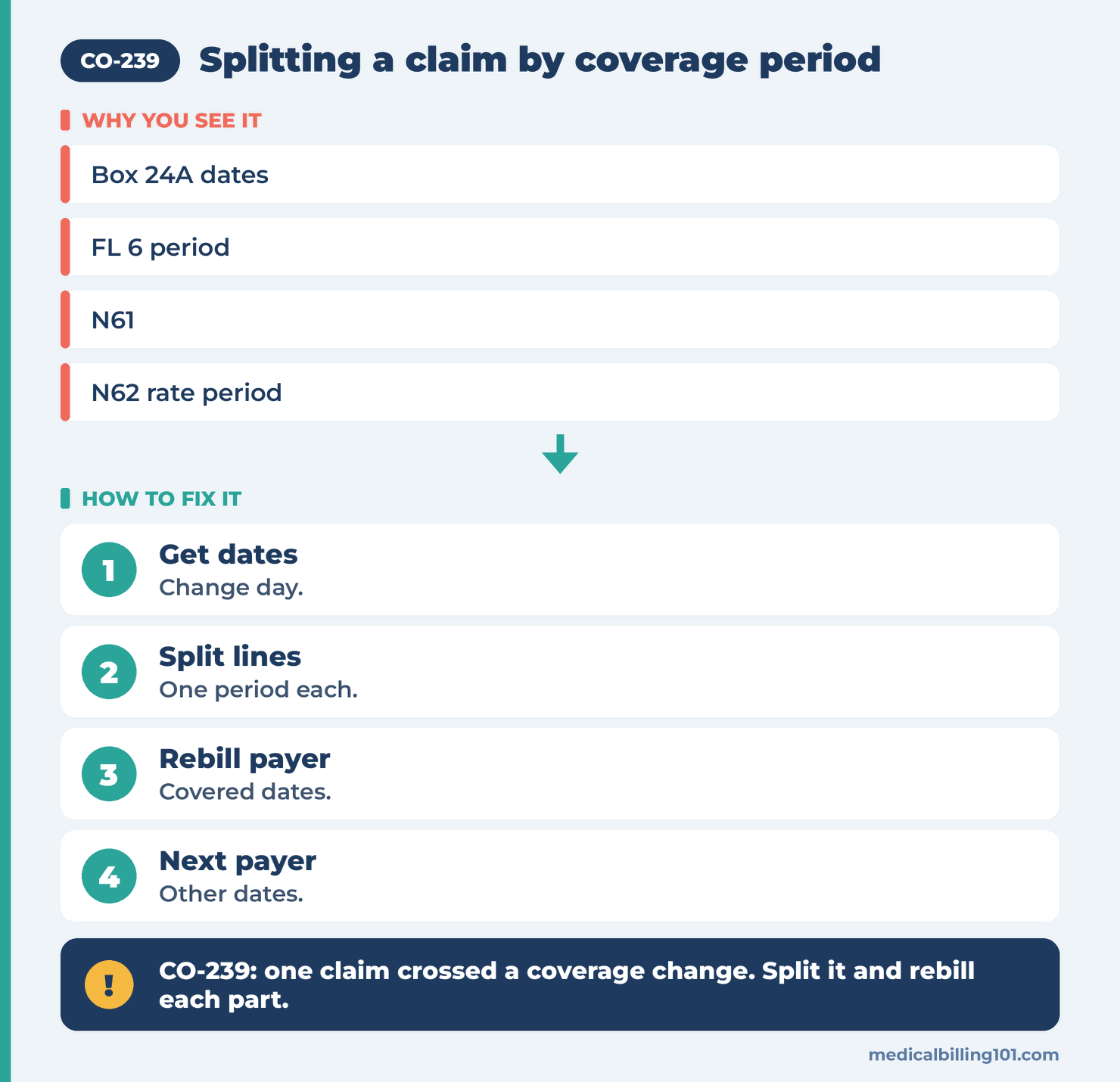
- Get the exact dates. Confirm the last covered day and the first day of any new plan, and write down which payer is primary on each side of the change. For Medicare patients, the CMS coordination of benefits overview explains how primary and secondary order is decided.
- Split the services. Every line on a claim must sit inside one coverage period.
- Rebill this payer. Send a new claim with only the covered dates.
- Bill the next payer. Send the remaining dates to the plan that covered them.
- Fix the setup. Add the change date to the patient account and the insurance registration screen, so future recurring claims are built inside a single coverage period automatically.
Example scenario (fictional names), part 2
How the CO-239 Denial Was Resolved
Daniel confirmed the dates with both plans.
Fix: He sent a new claim to the old plan with only the 09/08/26 and 09/12/26 visits. The 09/18/26 and 09/22/26 visits went to the spouse’s plan on their own claim.
Outcome: Both plans paid. Northgate added a coverage end date alert so the billing system now stops claims that cross it.
Names and details are illustrative; no real patient data.
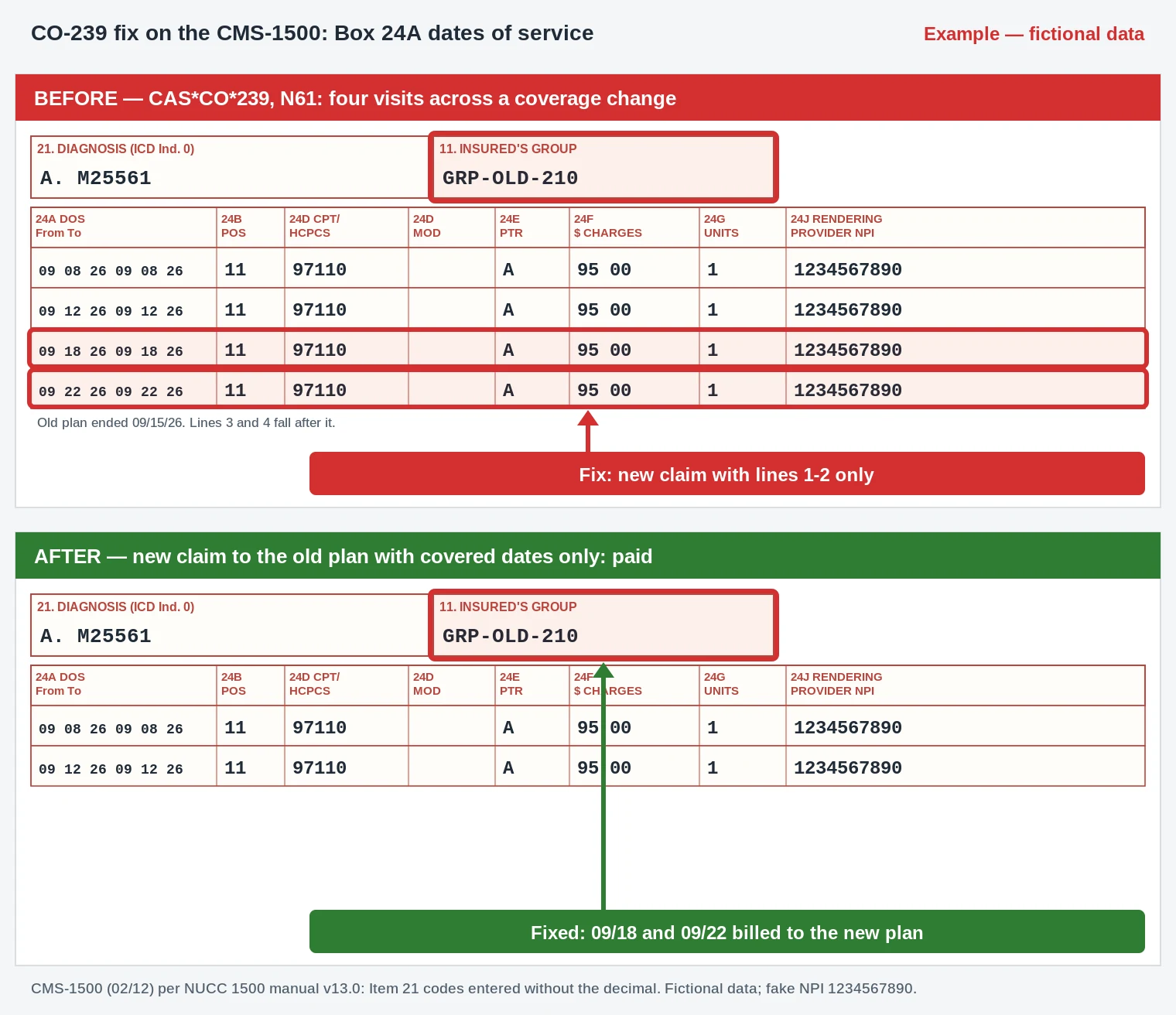
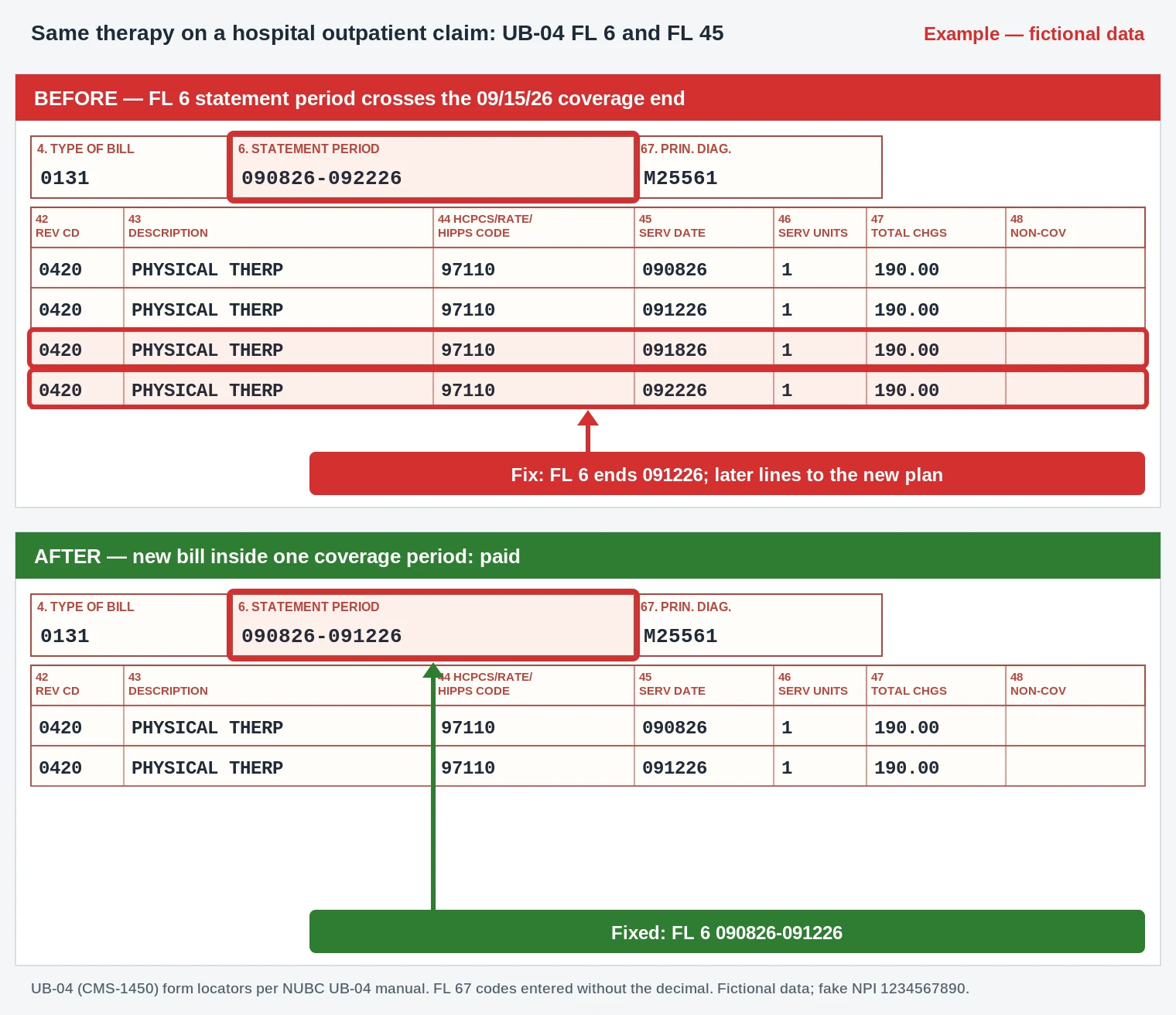
- Box 24A / FL 45: the 09/18/26 and 09/22/26 lines removed and billed on their own claim to the new plan.
- FL 6: statement period shortened from 090826-092226 to 090826-091226, inside the old plan’s coverage.
- Box 22 / FL 4: sent as a new claim (type of bill 0131), since nothing on the first claim paid.
- Box 21 / FL 67: M25.561 (entered as M25561) is unchanged.
CO-239 compared with nearby codes
| Code | Meaning | Your move |
|---|---|---|
| CO-239 | Spans covered and uncovered dates | Split and rebill |
| PR-238 | Payer cut the uncovered days | Check other coverage |
| CO-27 | Service after coverage ended | Bill the right payer |
| CO-26 | Service before coverage began | Bill the right payer |
FAQ
What does CO-239 mean?
Your claim includes dates with and without coverage. The payer wants separate claims.
Is CO-239 a corrected claim?
Usually you send a new claim with only the covered dates, since nothing on the first claim paid. Follow the payer’s rule.
What does N62 mean with CO-239?
The dates cross two rate periods. Split at the rate change.
Can I bill the patient for CO-239?
No. Group code CO means you fix and rebill.
Does CO-239 apply to inpatient stays?
Yes. On the UB-04 the split is made in the statement period, FL 6.
Sources
How we checked: each code quote on this page was matched word for word with the X12 CARC and RARC lists on 23 October 2026.
- X12, Claim Adjustment Reason Codes (CARC 239). Accessed 23 Oct 2026.
- X12, Remittance Advice Remark Codes (N61, N62). Accessed 23 Oct 2026.
- NUCC, 1500 Claim Form Instructions. Accessed 23 Oct 2026.
- NUBC, National Uniform Billing Committee. Accessed 23 Oct 2026.
- CMS, Coordination of Benefits and Recovery Overview. Accessed 23 Oct 2026.
Last updated: 23 October 2026 · Educational content; not legal advice.