
The CO-283 denial code means the payer says the attending provider on the claim cannot direct this patient’s care. You see it most on institutional claims where one clinician leads the plan, such as hospice. The fix is to compare the attending in UB-04 FL 76 with the signed election or plan of care, then correct it. (Primary source: X12 Claim Adjustment Reason Codes)
In brief: CARC 283 is about who leads the care, not about the service. A wrong name, a wrong NPI, or a clinician the patient never chose can trigger it. With CO, the facility cannot bill the patient for the denied amount.
Part of our denial codes library. Written by Manikandan J, CPC, CRCR, who has corrected attending provider edits on hospice and home health claims. Published 11 November 2026. Last updated: 11 November 2026. Code wording quoted word for word from X12. Read about the author and our editorial policy, or contact us to report an error.
What does denial code CO-283 mean?
Denial code CO-283 means the clinician reported as attending does not qualify to direct the patient’s care for this claim. The payer checks the attending field against its records. Those records may show a different designated attending, a provider type it does not accept, or no active enrollment.
| Field | Value |
|---|---|
| Code | 283 |
| Description | “Attending provider is not eligible to provide direction of care.” |
| Group codes | No X12 group restriction; CO is the most common |
| Start | 11/01/2017 |
Source: X12 Claim Adjustment Reason Codes, checked 11 November 2026.
Key terms: The attending provider is the clinician with the main role in directing the patient’s care, reported in UB-04 FL 76. A hospice election statement is the form where the patient chooses hospice and names an attending physician. CO means contractual obligation, so the facility owns the balance.
Methodology: the code wording is copied from the X12 list, and the hospice rules come from the eCFR and CMS manual pages cited below.
CO-283 vs OA-283: what is the difference?
CO-283 means a contracted payer holds your facility to its attending provider rules. OA-283 reports the same problem without a contract basis, such as on a claim to a payer you are not contracted with. Both point to the attending field, and neither moves the amount to the patient.
| Version | What it means for you | Best first move |
|---|---|---|
| CO-283 | Contracted payer; the facility absorbs the line until it is fixed | Match FL 76 with the signed election or order |
| OA-283 | Same attending problem, no contract claim | Check the payer’s provider rules, then correct |
Why is the attending provider not eligible?
The attending provider is not eligible when the claim names someone the payer cannot accept as the care lead. For example, Medicare hospice rules say the patient chooses the attending physician on the election statement (42 CFR 418.24). A different name in FL 76 does not match that choice.
Other causes include a provider type the plan does not accept, or an NPI that is not enrolled. For hospice, the attending can be a physician, a nurse practitioner or a physician assistant (42 CFR 418.3). Payers may also send N253, “Missing/incomplete/invalid attending provider primary identifier.”
Example scenario (fictional names), part 1
CO-283 Denial Example: What Happened
Priya Natarajan bills for Willow Bend Hospice. A patient with lung cancer, C34.90, entered as C3490, chose hospice under a fictional health plan that follows Medicare hospice rules.
On the election statement, the patient named nurse practitioner Lena Brooks from the family clinic as attending. The monthly claim, TOB 0811, listed routine home care, revenue code 0651. But FL 76 named Dr. Carl Benson, the oncologist who made the referral.
The 835 came back with CAS*CO*283 and N253 on the claim.
Was the referral itself the problem? Keep reading, or jump to how it was resolved. Keep reading, or jump to how the CO-283 denial was resolved.
How do I fix a CO-283 denial?
To fix a CO-283 denial, pull the document that names the attending. For hospice, that is the election statement or a signed change statement. Compare the name and NPI with FL 76. If they differ, correct FL 76 and send a replacement claim. If they match, confirm the provider’s enrollment.
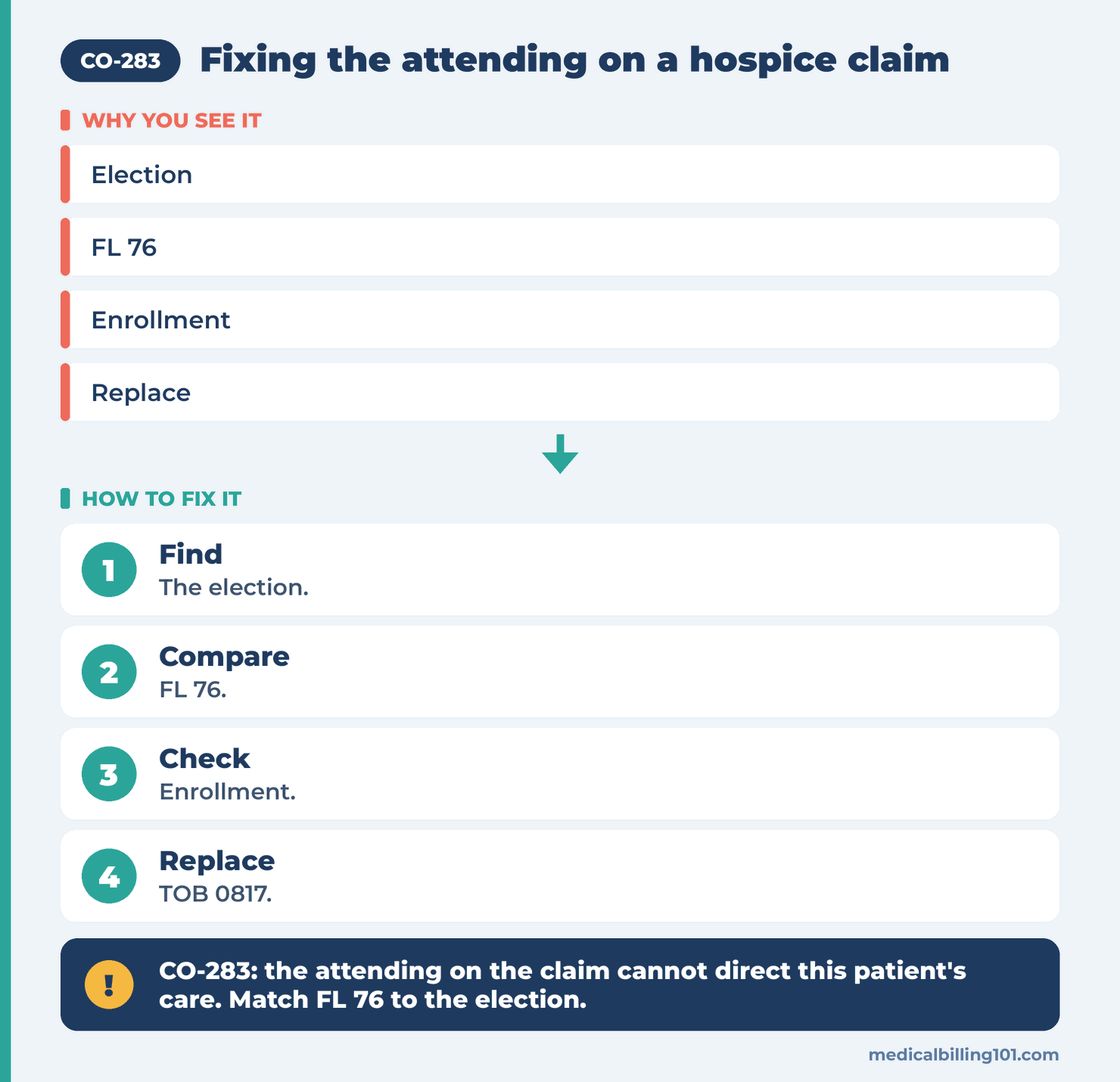
- Find the source document. Use the election statement, change form or signed plan of care.
- Compare FL 76. Check the name, NPI and provider type.
- Check enrollment. Confirm the attending is enrolled and active with the payer.
- Correct the claim. Put the right attending in FL 76 and send a replacement claim.
- Fix intake. Copy the attending from the signed form, not from the referral.
Example scenario (fictional names), part 2
How the CO-283 Denial Was Resolved
Priya opened the election statement. It named NP Brooks as attending, and no change statement was on file. The intake team had copied the referring oncologist into the attending field.
Fix: she put NP Brooks’s name and NPI in FL 76. She reported the hospice physician who certified the terminal illness in FL 78. Then she sent a replacement claim on TOB 0817 with the original claim number in FL 64.
Outcome: the plan reprocessed the claim and paid the routine home care days. Priya added an intake check that compares FL 76 with the election statement.
Names and details are illustrative; no real patient data.
Names and details are illustrative; no real patient data.
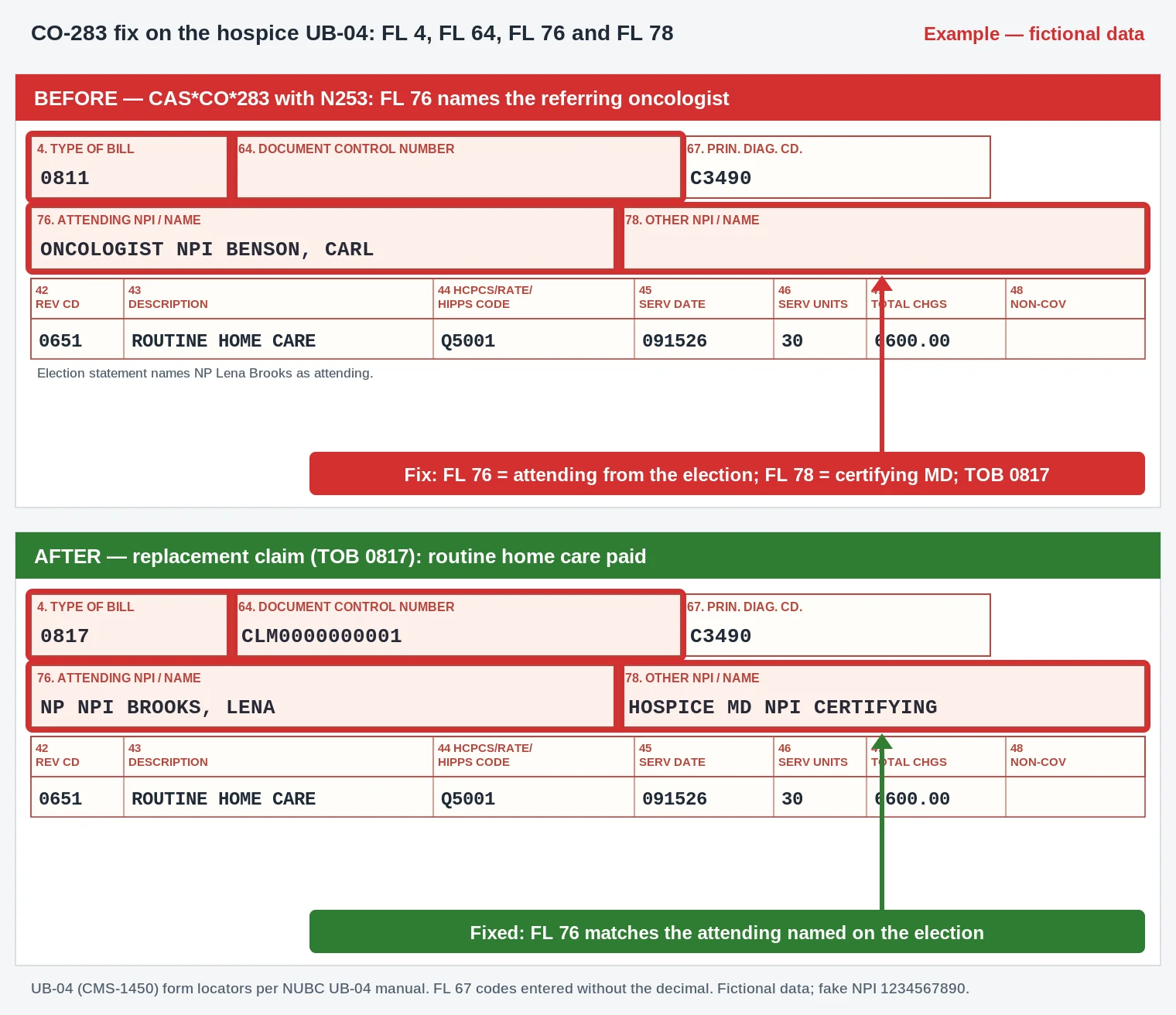
- FL 76: the referring oncologist was replaced with NP Lena Brooks, the attending the patient named on the election statement.
- FL 78: the hospice physician who certified the terminal illness is reported as the other provider.
- FL 4 + FL 64: replacement bill type 0817 with the original claim number.
- FL 42 / FL 67: revenue code 0651 and C34.90 (entered as C3490) are unchanged.
What if the patient changed the attending?
If the patient changed the attending, you need a signed change statement on file. Medicare rules say the patient files a signed statement that names the new attending and the effective date (42 CFR 418.24). Claims after that date should show the new attending.
Days before the change keep the old attending. So a claim that crosses the change date may need careful review. The CMS hospice claims manual explains which physician goes in each field.
Can I bill the patient for CO-283?
No, you cannot bill the patient for a CO-283 amount. CO means your payer contract puts the denied amount on the facility. The patient chose an attending, and the claim simply did not report that choice. Correct the claim instead of sending a statement.
Related codes
| Code | Meaning |
|---|---|
| CO-185 | Rendering provider not eligible to perform the service |
| CO-16 | Claim lacks information needed for adjudication |
| CO-170 | Payment denied when performed by this type of provider |
| CO-B7 | Provider was not certified for this service on this date |
FAQ
What does CO-283 mean?
The attending provider on the claim is not eligible to direct the patient’s care.
Where is the attending reported on a UB-04?
In FL 76, the attending provider name and identifiers.
Can a nurse practitioner be the hospice attending?
Yes. Medicare hospice rules allow a physician, a nurse practitioner or a physician assistant as attending.
Should I send a corrected claim for CO-283?
Yes, if FL 76 was wrong. Use a replacement claim with frequency 7 and the original claim number.
Does the patient owe a CO-283 amount?
No. CO puts the amount on the facility under the contract.
Sources
How we checked: the CARC 283 quote was matched word for word with the X12 CARC list on 11 November 2026, and N253 with the X12 RARC list.
- X12, Claim Adjustment Reason Codes (CARC 283, 185). Accessed 11 Nov 2026.
- X12, Remittance Advice Remark Codes (N253). Accessed 11 Nov 2026.
- eCFR, 42 CFR 418.24 (hospice election and attending changes). Accessed 11 Nov 2026.
- eCFR, 42 CFR 418.3 (attending physician definition). Accessed 11 Nov 2026.
- CMS, Medicare Claims Processing Manual, chapter 11 (hospice). Accessed 11 Nov 2026.
Last updated: 11 November 2026 · Educational content; not legal advice.
Related denial codes
- CO-185: Rendering Provider Not Eligible to Perform the Service
- CO-170: Payment Denied When Performed or Billed by This Type of Provider
- CO-B7: Provider Not Certified or Eligible on the Date of Service
- CO-8: Procedure Code vs Provider Type
- CO-183: Referring Provider Not Eligible to Refer
- CO-16: Claim Lacks Information or Has a Billing Error
- N290: Missing, Incomplete or Invalid Rendering Provider Identifier
- CO-282: Procedure or Revenue Code Inconsistent With Type of Bill