
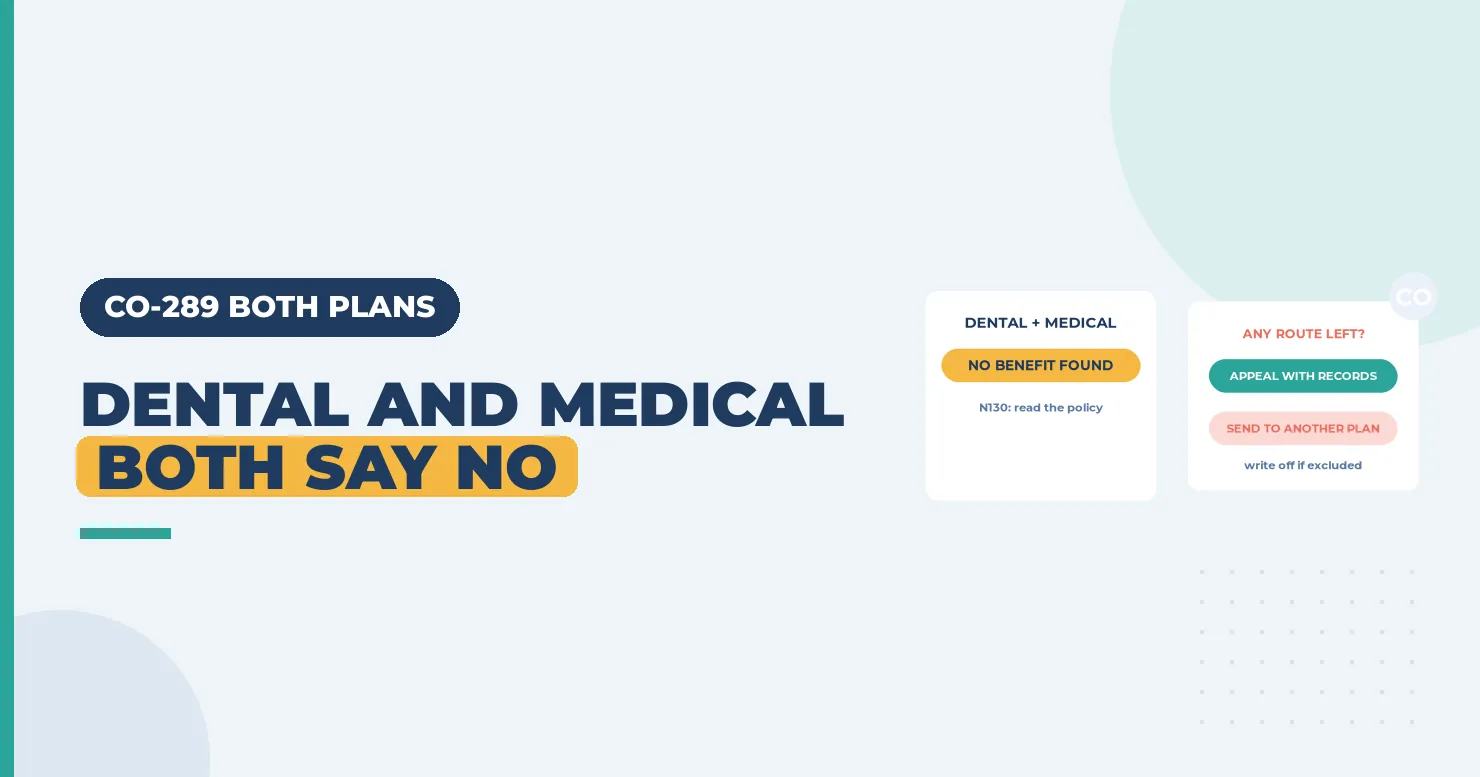
The CO-289 denial code means the payer looked at the service under both the patient’s dental plan and medical plan, and neither one covers it. There is no other plan to send it to. Your options are an appeal with records that meet the coverage policy, or a contractual write-off. (Primary source: X12 Claim Adjustment Reason Codes)
In brief: CARC 289 is the end of the dental-medical crossover road. The send-it-elsewhere codes are 254, 270 and 280. CARC 289 says both sides already said no. With CO, the provider usually cannot bill the patient.
Part of our denial codes library. Written by Manikandan J, CPC, CRCR, who has worked dental-medical crossover claims for oral surgery and dental sleep medicine offices. Published 13 November 2026. Last updated: 13 November 2026. Code wording quoted word for word from X12. Read about the author and our editorial policy, or contact us to report an error.
What does denial code CO-289 mean?
Denial code CO-289 means one payer, or a coordinated pair of plans, checked both benefit packages for the same service. Reason code 289 tells you the review is done on both sides and found no benefit. It does not ask you to resubmit anywhere.
| Field | Value |
|---|---|
| Code | 289 |
| Description | “Services considered under the dental and medical plans, benefits not available.” |
| Group codes | No X12 group restriction; CO is the most common |
| Start | 11/01/2017 |
| X12 note | Also see CARCs 254, 270 and 280 |
| Common remark | N130, “Consult plan benefit documents/guidelines for information about restrictions for this service.” |
Source: X12 Claim Adjustment Reason Codes, checked 13 November 2026.
Methodology: the code wording is copied from the X12 list, and the coverage rules come from the plan policy types and federal sources cited below.
Key terms: A crossover service is one that could fall under dental or medical benefits, such as oral surgery or an oral appliance. An exclusion is a service the plan does not cover at all (HealthCare.gov). CO is the contractual obligation group code.
CO-289 vs OA-289: what is the difference?
CO-289 means a plan you contract with ruled out both benefits, and your agreement keeps the balance with you. OA-289 reports the same double “no benefit” without a contract basis. That is common when you are out of network for one of the plans. Neither tells you the patient owes the amount.
| Version | What it tells you | First move |
|---|---|---|
| CO-289 | Both plans found no benefit; the contract holds you to the result | Read both coverage policies, then appeal or write off |
| OA-289 | Same result, no contract basis named | Ask the plan which group code applies to the member |
A PR-289 would place the amount on the patient. Only then does a patient statement come into play.
How is CARC 289 different from 254, 270 and 280?
CARC 289 is different because nothing is left to try elsewhere. CO-254 tells you to send a dental claim to the medical plan. CO-270 tells you to send a medical claim to the dental plan. CO-280 points to the pharmacy plan. The X12 note on CARC 289 links all four codes.
| CARC | Next step |
|---|---|
| 254 | Bill the medical plan |
| 270 | Bill the dental plan |
| 280 | Bill the pharmacy plan |
| 289 | Appeal or write off; both plans already reviewed it |
Example scenario (fictional names), part 1
CO-289 Denial Example: What Happened
Alana Price bills for Summit Dental Sleep Center. Dentist Dr. Victor Lane made a custom oral appliance for a patient with obstructive sleep apnea, G47.33, entered as G4733.
The fictional plan handles both dental and medical benefits. The office billed the dental side first, then the medical side with E0486.
The 835 came back with CAS*CO*289 and N130. The patient was told nothing was covered.
Was the appliance excluded, or was something missing? Keep reading, or jump to how it was resolved. Keep reading, or jump to how the CO-289 denial was resolved.
How do I fix a CO-289 denial?
To fix a CO-289 denial, read the medical and dental coverage policies for the exact service. If the service meets the medical policy, appeal with the records the policy asks for. For example, an oral appliance policy may require a sleep study and a physician order. If both policies truly exclude it, post the contractual write-off and update your intake rules.
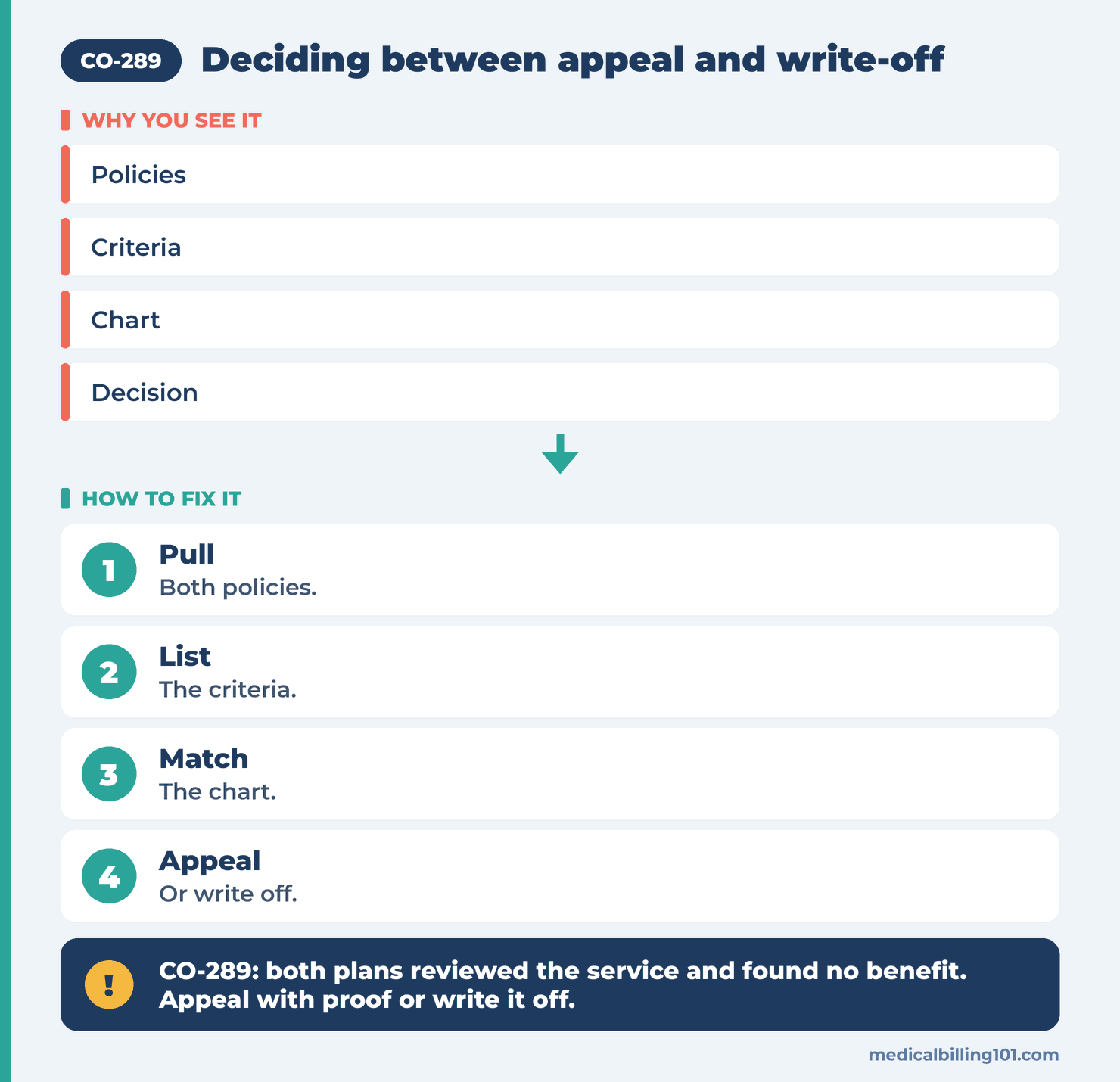
- Pull both policies. Find the medical and dental rules for the code billed.
- List the criteria. Note required tests, orders and diagnoses.
- Match the chart. Check whether your records meet each one.
- Appeal with proof. Send the records to the medical plan’s appeal route.
- Write off if excluded. Post the CO amount as a contractual adjustment.
Example scenario (fictional names), part 2
How the CO-289 Denial Was Resolved
Alana read the plan’s medical policy for oral appliances. It covered E0486 when a sleep study confirmed obstructive sleep apnea and a physician ordered the device. The first claim had neither document attached.
Fix: she sent a first-level appeal to the medical side with the sleep study report, the sleep physician’s order and the dentist’s fitting note.
Outcome: the plan reviewed the records and paid E0486 under the medical benefit. Alana now attaches the sleep study and order to every oral appliance claim.
Names and details are illustrative; no real patient data.
Names and details are illustrative; no real patient data.
When is CO-289 a true write-off?
CO-289 is a true write-off when both plans exclude the service and your records cannot change that. Cosmetic work and services listed as plan exclusions are common examples. An appeal will not create a benefit that the plan does not have. Marketplace dental rules also differ from medical rules, as HealthCare.gov explains.
Some contracts let you bill a member for a non-covered service when the patient signed a specific waiver before treatment. Check your contract and state rules first. Without that, keep CO amounts off the patient’s bill.
Can I bill the patient for CO-289?
No, you usually cannot bill the patient for a CO-289 amount. CO keeps the balance with the provider under the contract. The narrow exception is a valid advance waiver that your contract allows. Otherwise, appeal or write it off.
Related codes
| Code | Meaning |
|---|---|
| CO-254 | Dental plan: submit to the medical plan |
| CO-270 | Medical plan: submit to the dental plan |
| CO-280 | Medical plan: submit to the pharmacy plan |
| CO-96 | Non-covered charge |
FAQ
What does CO-289 mean?
Both the dental and medical plans reviewed the service and found no benefit for it.
Should I resubmit a CO-289 claim to another plan?
No. Both plans already reviewed it. Appeal with records or write it off.
Is CO-289 the same as CO-254?
No. CO-254 tells you to bill the medical plan. CO-289 means both plans said no.
What does N130 mean with CO-289?
N130 tells you to check the plan’s benefit documents for restrictions on the service.
Does the patient owe a CO-289 amount?
Usually not. CO keeps the amount with the provider unless a valid waiver applies.
Sources
How we checked: the CARC 289 quote was matched word for word with the X12 CARC list on 13 November 2026, and N130 with the X12 RARC list.
- X12, Claim Adjustment Reason Codes (CARC 289, 254, 270, 280). Accessed 13 Nov 2026.
- X12, Remittance Advice Remark Codes (N130). Accessed 13 Nov 2026.
- CMS, HCPCS Level II codes (E0486). Accessed 13 Nov 2026.
- HealthCare.gov, dental coverage in the Marketplace. Accessed 13 Nov 2026.
- HealthCare.gov, excluded services definition. Accessed 13 Nov 2026.
Last updated: 13 November 2026 · Educational content; not legal advice.