
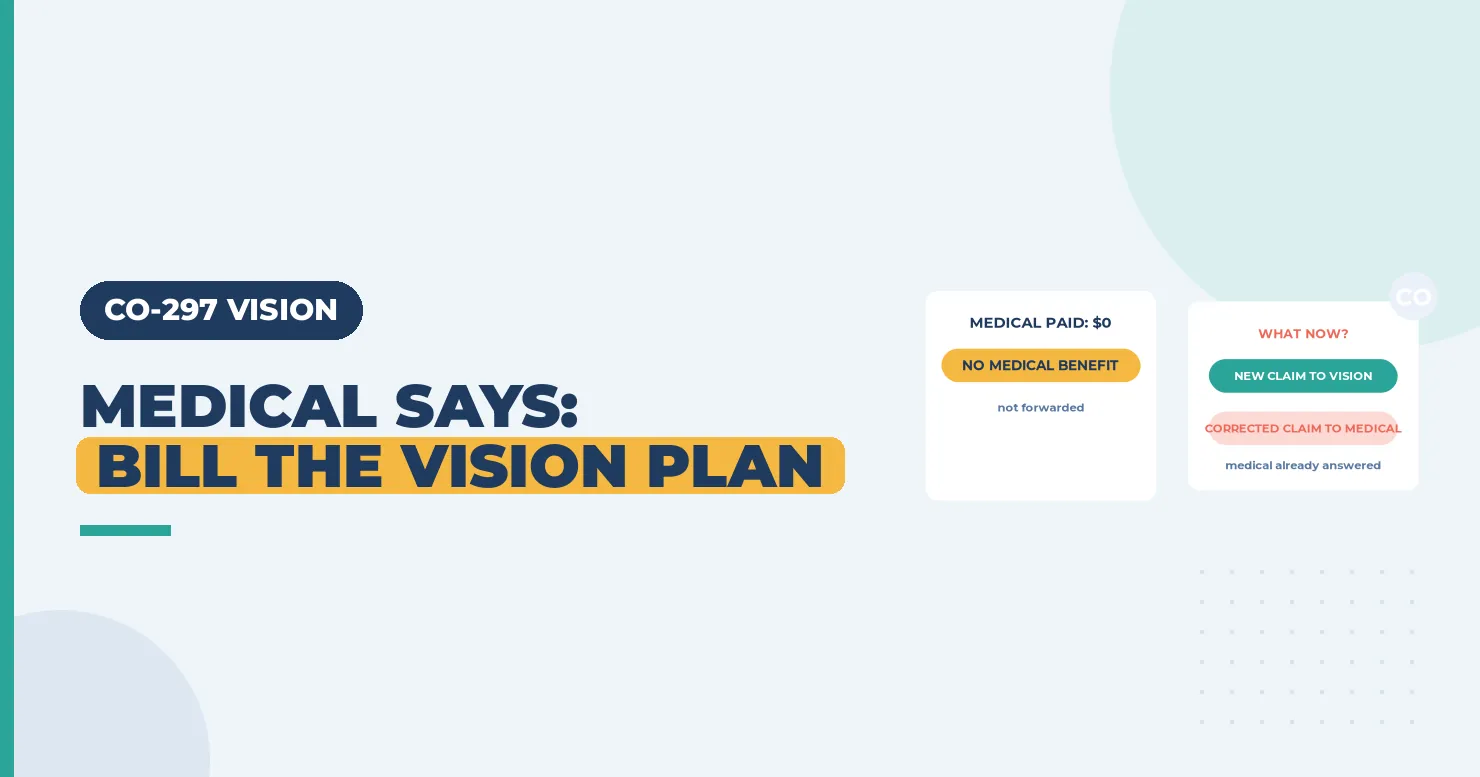
The CO-297 denial code means the medical plan received your claim but has no benefit for it. The plan tells you to send the service to the patient’s vision plan. You fix it by filing a new claim with the vision plan, using the vision member ID. (Primary source: X12 Claim Adjustment Reason Codes)
In brief: CARC 297 is a wrong-benefit notice, not a coding error. The medical plan did not forward the claim, so the next move is yours. Its twin, CARC 298, means the plan forwarded it for you.
Part of our denial codes library. Written by Manikandan J, CPC, CRCR, who has sorted medical and vision claims for optometry and ophthalmology offices. Published 15 November 2026. Last updated: 15 November 2026. Code wording quoted word for word from X12. Read about the author and our editorial policy, or contact us to report an error.
What does denial code CO-297 mean?
Denial code CO-297 means the medical plan paid nothing because the service falls under vision coverage. Reason code 297 usually appears on routine eye examinations, refractions, eyeglasses and contact lenses. The medical plan expects you to submit the service to the vision plan yourself.
| Field | Value |
|---|---|
| Code | 297 |
| Description | “Claim received by the medical plan, but benefits not available under this plan. Submit these services to the patient’s vision plan for further consideration.” |
| Group codes | No X12 group restriction; CO and OA both appear |
| Start | 03/01/2019 |
| Twin code | CARC 298 when the medical plan forwarded the claim |
Source: X12 Claim Adjustment Reason Codes, checked 15 November 2026.
Methodology: the code wording is copied from the X12 list, and the claim form steps follow the NUCC instructions cited below.
Key terms: A vision plan is separate coverage for routine eye care and eyewear. A medical eye visit treats a disease or symptom, such as glaucoma. CO is the contractual obligation group code.
CO-297 vs OA-297: what is the difference?
With CO-297, the medical plan books its zero as a contract adjustment. You cannot move that line to the patient’s balance. With OA-297, the plan reports the same routing message and assigns no liability. Either way, the vision plan is the next payer to bill.
Here is the short version. CO-297 means a contract zero, so bill vision. OA-297 means a plain zero, so bill vision too.
Why did the medical plan send me to the vision plan?
The medical plan sends you to the vision plan when the visit looks routine rather than medical. A refraction, a prescription check for eyeglasses, or an examination without a medical diagnosis usually fits that pattern. Many commercial medical policies exclude these services, and original Medicare excludes them too. Its page on routine eye exams says it does not cover exams for eyeglasses or contacts.
The diagnosis code usually decides which coverage applies. A routine examination code, such as Z01.00, points to vision coverage. A medical diagnosis, such as cataract or glaucoma, points to the medical policy instead.
Example scenario (fictional names), part 1
CO-297 Denial Example: What Happened
- Clinic: Larkspur Family Eye Care, an optometry office.
- Biller: Owen Pratt. Doctor: Dr. Celia Moreau, OD.
- Visit: a routine exam for new glasses, with no eye complaints.
- Claim: 92014 and 92015, diagnosis Z0100, sent to the patient’s medical plan on a CMS-1500.
- 835:
CAS*CO*297on both lines, zero paid, with remark codeN130. That remark reads “Consult plan benefit documents/guidelines for information about restrictions for this service.”
Which plan should Owen bill next, and what changes on the claim? Keep reading, or jump to how it was resolved. Keep reading, or jump to how the CO-297 denial was resolved.
How do I fix a CO-297 denial?
To fix a CO-297 denial, file a new claim with the patient’s vision plan. Get the vision member ID and the plan’s claim address or payer ID. Update the insurance fields, then submit. Do not send a corrected claim to the medical plan, because it already gave its answer.
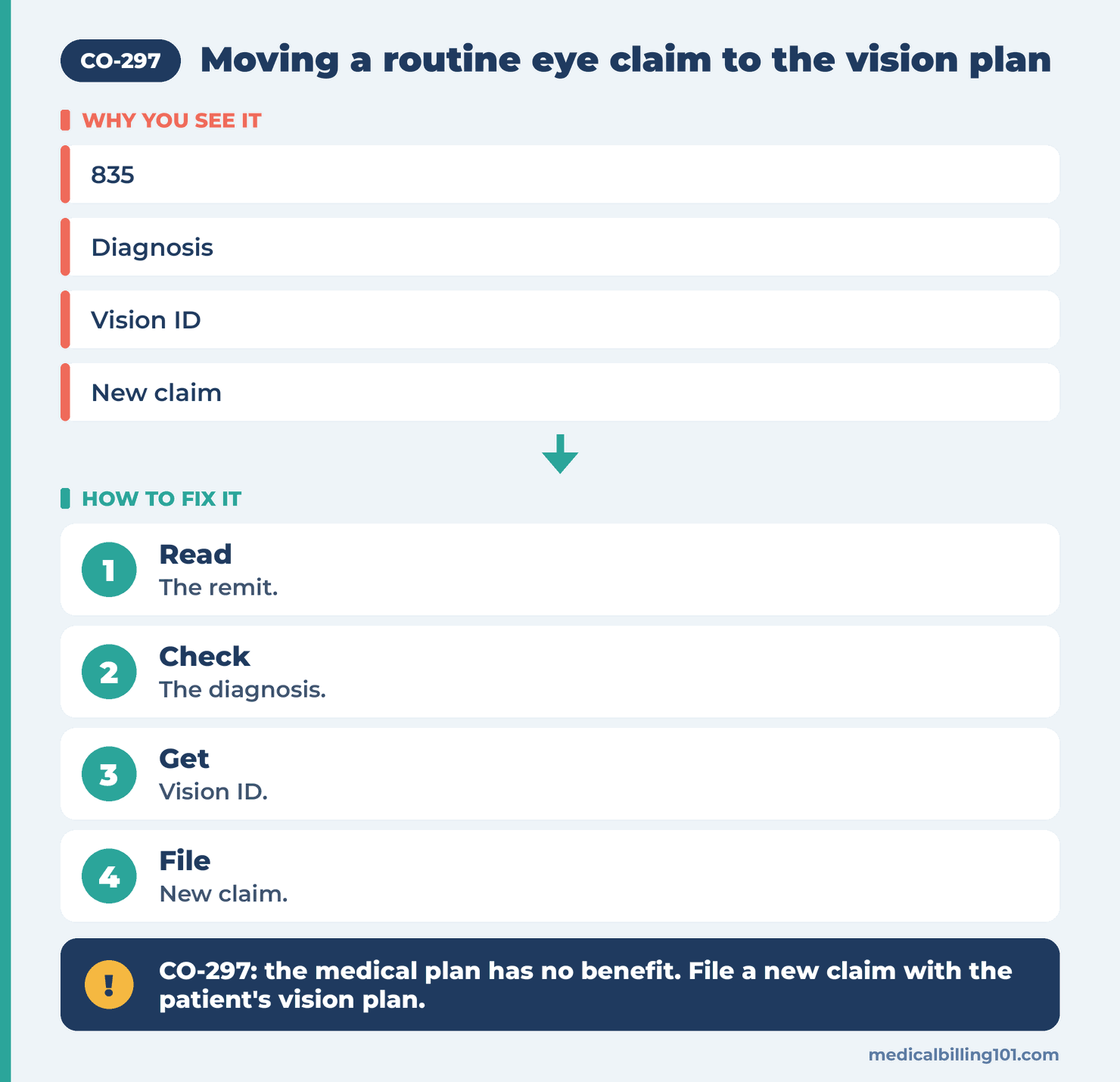
- Read the remit. Confirm CARC 297, not 298, so you know nothing was forwarded.
- Check the diagnosis. If the visit was medical, appeal to the medical plan instead.
- Get the vision details. Ask the patient for the vision card, or check the plan portal.
- File a new claim. Use the vision member ID in Box 1a and the vision plan in Box 11c.
- Post the medical zero. Note the vision claim date in the account.
Example scenario (fictional names), part 2
How the CO-297 Denial Was Resolved
Owen called the patient, who confirmed a separate vision insurance card through her employer. The examination was routine, and the chart documented no medical complaint. So the medical plan’s decision was correct.
Fix: Owen filed a new claim with the fictional vision plan. He put the vision member ID in Box 1a and the vision plan name in Box 11c. The codes and the diagnosis stayed the same.
Outcome: the vision plan paid the exam under its routine benefit. Owen now scans both cards at check-in and picks the payer by visit type.
Names and details are illustrative; no real patient data.
Names and details are illustrative; no real patient data.
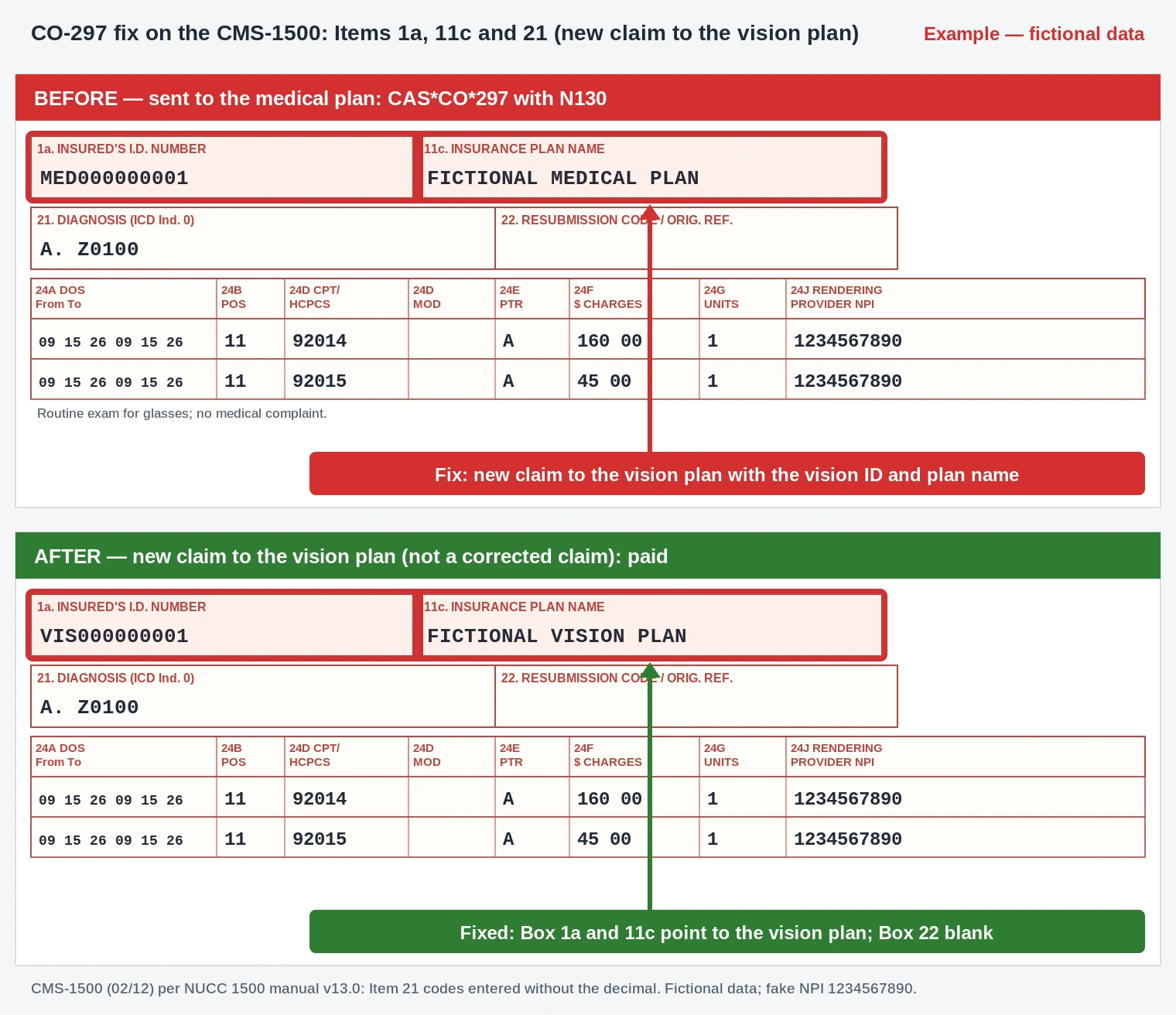
- Box 1a: the medical member ID was replaced with the patient’s vision plan member ID.
- Box 11c: the medical plan name was replaced with the vision plan name, and the claim went to the vision plan’s payer ID.
- Box 22: left blank, because this is a new claim to a different payer, not a corrected claim.
- Box 21 / 24D: Z01.00 (entered as Z0100), 92014 and 92015 are unchanged.
Can I bill the patient for CO-297?
No, not for the medical plan’s CO-297 line. Bill the vision plan first. After the vision plan processes the claim, the patient may owe a copayment or a non-covered amount under that separate policy. The NUCC 1500 instructions explain Box 1a and Box 11c.
What if the visit was really medical?
If the visit treated a medical problem, the vision plan is the wrong payer. For example, a red, painful eye or diabetic eye exam with a matching diagnosis is medical. Check that the claim carried that diagnosis. If it did, appeal to the medical plan with the visit note. If it did not, send a corrected claim with the right diagnosis. A wrong-payer case like CO-109 works the same way.
Related codes
| Code | Meaning |
|---|---|
| CO-270 | Medical plan says submit to the dental plan |
| CO-280 | Medical plan says submit to the pharmacy plan |
| CO-109 | Service not covered by this payer; send to the correct payer |
| CO-96 | Non-covered charges |
FAQ
What does CO-297 mean?
The medical plan has no benefit for the service and wants it sent to the vision plan.
Did the medical plan forward my claim?
No. CARC 297 means you must send it. CARC 298 means the plan forwarded it.
Should I send a corrected claim for CO-297?
No. Send a new claim to the vision plan with the vision member ID.
Which group code comes with CARC 297?
X12 sets no restriction. CO and OA both appear on these routing notices.
Does the patient owe the CO-297 amount?
No. Bill the vision plan first; any patient share comes from that plan.
Sources
How we checked: the CARC 297 quote was matched word for word with the X12 CARC list on 15 November 2026, and N130 with the X12 RARC list.
- X12, Claim Adjustment Reason Codes (CARC 297, 298, 109). Accessed 15 Nov 2026.
- X12, Remittance Advice Remark Codes (N130). Accessed 15 Nov 2026.
- NUCC, 1500 claim form instructions. Accessed 15 Nov 2026.
- Medicare.gov, eye exams (routine). Accessed 15 Nov 2026.
Last updated: 15 November 2026 · Educational content; not legal advice.