
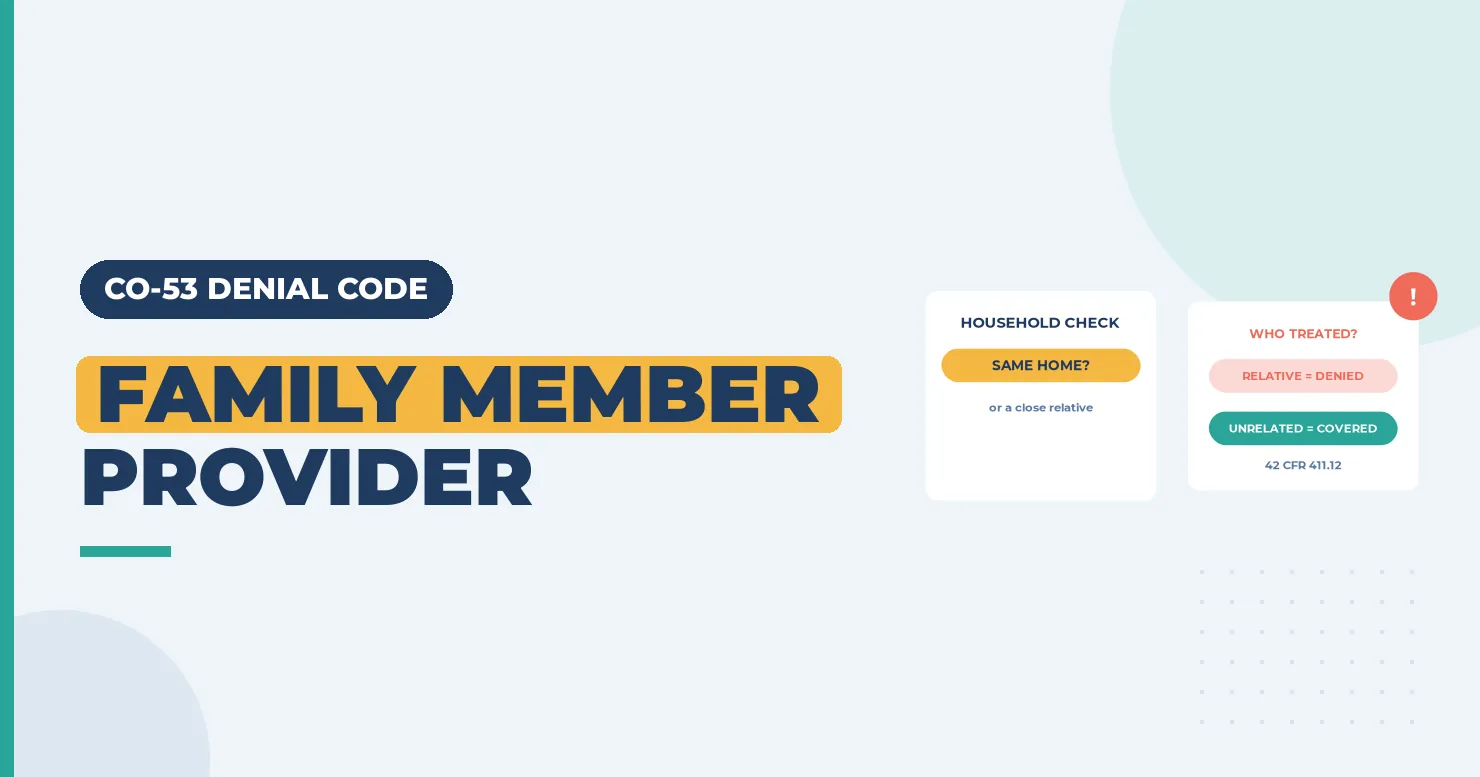
CO-53 means the payer won’t pay because the person who gave the service is an immediate relative of the patient or lives in the same household. Medicare has a written exclusion for these charges, and many commercial and Medicaid plans copy it. The denial is usually correct when a family member really treated the patient. It’s wrong when the payer matched the wrong people, such as two unrelated people who share a last name or an address. (Primary sources: X12 Claim Adjustment Reason Codes · 42 CFR 411.12).
In brief: CO-53 means “Services by an immediate relative or a member of the same household are not covered.” Check who actually rendered the service and how they’re related to the patient. If the payer got the facts wrong, appeal with proof. If the service really came from a relative, the claim can’t be fixed by rebilling, and another clinician should treat the patient from now on.
Part of our denial codes library. Written by Manikandan J, CPC, CRCR, who has reviewed provider and payer exclusion denials for billing companies. Published 20 October 2026. Last updated: 20 October 2026. Code wording is quoted word for word from X12.
X12 wording for CARC 53
| Field | Official X12 text |
|---|---|
| Description | “Services by an immediate relative or a member of the same household are not covered.” |
| Start | 01/01/1995 |
Source: X12 Claim Adjustment Reason Codes, checked 20 October 2026.
Denial code 53, CARC 53 and reason code 53
Denial code 53, CARC 53 and reason code 53 all name this one X12 code. The group code in front decides who carries the amount. With CO-53, the contract keeps it with the provider. Some plans send PR-53 when their member contract makes the patient liable, so read the group before you send a statement.
Who counts as an immediate relative?
Under the Medicare rule in 42 CFR 411.12, an immediate relative is a family member on a set list. It covers both blood and marriage ties:
| Relationship type | Who is included |
|---|---|
| Spouse | Husband or wife |
| Parents and children | Natural or adoptive parent, child and sibling |
| Step relatives | Stepparent, stepchild, stepbrother, stepsister |
| In-laws | Father-, mother-, son-, daughter-, brother- and sister-in-law |
| Grandparents | Grandparent, grandchild, and the spouse of either |
A household member is any person who shares a common home with the patient as part of a single family unit. The regulation says this includes domestic employees and others who live together as a family unit, such as a live-in caregiver, but not a mere roomer or boarder. Check the CMS Benefit Policy Manual, Chapter 16 for the exact Medicare wording, and check your commercial payer’s provider manual for its own version.
When the rule reaches a practice or company
The Medicare rule doesn’t stop at the relative’s own NPI. Under 42 CFR 411.12(c):
| Who bills | Is it excluded? |
|---|---|
| The relative physician, or a partnership or professional corporation billing their services | Yes |
| Incident-to services, such as a nurse’s injection | Yes, if the ordering or supervising physician is the relative |
| An individually owned provider or supplier whose owner is the relative | Yes |
| A partnership where any partner is the relative | Yes |
| A corporation other than a professional corporation | No, the exception applies |
A professional corporation is a corporation completely owned by one or more physicians, or by other health professionals where state law allows, that exists to practice medicine. That’s why a large hospital-owned group can often treat a staff member’s relative, while a solo practice can’t.
Why payers have this rule
The rule assumes family members would often give care without charging. A bill to the plan for that care is treated as a charge that wouldn’t normally exist. It also guards against fraud risk, since a relative can more easily bill for services that didn’t happen.
Situations that trigger CO-53
- A physician treats a parent or spouse and bills under their own NPI.
- A therapist or nurse treats a household member in a home health or private practice setting.
- A practice owned by the relative bills the service, even though another clinician signed the note.
- A payer data match links the patient and the provider through a shared address or last name.
- A transport or supply vendor owned by a relative bills for equipment or rides.
Working a CO-53 denial
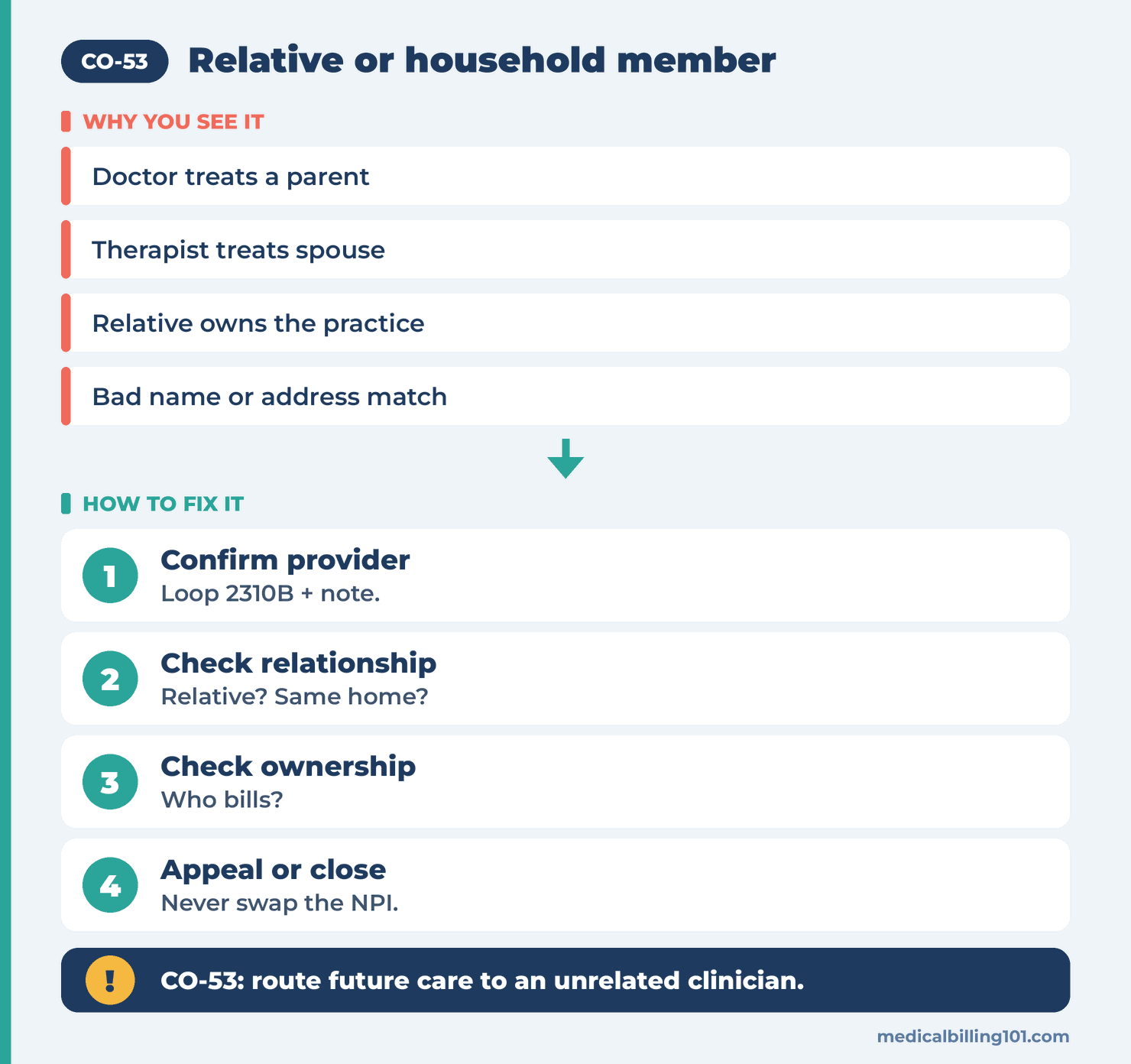
- Confirm the rendering provider. Check loop 2310B on the 837 and the signed note.
- Ask the provider whether they are related to the patient or share a home.
- Check ownership. Does the relative own the billing entity?
- If the facts are wrong, appeal with proof such as a different home address, an attestation, and the correct rendering NPI.
- If the facts are right, close the line under CO and don’t rebill under a different NPI.
- Plan future care with an unrelated clinician so later claims qualify.
What not to do
Never move the claim to another provider’s NPI unless that provider truly performed the service. Billing a service under a clinician who didn’t render it is a false claim, not a fix. Never collect from the patient under CO-53 either. The CO group means your contract treats the amount as a provider write-off.
Worked example (illustrative)
A physical therapist owns her clinic as a sole proprietor. Her mother-in-law comes in for knee rehab, and a staff therapist with no family tie does every visit. The claims go out under the clinic’s billing NPI, with the staff therapist as the rendering provider. The Medicare Advantage plan denies them with CAS*CO*53*96.00 because the clinic owner is related to the patient. The biller reads the plan’s provider manual, which follows the Medicare rule for individually owned suppliers. She confirms the denial applies, writes off the visits, and the patient moves to an unrelated clinic.
Consider a second case. A family doctor named Dr. Patel treats an unrelated patient who is also named Patel. The payer’s data match flags them as family. The biller appeals with the patient’s address and a signed statement, and the claim is paid.
Prevention checklist
- [ ] Ask at registration whether the patient is related to or lives with any clinician in the practice.
- [ ] Flag those patients in your system so a different provider is scheduled.
- [ ] Review ownership links for relative-owned billing entities.
- [ ] Check provider manuals for each payer’s version of the rule.
- [ ] Track CO-53 by payer to spot faulty data matches.
Related denial codes
- CO-96: non-covered charges.
- CO-109: claim not covered by this payer.
- CO-8: procedure code inconsistent with provider type.
- CO-16: claim lacks information needed for adjudication.
- Denial codes hub for every code we cover.
Key takeaways
CO-53 is the family member provider exclusion. Confirm who rendered the service and how they’re related to the patient. Appeal with proof when the payer matched the wrong people. When the relationship is real, close the line, never shift it to another NPI, and route future care to an unrelated clinician.
FAQ
What does CO-53 mean?
It means the service was given by an immediate relative of the patient or a member of the same household, so the plan won’t cover it.
Does Medicare cover care from a family member who is a doctor?
No. Medicare excludes charges by an immediate relative or household member under 42 CFR 411.12.
Which family members does the Medicare rule list?
Spouses, parents, children, siblings, step relatives, in-laws, grandparents and grandchildren, and spouses of grandparents or grandchildren.
Can I bill the patient for CO-53?
Not under the CO group. The contract treats it as a provider write-off.
Can another doctor in the practice bill it instead?
Only if that doctor actually performed the service. Moving the claim to a different NPI is not allowed.
How do I appeal a CO-53?
Show the payer that the provider and patient aren’t related and don’t share a home. Send an attestation and proof of address.
Sources
How we checked: every code quote on this page was compared word for word with the X12 CARC list on 20 October 2026.
- X12, Claim Adjustment Reason Codes (CARC 53). Accessed 20 Oct 2026.
- eCFR, 42 CFR 411.12, Charges imposed by an immediate relative or member of the household. Accessed 20 Oct 2026.
- CMS, Medicare Benefit Policy Manual, Ch. 16, General Exclusions From Coverage. Accessed 20 Oct 2026.
Last updated: 20 October 2026 · This page is educational and doesn’t replace payer contracts or coding rules.