
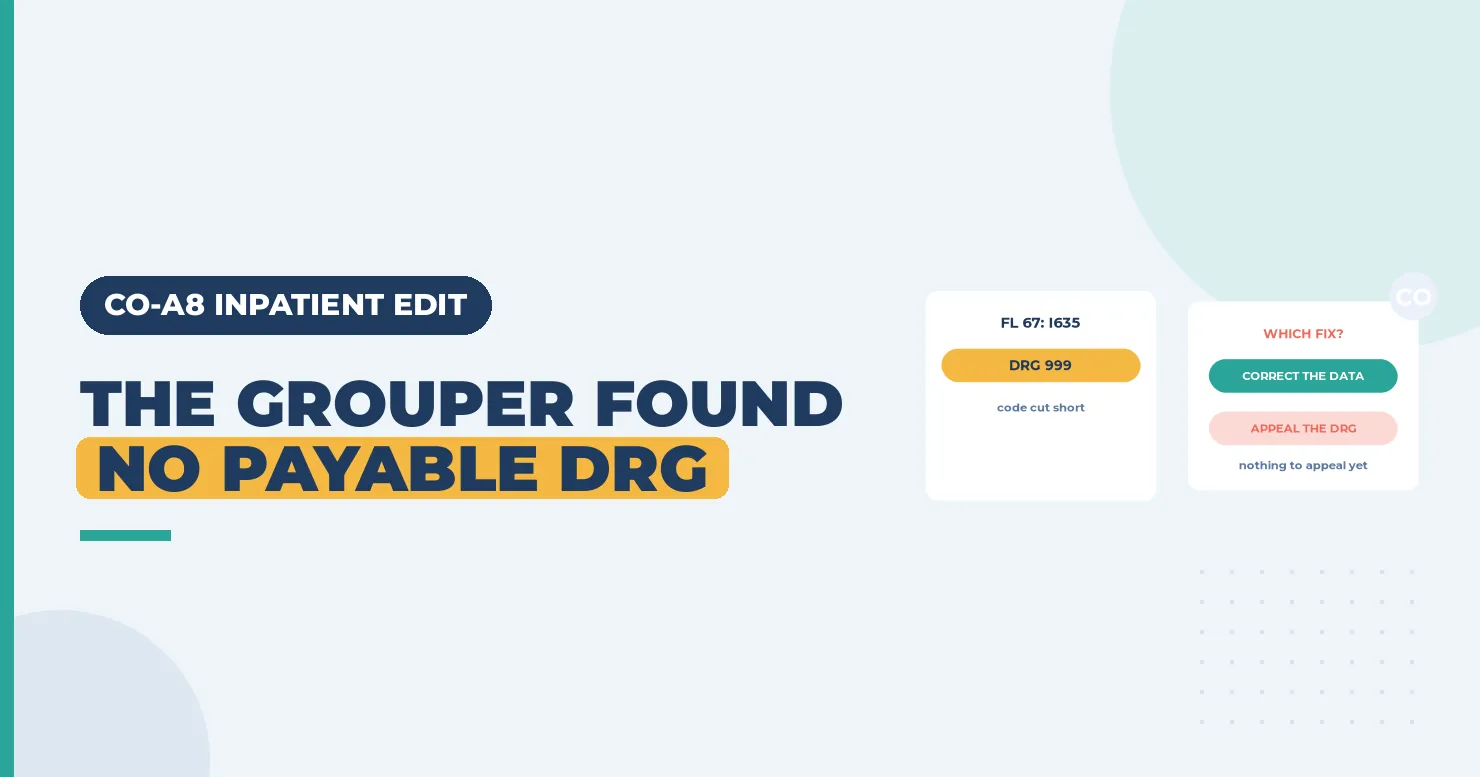
The CO-A8 denial code means the payer ran the inpatient claim through its DRG grouper and got no payable group back. The claim is not denied for coverage. It is stopped because a diagnosis, procedure, discharge status or demographic field made grouping impossible. Find that field, correct it and send a replacement claim. (Primary source: X12 Claim Adjustment Reason Codes)
In brief: reason code A8 lives on hospital inpatient claims paid by DRG. The usual cause is an invalid or incomplete principal diagnosis, such as a code missing its last character. Fix the data, not the DRG.
Part of our denial codes library. Written by Manikandan J, CPC, CRCR, who has reworked inpatient claims that came back with ungroupable DRG edits. Published 18 November 2026. Last updated: 18 November 2026. Code wording quoted word for word from X12. Read about the author and our editorial policy, or contact us to report an error.
What does denial code CO-A8 mean?
Denial code CO-A8 means the payer could not place the stay in a diagnosis related group. Under Medicare’s MS-DRG system, such a stay falls into DRG 999, “Ungroupable,” or DRG 998 when the principal diagnosis is not allowed as a discharge diagnosis. Either one pays nothing, so the payer reports CARC A8.
| Field | Value |
|---|---|
| Code | A8 |
| Description | “Ungroupable DRG.” |
| Group codes | No X12 group restriction; CO is the usual pairing |
| Start | 01/01/1995 (last modified 09/30/2007) |
| Claim type | Inpatient UB-04 or 837I paid by DRG, bill type 011x |
Source: X12 Claim Adjustment Reason Codes, checked 18 November 2026.
Methodology: the code wording is copied from the X12 list, and the grouping logic comes from the CMS MS-DRG files and definitions manual cited below.
Key terms: a DRG is the payment group a grouper assigns from the codes and patient data on the claim. A grouper is the software that reads those fields and returns the DRG. DRG 999 is the MS-DRG for a stay the grouper cannot classify.
CO-A8 vs OA-A8
The grouping failure is the same either way. Only the owner of the unpaid amount differs.
| Version | Meaning on the remit | What you do |
|---|---|---|
| CO-A8 | Hospital absorbs the amount under its contract until the claim groups | Correct the data and replace the claim |
| OA-A8 | No owner named, often on a crossover or secondary claim | Check the primary payer’s grouping, then correct the claim |
Neither version creates a patient balance. The patient owes only what a corrected remit assigns to PR.
Example scenario (fictional names), part 1
CO-A8 Denial Example: What Happened
Keiko Brandt works the inpatient denial queue at Millbrook Valley Hospital. Dr. Anand Kessler admitted a patient with an acute stroke, and the coder assigned I63.512, a left middle cerebral artery infarction. The UB-04 went out with bill type 0111 and a three-day room line.
The 835 from a fictional commercial payer paid zero. It carried CAS*CO*A8 and remark code N208, “Missing/incomplete/invalid DRG code.” The coding summary looked clean, so Keiko pulled the claim image itself.
What could make a correctly coded stroke stay ungroupable? Keep reading, or jump to how the CO-A8 denial was resolved.
What makes a DRG ungroupable?
A grouper needs valid values in every field it reads. The CMS MS-DRG definitions manual lists the codes that land in DRG 998, mostly pregnancy supervision codes. Other bad data usually lands in DRG 999.
| Field | Error that blocks grouping | Where it sits |
|---|---|---|
| Principal diagnosis | Invalid, deleted or incomplete code, for example a code missing its last character | FL 67 |
| Principal diagnosis | Code not allowed as a principal diagnosis, such as O09 supervision codes | FL 67 |
| Discharge status | Missing or invalid two-digit code | FL 17 |
| Procedure codes | Invalid ICD-10-PCS code or a wrong code version | FL 74 |
| Sex or birth date | Missing or invalid value | FL 11 and FL 10 |
How do I fix a CO-A8 denial?
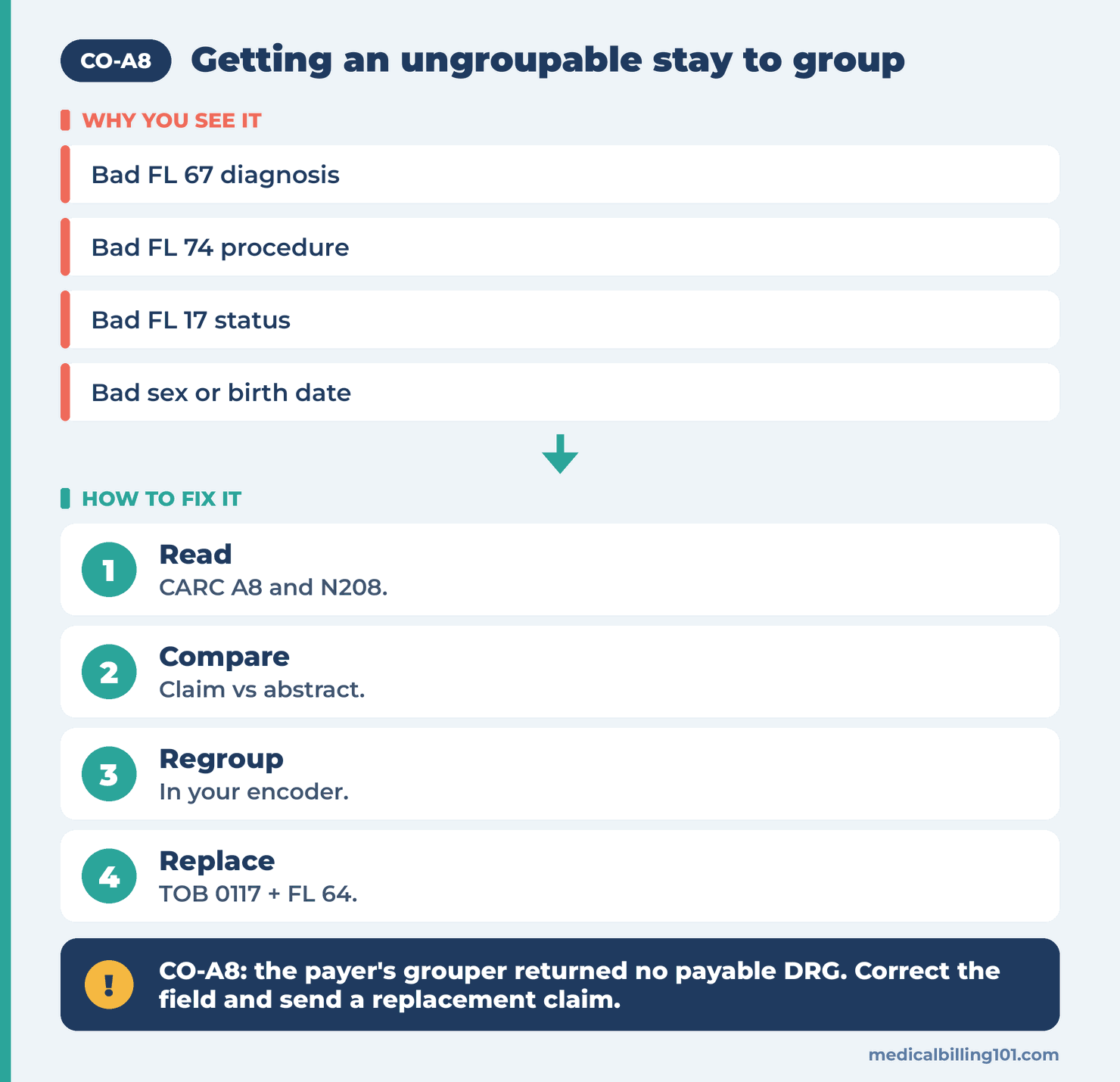
To fix a CO-A8 denial, find the field the grouper rejected and compare it with the coding abstract. Run the corrected data through your own grouper before you rebill. That check tells you the stay will group this time.
| Step | What to check | Tip |
|---|---|---|
| 1. Read the remit | CARC A8, any remark such as N208, and the DRG the payer returned | A returned 999 points to data, not policy |
| 2. Compare claim and abstract | FL 67, FL 74, FL 17, FL 10 and FL 11 | Interfaces often truncate long codes |
| 3. Regroup | Run the corrected codes through your encoder | Confirm a real DRG comes back |
| 4. Replace the claim | Bill type 0117 with the original claim number in FL 64 | Medicare ignores FL 71; some plans read it |
| 5. Fix the cause | Field length or mapping in the billing interface | Stops the same edit on other stays |
The CMS MS-DRG classifications and software page holds the grouper files for each fiscal year. Use the version that matches the discharge date, because codes change every October.
Example scenario (fictional names), part 2
How the CO-A8 Denial Was Resolved
Keiko compared the claim with the abstract. The coder had entered I63.512, but the billing interface cut FL 67 to four characters, so the claim said I635. That is a category heading, not a billable code, and the grouper returned DRG 999.
Fix: she sent a replacement claim with bill type 0117 and the original claim number in FL 64. FL 67 now carried the full I63512. She regrouped it first and got a stroke DRG back.
Outcome: the payer paid the stay under the correct DRG. IT widened the diagnosis field mapping, and Keiko added a pre-bill edit for non-billable codes.
Names and details are illustrative; no real patient data.
Names and details are illustrative; no real patient data.
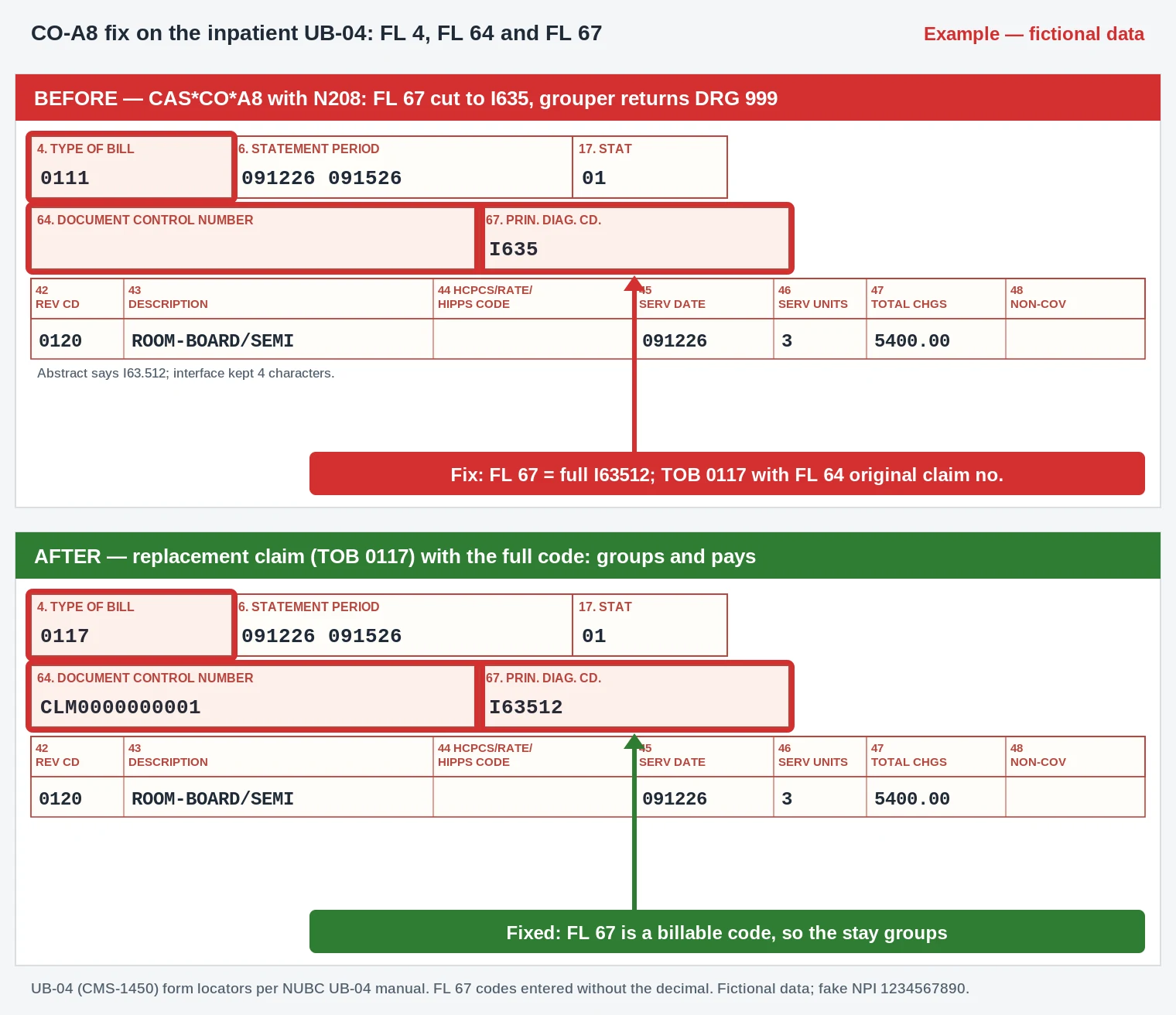
- FL 67: principal diagnosis restored from the truncated I635 (a category, not billable) to I63512, matching the coding abstract (I63.512).
- FL 4 + FL 64: replacement bill type 0117 with the original claim number; the inpatient classification (011x) stays the same.
- FL 6 / FL 17: the statement period, discharge status 01 and the room line are unchanged.
- CMS-1500: not shown; professional claims are not grouped into a DRG.
Can the hospital bill the patient for CO-A8?
No. A grouping failure is a claim data problem, and the CO group code keeps the amount on the provider side. Hold patient statements until the corrected remit shows the real deductible and coinsurance.
How do I prevent CARC A8?
Prevent it with two pre-bill checks. First, run every inpatient claim through the same grouper version the payer uses and hold any claim that returns DRG 998 or 999. Second, check that each ICD-10 code in the 837I matches the abstract character for character. The CMS ICD-10 code files show which codes are billable for each year.
Related codes
| Code | Meaning |
|---|---|
| CO-11 | Diagnosis does not fit the procedure |
| CO-16 | Claim lacks information or has a billing error |
| CO-306 | Type of bill does not match the patient status |
| CO-A6 | Prior hospital stay or 30-day transfer rule not met |
FAQ
What does CO-A8 mean?
The payer’s grouper could not assign a payable DRG to the inpatient claim.
Which DRG does an ungroupable claim get?
Under MS-DRG it is usually DRG 999. DRG 998 is used when the principal diagnosis is not valid as a discharge diagnosis.
What is the most common cause of CARC A8?
An invalid or incomplete principal diagnosis code in FL 67, often cut short by an interface.
How do I resubmit a CO-A8 claim?
Send a replacement claim with bill type 0117 and the original claim number in FL 64.
Does CO-A8 apply to outpatient claims?
Rarely. It applies to stays paid by DRG, which are inpatient claims.
Sources
How we checked: the CARC A8 quote was matched word for word with the X12 CARC list on 18 November 2026, and N208 with the X12 RARC list.
- X12, Claim Adjustment Reason Codes (CARC A8, 11, 16). Accessed 18 Nov 2026.
- X12, Remittance Advice Remark Codes (N208). Accessed 18 Nov 2026.
- CMS, MS-DRG classifications and software. Accessed 18 Nov 2026.
- CMS, ICD-10-CM/PCS MS-DRG v44.0 definitions manual (DRG 998). Accessed 18 Nov 2026.
- CMS, ICD-10 code files. Accessed 18 Nov 2026.
- CMS, Medicare Claims Processing Manual, Chapter 25 (UB-04 form locators). Accessed 18 Nov 2026.
Last updated: 18 November 2026 · Educational content; not legal advice.