
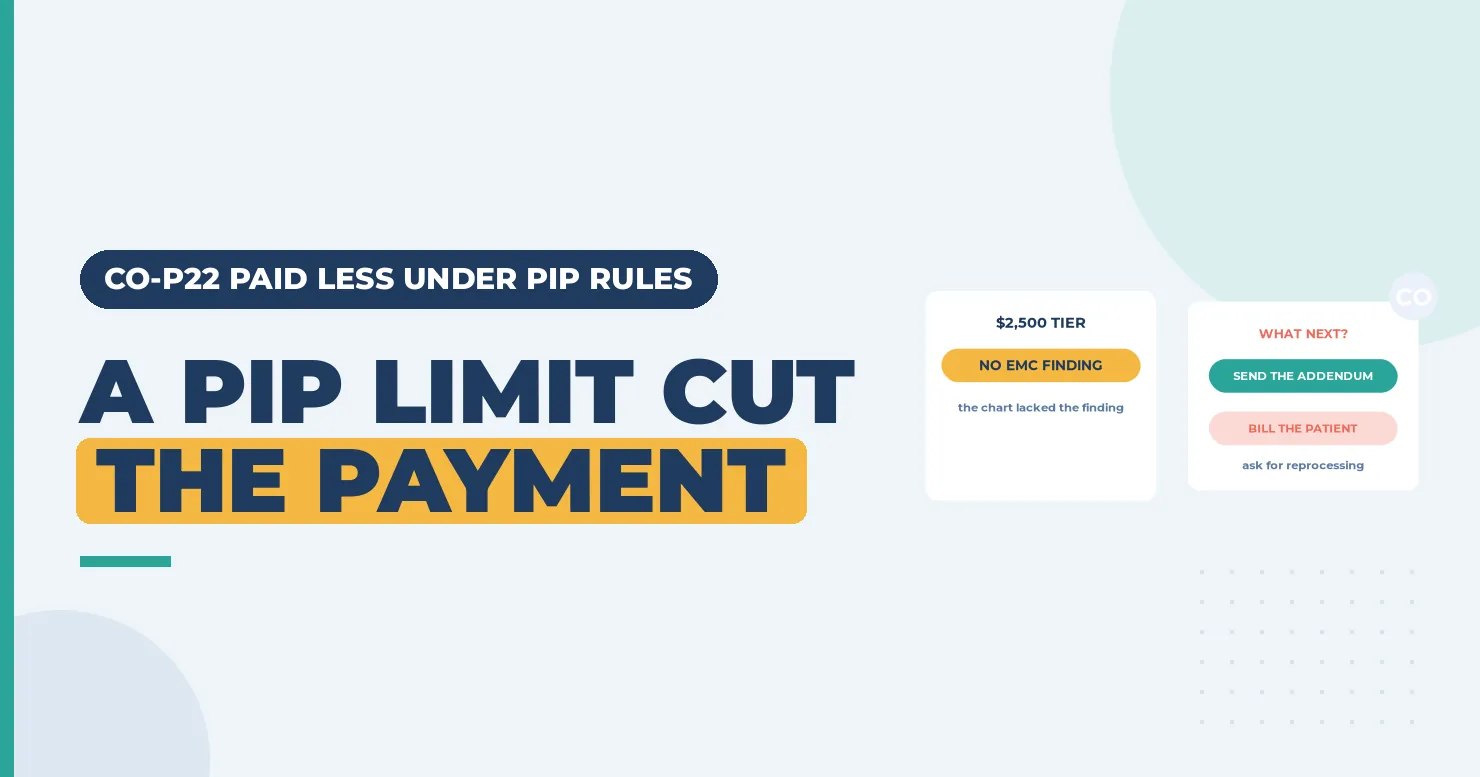
The CO-P22 denial code means an auto insurer paid your claim but reduced the amount because of the state rules or payment policies that govern Medical Payments Coverage (MedPay) or Personal Injury Protection (PIP). Part of the bill was paid, and the rest was adjusted away under a rule you may not see on the remit. (Primary source: X12 Claim Adjustment Reason Codes)
In brief: reason code P22 is a partial payment, not a full denial. Find which PIP or MedPay rule cut the payment, such as a benefit limit. Then see whether your records meet the rule’s exception. If they do, send the proof and ask for reprocessing. If not, post the adjustment as a write-off.
Part of our denial codes library. Written by Manikandan J, CPC, CRCR, who has worked auto injury claims for urgent care and primary care clients and has tracked PIP benefit limits on payment posting. Published 25 November 2026. Last updated: 25 November 2026. Code wording quoted word for word from X12. Read about the author and our editorial policy, or contact us to report an error.
What does denial code CO-P22 mean?
Denial code CO-P22 says the auto payer adjusted what it paid under MedPay or PIP jurisdiction rules or payment policies. It is the “adjusted” twin of P21, which denies payment outright. X12 limits the code to Property and Casualty Auto. As with P21, the payer must send the policy number segment at the claim level, or the healthcare policy identification segment at the line level, when the rule applies.
| Field | Value |
|---|---|
| Code | P22 |
| Description | “Payment adjusted based on the Medical Payments Coverage (MPC) and/or Personal Injury Protection (PIP) Benefits jurisdictional regulations, or payment policies.” |
| Use | Property and Casualty Auto only |
| Group codes | No X12 group restriction; CO is the usual pairing |
| Start | 11/01/2013; last modified 03/01/2018; replaces code Y2 |
| Remark codes | Vary by payer; read the line-level remark |
Source: X12 Claim Adjustment Reason Codes, checked 25 November 2026.
Methodology: the code wording is copied from the X12 list. The worked example uses the benefit limits in Florida’s PIP statute, which can be read online. Other states set their own limits.
Key terms: A benefit limit is the most the policy pays for medical care after a crash. An emergency medical condition (EMC) is a condition a qualified clinician has determined to be an emergency under the state’s definition. A payment adjustment is the part of a billed charge the payer does not pay.
CO-P22 vs OA-P22: where does the balance go?
With CO-P22, the provider writes off the adjusted amount unless a state rule says otherwise, and the injured person is not billed by default. OA-P22 is uncommon. It can appear on a second payer’s remit that repeats the auto carrier’s adjustment. In both cases, the first step is to read the auto carrier’s own explanation.
| Group | Who carries it | First check |
|---|---|---|
| CO-P22 | Your practice | Which PIP or MedPay rule was applied |
| OA-P22 | Not assigned | The auto carrier’s own remit |
Example scenario (fictional names), part 1
CO-P22 Denial Example: What Happened
Priya Ellison runs the front desk and billing at Bayshore Family Urgent Care in Florida. A cyclist was hit by a car and came in the same day with a sprained left wrist, S63502A. Physician assistant Jonas Pruitt examined him and billed 99204 and 73110 to a fictional PIP carrier.
The carrier paid part of the charges. The rest came back as CAS*CO*P22, and the explanation said medical benefits were limited to $2,500 for the claim. The chart has a note from Jonas saying the cyclist was in severe pain and could not use the hand.
Was the $2,500 limit correct, or was something missing from the claim file? Keep reading, or jump to how the CO-P22 denial was resolved.
Why do PIP and MedPay payments get adjusted under CARC P22?
The adjustment rules differ by state, so identify yours before you answer. These Florida rules are typical of what a limit-based adjustment looks like.
| Rule | Effect on the payment |
|---|---|
| Benefit cap | Medical and disability benefits stop at $10,000 |
| No-EMC limit | Care is limited to $2,500 if no clinician found an emergency medical condition |
| EMC limit | Up to $10,000 once a qualified clinician finds an emergency medical condition |
| Percent paid | The insurer may pay 80 percent of reasonable expenses |
The full text is in the Florida Statutes, section 627.736. For example, the statute lists the clinician types who may make the EMC finding, so check the credential on the note. Fee limits for physician services are tied to the Medicare physician fee schedule.
How do I fix a CO-P22 denial?
To fix a CO-P22 adjustment, identify the rule the payer applied, then check whether your chart supports an exception to that rule. If it does, send the proof to the adjuster and ask for reprocessing. If it does not, post the adjustment and move on.
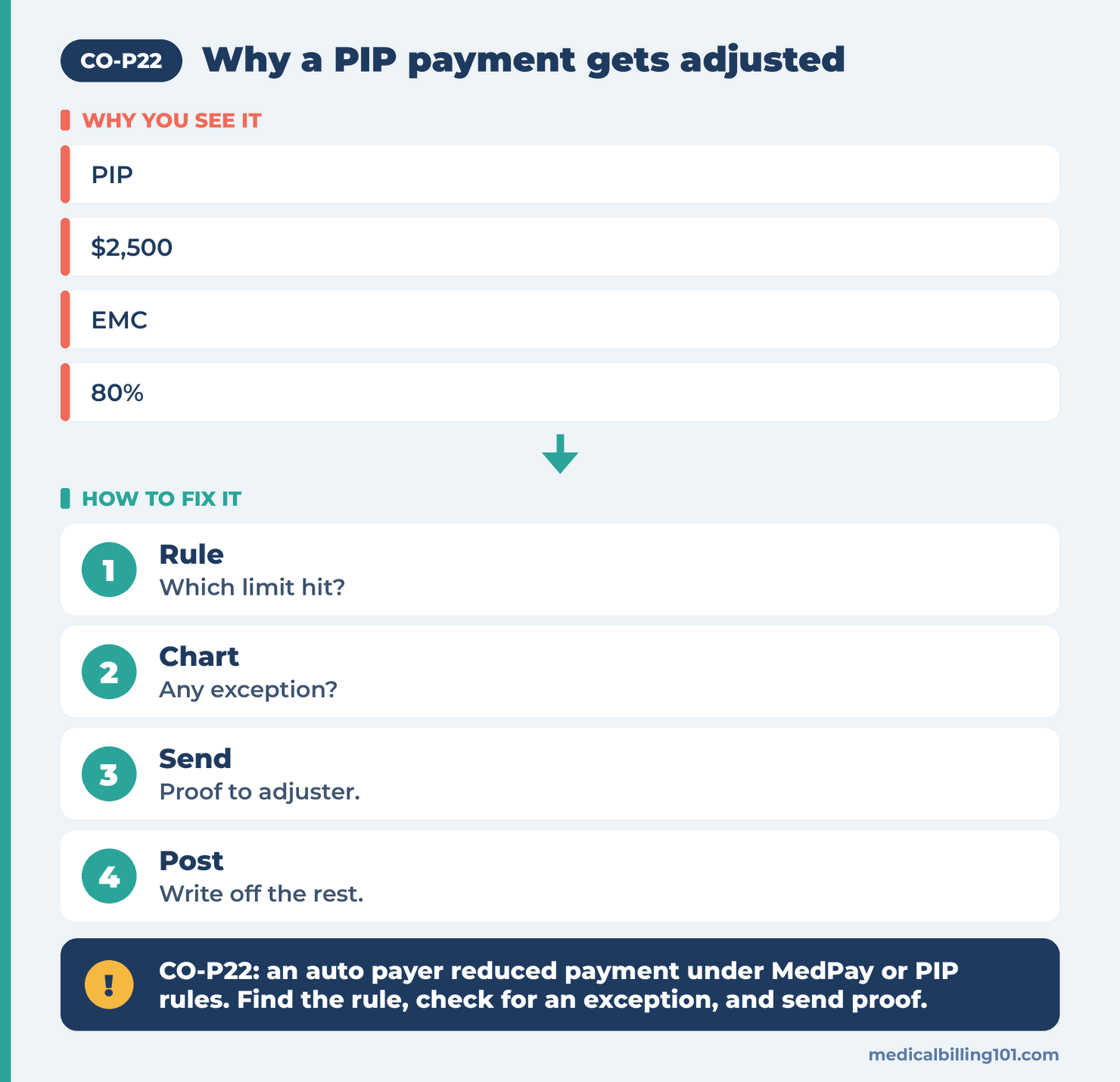
| Step | Action | Where to check |
|---|---|---|
| 1 | Read the line remark and explanation | The 835 and the payer’s EOB |
| 2 | Name the limit or rule applied | The state PIP or MedPay law |
| 3 | Test the chart against the exception | Clinician note and credentials |
| 4 | Send the proof with a written request | The adjuster, not a new claim |
| 5 | Track the benefits that remain | Payer’s benefit log |
| 6 | Post any final adjustment | Contract or write-off code |
Ask for the payer’s benefit ledger. Remaining benefits decide whether a later bill will be paid at all.
Example scenario (fictional names), part 2
How the CO-P22 Denial Was Resolved
Priya read the carrier’s explanation and the statute. Jonas is a physician assistant, and the law allows a physician assistant to make the emergency medical condition finding. His note described the pain and loss of use, but it never stated an emergency finding in so many words. The adjuster had no finding to rely on, so it applied the $2,500 limit.
Fix: Jonas added a signed, dated addendum stating his finding that the cyclist had an emergency medical condition on the visit date. Priya sent it to the adjuster with the claim number and asked for reprocessing. No new claim was needed because the billed lines were correct.
Outcome: the carrier lifted the limit to the $10,000 tier and paid the remaining allowed amount. Priya added an EMC prompt to the urgent care note template.
Names and details are illustrative; no real patient data.
Names and details are illustrative; no real patient data.
Can I bill the patient for a P22 adjustment?
Usually not. A CO group code puts the adjusted amount on the provider under the contract or the state rule. PIP laws often control what a provider may collect from an injured person, so read your state’s rule or ask your compliance lead before sending a statement.
Related codes
| Code | Meaning |
|---|---|
| CO-P21 | Payment denied under MedPay or PIP rules |
| CO-P20 | Service not paid under the outpatient facility fee schedule |
| CO-P19 | Code has a relative value of zero in the fee schedule |
| CO-P12 | Line priced at the state comp fee schedule rate |
| CO-P13 | Payment reduced or denied under a workers’ comp rule |
FAQ
What does CO-P22 mean?
An auto payer reduced its payment under the state’s MedPay or PIP rules or payment policies, such as a benefit limit.
Is CARC P22 the same as CARC P23?
No. P22 covers rule or policy adjustments in general. P23 is the narrower fee schedule adjustment under the same auto benefits.
Can I appeal a P22 adjustment?
Yes, if your chart meets an exception the payer missed. Send the proof to the adjuster and request reprocessing.
Does the $2,500 limit apply in every state?
No. The $2,500 and $10,000 tiers come from Florida’s PIP law. Check your own state’s rule.
What code did CARC P22 replace?
X12 lists P22 as the replacement for deactivated code Y2 from 11/01/2013.
Sources
How we checked: the CARC P22 quote was matched word for word with the X12 CARC list on 25 November 2026. The Florida benefit limits were read in the 2025 statute text on the Florida Senate site.
- X12, Claim Adjustment Reason Codes (CARC P22, P21, P20, P19, P12, P13, P10). Accessed 25 Nov 2026.
- Florida Senate, Florida Statutes section 627.736, required personal injury protection benefits. Accessed 25 Nov 2026.
- CMS, Physician Fee Schedule. Accessed 25 Nov 2026.
Last updated: 25 November 2026 · Educational content; not legal advice.