
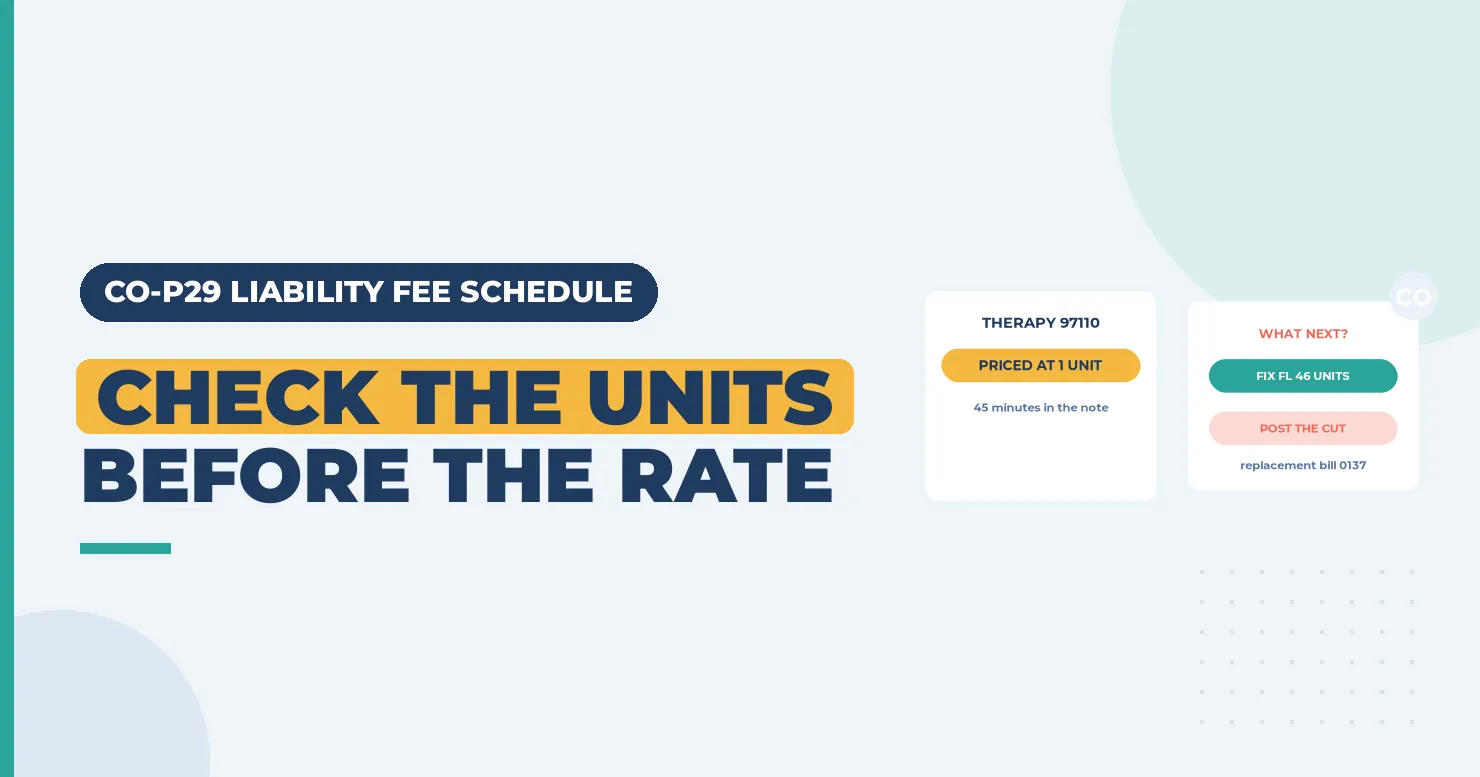
The CO-P29 denial code means an auto payer paid a line at a jurisdictional fee schedule under its liability benefits, and wrote off the rest of your charge. It is a pricing adjustment, not a denial, and most of the time the schedule is correct and the reduction is simply posted. When the paid amount looks far too low, the problem is often on the claim itself, such as the units. (Primary source: X12 Claim Adjustment Reason Codes)
In brief: reason code P29 says a fee schedule set the price. Before you dispute the rate, check exactly what the payer priced: the procedure code, the modifier and the number of units. If those values were wrong, send a replacement claim; if they were correct, post the reduction.
Part of our denial codes library. Written by Manikandan J, CPC, CRCR, who has posted auto injury remits for hospital rehab departments and audits timed therapy units before billing. Published 27 November 2026. Last updated: 27 November 2026. Code wording quoted word for word from X12. Read about the author and our editorial policy, or contact us to report an error.
What does denial code CO-P29 mean?
Denial code CO-P29 is a fee schedule adjustment on the liability benefits side of an auto claim. X12 limits it to Property and Casualty Auto. At the claim level, the payer must send the class of contract code segment. At the line level, it must send the healthcare policy identification segment, if the rules apply.
| Field | Value |
|---|---|
| Code | P29 |
| Description | “Liability Benefits jurisdictional fee schedule adjustment.” |
| Use | Property and Casualty Auto only |
| Group codes | No X12 group restriction; CO is the usual pairing |
| Start | 11/01/2017 |
| Remark codes | Vary by payer; read the line-level remark |
Source: X12 Claim Adjustment Reason Codes, checked 27 November 2026.
Methodology: the code wording is copied from the X12 list. Unit rules come from the CMS claims manuals, which many fee schedules follow. Auto fee rules differ by state, so check the rule your payer names.
Key terms: A fee schedule is a table of the most a payer will allow for each code. A timed code is a service billed in 15-minute units, such as 97110. Service units are the number of times a service was done, reported in UB-04 FL 46.
CO-P29 vs OA-P29: a write-off or a question mark
CO-P29 is the common form. It means the gap between your charge and the schedule amount is a provider write-off, and it is not moved to the patient. OA-P29 can show up too, because X12 sets no group limit. Treat OA as a prompt to ask the adjuster who is responsible for the difference. In both situations, calculate the allowed amount per unit before you take any other action.
| Group | What it suggests | First move |
|---|---|---|
| CO-P29 | Write-off under the fee schedule | Check units and code, then post or rebill |
| OA-P29 | Other adjustment, owner unclear | Ask the adjuster, then check units |
Example scenario (fictional names), part 1
CO-P29 Denial Example: What Happened
Tomas Reyes posts remits for the outpatient rehab unit at Riverbend Community Hospital. Kendra Walsh, PT, treated a bus driver for a low back strain after a side-impact crash. Her note shows 45 minutes of therapeutic exercise, 97110, with S39.012D (entered as S39012D).
The other driver’s insurer, a fictional carrier named Harbor State Insurance, had agreed in writing to pay the hospital. The 835 paid a small amount on the 97110 line and adjusted the rest with CAS*CO*P29. Tomas first thought the carrier had used the wrong rate.
Was the fee schedule wrong, or was something else on the claim? Keep reading, or jump to how the CO-P29 denial was resolved.
What causes a CARC P29 fee schedule cut?
A P29 reduction is normal whenever the schedule allows less than your charge, and it becomes a problem only when the payer priced the wrong service or quantity. For example, one unit billed for a 45-minute timed service will price at one unit. Here are the usual causes.
| Cause | What it looks like |
|---|---|
| Schedule below your charge | Normal; allowed matches the schedule for the code |
| Units too low | Allowed per unit is right, total is low |
| Wrong code or modifier | A cheaper code was priced |
| Wrong state schedule | Payer used a schedule from another state |
| Bundling under the schedule | One line paid, a related line zeroed |
Several states write automobile injury fee limits directly into their insurance statutes. Michigan, for example, caps provider payments for PIP-covered care at a percent of Medicare in MCL 500.3157. P29 is the liability-side code, so ask the payer which rule it used for your claim.
How do I fix a CO-P29 denial?
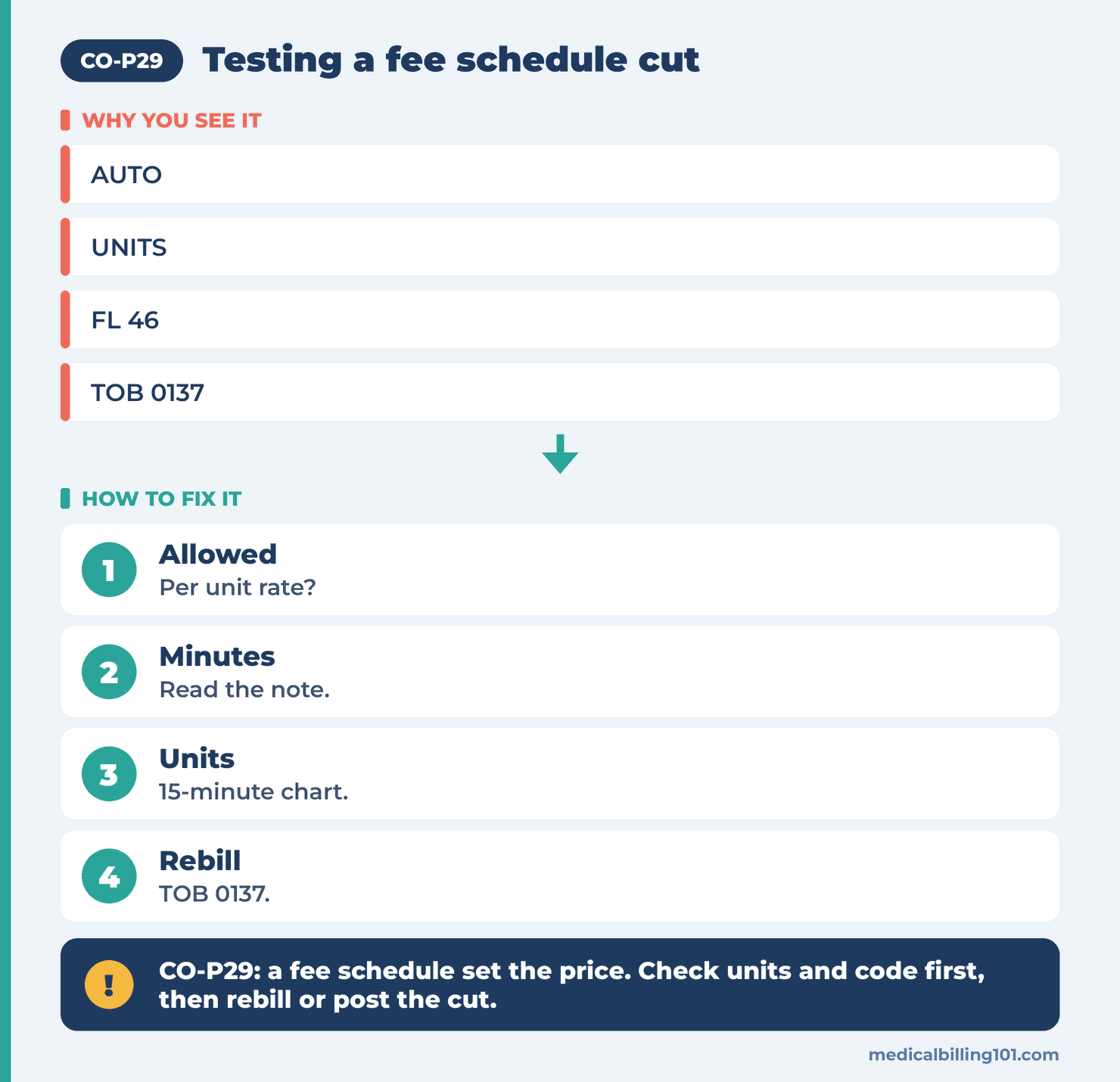
To fix CO-P29, divide the allowed amount by the units the payer priced. If the per-unit rate matches the published schedule, the reduction is legitimate. If the units or code were wrong, send a replacement claim with the right values.
| Step | Action | Where to check |
|---|---|---|
| 1 | Find the allowed amount and units on the 835 | SVC segment of the line |
| 2 | Compare the per-unit rate with the schedule | The payer’s named schedule |
| 3 | Count the timed minutes in the note | Therapy flowsheet |
| 4 | Convert minutes to units | CMS 15-minute unit chart |
| 5 | Send a replacement claim | TOB 0137, FL 46 units, FL 64 |
| 6 | If all values were right, post the cut | Posting rules |
The CMS Medicare Claims Processing Manual, chapter 5, section 20.2 lists 38 through 52 minutes as 3 units. The UB-04 instructions in chapter 25 say FL 46 units equal the number of times a HCPCS service was done.
Example scenario (fictional names), part 2
How the CO-P29 Denial Was Resolved
Tomas divided the allowed amount by one unit, and it matched the schedule rate for 97110. Then he opened the claim. FL 46 showed 1 unit, but the note had 45 timed minutes. The charge interface had dropped the unit count on its way to billing.
Fix: he sent a replacement UB-04 with bill type 0137 and the original claim number in FL 64. FL 46 now showed 3 units on the 0420 line.
Outcome: the carrier repriced 97110 at three units under the same schedule. Tomas asked the IT team to carry timed units through the charge interface.
Names and details are illustrative; no real patient data.
Names and details are illustrative; no real patient data.
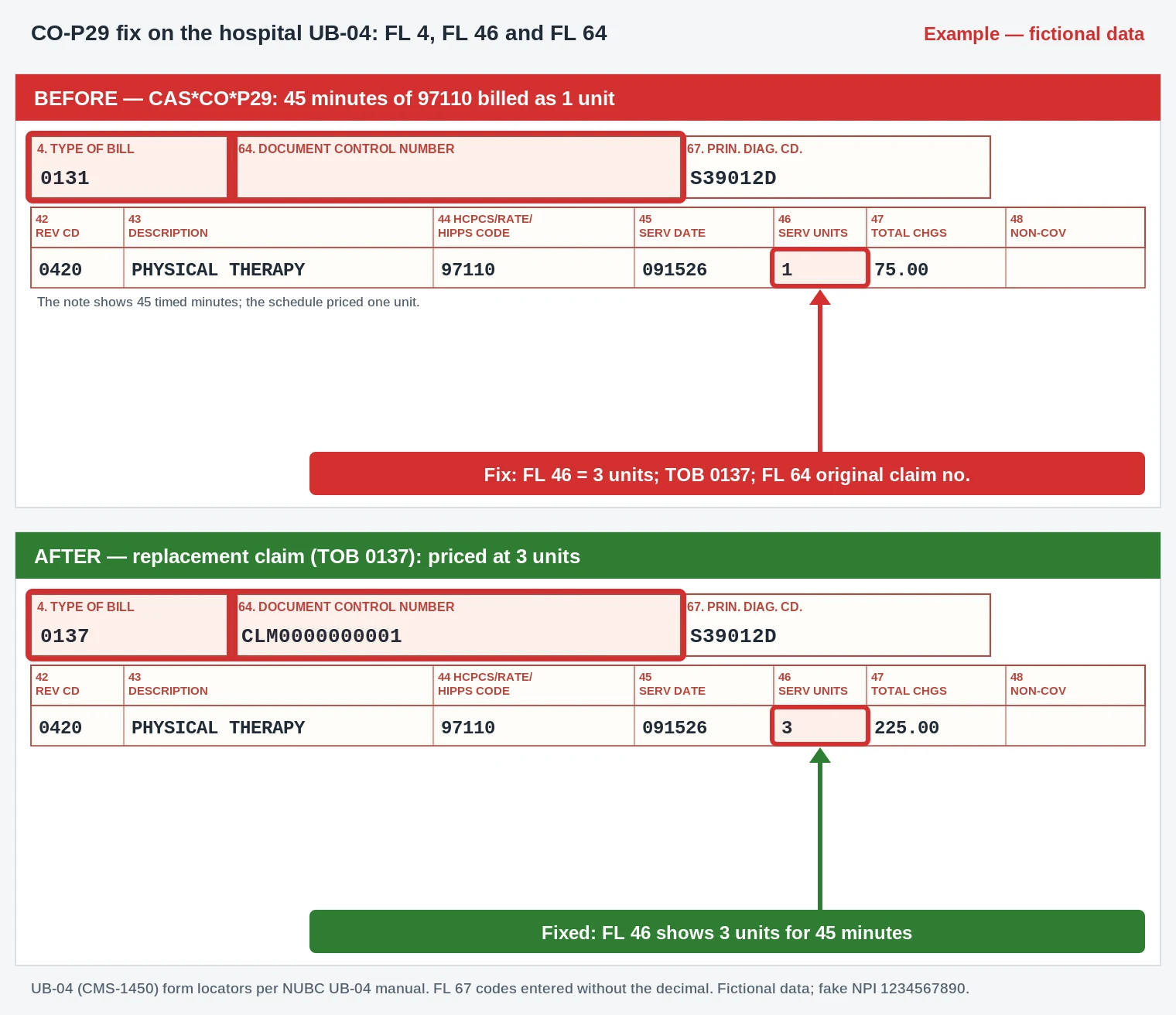
- FL 46: service units on the 0420 line changed from 1 to 3, because the note records 45 timed minutes of 97110 (38 through 52 minutes is 3 units).
- FL 47: the line charge follows the units, so it changes with them.
- FL 4 + FL 64: replacement bill type 0137 with the original claim number.
- FL 44 / FL 67: 97110 and S39.012D (entered as S39012D) are unchanged.
- CMS-1500: not shown; the hospital therapist’s time is billed only on the facility claim.
Can I bill the patient for the P29 difference?
No, not under CO. The difference between your charge and the schedule amount is a provider write-off, and many state fee regulations also prohibit billing the injured person for that difference.
Related codes
| Code | Meaning |
|---|---|
| CO-P27 | Payment denied under liability coverage rules |
| CO-P23 | PIP fee schedule adjustment |
| CO-P12 | Line priced at the state comp fee schedule rate |
| CO-P20 | Service not paid under the outpatient facility schedule |
| CO-P19 | Procedure has a relative value of zero |
FAQ
What does CO-P29 mean?
An auto payer priced the line at a fee schedule under liability benefits. The rest of the charge is adjusted off.
Is CARC P29 the same as P23?
No. P23 is the fee schedule code for PIP or medical payments coverage. P29 is for liability benefits.
How many units is 45 minutes of 97110?
Under the CMS 15-minute chart, 38 through 52 minutes is 3 units. Check the rule your payer follows.
Can I appeal a P29 rate?
Yes, if the payer applied the wrong schedule or priced the wrong code. If the original claim carried incorrect units, send a replacement claim instead of an appeal.
Which UB-04 field shows units?
FL 46. On a hospital claim, a units error is fixed there with bill type 0137 and the original claim number in FL 64.
Sources
How we checked: the CARC P29 quote was matched word for word with the X12 CARC list on 27 November 2026. The unit chart and FL 46 rule were read in the CMS manuals.
- X12, Claim Adjustment Reason Codes (CARC P29, P27, P23, P12, P20, P19). Accessed 27 Nov 2026.
- CMS, Medicare Claims Processing Manual, chapter 5 (therapy units). Accessed 27 Nov 2026.
- CMS, Medicare Claims Processing Manual, chapter 25 (UB-04 form locators). Accessed 27 Nov 2026.
- Michigan Legislature, MCL 500.3157, auto injury fee limits. Accessed 27 Nov 2026.
Last updated: 27 November 2026 · Educational content; not legal advice.