
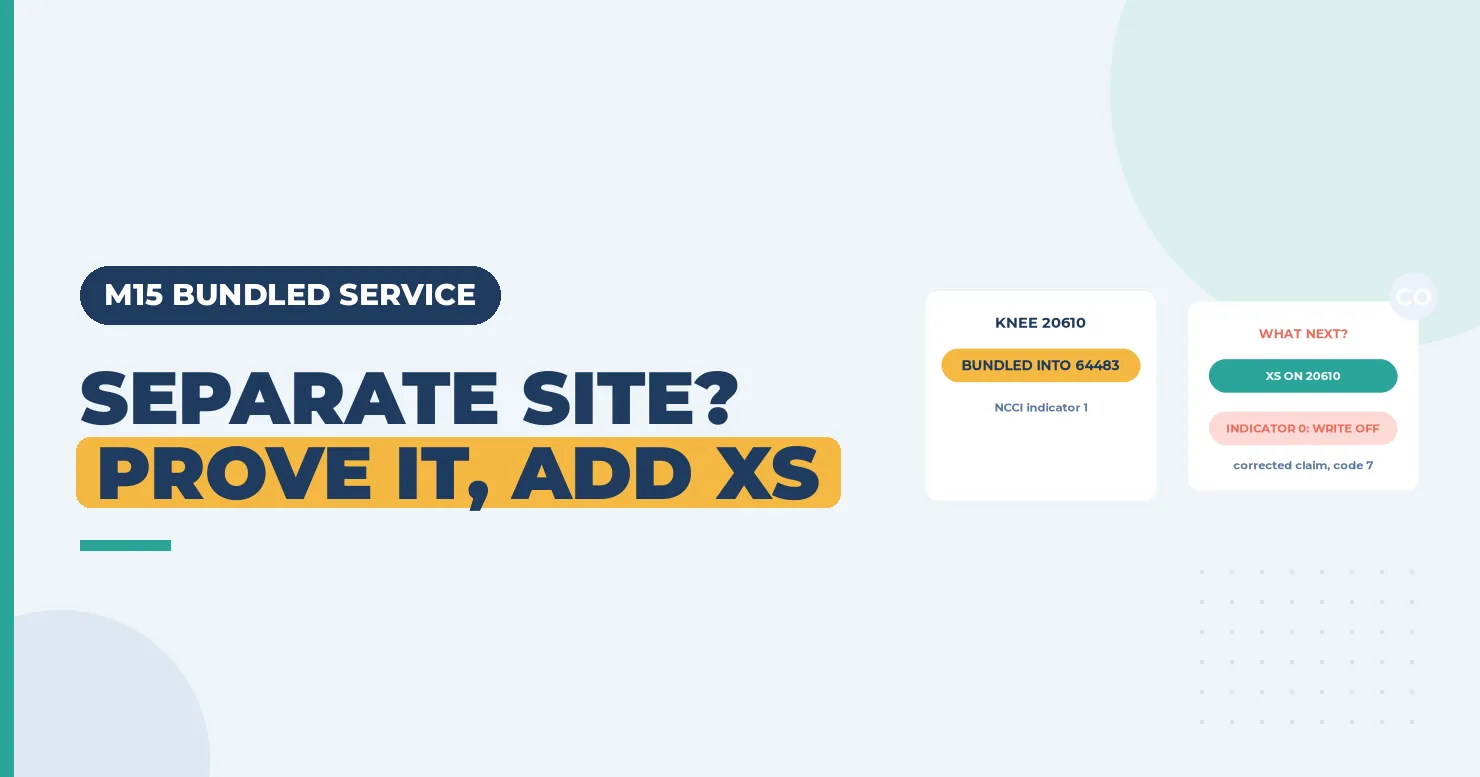
The M15 denial code is a remark that says the payer bundled one of your lines into another procedure on the same claim. It treats the two services as parts of a single procedure, so it pays only one. Sometimes that is correct. Sometimes the second service was truly separate, such as a procedure on a different body part, and a modifier was missing. (Primary source: X12 Remittance Advice Remark Codes)
In brief: remark code M15 is a bundling denial. Look up the code pair in the NCCI edit table. If the modifier indicator is 0, write the line off. If it is 1 and the record shows a separate site or session, add the right modifier and send a corrected claim.
Part of our denial codes library. Written by Manikandan J, CPC, CRCR, who has worked bundling denials for pain management and orthopedic clients and keeps NCCI pair checks in the claim scrubber. Published 28 November 2026. Last updated: 28 November 2026. Code wording quoted word for word from X12. Read about the author and our editorial policy, or contact us to report an error.
What does remark code M15 mean?
Remark code M15 says separately billed services were bundled because the payer considers them components of the same procedure. Separate payment is not allowed for the bundled line. M15 explains a CARC, usually a bundling reason. Most payers base the bundling on the National Correct Coding Initiative, or NCCI, edit tables.
| Field | Value |
|---|---|
| Code | RARC M15 |
| M15 wording | “Separately billed services/tests have been bundled as they are considered components of the same procedure. Separate payment is not allowed.” |
| Type | Remittance Advice Remark Code |
| Start | 01/01/1997 |
| Paired with | A bundling CARC, such as 97, 234 or 236 |
| Group code | Usually CO; the patient is not billed |
Source: X12 Remittance Advice Remark Codes, checked 28 November 2026.
Methodology: the code wording is copied from the X12 list. The code pair in the example was checked in the CMS practitioner and hospital NCCI tables, version 32.3, effective October 1, 2026.
Key terms: An NCCI procedure-to-procedure edit is a code pair that is not paid together on the same day without a valid reason. The modifier indicator shows whether a modifier can bypass the edit: 0 means never, 1 means allowed. Modifier XS marks a service on a separate organ or structure.
Which CARC and group code come with M15?
M15 rides on a bundling CARC, and the group is almost always CO. CO means the provider absorbs the bundled amount under the contract. The patient should not get a bill for it. The CARC tells you which kind of bundling rule fired.
| Pair | What it suggests | First move |
|---|---|---|
| CO-97 with M15 | Line included in another paid service | Look up the code pair |
| CO-234 with M15 | Procedure not paid separately | Check the payer’s bundling policy |
| CO-236 with M15 | NCCI pair billed without a valid modifier | Check the modifier indicator |
Example scenario (fictional names), part 1
M15 Denial Example: What Happened
Priya Shah bills for Lakeside Spine and Pain, which works in a hospital outpatient department. Dr. Marcus Webb did a right L5 transforaminal epidural injection, 64483, for lumbar radiculopathy, M54.16 (entered as M5416). In the same session, he injected the patient’s left knee, 20610, for knee arthritis, M17.12 (entered as M1712).
The fictional commercial plan, Harbor Point Health, follows NCCI. It paid 64483 but denied 20610 with CAS*CO*236 and remark M15.
Why would a knee injection be bundled into a spine injection? Keep reading, or jump to how the M15 denial was resolved.
What causes an M15 bundling denial?
An M15 denial comes from a code pair edit or a payer bundling policy. For example, NCCI lists 64483 with 20610 as a pair, and its stated rationale is misuse of the column two code with the column one code. Here are the usual causes.
| Cause | What it looks like |
|---|---|
| True component billed separately | Modifier indicator 0; no bypass |
| Separate site, no modifier | Indicator 1, but no XS or 59 |
| Modifier does not match the record | XS used when the note shows a separate session |
| Payer policy stricter than NCCI | Bundled even with a modifier |
| Separate session not shown | No XE when visits were hours apart |
The CMS NCCI procedure-to-procedure page posts the practitioner and hospital tables. In version 32.3, both list 64483 with 20610, with modifier indicator 1.
How do I fix an M15 denial?
To fix an M15 denial, find the code pair and its modifier indicator. If the indicator is 0, post the write-off. If it is 1 and the record shows a separate site or session, add the matching modifier and send a corrected claim.
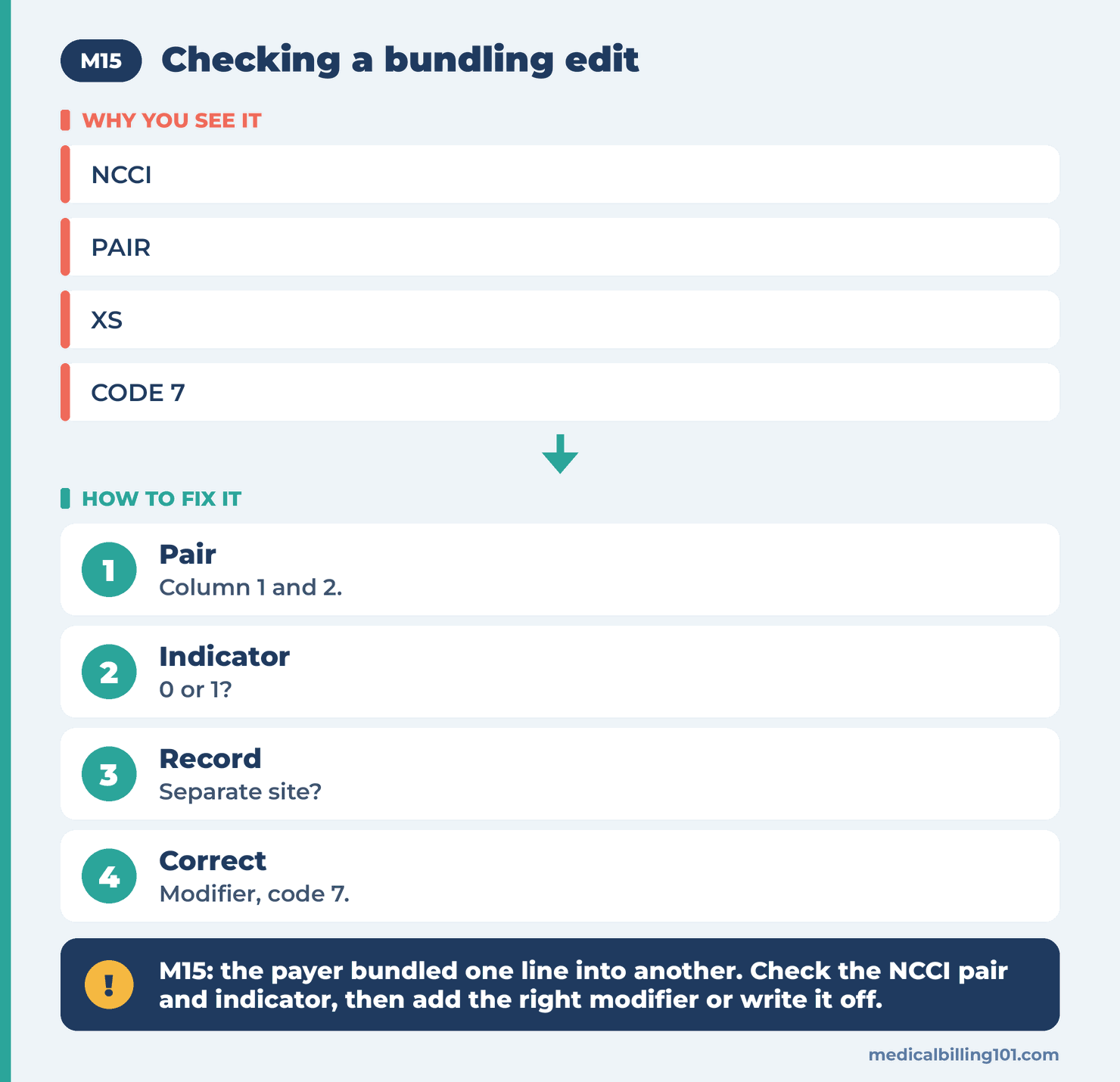
| Step | Action | Where to check |
|---|---|---|
| 1 | Find the column 1 and column 2 codes | NCCI table |
| 2 | Read the modifier indicator | 0 or 1 |
| 3 | Confirm a separate site or session | Procedure note |
| 4 | Add XS, XE, XP, XU or 59 to the right line | Box 24D or FL 44 |
| 5 | Send a corrected claim | Box 22 code 7, or bill type 0137 with FL 64 |
| 6 | If the payer still bundles, appeal with the note | Payer policy and NCCI table |
The CMS modifier 59 booklet defines XS as a separate structure. It also warns that modifiers must not be used to bypass an edit unless the record supports them. NUCC places up to four modifiers in Box 24D, per its 1500 instructions.
Example scenario (fictional names), part 2
How the M15 Denial Was Resolved
Priya pulled both procedure notes. The spine injection was at right L5. The knee injection was a separate site with its own diagnosis and its own consent. The NCCI indicator for the pair was 1.
Fix: Priya added modifier XS to 20610 on a corrected claim, with Box 22 code 7 and the original claim number. The hospital sent the same fix on its UB-04, with bill type 0137 and FL 64.
Outcome: Harbor Point paid the knee injection on both claims. Priya added a scrubber rule that stops a 64483 and 20610 claim without a distinct-site modifier.
Names and details are illustrative; no real patient data.
Names and details are illustrative; no real patient data.
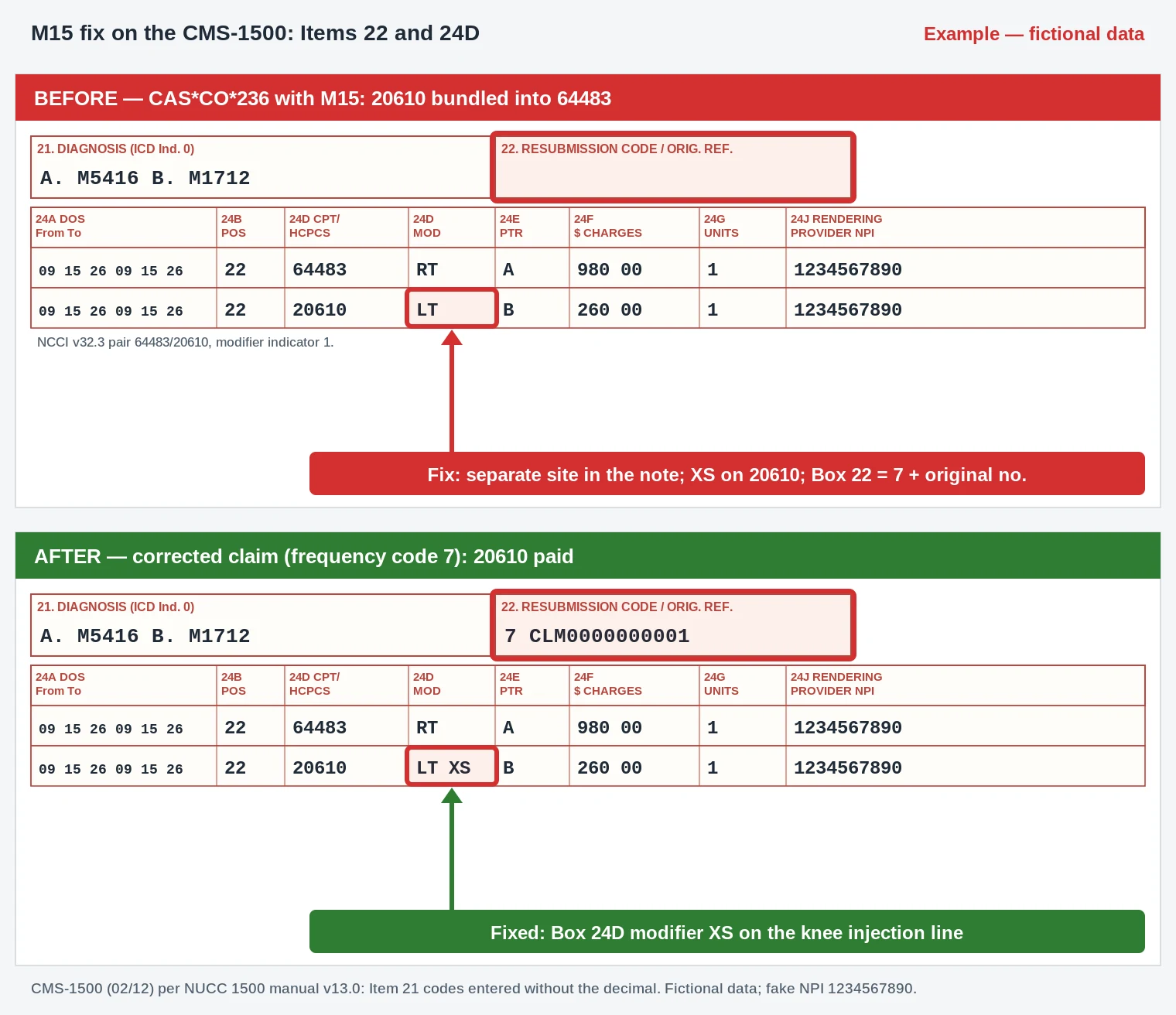
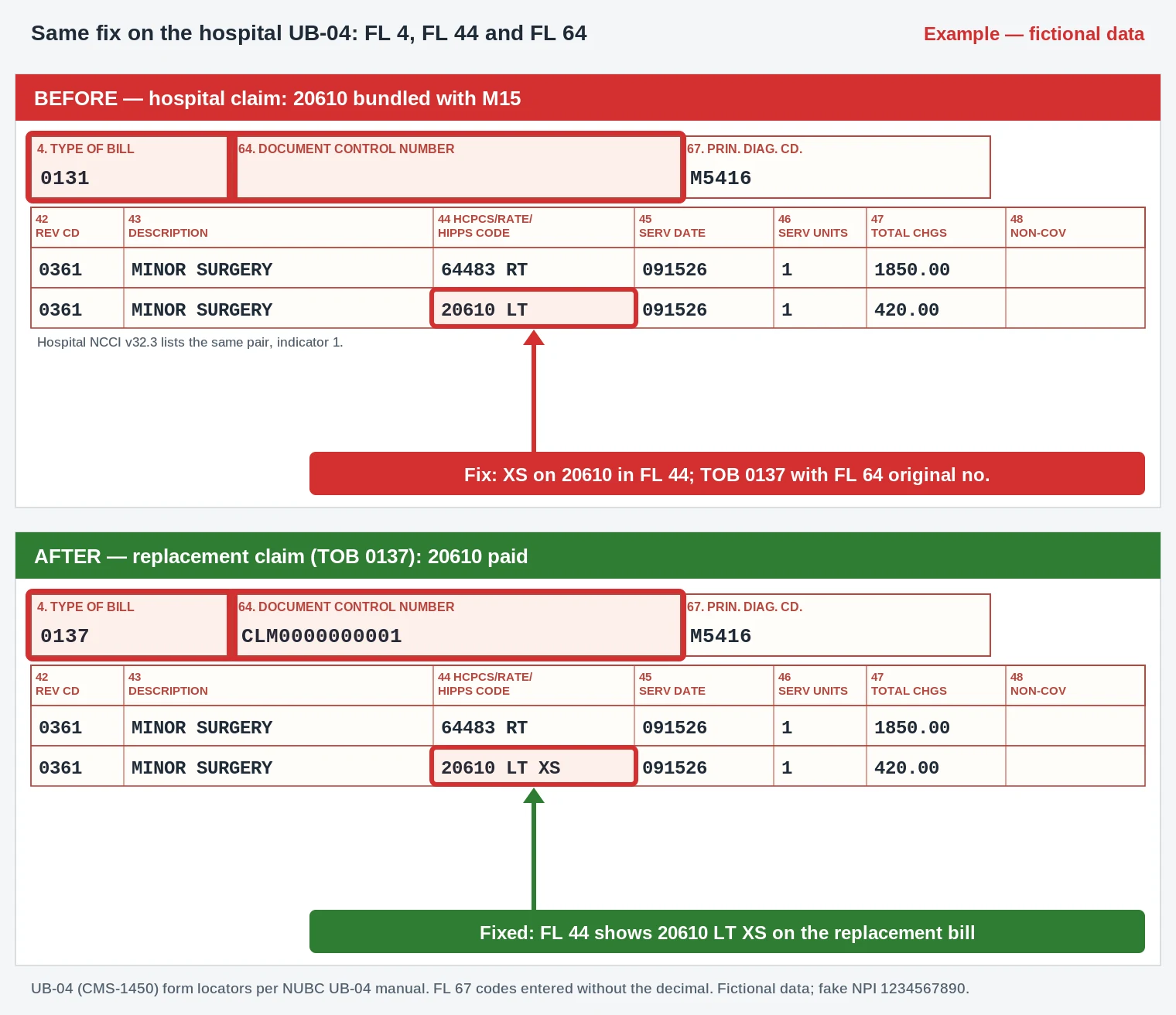
- Box 24D / FL 44: modifier XS added to 20610, because the knee is a separate structure from the L5 spine level; the procedure note documents both sites.
- Box 22 / FL 4 + FL 64: frequency code 7 with the original claim number (bill type 0137 on the UB-04).
- Box 21 / FL 67: M54.16 and M17.12 (entered as M5416 and M1712) are unchanged; the knee line points to M1712.
- 64483: unchanged and already paid; only the bundled line is corrected.
Can I bill the patient for an M15 denial?
No. Under CO, the bundled amount is part of the contract, so the provider writes it off or corrects the claim. The patient’s share was already set on the paid line. Billing the patient for a bundled service would break most network contracts.
Related codes
| Code | Meaning |
|---|---|
| CO-236 | Code pair not allowed together under NCCI |
| CO-234 | Procedure not paid separately |
| CO-59 | Multiple or concurrent procedure rules |
| CO-B15 | Qualifying service not received |
| M51 | Missing or invalid procedure code |
FAQ
What does M15 mean on a remit?
It means the payer bundled a separately billed service into another procedure and will not pay it on its own.
Is M15 always a final denial?
No. If the modifier indicator is 1 and the record shows a separate site or session, a corrected claim with a modifier can be paid.
Which line gets the modifier?
Usually the column 2 code. CMS allows the modifier on either code of the pair.
Should I use 59 or XS?
Use XS, XE, XP or XU when one fits. CMS says to use 59 only when no more specific modifier applies.
Do commercial plans follow NCCI?
Many do, but each plan sets its own policy. Check the plan’s bundling policy as well as the NCCI table.
Sources
How we checked: the M15 quote was matched word for word with the X12 RARC list on 28 November 2026. The code pair was checked in the CMS NCCI practitioner and hospital tables, version 32.3.
- X12, Remittance Advice Remark Codes (RARC M15, M51). Accessed 28 Nov 2026.
- X12, Claim Adjustment Reason Codes (CARC 97, 234, 236, 59, B15). Accessed 28 Nov 2026.
- CMS, Medicare NCCI procedure-to-procedure edits. Accessed 28 Nov 2026.
- CMS MLN, Proper use of modifiers 59, XE, XP, XS and XU. Accessed 28 Nov 2026.
- NUCC, 1500 Claim Form Instructions. Accessed 28 Nov 2026.
Last updated: 28 November 2026 · Educational content; not legal advice.