

M5 is a Remittance Advice Remark Code (RARC) about monthly rental payments for equipment. A remark code is a message on a remittance that adds detail to a payment or adjustment. A capped rental item is durable medical equipment that Medicare pays for month by month, up to a limit. M5 describes how long monthly rental payments can continue. It is a remark, not a Claim Adjustment Reason Code, so the CARC and group code on the same line carry the money. Many people search for “m5 remark code”, and that is the phrase this page answers. (Primary sources: X12 Remittance Advice Remark Codes · CMS Claims Processing Manual, Ch. 20, §30.5 · CMS fact sheet on capped rental items)
Quick answer: M5 tells you how long monthly rental payments can continue. Its wording says the 15th month, but for capped rental items first rented on or after 1 January 2006, CMS says the cap is 13 continuous months. Read the CARC and group code on the same line, count the rental months, and check your DME MAC’s current rules before you rebill or appeal.
Part of our denial codes library. Written by Manikandan, a revenue cycle management specialist with more than 10 years of US medical billing experience. Last reviewed: 16 October 2026. Official code wording is quoted word for word from X12; Medicare rules link to their CMS source.
M5 remark code description (official X12 wording)
X12 Remittance Advice Remark Code M5, verbatim:
“Monthly rental payments can continue until the earlier of the 15th month from the first rental month, or the month when the equipment is no longer needed.”
Source: X12 Remittance Advice Remark Codes, checked 16 October 2026. Start: 01/01/1997. X12 does not mark M5 as an “Alert.”
What M5 means in plain English
- It is an information message about rental limits. It does not say why a line was adjusted.
- Two things end rental payments. One is the month count from the first rental month. The other is the month the equipment is no longer needed.
- The CARC and group code carry the money. Read them first, as you would for any remark code.
- The wording is old. It uses the 15th month. Current CMS rules for most capped rental items use 13 months.
- It points at the rental count. Your job is to check how many months were paid and how many are left.
The 15-month wording vs the 13-month rule
CMS Claims Processing Manual Ch. 20, §30.5 says that for capped rental items, DME MACs pay “on a monthly rental basis not to exceed a period of continuous use of 15 months.” The same section says that if the beneficiary takes the purchase option, rental fees continue “not to exceed a period of continuous use of 13 months.”
Later law changed the main rule. A CMS fact sheet says the Deficit Reduction Act of 2005 “revised Medicare payments for capped rental items to 13 continuous months only,” and that the supplier must transfer ownership after the 13th continuous month. It applies to capped rental items “for which the first rental month occurs on or after January 1, 2006.” The rule is also in 42 CFR 414.229(f). A 2015 CMS transmittal, Change Request 9062, is titled “Payment Repairs to Capped Rental Equipment Prior to the End of the 13-Month Cap.”
So M5’s text matches the older 15-month rule. Do not use “15th month” as your count. Use the cap that applies to your item and its first rental date.
M5 vs M7, N381 and lookalikes
| Code | Type | Official idea | Difference |
|---|---|---|---|
| M5 | RARC | Monthly rental payments can continue until the earlier of the 15th month or the month the equipment is no longer needed | Rental limit message. This page |
| M7 | RARC | No rental payments after the item is purchased, returned or after the total of issued rental payments equals the purchase price | Rental ends by purchase or return |
| M15 | RARC | Separately billed services have been bundled | Bundling, not rental |
| N381 | RARC (Alert) | Consult our contractual agreement | Contract pointer. See N381 |
| CO-97 | CARC | Benefit included in the payment for another service | Dollar adjustment. See CO-97 |
How the rental month count works
A period of continuous use begins with the first month of medical need and lasts until the medical need for the item ends, under 42 CFR 414.230. An interruption of no more than 60 consecutive days, plus the days left in the rental month in which use stopped, is temporary. A longer gap can start a new rental period if the supplier sends the required information.
CMS Ch. 20, §130.9 lists the modifiers that show rental status on a claim. For example:
- RR is used when DME is to be rented.
- KH marks the initial claim, purchase or first month rental.
- KI marks the second or third month rental.
- KJ marks capped rental months four to fifteen.
CMS also says that for the month of death or discontinuance of use, DME MACs pay the full month of rental, per Ch. 20, §30.5.4.
Common triggers for an M5 line
- The count reached the cap. The supplier billed a rental month after the last payable month.
- Wrong first rental month. The supplier’s count started on a different date from the payer’s.
- Gap in use read as a break. For example, a hospital stay that the payer counted differently.
- Wrong rental modifier. The line used a modifier that does not match the month.
- Equipment no longer needed. The supplier kept billing after the need ended.
- A change of supplier. The new supplier’s count did not match the payer’s record.
Where M5 shows up in the 835
CLP*PCN18807*4*58.00*0.00*0.00*12*CLAIM907711~
SVC*HC:E0260:RR:KJ*58.00*0.00**1~
CAS*CO*119*58.00~
LQ*HE*M5~
- Status code 4 means the claim was denied.
- The line paid $0.
- LQ*HE*M5 carries the remark code. In some remits it appears in an RMK segment instead.
- The CARC on the CAS segment is the reason for the adjustment.
- This sample is illustrative only. Real remits vary.
How to work an M5 line: decision path
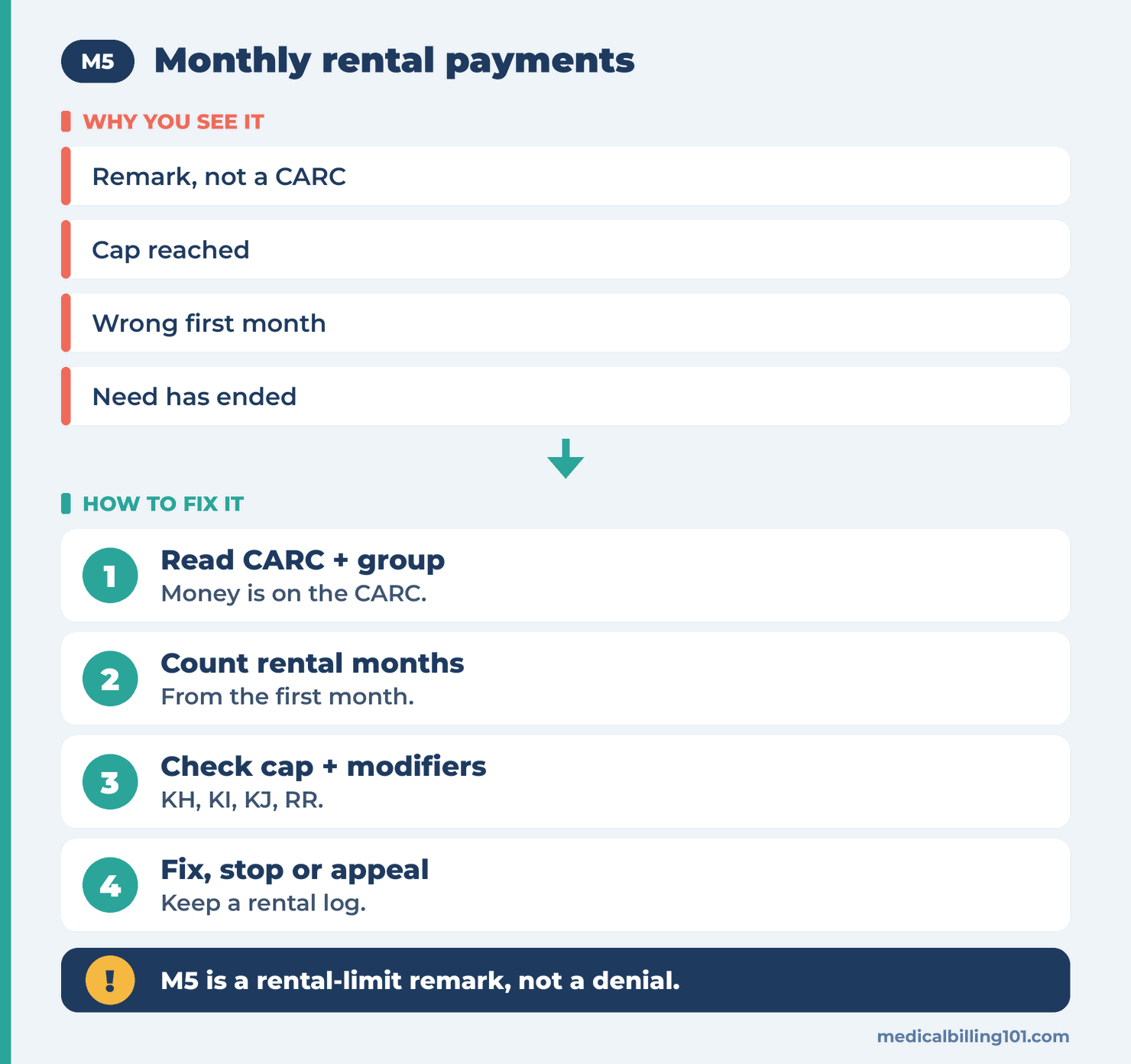
- Read the CARC and group code on the same line. Note the amount.
- Find the first rental month for this item and this patient.
- Count the paid rental months on your own records and on the payer’s.
- Check the cap for the item and its first rental date, using your DME MAC’s current rules.
- Check the modifiers against the month number.
- If you billed past the cap, stop billing rental and adjust the line off.
- If your count was wrong, correct the dates or modifiers and resubmit.
- If the payer’s count was wrong, appeal with the rental log and the dates of use.
Medicare, commercial and Medicaid notes
Medicare. Medicare pays reasonable and necessary maintenance and servicing of beneficiary-owned capped rental items after title transfers, per the CMS fact sheet. For Medicare claims, use the DME MAC’s rules and fee schedule.
Commercial. Plans set their own rental terms. Ask the plan for its rental cap, its purchase option and its counting rules.
Medicaid. State programs publish their own DME rental policies. Check the state provider manual.
Worked example (illustrative)
A supplier rents a capped rental item to a patient starting in January 2025. In February 2026, the supplier bills rental month 14. The remit shows no payment and remark M5.
Reading it: The remark is about rental limits. The remit also shows a CARC and group code, and those explain the adjustment.
Check: Rental months paid were January 2025 through January 2026, which is 13. The item’s first rental month was after 1 January 2006, so the 13-month cap applies under the CMS fact sheet.
Fix: The supplier stops billing rental and adjusts the line off. The supplier confirms that title transferred to the patient, and bills later maintenance and servicing under the CMS rules for beneficiary-owned items.
Second scenario: The supplier’s own log shows a 70-day gap that should have started a new rental period. The supplier sends the payer the log and the required information.
Prevention checklist
- [ ] Keep a rental log with the first rental month and the paid month count.
- [ ] Set the cap for each item and each first rental date in your billing system.
- [ ] Check rental modifiers against the month number before billing.
- [ ] Record the date the need ends, and stop billing that month.
- [ ] Review remit remarks for M5 and M7 each month.
- [ ] Keep the CARC and RARC guide handy for staff training.
Related codes
- N381: consult the contractual agreement.
- CO-97: benefit included in another service.
- MA130: unprocessable claim with no appeal rights.
- MA13: alert about billing the patient for amounts not reported under PR.
- CARC and RARC guide.
Key takeaways
M5 is a remark about rental limits, and its wording is the older 15-month rule. For most capped rental items first rented since 2006, CMS uses 13 months. Count the rental months, check the cap, and read the CARC and group code on the line.
FAQ
What is the M5 remark code description?
X12 describes M5 as “Monthly rental payments can continue until the earlier of the 15th month from the first rental month, or the month when the equipment is no longer needed.”
Is M5 a denial?
No. It is a remark code. The CARC and group code on the line explain the adjustment.
Is the cap 15 months or 13 months?
M5 and CMS Ch. 20 §30.5 use 15 months. A CMS fact sheet says capped rental items first rented on or after 1 January 2006 are limited to 13 continuous months.
What do KH, KI and KJ mean?
Per CMS Ch. 20 §130.9, KH is the initial claim or first month rental, KI is the second or third month, and KJ covers capped rental months four to fifteen.
What if the patient dies or stops using the item?
CMS Ch. 20 §30.5.4 says DME MACs pay the full month rental for the month of death or discontinuance of use.
How is M5 different from M7?
M5 is about the month cap and the end of need. M7 is about rental payments after the item is purchased, returned or fully paid.
Quick facts
| Item | Value |
|---|---|
| X12 RARC | M5 |
| X12 start | 01/01/1997 |
| Type | Remark code (not an Alert) |
| Official wording | Monthly rental payments can continue until the earlier of the 15th month from the first rental month, or the month when the equipment is no longer needed |
| Current cap for most capped rental items | 13 continuous months (first rental on or after 1 January 2006) |
| Common confusions | M7 (purchase or return), CO-97 (bundled) |
| Last reviewed | 16 October 2026 |
Sources
- X12, Remittance Advice Remark Codes (M5, M7, M15, N381). M5 Start 01/01/1997. Accessed 16 Oct 2026.
- CMS, Medicare Claims Processing Manual (IOM 100-04), Ch. 20, §30.5, §30.5.4 and §130.9. Accessed 16 Oct 2026.
- CMS fact sheet, Changes to Medicare Payment for Oxygen Equipment, Oxygen Contents, and Capped Rental DME (1 Nov 2006). Accessed 16 Oct 2026.
- eCFR, 42 CFR 414.229 and 414.230. Accessed 16 Oct 2026.
- CMS, Transmittal 3196, Change Request 9062 (13 Feb 2015). Accessed 16 Oct 2026.
Code wording and Medicare rules on this page were checked on 16 October 2026 against X12, CMS and eCFR sources.
Last reviewed: 16 October 2026 · This page is educational and doesn’t replace payer-specific contracts or coding rules.