

The OA-271 denial code means a payer is paying a later installment on a claim and pointing back to contract reductions it already reported. It is not a new cut. The fix is to match the installment to the first remit, post the payment, and avoid writing off the same reduction twice. (Primary source: X12 Claim Adjustment Reason Codes)
In brief: CARC 271 covers prior contract reductions on a deferred payment schedule. X12 allows it only with group code OA. It shows up when a contract splits payment into installments, such as a long stay paid in three parts.
Part of our denial codes library. Written by Manikandan J, CPC, CRCR, who has posted split and deferred payments for hospital and physician billing teams. Published 10 November 2026. Last updated: 10 November 2026. Code wording quoted word for word from X12. Read about the author and our editorial policy, or contact us to report an error.
What does denial code OA-271 mean?
Denial code OA-271 means the amount on this line is a contract reduction the payer reported on an earlier remit. Back then, part of the payment was deferred. Now a scheduled installment is paid, and the payer repeats the old reduction so the claim balances. Nothing new is taken from you.
| Field | Value |
|---|---|
| Code | 271 |
| Description | “Prior contractual reductions related to a current periodic payment as part of a contractual payment schedule when deferred amounts have been previously reported. (Use only with Group Code OA)” |
| Group code | OA only |
| Start | 11/01/2015 |
| Last modified | 03/01/2018 |
Source: X12 Claim Adjustment Reason Codes, checked 10 November 2026.
Key terms: A CARC is a Claim Adjustment Reason Code that says why a line paid differently than billed. A deferred amount is money the payer owes but holds back to pay later on a schedule. OA means other adjustment, so neither the contract nor the patient gets a new balance from this line.
Methodology: the code wording is copied from the X12 list, and the companion codes come from the X12 CARC and RARC lists cited below.
Why is CARC 271 OA only and never CO?
CARC 271 is OA only because the reduction was already assigned on the first remit. That first remit used CO for the contract write-off. Repeating it as CO would tell your system to write it off again. OA keeps the line as a reconciling note, not a second contractual adjustment.
| Version | What it would mean | Allowed? |
|---|---|---|
| OA-271 | Earlier contract reduction repeated to balance the installment | Yes, the only valid group |
| CO-271 | A brand new contractual write-off | No, X12 does not allow it |
So if you ever see CO-271, ask the payer to correct the group code. It breaks the posting logic.
How do deferred payments show up on an 835?
Deferred payments usually show up in two steps. The first remit pays part of the claim and holds the rest with CO-143, “Portion of payment deferred.” Later remits pay the held money in installments. OA-271 links each installment back to the reductions reported the first time.
- First remit: allowed amount, contract write-off, and the deferred part.
- Installment remits: a share of the deferred amount, plus OA-271 for context.
- Last installment: often the remark N85, “Alert: This is the final installment payment.”
Example scenario (fictional names), part 1
OA-271 Denial Example: What Happened
Priya Nandakumar posts payments for Cedar Hollow Rehab Hospital. A fictional commercial plan pays long inpatient rehab stays in three parts under its contract. The first remit for one stay allowed the claim, wrote off the contract difference, and deferred two thirds with CO-143.
A month later the second remit arrived. It paid one installment and listed CAS*OA*271 with the same amount as the original write-off. Priya’s posting rule treated every adjustment as a write-off. The account now showed a credit balance.
Did the payer cut the claim twice, or was the posting wrong? Keep reading, or jump to how it was resolved. Keep reading, or jump to how the OA-271 denial was resolved.
How do I post an OA-271 line correctly?
To post an OA-271 line correctly, record the installment payment and treat the OA-271 amount as information only. Do not write it off again. First tie it to the original remit and the contract schedule. Then check the remaining deferred balance.
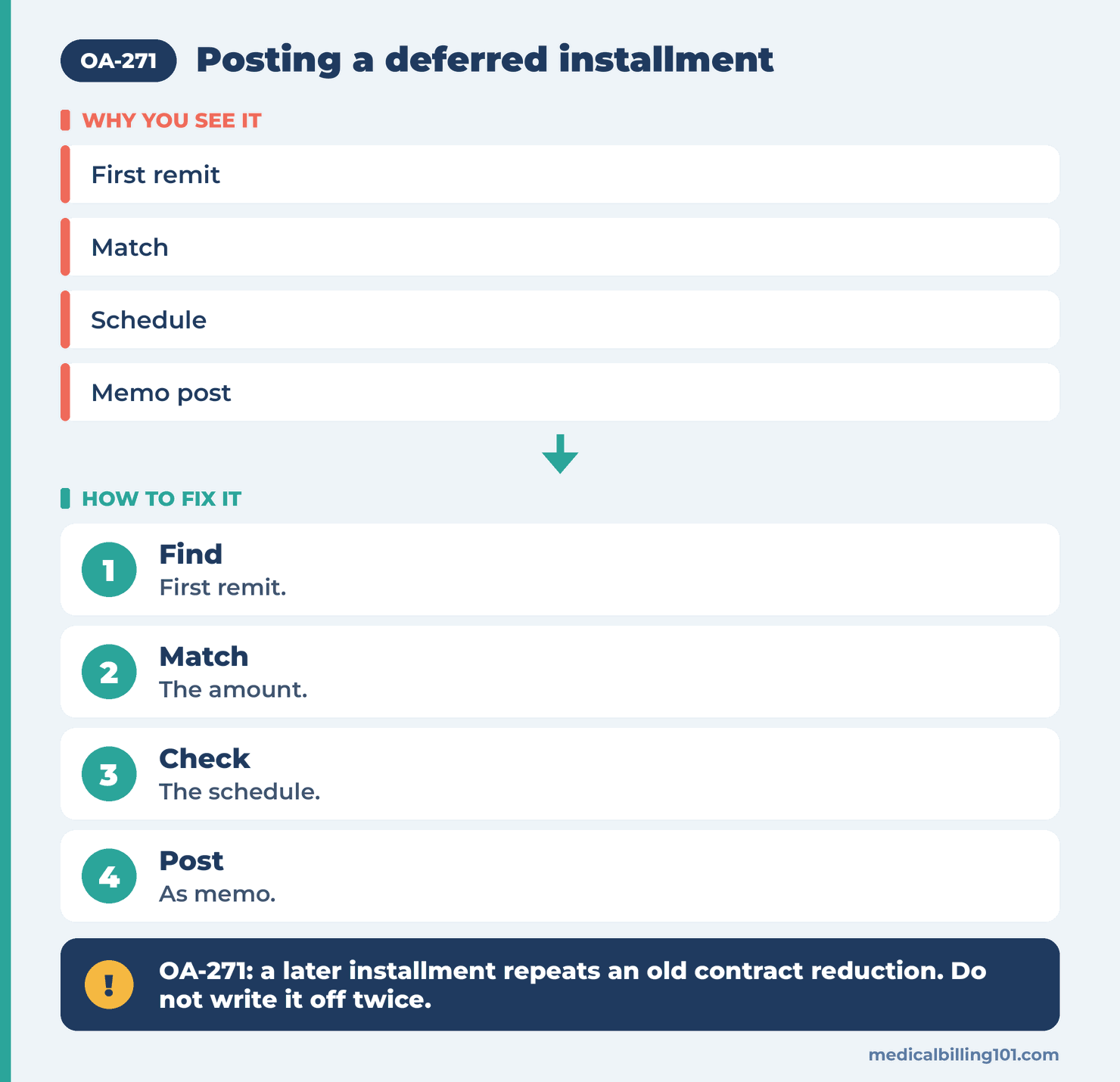
- Find the first remit. Pull the 835 that showed the CO-143 deferral and the CO write-off.
- Match the amounts. The OA-271 amount should equal the reduction already posted.
- Check the schedule. Compare the installment with the payment terms in your contract.
- Post without a write-off. Map OA-271 to a zero-impact or memo adjustment code.
- Track what is left. Keep the deferred balance open until the final installment.
Claim form note
No claim form visual is shown here. OA-271 is a remittance posting issue. Nothing on the CMS-1500 or UB-04 was wrong, so there is no box or form locator to correct.
Example scenario (fictional names), part 2
How the OA-271 Denial Was Resolved
Priya pulled the first remit and the contract. The OA-271 amount matched the write-off posted a month earlier to the cent. The contract called for three installments.
- She reversed the second write-off her system had taken.
- She remapped OA-271 in the posting rules as a memo adjustment.
- She left the last third open as a deferred receivable.
Outcome: the credit balance disappeared and no refund went out by mistake. The third remit carried N85 and closed the account at zero.
Names and details are illustrative; no real patient data.
Names and details are illustrative; no real patient data.
Is OA-271 the same as Medicare periodic interim payment?
No. OA-271 is not the same as Medicare periodic interim payment (PIP). PIP is a Medicare method for paying some providers in even biweekly amounts, set out in 42 CFR 413.64. CARC 271 is about one claim whose payment a contract spreads over installments.
For example, a PIP hospital sees lump payments that are not tied to single claims. An OA-271 line is always tied to one claim. Remark codes such as MA106, “PIP (Periodic Interim Payment) claim,” flag PIP claims instead.
Can I appeal or bill the patient for OA-271?
No. There is nothing to appeal or bill on an OA-271 line. It does not reduce payment and does not create patient responsibility. Contact the payer only when the installment amounts do not match your contract schedule, or the group code is wrong.
What mistakes cause trouble with OA-271?
Most OA-271 problems come from posting, not from the payer. For example, the most common one is an auto-post rule that writes off every adjustment. That doubles the contract write-off and creates a false credit. Another is closing the account before the last installment arrives.
- Mapping OA-271 to the same write-off code as CO-45.
- Counting OA-271 lines as denials in your reports.
- Refunding a credit that only exists because of a double write-off.
Related codes
| Code | Meaning |
|---|---|
| CO-143 | Portion of payment deferred |
| CO-45 | Charge exceeds fee schedule or contract amount |
| OA-133 | Line pending further review |
FAQ
What does OA-271 mean?
A later installment is paid, and the payer repeats an earlier contract reduction for reference.
Is OA-271 a denial?
No. It is a reconciling adjustment on a deferred payment schedule.
Should I write off the OA-271 amount?
No. That reduction was written off on the first remit already.
Which code shows the original deferral?
CARC 143, “Portion of payment deferred,” usually appears on the first remit.
How do I know the schedule is finished?
The last remit often carries remark N85 for the final installment.
Sources
How we checked: the CARC 271 and CARC 143 quotes were matched word for word with the X12 CARC list on 10 November 2026, and N85 with the X12 RARC list.
- X12, Claim Adjustment Reason Codes (CARC 271, 143). Accessed 10 Nov 2026.
- X12, Remittance Advice Remark Codes (N85). Accessed 10 Nov 2026.
- X12, Claim Adjustment Group Codes. Accessed 10 Nov 2026.
- eCFR, 42 CFR 413.64 (periodic interim payments). Accessed 10 Nov 2026.
Last updated: 10 November 2026 · Educational content; not legal advice.