
The PR-10 denial code appears when the diagnosis on a claim does not fit the sex recorded for the patient, and the plan lists the balance as patient responsibility. In most offices this traces back to a registration field, not to the care itself. A single wrong letter in the sex field can deny an entire visit. (Primary source: X12 Claim Adjustment Reason Codes)
In brief: reason code 10 reads “The diagnosis is inconsistent with the patient’s gender.” Confirm the sex on the claim matches the payer’s member file. If it does and the diagnosis is still correct for this patient, use the payer’s override process instead of billing the patient.
Part of our denial codes library. Written by Manikandan J, CPC, CRCR, who has resolved demographic edits on women’s health, urology and hospital outpatient claims. Published 29 October 2026. Last updated: 29 October 2026. Code wording quoted word for word from X12. Read about the author and our editorial policy, or contact us to report an error.
Official wording for CARC 10
| Field | Value |
|---|---|
| Code | 10 |
| Description | “The diagnosis is inconsistent with the patient’s gender.” |
| Usage note | Refer to the 835 Healthcare Policy Identification Segment (loop 2110 REF), if present |
| Start | 01/01/1995 (last modified 07/01/2017) |
| Group on this page | PR, patient responsibility |
Source: X12 Claim Adjustment Reason Codes, checked 29 October 2026.
Key terms: A sex-specific diagnosis is an ICD-10-CM code that the code set or the payer limits to one sex, such as menopausal states or prostate conditions. The sex field is Box 3 on the CMS-1500 and FL 11 on the UB-04. A PR adjustment means the plan assigned the amount to the member rather than to the provider’s contract.
Methodology: the CARC and RARC text is copied from the X12 lists, and the override rules come from the CMS transmittal and payer pages linked below.
Three reasons the edit fires
- A registration error. Someone selected the wrong sex at check-in, or a system migration flipped the value. This is the most common cause and the easiest to fix.
- A member file mismatch. The claim is right, but the plan’s enrollment record shows a different sex. The remark MA39, “Missing/incomplete/invalid gender.” often points here.
- A valid clinical exception. The diagnosis is correct for this patient even though the edit expects the other sex. Transgender and intersex patients are the main example.
Only the third reason involves the care itself. The first two are data problems, and the patient should not pay for them.
PR-10 compared with nearby codes
| Code | Conflict | Typical owner |
|---|---|---|
| CO-10 | Diagnosis vs sex | Provider |
| PR-10 | Diagnosis vs sex | Patient, per the plan |
| CO-7 | Procedure vs sex | Provider |
| CO-9 | Diagnosis vs age | Provider |
| PR-6 | Procedure vs age | Patient, per the plan |
Example scenario (fictional names), part 1
PR-10 Denial Example: What Happened
Lena Okafor bills for Riverbend Women’s Health, a fictional practice that moved to a new EHR last month. A fictional commercial plan denied a follow-up visit, CPT 99214, coded with N95.1 for menopausal symptoms. The remit read CAS*PR*10*168.00 with LQ*HE*MA39.
The statement system marked the full $168 as the patient’s balance. The chart and the patient’s insurance card looked normal.
Where did a routine visit pick up a sex conflict? Keep reading, or jump to how it was resolved. Keep reading, or jump to how the PR-10 denial was resolved.
Steps to resolve a PR-10
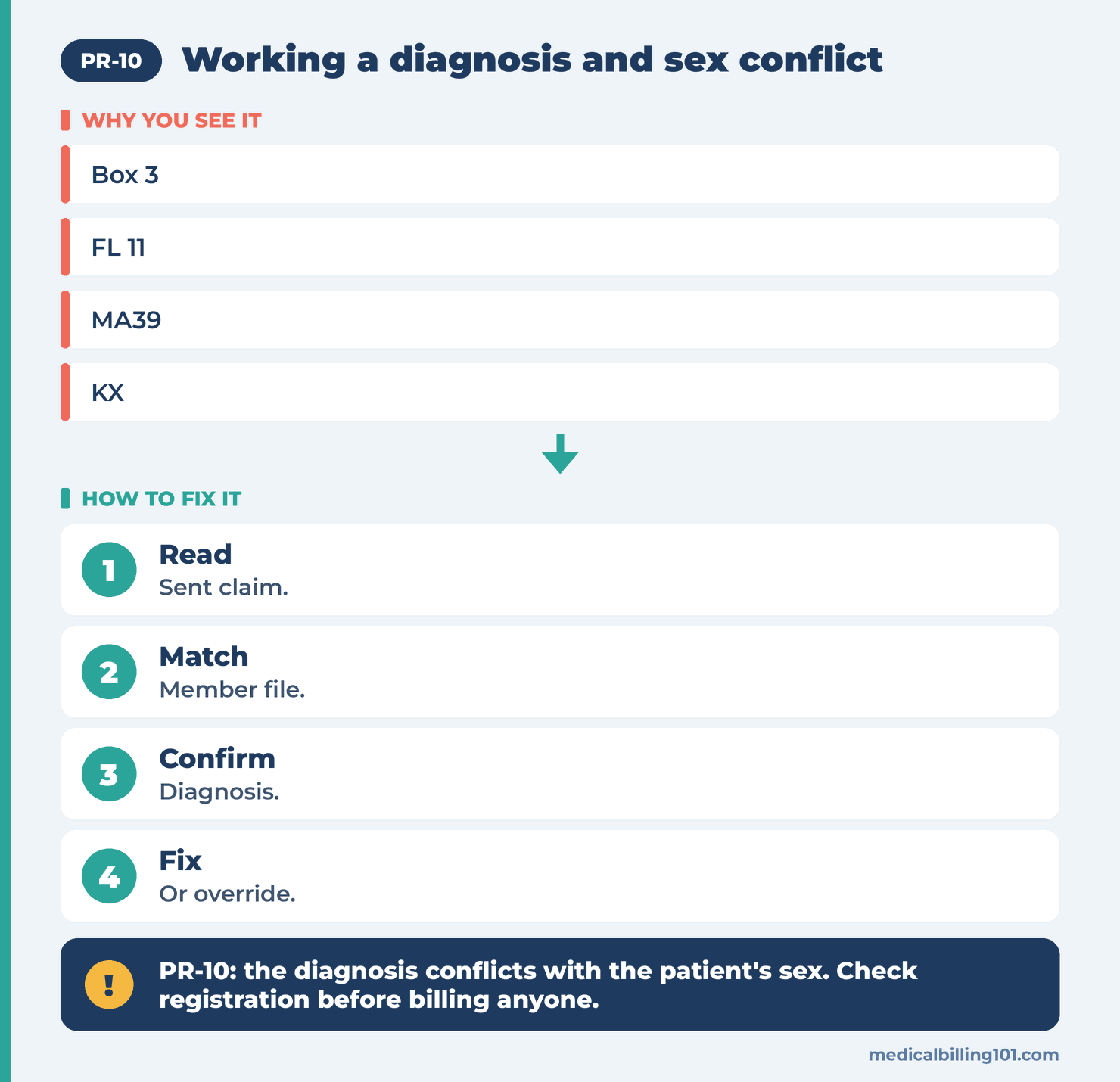
- Read the sex field on the claim you sent. Check Box 3 on the CMS-1500 or FL 11 on the UB-04, not the screen in your practice system.
- Match it with the payer’s member file. Use an eligibility check, for example the 271 response, or the payer portal.
- Confirm the diagnosis. Make sure the ICD-10-CM code is right and coded to the highest specificity the note supports.
- Fix data errors with a corrected claim. Use frequency code 7 and the original claim number on professional claims, or type of bill xx7 on facility claims (NUCC 1500 claim form instructions).
- For a valid exception, use the override. See the next section.
When the diagnosis is right for the patient
Medicare created an override for gender-specific edits. Under CMS transmittal R1877CP, institutional outpatient claims report condition code 45, and professional claims add modifier KX to the gender-specific line (CMS R1877CP). The KX modifier tells the contractor the service is medically appropriate despite the sex edit.
Many commercial plans follow similar rules. One published example is the HMSA guidance on KX and condition code 45 (HMSA provider guidance). Check your payer’s policy, and keep documentation that supports the service. Do not change a correct sex field just to pass an edit.
Example scenario (fictional names), part 2
How the PR-10 Denial Was Resolved
Lena compared the sent claim with the chart. During the EHR migration, the sex field for a group of patients had been converted with the wrong value, so Box 3 showed M. The payer’s member file correctly showed F.
Fix: she corrected Box 3 to F and sent a corrected claim with frequency code 7 and the original claim number. The 99214 line and the N95.1 diagnosis did not change.
Outcome: the plan paid the visit, and the $168 was removed from the patient’s account. Lena ran a report on every migrated record and found 41 more with the same error before they reached a payer.
Names and details are illustrative; no real patient data.
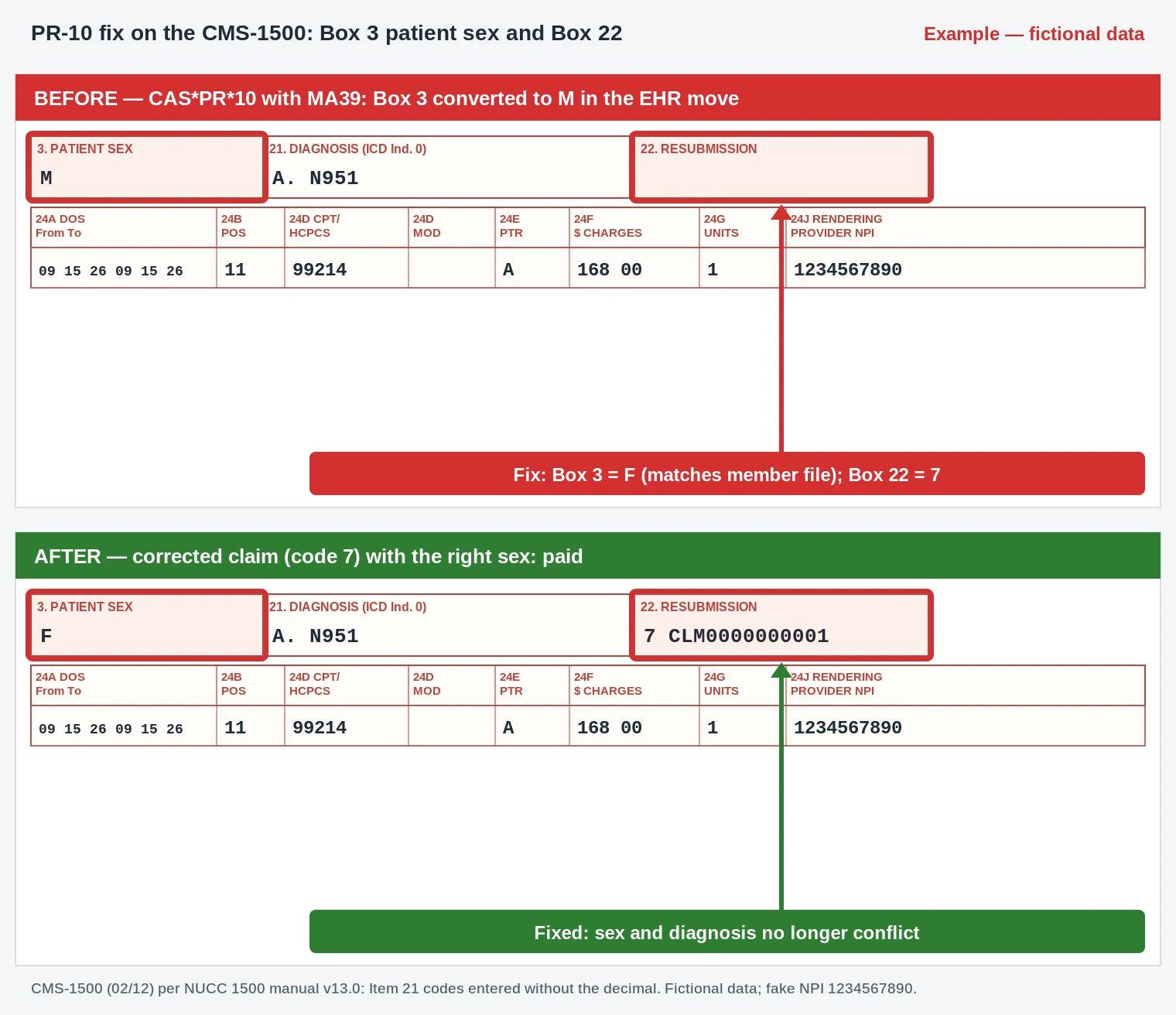
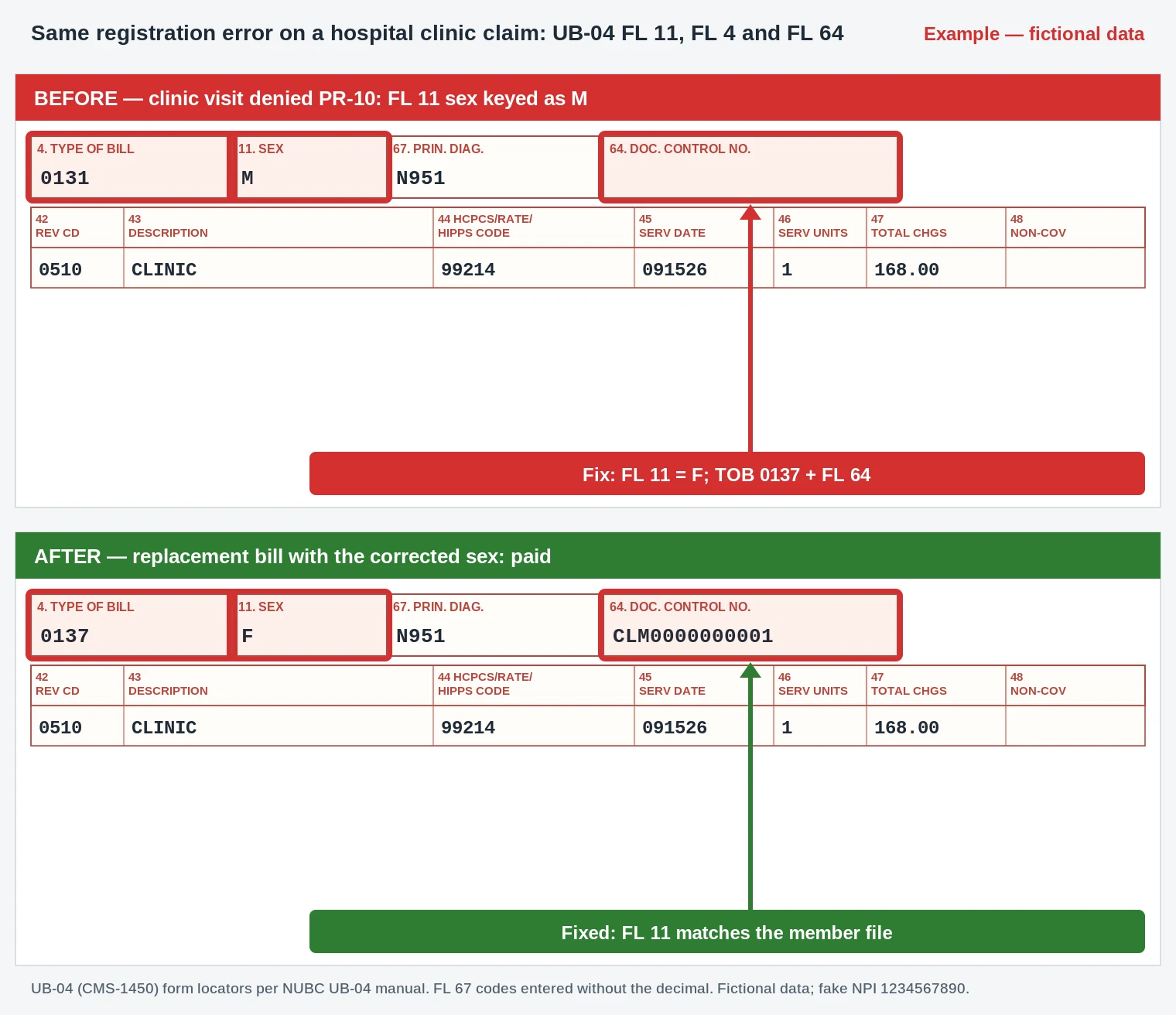
- Box 3 / FL 11: patient sex corrected from M to F to match the chart and the payer’s member file.
- Box 21 / FL 67: N95.1 (entered as N951) is unchanged; the diagnosis was right.
- Box 24D / FL 44: 99214 is unchanged; no KX modifier, because this was a data error, not an exception.
- FL 18-28: no condition code 45; that code is for valid gender-edit exceptions only.
- Box 22 / FL 4 + FL 64: frequency code 7, or type of bill 0137, with the original claim number.
Prevention
- Audit the sex field after any EHR or practice system conversion.
- Show the payer’s sex value next to yours at eligibility check.
- Build a scrubber rule that flags sex-specific diagnoses before claims leave.
- Train front-desk staff to ask how the patient’s insurance lists them, respectfully and privately.
FAQ
What does PR-10 mean?
The diagnosis conflicts with the patient’s sex on the claim, and the plan put the balance on the patient.
Is PR-10 usually the patient’s fault?
No. It usually comes from a registration or member file error, which the office should fix.
What remark code comes with denial code 10?
Often MA39, “Missing/incomplete/invalid gender.” Some payers add a policy REF in loop 2110.
How do I bill for a transgender patient?
Medicare uses modifier KX on professional claims and condition code 45 on institutional claims. Check each commercial payer’s rules.
Can I just change the sex field to get paid?
No. Only correct it when it is wrong. Use the payer’s override when the diagnosis is valid for the patient.
Sources
How we checked: the CARC 10 and MA39 text was compared word for word with the X12 lists on 29 October 2026.
- X12, Claim Adjustment Reason Codes (CARC 10). Accessed 29 Oct 2026.
- X12, Remittance Advice Remark Codes (MA39). Accessed 29 Oct 2026.
- CMS, Transmittal R1877CP: condition code 45 and modifier KX. Accessed 29 Oct 2026.
- HMSA, Modifier KX and condition code 45. Accessed 29 Oct 2026.
- NUCC, 1500 claim form instructions. Accessed 29 Oct 2026.
- CMS, Medicare Claims Processing Manual, chapter 25. Accessed 29 Oct 2026.
- CMS, ICD-10 codes. Accessed 29 Oct 2026.
Last updated: 29 October 2026 · Educational content; not legal advice.
Related denial codes
- CO-10: Diagnosis Inconsistent With the Patient’s Gender
- PR-11: Diagnosis Inconsistent With the Procedure
- CO-9: Diagnosis Inconsistent With the Patient’s Age
- CO-11: The Diagnosis Is Inconsistent With the Procedure
- PR-8: Provider Type Mismatch Billed to the Patient
- CO-8: Procedure Code vs Provider Type
- CO-12: Diagnosis Inconsistent With Provider Type
- CO-7: Procedure or Revenue Code Inconsistent With the Patient’s Gender