
PR-158 means the payer believes the service was provided outside the United States. Most health plans, and Original Medicare, pay little or nothing for care given abroad. Today the code often shows up on telehealth visits, when the patient joins a video call from another country. It also appears when an address or location field makes a US patient look foreign. The PR group means the payer has assigned the balance to the patient, but first check the location facts. (Primary source: X12 Claim Adjustment Reason Codes)
In brief: CARC 158 reads “Service/procedure was provided outside of the United States.” Confirm where the patient and provider were. If it was really abroad, the patient usually owes under the plan. If the place counts as the US, such as Puerto Rico or Guam, appeal with proof.
Part of our denial codes library. Written by Manikandan J, CPC, CRCR, who has worked Medicare and commercial denials for multi-state practices. Published 21 October 2026. Last updated: 21 October 2026. Code wording quoted word for word from X12.
Reason code 158 in the X12 list
| Field | X12 text |
|---|---|
| Code | 158 |
| Description | “Service/procedure was provided outside of the United States.” |
| Start | 09/30/2003 |
| Last modified | 09/30/2007 |
Source: X12 Claim Adjustment Reason Codes, checked 21 October 2026.
What counts as the United States
Service location is where the care actually happened. For telehealth, payers look at where the patient was during the visit. US territory for Medicare means the 50 states, DC, Puerto Rico, the US Virgin Islands, Guam, the Northern Mariana Islands and American Samoa. A foreign claim is one for care given anywhere else.
The federal rule is 42 CFR 411.9. It says Medicare does not pay for services outside the US, with narrow hospital exceptions. Ships count as US waters only in a US port or within 6 hours of one. Medicare’s travel coverage page explains the same limits for patients.
| Situation | How payers usually treat it |
|---|---|
| Patient on a video visit from abroad | Outside the US |
| Patient in Puerto Rico or Guam | Inside the US for Medicare |
| Cruise ship far from a US port | Outside the US |
| Foreign hospital closer in an emergency | Possible Medicare exception |
Commercial plans set their own rules. Some cover emergency care abroad, and some Medicare Advantage plans add travel benefits. Check the plan’s documents.
Example scenario (fictional names), part 1
PR-158 Denial Example: What Happened
Dana Ortiz is the billing lead at Ridgeway Family Medicine in Tampa, Florida. A patient with type 2 diabetes and high blood pressure (E11.9, I10) came in for a follow-up, billed as 99213 with place of service 11.
Coastline Health PPO, a fictional commercial plan, denied the visit with CAS*PR*158 and remark LQ*HE*MA37, “Missing/incomplete/invalid patient’s address.” The patient spends winters in Tampa but her home address is in San Juan.
Why did an office visit in Florida get a foreign-service denial, and can Dana fix it? Keep reading, or jump to how the PR-158 denial was resolved.
Remark codes you may see with CARC 158
| RARC | X12 wording |
|---|---|
| N130 | “Consult plan benefit documents/guidelines for information about restrictions for this service.” |
| MA37 | “Missing/incomplete/invalid patient’s address.” |
| N776 | “This service is not a covered Telehealth service.” |
See the X12 RARC page for others.
How to handle a PR-158 denial
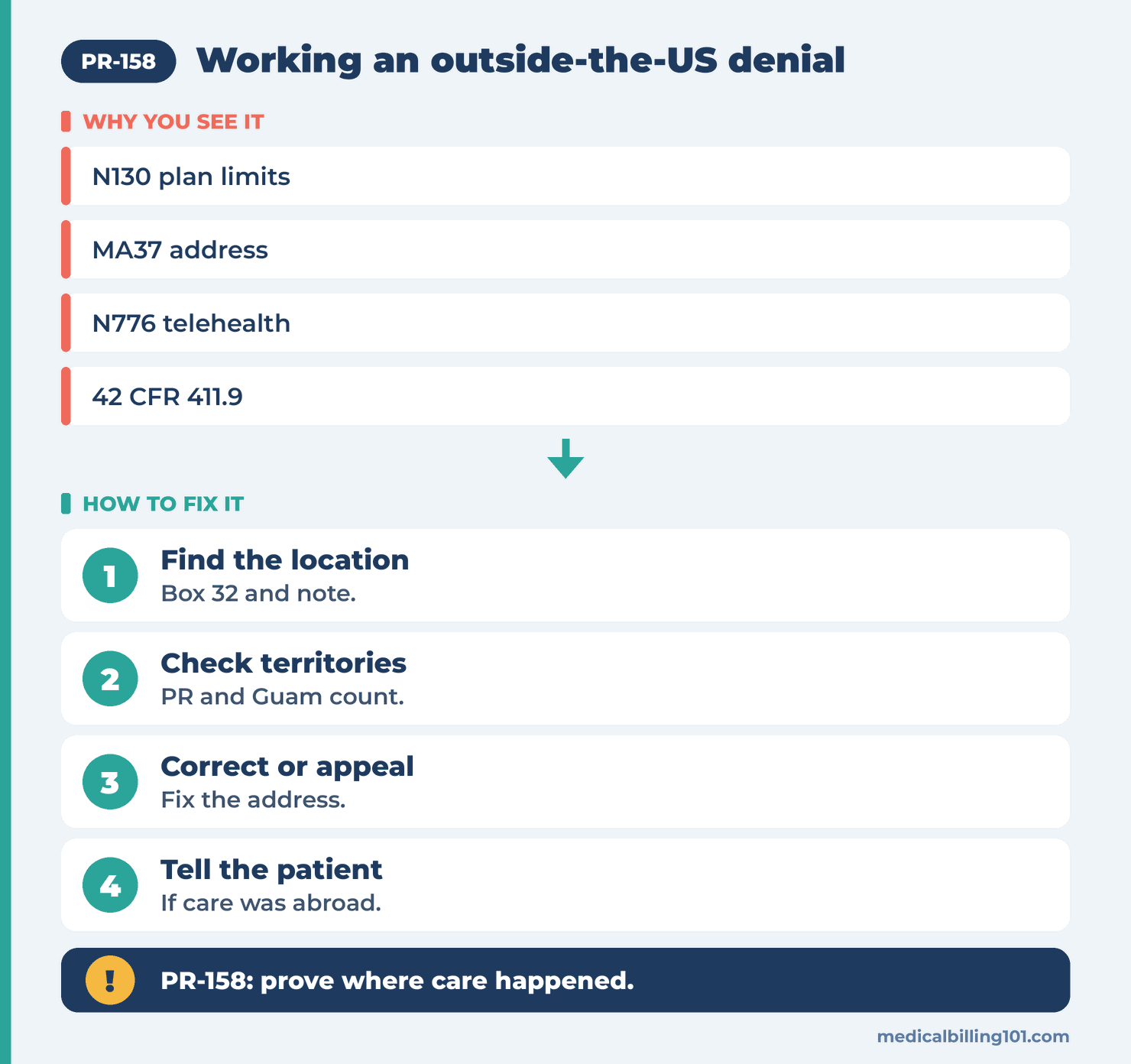
- Find where care happened. For telehealth, the note should record the patient’s location at the start of the visit.
- Check the territory list. Puerto Rico, Guam and the other territories count as the US for Medicare and for many plans.
- Check the address fields. For example, a territory entered as a country can look foreign to the payer.
- If it was really abroad, read the plan. Look for travel or emergency benefits before billing the patient.
- If it wasn’t abroad, appeal. Send the note showing the patient’s location and the corrected address.
- Tell the patient early. Explain the denial before you send a bill for a PR balance.
- Fix the intake step. Ask every video patient where they are and record it.
Example scenario (fictional names), part 2
How the PR-158 Denial Was Resolved
Dana checked the claim. The service facility in Box 32 was the Tampa office, and the sign-in sheet showed the patient there that day. The front desk had typed Puerto Rico into the country field of the patient’s address, so the plan’s system read her as a foreign patient.
Fix: Dana corrected the address to the US territory format and sent a corrected claim, frequency code 7. Her cover note pointed to Box 32 and to the plan’s own definition of the United States, which includes Puerto Rico.
Outcome: the plan reversed PR-158 and paid the visit. The front desk now enters territory addresses with the state code, not a country.
Names and details are illustrative; no real patient data.
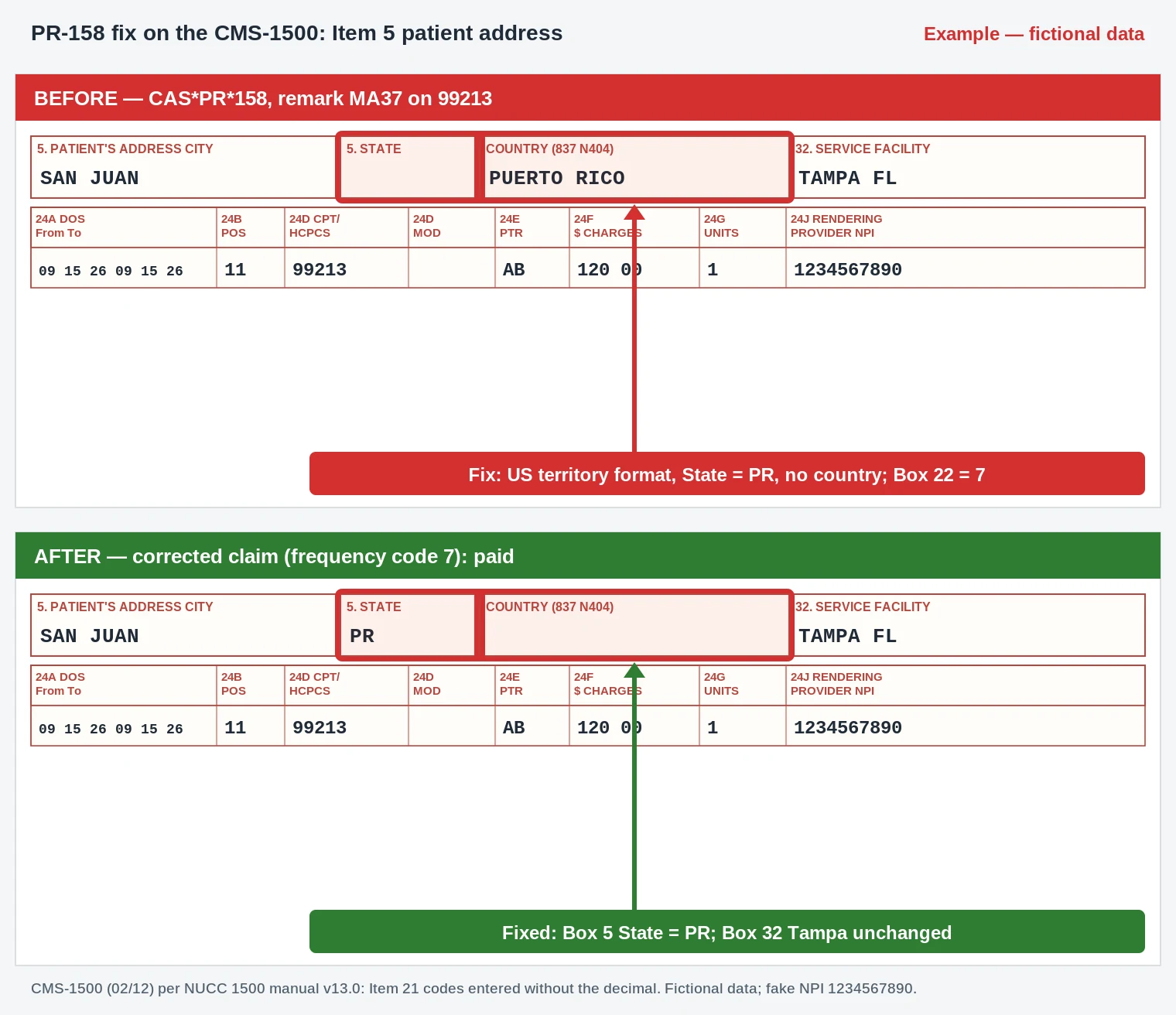
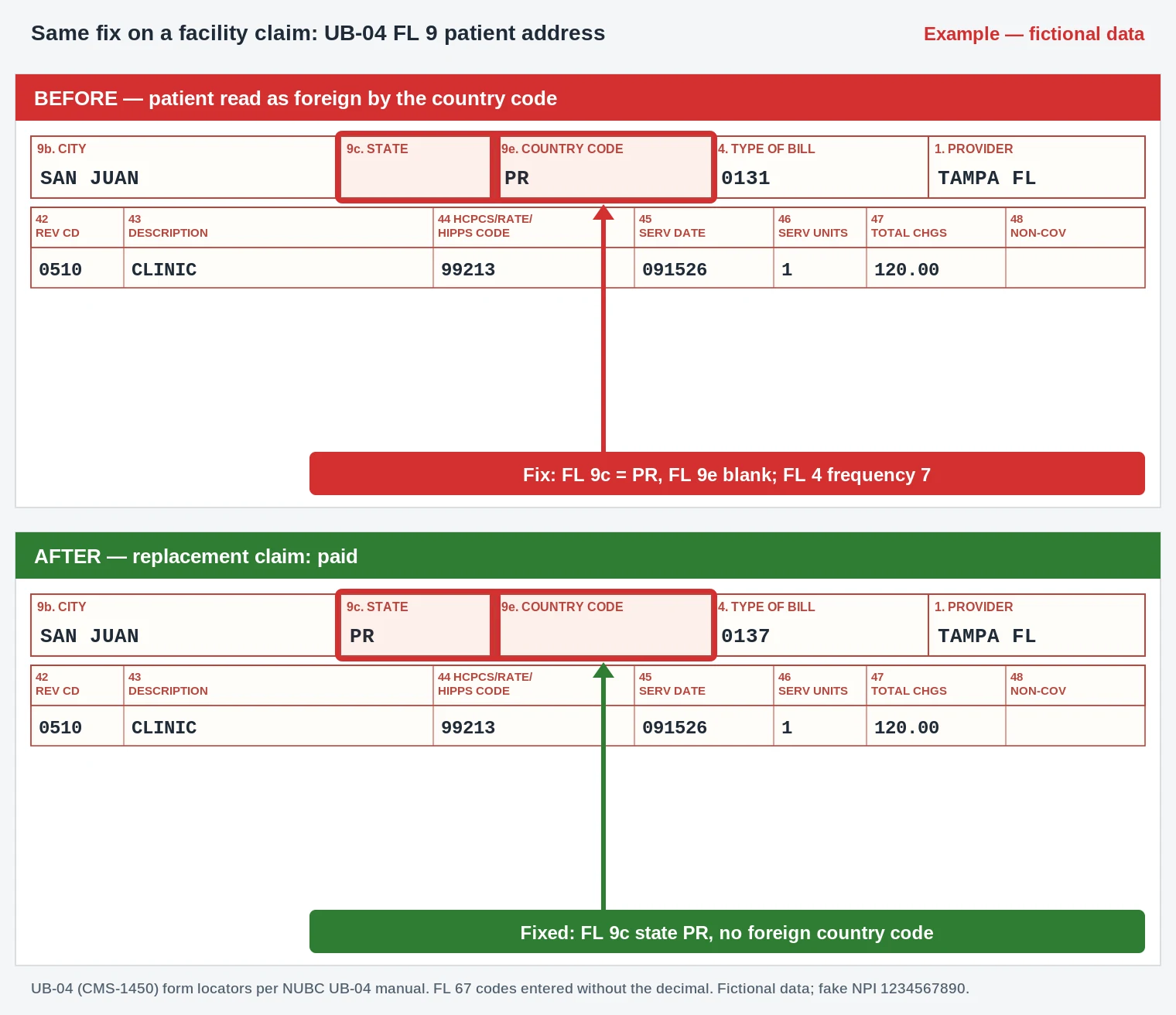
- Box 5 / FL 9: Puerto Rico entered as the state code PR, not as a foreign country (UB-04 FL 9c state, FL 9e country left blank).
- Box 32 / FL 1: the Tampa office address is unchanged; the visit happened there.
- Box 22 / FL 4 + FL 64: frequency code 7 with the original claim number (type of bill 0137).
- Box 21 / FL 67: E11.9 and I10 (entered as E119 and I10) are unchanged.
Worked example (illustrative)
Consider a patient who books a routine video visit while on vacation in Mexico. The note records the location. The plan denies with PR-158 and has no travel benefit for routine care. The practice doesn’t appeal. It explains the rule to the patient, bills the visit under its financial policy and adds a location question to its telehealth check-in.
When PR-158 is wrong
| Sign | What to do |
|---|---|
| The patient was in a US territory | Appeal with the note and address |
| The visit was in person in the US | Correct the claim or appeal with Box 32 and the sign-in record |
| The plan has a travel benefit | Ask for review under that benefit |
Related codes
- CO-96: non-covered charges, with a remark code.
- PR-204: not covered under the patient’s current benefit plan.
- CO-109: claim not covered by this payer or contractor.
- CO-16: claim lacks information needed for adjudication.
Recap
PR-158 means the payer thinks the care happened outside the US. Confirm the location from the note. If it was abroad, check the plan and tell the patient. If it was in a US state or territory, appeal with proof. Then make location checks part of every video visit.
FAQ
What does denial code PR-158 mean?
The payer believes the service was given outside the US. It reads “Service/procedure was provided outside of the United States.”
Does Medicare cover care outside the US?
Rarely. Original Medicare pays only in narrow cases, mostly foreign hospital stays tied to emergencies or nearby hospitals.
Is Puerto Rico outside the US for billing?
No. For Medicare, Puerto Rico, Guam, the US Virgin Islands, the Northern Mariana Islands and American Samoa count as the US.
Can I bill the patient for a PR-158 denial?
Usually yes, if the care really was abroad and the plan has no travel benefit. Explain the denial first.
How do payers know a patient was abroad?
From the address, the place of service, the visit note or a records review.
What about telehealth visits from another country?
Most plans treat them as care outside the US. State licensing rules may also apply.
Sources
How we checked: each code quote on this page was matched word for word with the X12 CARC and RARC lists on 21 October 2026.
- X12, Claim Adjustment Reason Codes (CARC 158, 16, 96, 109, 204). Accessed 21 Oct 2026.
- X12, Remittance Advice Remark Codes (N130, MA37, N776). Accessed 21 Oct 2026.
- eCFR, 42 CFR 411.9, Services furnished outside the United States. Accessed 21 Oct 2026.
- Medicare.gov, Travel outside the U.S.. Accessed 21 Oct 2026.
Last updated: 21 October 2026 · Educational content; not legal advice.