
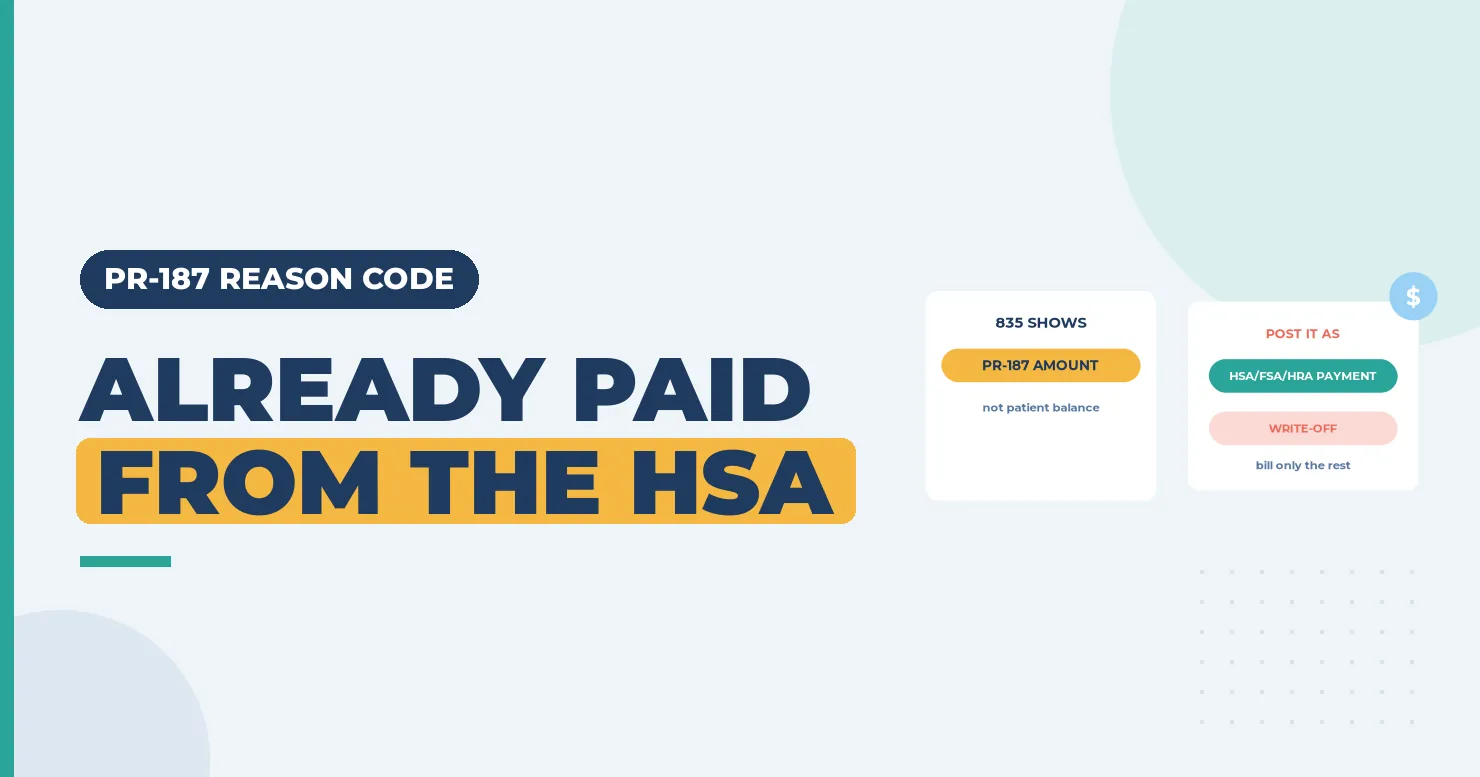
PR-187 is not really a denial. It tells you that part of the patient’s share was paid from a consumer spending account, such as a health savings account (HSA), flexible spending account (FSA) or health reimbursement account (HRA). Some plans run those accounts themselves and pay the provider straight from them. The 835 reports that money with CARC 187, so your posting has to treat it as a payment toward the patient balance, not as a write-off. (Primary source: X12 Claim Adjustment Reason Codes)
In brief: CARC 187 reads “Consumer Spending Account payments (includes but is not limited to Flexible Spending Account, Health Savings Account, Health Reimbursement Account, etc.)” Post the CARC 187 amount as a patient-side payment from the account. Bill the patient only for what is left after that payment.
Part of our denial codes library. Written by Manikandan J, CPC, CRCR, who has set up remittance posting rules for practices with high-deductible plan patients. Published 22 October 2026. Last updated: 22 October 2026. Code wording quoted word for word from X12.
Official CARC 187 description
| Field | X12 text |
|---|---|
| Code | 187 |
| Description | “Consumer Spending Account payments (includes but is not limited to Flexible Spending Account, Health Savings Account, Health Reimbursement Account, etc.)” |
| Start | 06/30/2005 |
| Last modified | 01/25/2009 |
Source: X12 Claim Adjustment Reason Codes, checked 22 October 2026.
The accounts behind reason code 187
- A health savings account (HSA) is a tax-advantaged account the patient owns, paired with a high-deductible plan. See HealthCare.gov’s HSA entry.
- A flexible spending account (FSA) is an employer account funded from the employee’s pay for medical costs. See HealthCare.gov’s FSA entry.
- A health reimbursement account (HRA) is funded by the employer and reimburses eligible costs. See HealthCare.gov’s HRA entry.
IRS Publication 969 explains which costs these accounts can pay.
Example scenario (fictional names), part 1
PR-187 Denial Example: What Happened
Daniel Reyes posts payments for Northfield Dermatology. Dr. Amara Singh removed a suspicious lesion from a patient’s back and sent it to pathology. The claim to Prairie Crest Health, a fictional commercial plan, listed 11402 and 88305 for a neoplasm of uncertain behavior of skin (D48.5).
The 835 showed most of the allowed amount as deductible, then a second adjustment, CAS*PR*187, with remark LQ*HE*N520, “Alert: Payment made from a Consumer Spending Account.” Daniel’s posting rule treated every PR amount as patient balance, so the patient statement was about to show the whole deductible.
Was the patient really going to owe that much, or had part of it already been paid? Keep reading, or jump to how the PR-187 denial was resolved.
Why group code PR shows up with CARC 187
Group codes tell you who carries the amount. CARC 187 describes the patient’s own share, paid from the patient’s or employer’s account, so plans often report it with group code PR. Some plans use OA instead. Either way, read the dollar figure with the payment data in the 835 and the patient’s account statement. The key point: money reported under CARC 187 has already been paid, or is being sent.
Related remark codes help you tell which case you have:
| RARC | X12 wording | What it means for posting |
|---|---|---|
| N520 | “Alert: Payment made from a Consumer Spending Account.” | The account paid; post it as a payment |
| N367 | “Alert: The claim information has been forwarded to a Consumer Spending Account processor for review; for example, flexible spending account or health savings account.” | Payment may follow separately |
| N740 | “The member’s Consumer Spending Account does not contain sufficient funds to cover the member’s liability for this claim/service.” | Bill the patient for the balance |
How to post and work a PR-187 line
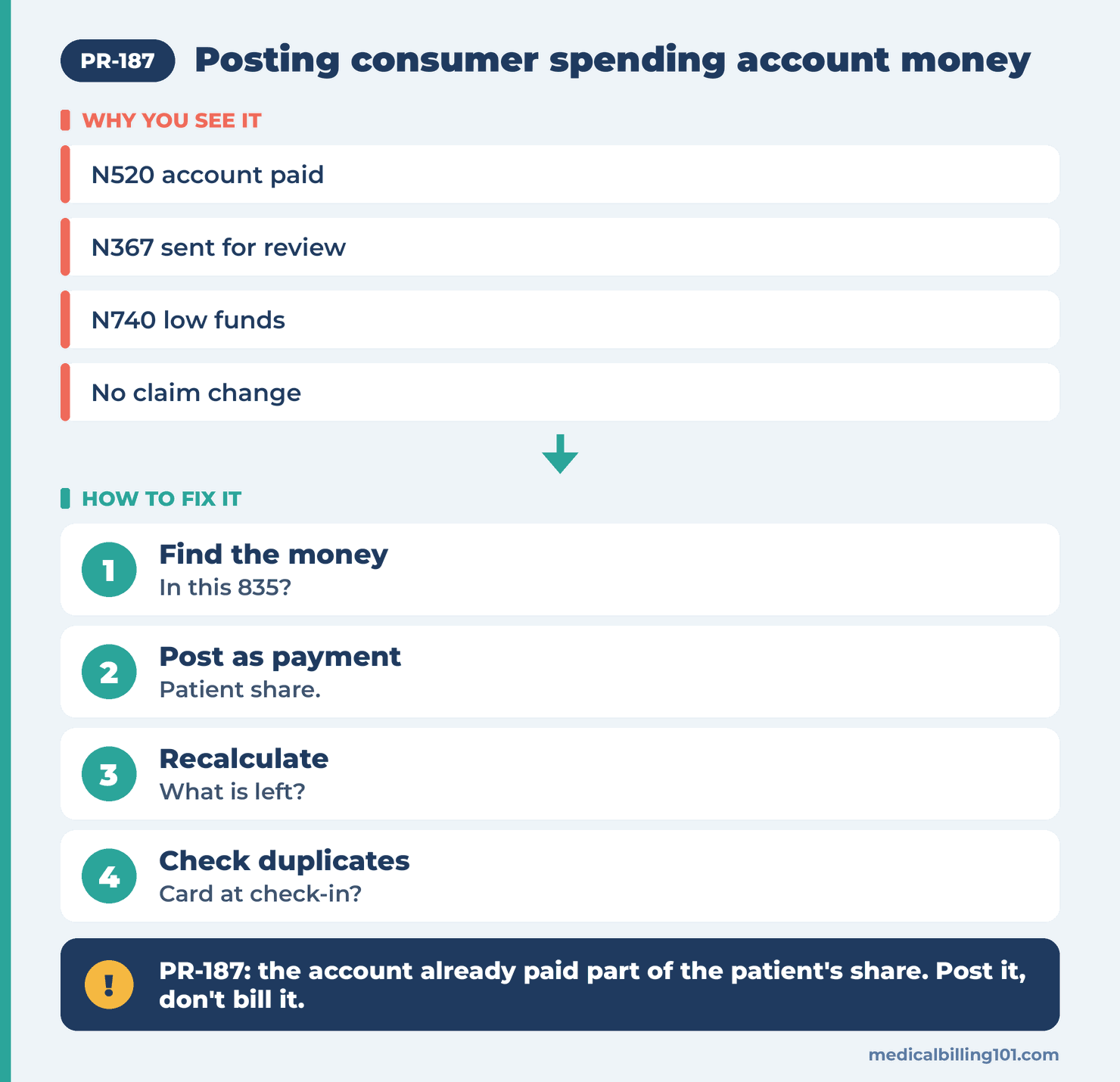
- Find the money. Check whether the account payment came in this 835 or will arrive as a separate payment.
- Post it as a payment toward patient responsibility. For example, use a payment type such as HSA/FSA payment, not a contractual or bad-debt adjustment.
- Recalculate the patient balance. Deductible plus coinsurance, minus the CARC 187 amount, is what the patient still owes.
- Check for duplicates. If the patient also paid at the front desk with an HSA card, the account may have paid twice. Refund the extra.
- Fix your posting rules. Make CARC 187 its own rule so it never flows into the patient balance.
Example scenario (fictional names), part 2
How the PR-187 Denial Was Resolved
Daniel matched the 835 with the deposit. Prairie Crest had paid the CARC 187 amount from the patient’s HRA in the same payment. His system had treated it as a patient adjustment, so it looked like the patient still owed the whole deductible.
Fix: no claim change was needed. Daniel reversed the posting and re-posted the CARC 187 amount as an HRA payment against the patient’s share, then held the statement.
Outcome: the patient statement showed only the small balance the HRA didn’t cover. Northfield added a separate posting rule for CARC 187 and N520 so account payments never land in patient balance again.
Names and details are illustrative; no real patient data.
Why there’s no claim form fix for CARC 187
Nothing on the CMS-1500 or UB-04 was wrong. The claim, codes and diagnosis were all correct. CARC 187 is a payment-reporting code, so the work happens in posting and patient billing, not in a corrected claim.
PR-187 vs similar patient-share codes
| Code | What it means | How to post it |
|---|---|---|
| PR-187 | Paid from a consumer spending account | Payment toward patient share |
| PR-1 | Deductible amount | Patient balance |
| PR-2 | Coinsurance amount | Patient balance |
| PR-3 | Co-payment amount | Patient balance |
Recap
PR-187 means part of the patient’s share was paid from an HSA, FSA or HRA. Post that amount as a payment, not as patient balance or a write-off. Then bill the patient only for what is left. No corrected claim is needed.
FAQ
What does PR-187 mean on an EOB or 835?
It shows the amount paid from the patient’s consumer spending account, such as an HSA, FSA or HRA.
Is PR-187 a denial?
No. It’s a payment-reporting code. The service was processed and part of the patient’s share was paid from an account.
Should I bill the patient for the PR-187 amount?
No. That amount is already paid from the account. Bill only the balance left after it.
Why is CARC 187 sometimes reported with OA?
Plans choose the group code. Some use PR because it’s the patient’s share, while others use OA. The posting rule is the same.
What if the patient also paid with an HSA card at check-in?
The account may have paid twice. Compare the two payments and refund any overpayment.
Do I need to send a corrected claim?
No. Nothing on the claim was wrong.
Sources
How we checked: each code quote on this page was matched word for word with the X12 CARC and RARC lists on 22 October 2026.
- X12, Claim Adjustment Reason Codes (CARC 187, 1, 2, 3). Accessed 22 Oct 2026.
- X12, Remittance Advice Remark Codes (N520, N367, N740). Accessed 22 Oct 2026.
- IRS, Publication 969. Accessed 22 Oct 2026.
- HealthCare.gov glossary: HSA, FSA and HRA. Accessed 22 Oct 2026.
Last updated: 22 October 2026 · Educational content; not legal advice.