
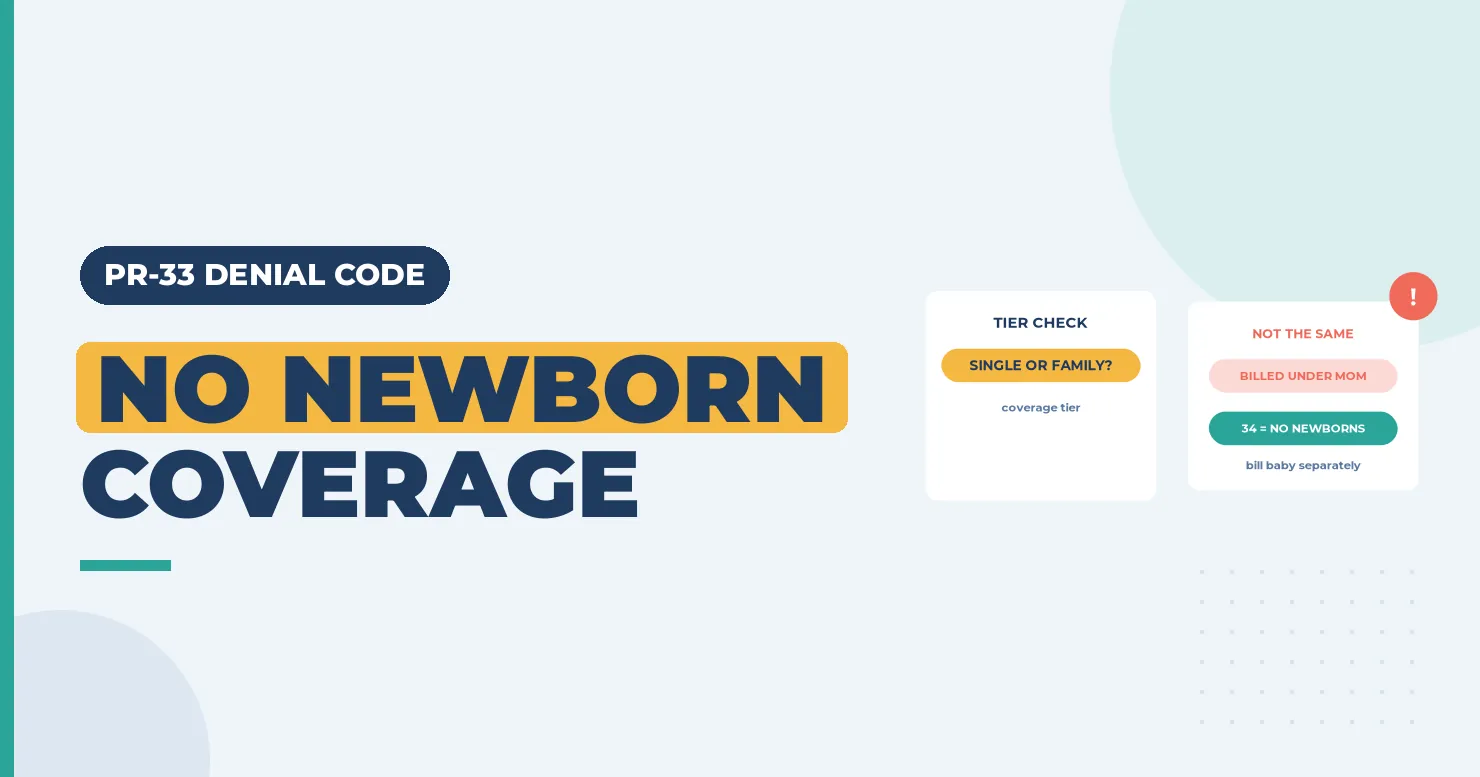
PR-34 is a newborn coverage denial. The payer is saying the insured’s policy doesn’t cover the baby. Most often the parent has an employee-only or individual plan, or the baby was never added. Sometimes the baby’s care was billed under the mother’s ID when the plan wanted a separate claim. The way forward is to get the baby enrolled, or find the plan that does cover them. (Primary sources: X12 Claim Adjustment Reason Codes · U.S. Department of Labor, HIPAA special enrollment).
In brief: PR-34 means “insured has no coverage for newborns.” Check the parent’s coverage tier and whether the baby was added. Under HIPAA, employer group plans must let a parent enroll a newborn within at least 30 days of birth, with coverage back to the date of birth. Once the baby is enrolled, bill the baby’s care under the baby’s own member details and rebill. Bill the family only after those routes are closed.
Part of our denial codes library. Written by Manikandan J, CPC, CRCR, who has more than 10 years of US medical billing and revenue cycle experience. Published 20 October 2026. Last updated: 20 October 2026. Code wording is quoted word for word from X12.
X12 wording for CARC 34
| Field | Official X12 text |
|---|---|
| Description | “Insured has no coverage for newborns.” |
| Start | 01/01/1995 |
| Last modified | 09/30/2007 |
Source: X12 Claim Adjustment Reason Codes, checked 20 October 2026.
Denial code 34, CARC 34 and reason code 34
One X12 code, three common names. When you see denial code 34 or reason code 34 in a portal, the remit will also show a group code. With PR-34 the payer assigns the amount to the patient. With CO-34 your contract keeps it with the provider.
PR-34 vs PR-33: newborn or any dependent?
| PR-34 | PR-33 | |
|---|---|---|
| What the payer says | The policy doesn’t cover newborns | The policy doesn’t cover dependents at all |
| Typical example | Baby billed under a parent with an employee-only plan | Spouse billed under an employee-only plan |
| Usual fix | Enroll the baby within the plan’s deadline | Find the patient’s own coverage |
| Can the claim data fix it? | Sometimes, if the baby was billed under the mother | No |
Who pays: group code table
| Group + CARC | Who carries it | What to know |
|---|---|---|
| PR-34 | Patient | Billable to the family once enrollment and other coverage are ruled out. |
| CO-34 | Provider | Contract bars patient billing. Enroll the baby or write off. |
| OA-34 | Not assigned | Check the primary payer’s handling. |
CMS describes PR amounts as ones that “may be billed to the patient or insured” (Medicare Claims Processing Manual, Ch. 22, §60.1).
Common causes of PR-34
Remark wording is from the X12 RARC list. Pairings vary by payer.
| Cause | Typical RARC | Fix |
|---|---|---|
| Parent has an employee-only or individual plan | N30 | Ask the parent to add the baby, or look for the other parent’s plan. |
| Baby not yet added to the policy | N197 | The subscriber must enroll the baby with the employer or plan. |
| Baby’s care billed on the mother’s claim | N15 | Bill the newborn’s services on a separate claim. |
| Enrollment deadline missed | N30 | Check the other parent’s plan or Medicaid. |
| Wrong subscriber chosen at registration | N30 | Re-register under the right policy. |
Resolving PR-34 step by step
A coverage tier is the level of a plan, such as employee only, employee plus child, or family.

- Check the coverage tier. Eligibility responses and payer portals show whether the plan covers children.
- Ask whether the baby has been added. For example, a parent may have sent the form but the plan hasn’t loaded it yet.
- Check the deadline. Most employer plans give at least 30 days from birth.
- Have the parent enroll the baby if they’re still in time. Coverage can start on the date of birth.
- Bill the baby’s care separately under the baby’s own member details.
- Bill the family only when no coverage applies.
Special enrollment for a newborn
Special enrollment is a window outside open enrollment when a life event lets someone join a plan.
Under HIPAA’s special enrollment rules, employer group health plans must let an employee enroll a new child within at least 30 days of birth or adoption. Coverage for a birth starts on the date of birth. So a PR-34 on a newborn’s first days can often be reversed once the parent enrolls the baby in time. The U.S. Department of Labor explains the rules.
Appeal approach
PR-34 is rarely won by appeal, because the plan’s coverage is a fact. Appeal only if the baby was enrolled in time and the payer’s file is wrong. Send the enrollment confirmation showing the baby’s effective date.
Questions to ask the payer about a PR-34
- What coverage tier did the subscriber have on the date of birth?
- Has an enrollment request for the baby been received?
- If the parent enrolls the baby now, will coverage go back to the date of birth?
- Should the baby’s services be billed under the baby’s own member ID?
Worked example (illustrative)
A baby is born on 3 September. The hospital bills the baby’s nursery care under the father’s plan. The remit shows CAS*PR*34*1240.00. The biller learns the father’s plan is still employee-only. The biller calls the father on 20 September, well within the 30-day window. He adds the baby, with coverage from the date of birth. The biller then rebills the baby’s care on its own claim, and it pays.
Prevention checklist
- [ ] Remind parents at discharge to add the baby to their plan.
- [ ] Note the enrollment deadline on the baby’s account.
- [ ] Bill newborn services on their own claim, such as nursery and pediatric visits.
- [ ] Check the tier, not just active status, before billing a newborn claim.
- [ ] Track PR-34 by payer to spot loading delays.
Related denial codes
- PR-33: the insured has no dependent coverage.
- PR-32: the patient isn’t an eligible dependent.
- CO-31: the patient can’t be identified as the payer’s insured.
- CO-26: expenses incurred before coverage began.
- CO-109: claim not covered by this payer.
- Denial codes hub for every code we cover.
Key takeaways
PR-34 means the parent’s plan doesn’t cover the newborn. Get the baby enrolled within the special enrollment window, bill the baby’s care on its own claim, and bill the family only when no plan applies.
FAQ
What does denial code PR-34 mean?
It means the insured’s policy doesn’t cover newborns, so the payer won’t pay for the baby’s care under it. The PR group puts the balance on the patient.
What is the difference between PR-33 and PR-34?
PR-33 means the plan has no dependent coverage at all. PR-34 is specific to newborns.
How long does a parent have to add a newborn?
Employer group plans must allow at least 30 days from birth under HIPAA special enrollment. Some plans allow longer.
Will coverage go back to the date of birth?
Yes, for HIPAA special enrollment after a birth, coverage starts on the date of birth.
Can I bill the family for PR-34?
Yes, under the PR group, but first check for enrollment, the other parent’s plan, or Medicaid.
Should I appeal PR-34?
Only if the baby was enrolled in time and the payer’s file is wrong.
Sources
How we checked: every code quote on this page was compared word for word with the X12 CARC and RARC lists on 20 October 2026.
- X12, Claim Adjustment Reason Codes (CARC 34, 33). Accessed 20 Oct 2026.
- X12, Remittance Advice Remark Codes (N30, N197, N15). Accessed 20 Oct 2026.
- U.S. Department of Labor, HIPAA and special enrollment. Accessed 20 Oct 2026.
- CMS, Medicare Claims Processing Manual, Ch. 22, §60.1 Group Codes. Accessed 20 Oct 2026.
Last updated: 20 October 2026 · This page is educational and doesn’t replace payer contracts or coding rules.