To bill 97750 to Humana Medicare Advantage, bill it as a separate, timed physical performance test with its own written report. Get it on the Cohere authorization and add GP. Use 59 or XU with 97530 only for truly separate test time.
Most 97750 denials from Humana are not coding errors. They are record reviews. The payer wants proof the test was a distinct service, not routine progress measurement.
TL;DR: CPT 97750 is a timed code, billed in 15-minute units. NCCI bundles it into 97530 unless a modifier shows separate time. It is never payable with an evaluation or re-evaluation (97161-97168) on the same day. Humana MA lists 97750 on its Cohere prior authorization list. Send a separate test report, minutes, and the authorization with every records request.
Written by Manikandan J, CPC, CRCR, a certified coder and revenue cycle specialist. Published 15 November 2026. Last updated: 15 November 2026.
Table of Contents
How do you bill 97750 to Humana Medicare Advantage?
Bill 97750 on its own claim line with the GP modifier and units based on test minutes. Make sure the Cohere authorization covers 97750. Attach a separate written report that names the test, the score and the plan-of-care change. Add 59 or XU only when the test time does not overlap 97530 time.
CPT 97750 is the code for a physical performance test or measurement, with written report, each 15 minutes. Examples include a functional capacity evaluation, isokinetic testing and the Tinetti balance test. Wellpoint Federal’s billing article A56566 lists those examples. It says the test must go beyond the usual evaluation work.
Humana follows CMS coverage rules for its Medicare Advantage plans. So the Original Medicare rules below are your baseline. Humana then adds its own prior authorization and records review on top.
| Claim item | What to report for 97750 | Source |
|---|---|---|
| Units | 15-minute units by the 8-minute rule; MUE is 8 units per day | CMS Claims Manual ch.5 §20.2; CMS MUE file |
| Therapy modifier | GP for physical therapy plans of care | CMS Claims Manual ch.5 §10.3.3 |
| With 97530 or 97140 | NCCI edit, modifier indicator 1; 59 or XU only for separate time | NCCI PTP edits v32.3 |
| With 97161-97168 | NCCI edit, modifier indicator 0; no modifier allowed | NCCI PTP edits v32.3 |
| Prior authorization | 97750 is on Humana’s MA list, managed by Cohere | Humana MA prior authorization list |
Why does Humana deny 97750 with CO-236?
CARC 236 means the procedure or modifier combination is not compatible with another procedure on the same day under NCCI. Humana uses it when 97750 and 97530 appear together. The NCCI file lists 97530 as column one and 97750 as column two. The rationale is “more extensive procedure.”
The edit has modifier indicator 1. That means a modifier can bypass it when the services are truly distinct. But a modifier is a claim, not proof. When Humana sees the modifier, it can pend the line and ask for records. That is why your rep said the denial was about records.
Our CO-236 denial code guide explains the code in full. To check any pair yourself, use our NCCI edit checker. It shows the same 97530 and 97750 edit from the current CMS file.
One pair cannot be fixed with any modifier. NCCI lists 97750 under every PT and OT evaluation and re-evaluation code, 97161 through 97168, with indicator 0. If a progress visit was billed as 97164, the 97750 line will never pay.
Should you use modifier 59 or XU on 97750 with 97530?
Modifier XU means an unusual, non-overlapping service. Use 59 or XU on 97750 only when the test had its own minutes, separate from therapeutic activities. The CMS MLN fact sheet on modifiers 59 and X{EPSU} says a modifier must not be used just to bypass an edit.
Ask Humana which modifier its edits prefer. Many payers accept either 59 or XU. Do not put both on one line. Our modifier 25 and 59 helper walks through the choice.
The note must show two time blocks. For example, 20 minutes of a balance test, then 25 minutes of 97530. If the test happened during the activity, it is part of 97530. Then 97750 should not be billed at all.
Records decide these cases, not the modifier. A reviewer reads the minutes first, then the report.
Can you bill 97750 for tests done at a progress report or discharge?
Yes, but only when the test is a distinct, standardized test with its own written report. Routine re-checks at a progress note are not 97750. Billing article A56566 says 97750 should not be billed for assessments done as the patient moves through the episode. Range of motion and manual muscle checks fall in that group.
Writing a progress report is documentation, not a separate billable service. The Medicare Benefit Policy Manual, Chapter 15, section 220.3 requires one at least once every 10 treatment days. Section 220 also says assessment is included in other services and is not separately payable.
So a test at the 10th visit needs a reason beyond the calendar. Good reasons include a fall, a new balance complaint, or a decision on discharge or continued care. A standardized balance test such as the Berg can qualify when it answers that question.
When I review PT claims denied for 97750, the test report is usually just a score pasted into the progress note. There is no start time, no stop time, and no plan change.
What records should you send Humana for a 97750 review?
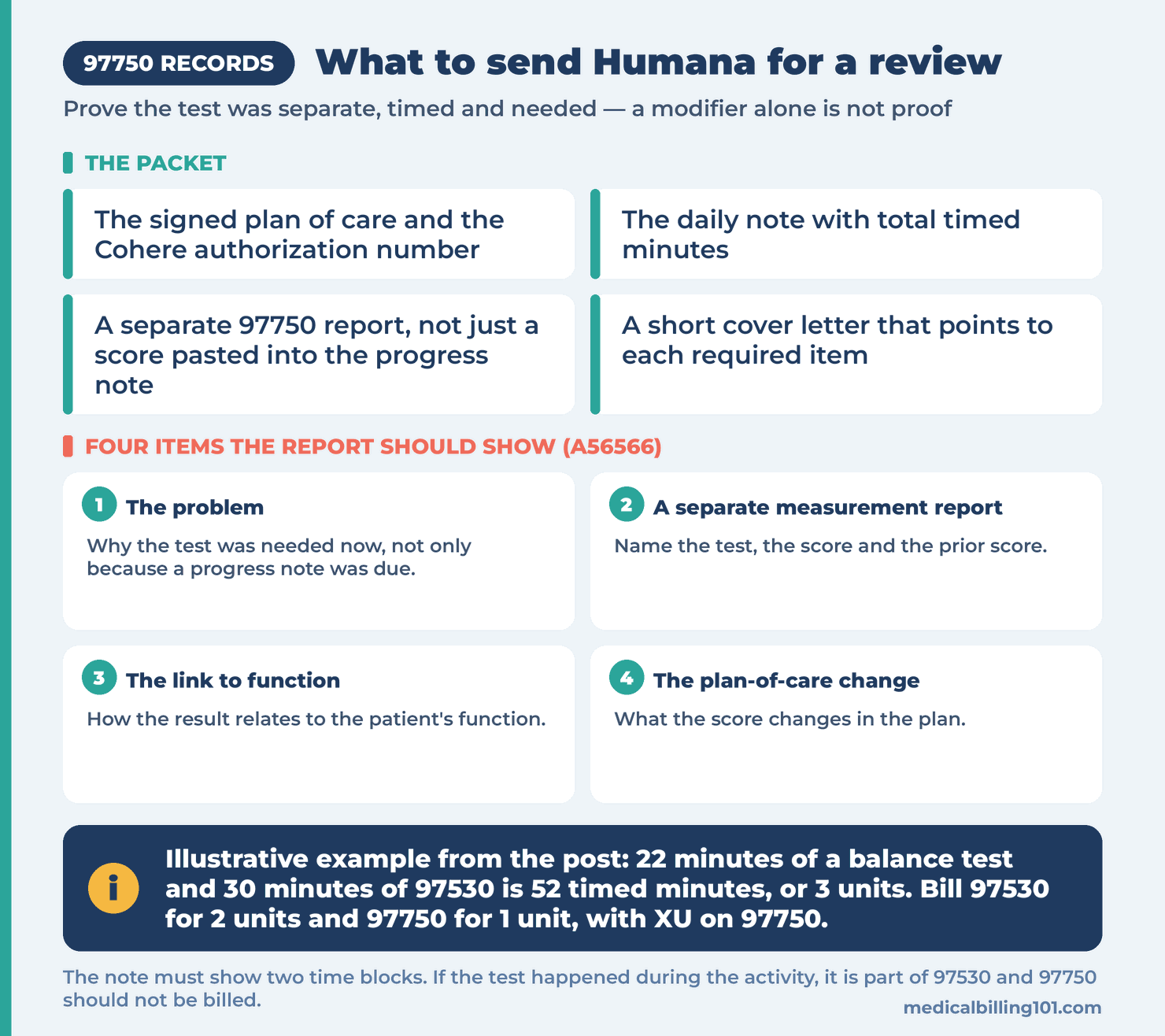
Send a packet that proves the test was separate, timed and needed. Include the signed plan of care and the Cohere authorization number. Add the daily note with total timed minutes, and a separate 97750 report. The report should name the test, the score, the prior score and the effect on the plan.
Billing article A56566 lists four items for 97750 documentation. They are the problem, a separate measurement report, the link to function, and the plan-of-care change. Use those four as your report headings.
Read our guide on medical necessity documentation payers actually look for. It shows how reviewers read therapy notes. A short cover letter that points to each item speeds up the review.
Here is an illustrative example. A patient gets 22 minutes of a balance test and 30 minutes of 97530. Total timed time is 52 minutes, which allows 3 units. Bill 97530 for 2 units and 97750 for 1 unit, with XU on 97750.
How many units of 97750 can you bill, and what does it pay?
Timed units are 15-minute blocks counted under the 8-minute rule. Count all timed minutes for the day, then split units by time. The Medicare Claims Processing Manual, Chapter 5, section 20.2 gives the chart. For example, 8 to 22 minutes is 1 unit, and 23 to 37 minutes is 2 units.
The Medicare MUE for 97750 is 8 units per day. CMS publishes it in the quarterly practitioner MUE file. The 2026 national non-facility amount is about $33.73 per unit, from 1.01 total RVUs times the $33.4009 conversion factor. Your Humana contract rate may differ.
The 2026 KX modifier threshold is $2,480 for PT and speech therapy combined, per CMS therapy services. Original Medicare requires KX above that amount. Ask Humana whether your contract also expects KX, since MA plans set their own claim edits.
Does Humana Medicare Advantage need prior authorization for 97750?
Yes, for most members. The Humana Medicare Advantage prior authorization list places PT and OT codes, including 97750, under Cohere Health. The list applies to Humana MA HMO and PPO plans. Private fee-for-service plans do not need prior authorization.
Check that the approved units cover the test date and the 97750 code. A missing authorization is a different denial from CO-236. Request a retro review through Cohere if your plan allows it.
If Humana still denies a clean, documented line, file a dispute or appeal. Our appeal letter generator drafts the letter. For other Humana edits, see our answer on Humana denying 87811 QW and 87804-59.
3-step checklist
- Confirm the Cohere authorization covers 97750, and never bill it on a day with 97161-97168.
- Bill 97750 with GP and test-minute units, adding 59 or XU only for separate test time.
- Keep a separate test report with times, scores, prior scores and the plan change, and send it with every records request.
FAQ
Can 97750 be billed with a PT re-evaluation on the same day?
No. NCCI lists 97750 as a column two code under 97161 through 97168 with modifier indicator 0. No modifier can bypass that edit. If you bill a re-evaluation, the test is part of it.
Is the Berg Balance Scale billable as 97750?
It can be, when it is a separate, timed test with its own written report and a clear reason. Billing article A56566 lists the Tinetti balance test as an example. Routine re-checks during treatment are not 97750.
What does CO-236 mean on a 97750 line?
CARC 236 means the procedure or modifier combination is not compatible with another procedure on the same day under NCCI. For 97750, the usual partner is 97530. Humana may pend the line for records when a modifier is used.
Is 97750 a timed code?
Yes. 97750 is billed in 15-minute units. Medicare counts units under the 8-minute rule in Claims Processing Manual Chapter 5, section 20.2. The Medicare MUE is 8 units per day.
Does Humana require prior authorization for 97750?
Yes, for most Humana Medicare Advantage HMO and PPO members. Humana’s MA prior authorization list places 97750 and other PT codes under Cohere Health. Private fee-for-service plans do not require prior authorization.
Sources
My methodology was simple. I checked the NCCI file, the CMS therapy manuals, a MAC article on 97750 and Humana’s prior authorization list. Contract terms differ, so confirm details with Humana.
- CMS, Medicare NCCI practitioner PTP edits, version 32.3 (October 2026). Accessed 15 Nov 2026.
- Wellpoint Federal, Billing and Coding: Outpatient Physical and Occupational Therapy Services (A56566). Accessed 15 Nov 2026.
- CMS, Medicare Claims Processing Manual, Chapter 5, sections 10.3.3 and 20.2. Accessed 15 Nov 2026.
- CMS, Medicare Benefit Policy Manual, Chapter 15, sections 220 and 220.3. Accessed 15 Nov 2026.
- CMS, Therapy Services (CY 2026 KX modifier threshold). Accessed 15 Nov 2026.
- CMS MLN, Proper Use of Modifiers 59, XE, XP, XS and XU. Accessed 15 Nov 2026.
- Humana, Medicare Advantage and D-SNP Prior Authorization and Notification List (effective 1 July 2026). Accessed 15 Nov 2026.
- X12, Claim Adjustment Reason Codes (CARC 236). Accessed 15 Nov 2026.
Read about the author, or contact us with a question. See our editorial policy.
Last updated: 15 November 2026 · Educational content for U.S. billers. Check each payer’s current policy.