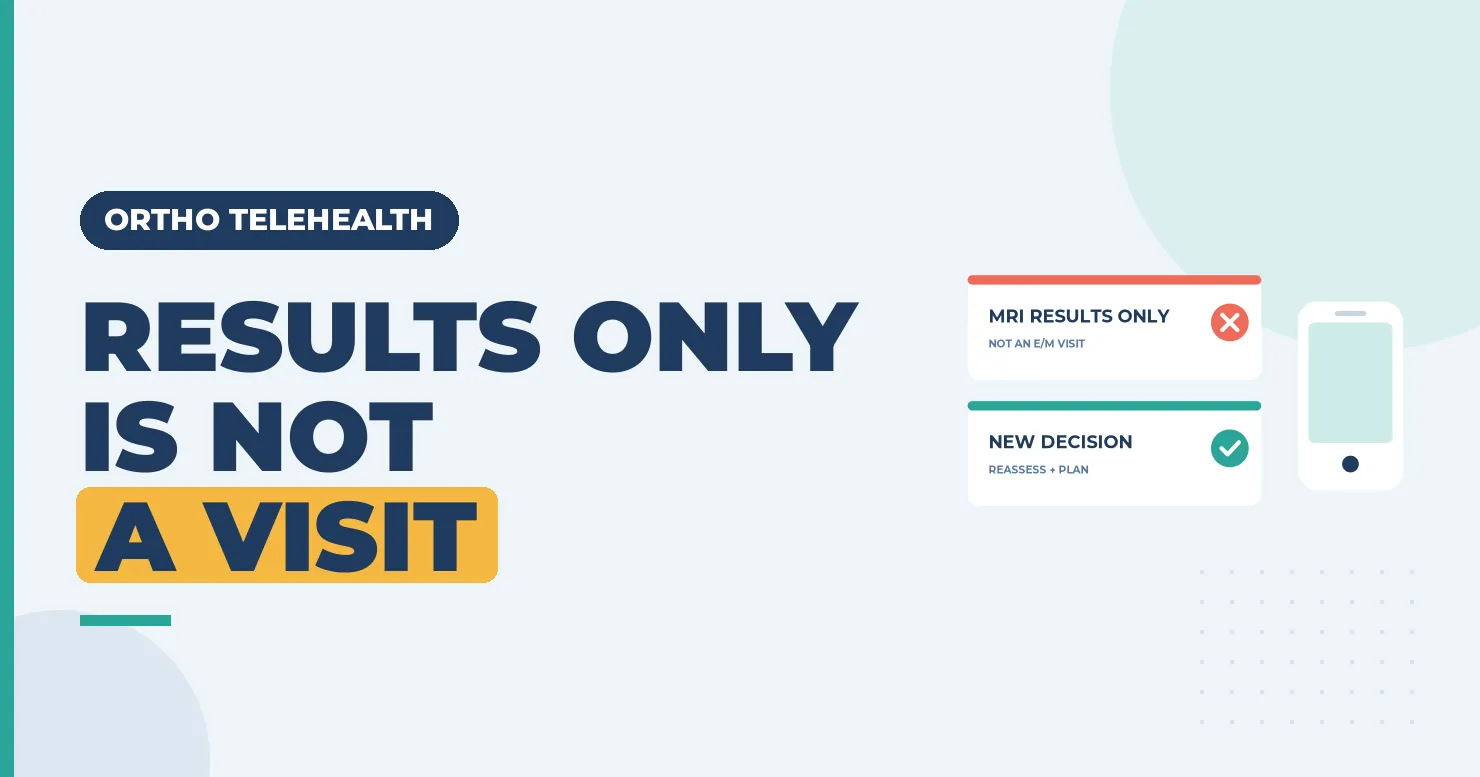
An orthopedic telehealth follow-up is billable when it is a real follow-up visit with new decision making, not just a call to relay results. Bill it as an office E/M code (99212-99215) for Medicare, with POS 10 and modifier 93 if it was audio-only.
The fix for most denials is documentation. The note must show why the visit was needed, what was decided, and how the call happened.
TL;DR: CPT says telemedicine codes are not for routine calls that only pass along results from an earlier visit. A phone visit that reassesses the knee, reviews the MRI with the patient and changes the plan can be an E/M visit. Medicare pays audio-only E/M in the home through 31 December 2027 with modifier 93. A short, patient-initiated call can be 98016 instead.
Written by Manikandan J, CPC, CRCR, a certified coder and revenue cycle specialist. Published 15 November 2026. Last updated: 15 November 2026.
Table of Contents
When is an orthopedic telehealth follow-up billable?
A telehealth follow-up is billable when the provider evaluates the patient and makes a medical decision during a live call. The call must replace an in-person visit the patient needed anyway. It must not be a quick results message tied to a visit that already got credit.
The CPT telemedicine guidelines draw this line clearly. Telemedicine services can be used for a required follow-up, such as re-assessing response to a treatment plan. They are not used for routine calls about an earlier encounter, such as giving lab results. The SIR coding Q&A on the 2025 telemedicine codes summarizes that guideline.
So ask one question about every ortho phone note. Would this patient have needed an office visit for this decision? If yes, the call can be a visit. If the call only repeated what was already planned, it is not.
Is a phone call to discuss MRI results billable?
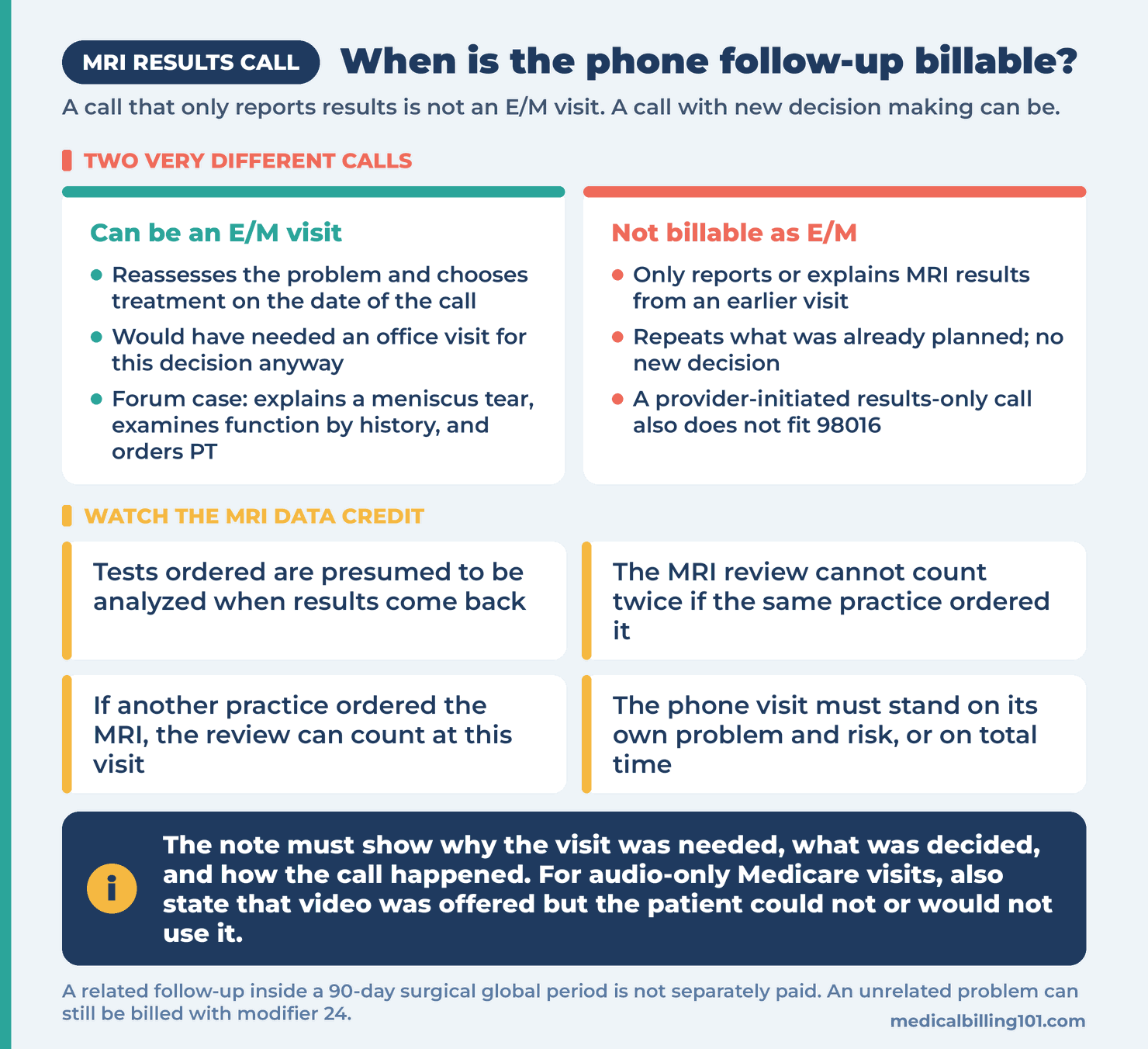
A call that only reports MRI results is not billable as an E/M visit. A call that uses the MRI to reassess the problem and choose treatment can be. The difference is new medical decision making, documented in the note, on the date of the call.
Watch the data credit. The AMA E/M guidelines say tests ordered are presumed to be analyzed when results come back. So the MRI counts in the visit where it was ordered. The AMA E/M descriptors and guidelines explain this rule.
That means the MRI review cannot count twice. The phone visit must stand on its own problem and risk elements, or on total time. If the MRI was ordered by another practice, the review can count at the visit where it is analyzed.
Take the common case from the forum. The provider calls, explains a meniscus tear on the MRI, examines function by history, and orders physical therapy. An office visit is set for after PT. That call has a reassessment and a new treatment decision, so it can support an E/M level.
When I audit ortho telehealth claims, the most common gap is a note that lists call time but never says why video was not used.
What documentation does an orthopedic telehealth visit need?
The note needs the same medical content as an office visit, plus the telehealth facts. Record the patient’s location, the provider’s location, consent, and whether it was audio-video or audio-only. Then document the history, the assessment, the decision and the plan.
Modifier 93 means the service was delivered by real-time, audio-only telecommunication, such as a phone call. For audio-only Medicare visits, add one more line. State that the provider could use video, but the patient could not or would not. 42 CFR 410.78 sets that condition and requires modifier 93 on the claim.
Pick the level by MDM or by total time on the date. For established patients, total time must meet 10 minutes for 99212, 20 for 99213, 30 for 99214 and 40 for 99215. Our E/M level calculator checks MDM and time together.
A good ortho note names the problem status, such as worsening knee pain after injury. It names the options discussed, such as PT, injection or surgical referral. It ends with the order and the follow-up plan.
Which codes, POS and modifiers apply to a Medicare telehealth follow-up?
Medicare wants the office E/M codes 99212-99215 for telehealth follow-ups, not the CPT telemedicine codes. In the 2026 fee schedule, 98000-98015 carry status I, so Medicare does not pay them. Use POS 10 for a patient at home and POS 02 elsewhere.
| Claim item | Medicare rule for an ortho telehealth follow-up | Source |
|---|---|---|
| Visit code | 99212-99215; 98000-98015 are status I (not paid) | CMS 2026 PFS RVU file |
| Place of service | POS 10 patient at home; POS 02 other location | CMS Telehealth FAQ (Q8) |
| Audio-only | Modifier 93; patient at home; video offered but declined or not possible | 42 CFR 410.78 |
| Audio-video | No telehealth modifier needed on professional claims | CMS MLN901705; AAFP |
| Home as originating site | Allowed through 31 December 2027 | CMS Telehealth FAQ (Q1, Q6) |
| Payment rate | POS 10 pays the non-facility rate | CMS Telehealth FAQ (Q8) |
POS 10 is the place of service code for telehealth provided in the patient’s home. Medicare pays it at the non-facility rate. The 2026 national non-facility amount for 99213 is about $95.19. That is 2.85 total RVUs times the $33.4009 conversion factor. 99212 is about $59.45. Your locality rate will differ.
Plan for 2027 now. The CMS telehealth FAQ says modifiers BB and BC are required from 1 January 2027. BB flags certain virtual platform arrangements, and BC flags incident-to telehealth. CMS says neither changes payment.
Can you bill 98016 or G2252 for a short results call?
Yes, but only for short, patient-initiated calls with an established patient. CPT 98016 is a brief virtual check-in with 5-10 minutes of medical discussion. G2252 covers 11-20 minutes. Neither can come from a related E/M visit in the prior 7 days.
The call also cannot lead to an E/M visit or procedure within 24 hours or the soonest available appointment. If it does, it bundles into that visit. A provider-initiated call to give MRI results does not fit 98016, because the patient did not start it.
The 2026 Medicare file lists 98016 at 0.52 non-facility RVUs, about $17.37. G2252 is 0.85 RVUs, about $28.39. Both are active (status A). The AAFP telehealth coding page lists both codes and the 7-day and 24-hour rules.
Remember the audio-only telemedicine rule in CPT as well. Audio-only visits under 98008-98015 need more than 10 minutes of medical discussion. Below that, 98016 is the only option for payers that use the CPT telemedicine codes.
What if the call falls in a surgical global period?
A related follow-up call inside a 90-day global period is not separately paid. Report it with 99024 if your practice tracks post-op visits. The Medicare Claims Processing Manual, Chapter 12, section 40.1 includes post-op follow-up visits in the surgical package.
Orthopedic practices hit this often after arthroscopy or fracture care. Before you bill any telehealth E/M, check the surgery date and global days. Our global period calculator gives the end date from the CPT code and date of surgery.
An unrelated problem during the global period can still be billed. Use modifier 24 and a diagnosis that shows the new problem. See our global surgical package guide for the full rules.
How do commercial payers and Medicare Advantage bill ortho telehealth?
Commercial payers, Medicare Advantage plans and Medicaid set their own telehealth rules. Many still want 99212-99215 with POS 02 or 10 and modifier 95 for video. Some have adopted 98000-98015. Some do not pay audio-only visits at all.
Check the payer’s telehealth policy before the visit is scheduled. Confirm the code family, the POS, the modifier, and whether audio-only is covered. A wrong POS often returns as CO-5 or CO-58.
The same logic about results calls applies to every payer. A payer that audits will ask what decision was made that day. For another ortho-related answer, see how carriers are changing x-ray claim processing.
Here is an illustrative example. A 15-minute audio-only call reviews the MRI, reassesses pain and function, and orders PT. For Medicare, bill 99212 by time or 99213 if MDM supports low complexity, with POS 10 and modifier 93.
3-step checklist
- Confirm the call made a new decision, and is not a results-only call or a post-op visit inside a global period.
- Document locations, consent, audio-video or audio-only, the video-declined reason, MDM and total time.
- Bill 99212-99215 with POS 10 or 02 and modifier 93 for audio-only Medicare visits, or 98016 for short patient-initiated calls.
FAQ
Can I bill a telehealth visit just to give MRI results?
No. CPT telemedicine guidelines say these services are not used for routine calls about a prior encounter, such as giving results. The call must include a new evaluation and decision to be billed as an E/M visit.
Does Medicare pay 98000-98015 for telehealth?
No. In the 2026 Medicare fee schedule, 98000-98015 have status I. Medicare wants 99202-99215 for telehealth visits, with POS 02 or 10 and modifier 93 for audio-only. 98016 is paid.
What modifier goes on an audio-only Medicare telehealth visit?
Modifier 93. 42 CFR 410.78 requires it when the patient is at home and the provider could use video, but the patient could not or would not. RHCs and FQHCs may use FQ.
Can the MRI review count toward MDM on the phone visit?
Not if the same practice ordered it at a prior visit. The AMA E/M guidelines say ordered tests count at the encounter where they were ordered. The phone visit must rely on its problem, risk or time.
How long can Medicare patients get telehealth at home?
The CMS telehealth FAQ says Medicare patients can get telehealth anywhere in the U.S., including at home, through 31 December 2027. Audio-only visits at home are also allowed through that date.
Sources
My methodology was simple. I checked the CMS telehealth FAQ, the federal telehealth regulation, the 2026 Medicare RVU file, the AMA E/M guidelines and the CPT telemedicine guidance. Payer policies differ, so confirm details with each plan.
- CMS, Telehealth FAQ (updated October 2026). Accessed 15 Nov 2026.
- eCFR, 42 CFR 410.78 Telehealth services. Accessed 15 Nov 2026.
- CMS MLN901705, Telehealth and Remote Monitoring (December 2025). Accessed 15 Nov 2026.
- CMS, Physician Fee Schedule, 2026 RVU file (October release). Accessed 15 Nov 2026.
- AMA, CPT E/M Services Descriptors and Guidelines. Accessed 15 Nov 2026.
- Society of Interventional Radiology, Coding Q&A on telemedicine codes 98000-98016. Accessed 15 Nov 2026.
- AAFP, Coding for Telehealth: Audio, Video and Virtual-Digital Visits. Accessed 15 Nov 2026.
- CMS, Medicare Claims Processing Manual, Chapter 12, section 40.1. Accessed 15 Nov 2026.
Read about the author, or contact us with a question. See our editorial policy.
Last updated: 15 November 2026 · Educational content for U.S. billers. Check each payer’s current policy.