

CO-122 means the payer paid less for a mental health service because of a psychiatric reduction. For decades, Medicare applied such a reduction to outpatient mental health treatment. That rule was phased out, and since 2014 Medicare treats these services like other Part B care for cost sharing. So when CO-122 shows up on a claim today, it usually points to an old contract term, a plan rule or a system setting worth a second look. The CO group means you can’t bill the patient for it. (Primary source: X12 Claim Adjustment Reason Codes)
In brief: CARC 122 reads “Psychiatric reduction.” Medicare’s version, the outpatient mental health treatment limitation, reached 100 percent in 2014, so it no longer cuts payment. If a plan still applies a reduction, ask which contract term allows it, and dispute it if none does.
Part of our denial codes library. Written by Manikandan J, CPC, CRCR, who has billed for outpatient behavioral health groups. Published 21 October 2026. Last updated: 21 October 2026. Code wording is quoted word for word from X12.
X12 listing for CARC 122
| Field | X12 text |
|---|---|
| Code | 122 |
| Description | “Psychiatric reduction.” |
| Start | 01/01/1995 |
Source: X12 Claim Adjustment Reason Codes, checked 21 October 2026.
Example scenario (fictional names), part 1
CO-122 Denial Example: What Happened
Jordan Lee bills for Clearwater Counseling Group. Therapist Nadia Holt saw a patient for a 60-minute psychotherapy session for generalized anxiety disorder (F41.1), billed as 90837. The claim went to Elmstead Health Plan, a fictional commercial plan.
The payment came in well under the contract rate. The 835 showed CAS*CO*122 with remark LQ*HE*N381. Jordan had never seen a psychiatric reduction on an Elmstead claim before this quarter.
Where did a cut that Medicare dropped years ago come from? Keep reading, or jump to how the CO-122 denial was resolved.
The Medicare history behind CARC 122
The outpatient mental health treatment limitation was Medicare’s psychiatric reduction. It limited the share of approved charges Medicare would recognize for outpatient mental health treatment. The Medicare Claims Processing Manual, Chapter 12, section 210, lists how it was phased out:
| Dates | Limitation | Medicare pays / patient pays |
|---|---|---|
| Before 2010 | 62.5% | Reduced share |
| 2010 to 2011 | 68.75% | 55% / 45% |
| 2012 | 75% | 60% / 40% |
| 2013 | 81.25% | 65% / 35% |
| 2014 onward | 100% | 80% / 20% |
At 100 percent, the limitation no longer reduces anything. That’s why CO-122 is rare on Medicare claims for current dates of service.
Why commercial plans might still use CO-122
- Old contract language, such as a rate exhibit written before parity rules.
- A system rule left on after the contract changed.
- A plan design term for some out-of-network or limited benefits.
Mental health parity is the federal rule that mental health benefits can’t be more restrictive than medical benefits in many plans. CMS summarizes it on its mental health parity page. If a plan cuts only mental health payments, it’s fair to ask how that fits.
Remark codes with CARC 122
| RARC | X12 wording |
|---|---|
| N381 | “Alert: Consult our contractual agreement for restrictions/billing/payment information related to these charges.” |
See the X12 RARC list for more.
How to dispute a CO-122 reduction
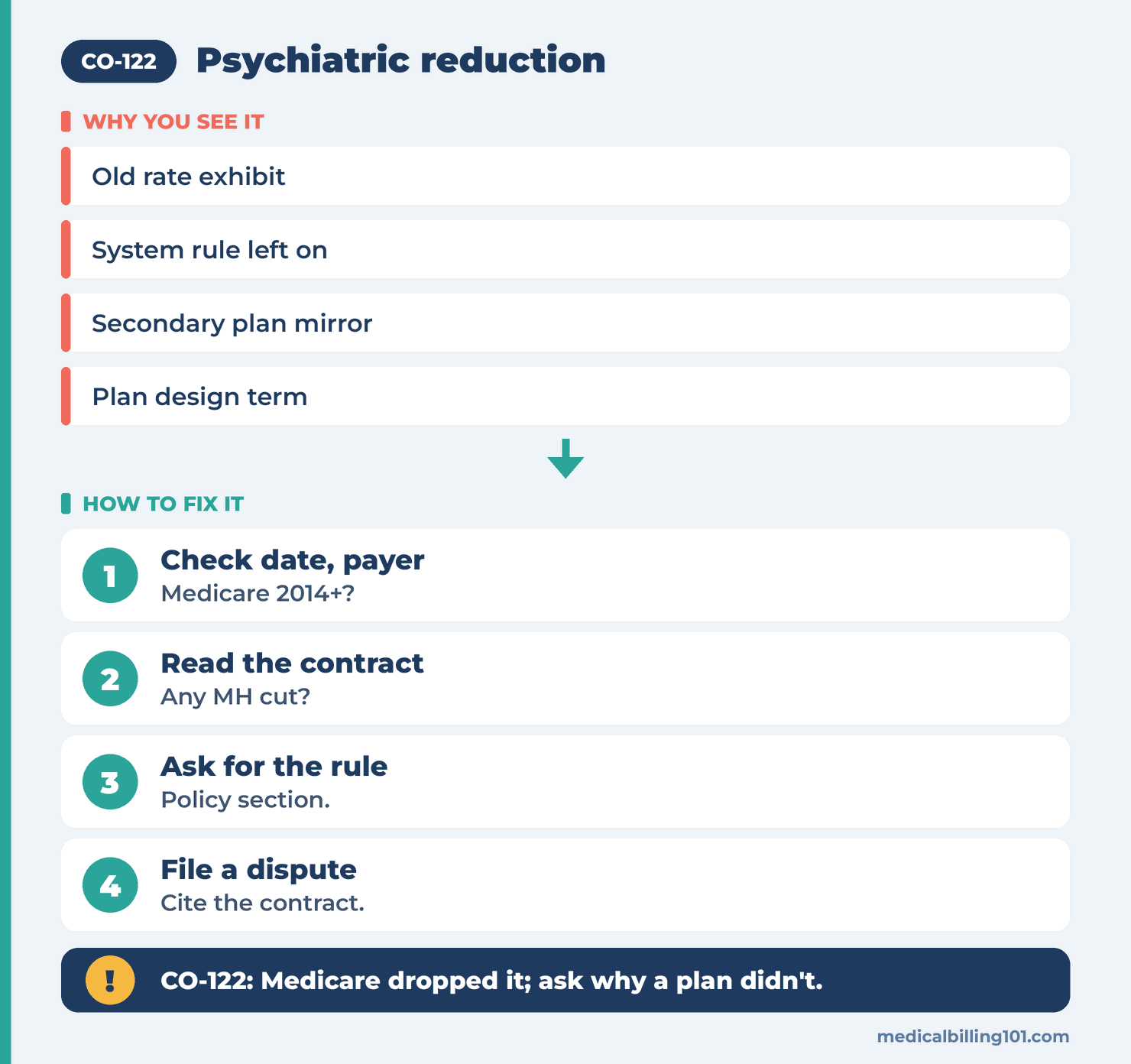
- Check the date of service and payer. For Medicare dates since 2014, expect no psychiatric reduction.
- Read your contract. Look for any clause that reduces mental health rates.
- Ask the plan for the rule. Request the policy or contract section behind the cut.
- Compare to medical services. For example, does the plan cut similar medical visits the same way?
- File a payment dispute. Cite the contract and, where it applies, ask how the cut fits parity rules.
- Track by payer. One setting error can hit every behavioral health claim.
Example scenario (fictional names), part 2
How the CO-122 Denial Was Resolved
Jordan asked Elmstead for the rule behind the cut, as N381 suggested. The plan pointed to a rate exhibit from years ago. Clearwater’s current amendment, signed last year, had replaced that exhibit and dropped any psychiatric reduction.
Fix: Jordan filed a payment dispute with the signed amendment and a list of affected claims. He asked the plan to update its system too.
Outcome: Elmstead reprocessed the claims at the full contract rate. Jordan now checks the first remit after every contract change.
Names and details are illustrative; no real patient data.
Worked example (illustrative)
A psychiatry practice sees CARC 122 on a secondary payer’s remit for a Medicare patient. The primary Medicare payment shows the normal 80 percent. The biller finds that the secondary plan’s system still mirrored the old limitation. She sends the plan the CMS manual section showing the 100 percent rate since 2014, and the plan corrects its payment.
Mistakes to avoid
- Accepting CO-122 as normal. For current Medicare dates, it shouldn’t appear.
- Billing the patient the difference. The CO group makes that off-limits.
- Not checking amendments. Old exhibits linger in payer systems.
- Ignoring patterns. One cut often means many.
Related codes
- CO-45: charge exceeds the fee schedule or contracted amount.
- CO-59: multiple or concurrent procedure rules.
- CO-253: sequestration reduction.
Key takeaways
CO-122 is a psychiatric reduction. Medicare’s version reached 100 percent in 2014, so it no longer lowers payment. When a plan applies CO-122 now, ask for the contract term behind it, compare it with medical services and dispute it when the contract doesn’t support it.
FAQ
What does CO-122 mean?
It means “Psychiatric reduction.” The payer paid less because the service was mental health treatment.
Does Medicare still apply a psychiatric reduction?
No. The outpatient mental health treatment limitation reached 100 percent in 2014, so Medicare pays 80 percent like other Part B services.
Can I bill the patient for CO-122?
No. The CO group makes it a provider adjustment.
Why would a commercial plan use CARC 122?
Usually an old contract term or a system setting. Ask the plan for the rule and check your current contract.
Does mental health parity affect CO-122?
It may. Many plans can’t treat mental health benefits more strictly than medical ones. Ask the plan to explain the cut.
What does N381 mean with CARC 122?
N381 points you to your contract for the payment terms.
Sources
How we checked: each code quote on this page was compared word for word with the X12 CARC and RARC lists on 21 October 2026.
- X12, Claim Adjustment Reason Codes (CARC 122, 45, 59, 253). Accessed 21 Oct 2026.
- X12, Remittance Advice Remark Codes (N381). Accessed 21 Oct 2026.
- CMS, Medicare Claims Processing Manual, Chapter 12, section 210. Accessed 21 Oct 2026.
- CMS, Mental Health Parity and Addiction Equity Act. Accessed 21 Oct 2026.
Last updated: 21 October 2026 · This page is educational and isn’t legal advice.