
PR-160 means the plan says the injury came from an activity its benefits exclude. Common examples are motor racing, skydiving, bungee jumping and other high-risk hobbies named in the plan documents. The payer learns the cause from accident questions, external cause codes or the ER note. The PR group puts the balance on the patient, but federal rules limit these exclusions, so read the facts before you bill anyone. (Primary source: X12 Claim Adjustment Reason Codes)
In brief: CARC 160 reads “Injury/illness was the result of an activity that is a benefit exclusion.” Get the plan’s exact exclusion and the note’s account of the injury. If a medical condition or domestic violence caused it, a group plan generally can’t apply the exclusion, so appeal.
Part of our denial codes library. Written by Manikandan J, CPC, CRCR, who has worked emergency and orthopedic injury claims for commercial plans. Published 21 October 2026. Last updated: 21 October 2026. Code wording quoted word for word from X12.
Reason code 160 in the X12 list
| Field | X12 text |
|---|---|
| Code | 160 |
| Description | “Injury/illness was the result of an activity that is a benefit exclusion.” |
| Start | 09/30/2003 |
| Last modified | 09/30/2007 |
Source: X12 Claim Adjustment Reason Codes, checked 21 October 2026.
How activity exclusions work
A benefit exclusion is care the plan won’t pay for, listed in its documents. HealthCare.gov defines excluded services as care your plan doesn’t pay for or cover. A source-of-injury exclusion is narrower. It removes benefits for an injury because of how it happened, such as during a named sport.
For group health plans, 29 CFR 2590.702 sets a limit. If the plan covers that type of injury, it can’t deny benefits when the injury came from domestic violence or a medical condition. That includes physical and mental health conditions, even ones not diagnosed before the injury.
| Plan wording you may see | What to check |
|---|---|
| Motorized racing or off-road riding | Was the patient racing, or just riding? |
| Skydiving, bungee or hang gliding | Does the note name that activity? |
| Self-inflicted injury | Was a mental health condition involved? |
| Injury while committing a crime | Is there any record of a crime? |
Example scenario (fictional names), part 1
PR-160 Denial Example: What Happened
Priya Nair is the billing manager at Summit Orthopedic Associates. A patient fell from a dirt bike on a trail and broke his right wrist (S52.501A). The surgeon did closed treatment of the fracture, billed as 25600.
Pinecrest Employer Health Plan, a fictional self-funded group plan, denied the claim with CAS*PR*160 and remark LQ*HE*N130, “Consult plan benefit documents/guidelines for information about restrictions for this service.” The plan excludes injuries from riding off-road motor vehicles.
Is the patient stuck with the bill, or is there something in the record that changes the answer? Keep reading, or jump to how the PR-160 denial was resolved.
Remark codes you may see with CARC 160
| RARC | X12 wording |
|---|---|
| N130 | “Consult plan benefit documents/guidelines for information about restrictions for this service.” |
| N305 | “Missing/incomplete/invalid injury/accident date.” |
| N744 | “Adjusted because the services may be related to an auto/other accident.” |
See the X12 RARC page for others.
How to handle a PR-160 denial
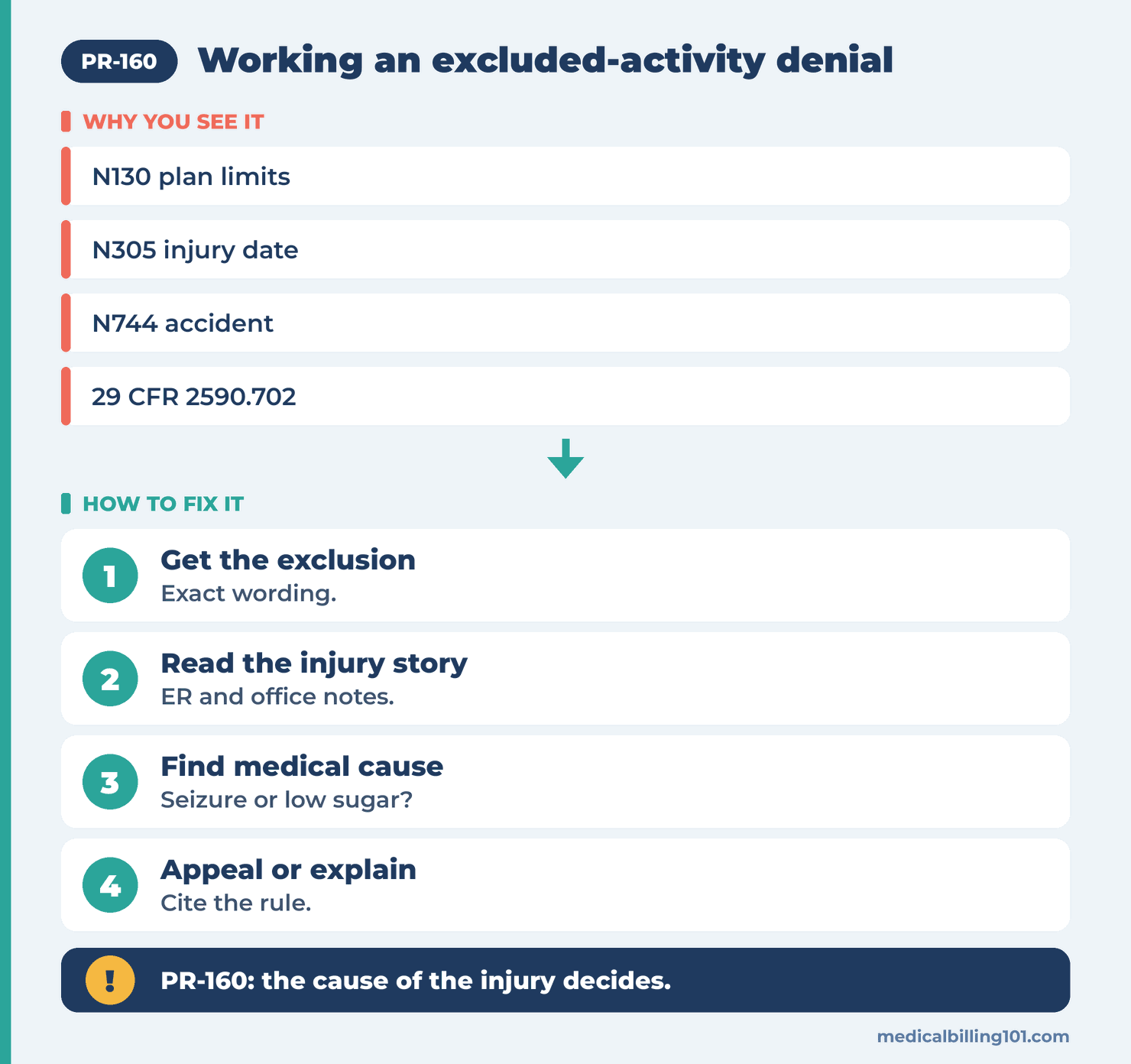
- Get the exact exclusion. Ask for the plan document page that names the activity.
- Read the injury story. Check the ER and office notes for what the patient was doing.
- Look for a medical cause. For example, a seizure, fainting spell or low blood sugar before the fall.
- Check the external cause codes. Make sure they match the note and don’t overstate the activity.
- Appeal when the rule can’t apply. Cite 29 CFR 2590.702 and attach the notes on the medical cause.
- Check other coverage. Auto, workers’ comp or event insurance may pay first.
- Tell the patient before billing. If the exclusion stands, explain it and offer the plan’s appeal steps.
Example scenario (fictional names), part 2
How the PR-160 Denial Was Resolved
Priya read the ER note. The patient told the ER doctor he blacked out on the trail and woke up on the ground. The ER found low blood sugar from his insulin, and his chart listed type 1 diabetes (E10.649). The fall came from a medical event, not from the riding itself.
Fix: Priya appealed. She attached the ER note and lab results, added E10.649 to the claim and cited the source-of-injury rule in 29 CFR 2590.702.
Outcome: the plan reversed PR-160 and paid the fracture care. Priya now flags activity denials for a quick note review before any patient bill goes out.
Names and details are illustrative; no real patient data.
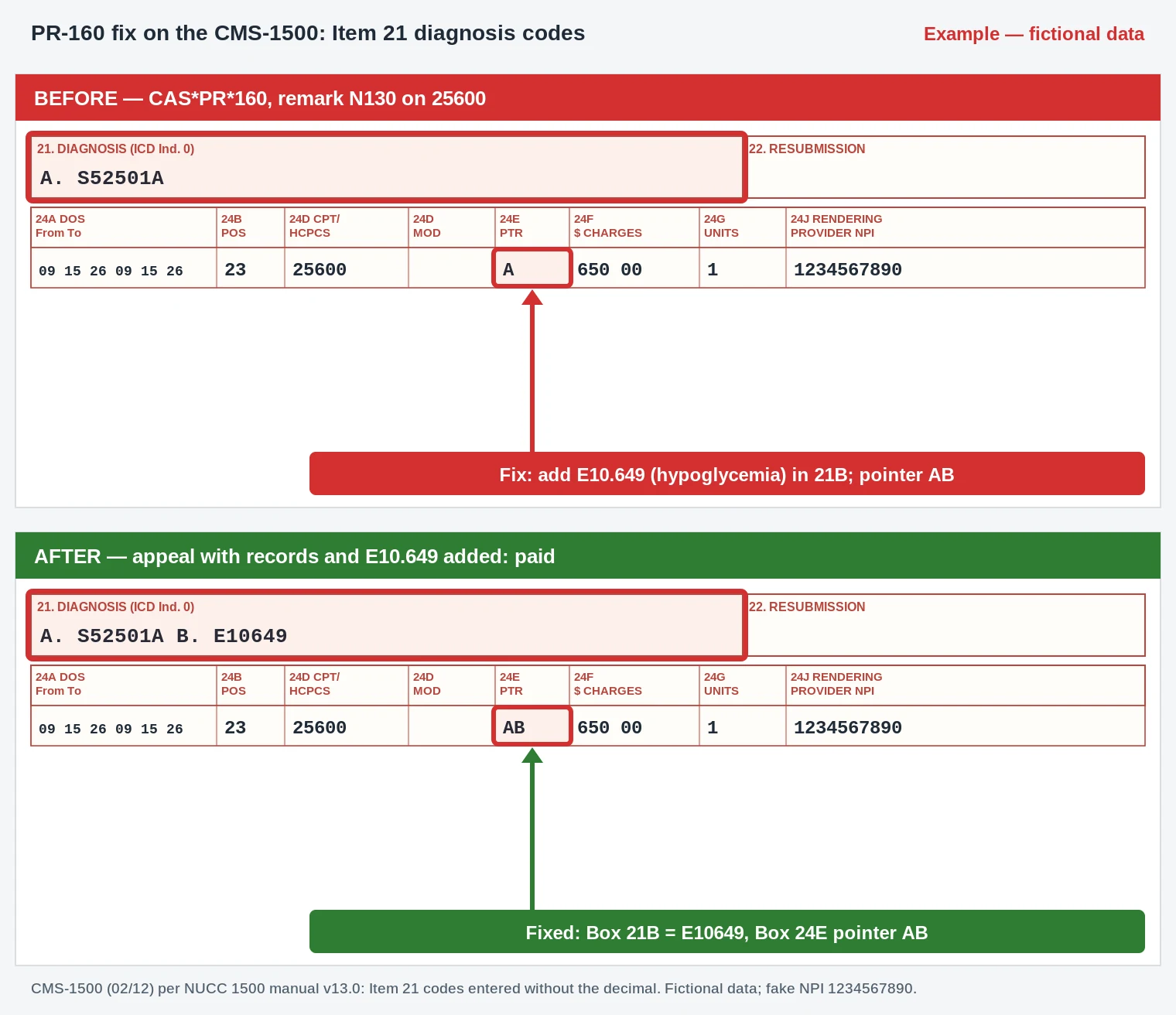
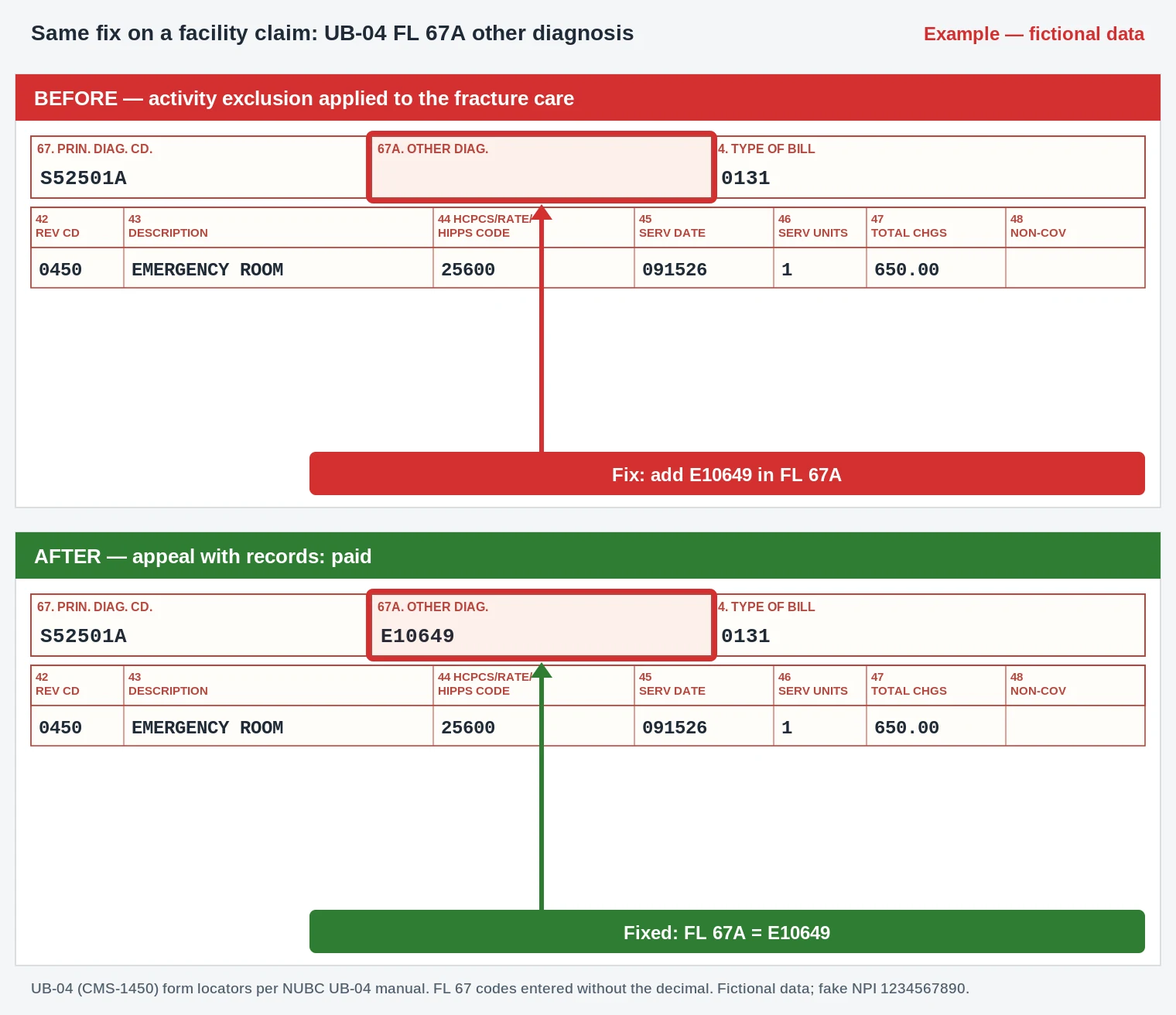
- Box 21B / FL 67A: E10.649 (type 1 diabetes with hypoglycemia), entered as E10649, added to show the fall came from a medical event.
- Box 21A / FL 67: S52.501A, entered as S52501A, stays first; Box 24E pointer becomes AB.
- Appeal: the ER note and lab results went with it. The story doesn’t describe a corrected claim, so Box 22 / FL 4 frequency stays as is.
Worked example (illustrative)
Consider a patient who breaks an ankle at a skydiving center. The plan excludes skydiving, and the note shows no medical cause. The clinic confirms the exclusion with the plan, checks whether the skydiving center carries accident coverage and then bills the patient. It gives the patient the plan’s appeal rights in case he wants to argue the facts.
When PR-160 is wrong
| Sign | What to do |
|---|---|
| A medical condition caused the injury | Appeal and cite 29 CFR 2590.702 |
| The injury came from domestic violence | Appeal; the exclusion can’t apply |
| The activity isn’t the one named | Appeal with the plan wording and the note |
Related codes
- CO-96: non-covered charges, with a remark code.
- PR-204: not covered under the patient’s current benefit plan.
- CO-19: work-related injury; workers’ comp should pay.
- CO-21: injury is the liability of the no-fault carrier.
Recap
PR-160 means the plan says the injury came from an activity it excludes. Get the exact exclusion and read the injury story. If a medical condition or domestic violence caused the injury, a group plan generally can’t deny on that basis, so appeal. If the exclusion stands, check other coverage, then explain the bill.
FAQ
What does denial code PR-160 mean?
The plan says the injury came from an excluded activity. It reads “Injury/illness was the result of an activity that is a benefit exclusion.”
Can a health plan exclude injuries from risky sports?
Many group plans can, if the plan documents list the activity. The exclusion can’t apply when a medical condition or domestic violence caused the injury.
How do I appeal CARC 160?
Send the notes that show the cause of the injury and cite the plan wording. Add 29 CFR 2590.702 if a medical condition was behind it.
Can I bill the patient for PR-160?
Yes, if the exclusion really applies. Explain it first and share the plan’s appeal steps.
Do external cause codes trigger PR-160?
They can. Codes for the activity tell the plan how the injury happened, so they must match the note.
Is PR-160 the same as a work injury denial?
No. Work injuries go to workers’ comp and usually come back as CO-19.
Sources
How we checked: each code quote on this page was matched word for word with the X12 CARC and RARC lists on 21 October 2026.
- X12, Claim Adjustment Reason Codes (CARC 160, 19, 21, 96, 204). Accessed 21 Oct 2026.
- X12, Remittance Advice Remark Codes (N130, N305, N744). Accessed 21 Oct 2026.
- eCFR, 29 CFR 2590.702, Prohibiting discrimination based on a health factor. Accessed 21 Oct 2026.
- HealthCare.gov, Excluded services. Accessed 21 Oct 2026.
Last updated: 21 October 2026 · Educational content; not legal advice.