
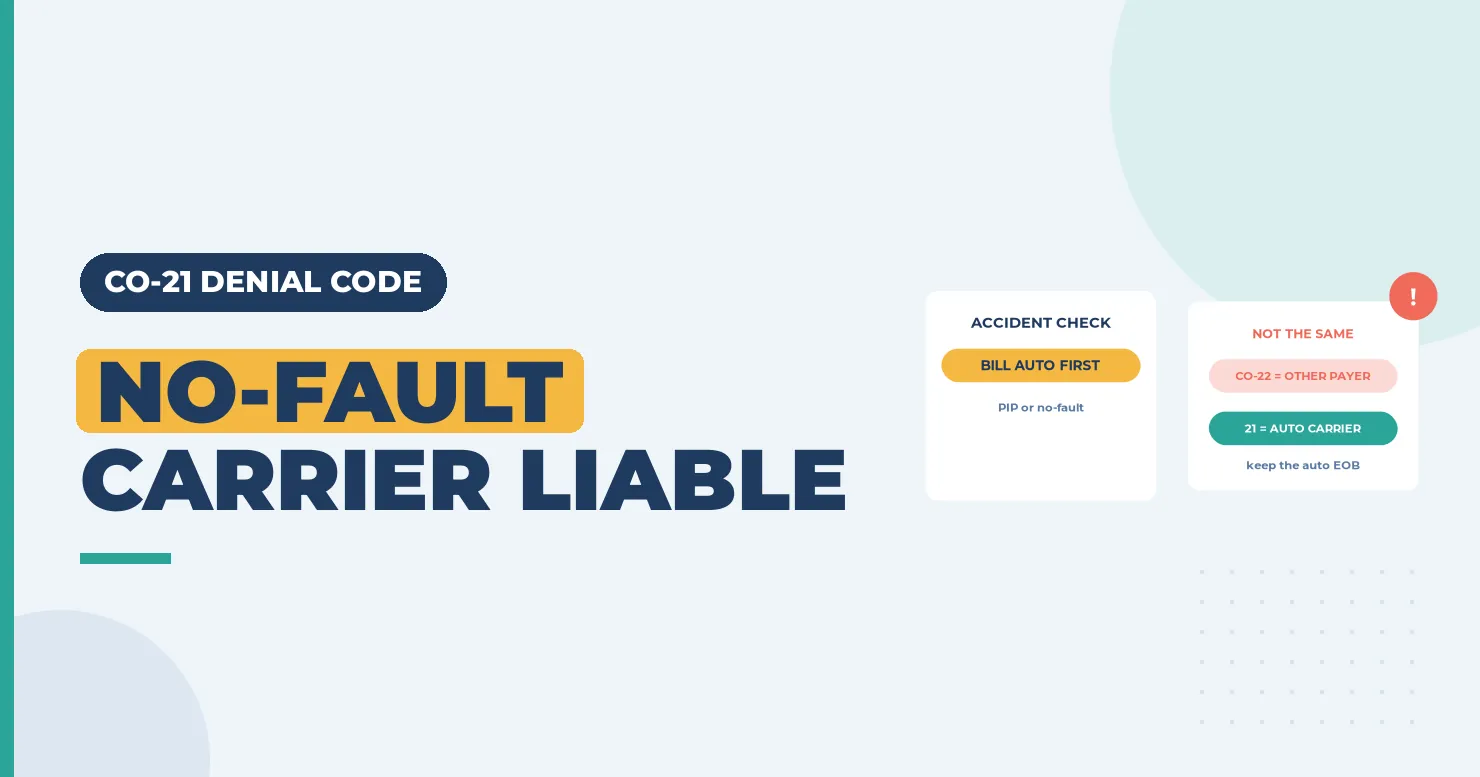
CO-21 is a routing denial. The health plan has decided the injury or illness on the claim belongs to a no-fault carrier, the auto insurer that pays medical bills after a car accident regardless of who caused it. Until that carrier has paid or denied, the health plan won’t. The work is mostly routing: confirm the accident, bill the auto policy, then come back to the health plan with the auto carrier’s answer. (Primary sources: X12 Claim Adjustment Reason Codes · CMS Medicare Secondary Payer · X12 Remittance Advice Remark Codes).
In brief: CO-21 means “this injury/illness is the liability of the no-fault carrier.” Ask the patient about the accident and the auto policy, bill the no-fault or personal injury protection (PIP) carrier, and keep its EOB. If the auto benefits are exhausted or denied, rebill the health plan with that EOB attached. If there was no accident, correct the claim’s accident indicators and ask the plan to update its records.
Part of our denial codes library. Written by Manikandan J, CPC, CRCR, who has more than 10 years of US medical billing and revenue cycle experience. Published 20 October 2026. Last updated: 20 October 2026. Code wording is quoted word for word from X12.
Official X12 wording for CARC 21
| Field | Official X12 text |
|---|---|
| Description | “This injury/illness is the liability of the no-fault carrier.” |
| Start | 01/01/1995 |
| Last modified | 09/30/2007 |
Source: X12 Claim Adjustment Reason Codes, checked 20 October 2026. No usage note or remark code rule applies.
Denial code 21, CARC 21 and reason code 21
All three describe one X12 code. Denial code 21 and reason code 21 are the casual names. “CO-21” adds the group code. Some payers send OA-21 instead, because the balance isn’t really the provider’s or the patient’s yet. It belongs to another payer.
What a no-fault carrier is
No-fault insurance is auto coverage that pays medical costs for people hurt in a crash, whatever the fault. Personal injury protection, or PIP, is the most common form. Some states require it, and it’s optional in others. When a health plan sees signs of a car accident, it expects the no-fault policy to pay first, up to its limit.
Who pays: group code table
| Group + CARC | Who carries it now | What to do |
|---|---|---|
| CO-21 | Provider, until the no-fault carrier pays or denies | Bill the auto carrier, then rebill with its EOB. |
| OA-21 | Not assigned | Same route. Common on secondary or crossover lines. |
| PR-21 | Patient | Rare. Usually means the patient must pursue the auto claim. Confirm before billing. |
Why plans send CO-21
Remark wording is from the X12 RARC list. Pairings vary.
| Cause | Typical RARC | Fix |
|---|---|---|
| Claim shows an auto accident indicator or accident date | N744 | Confirm the accident. Bill the no-fault carrier first. |
| Plan’s file shows open no-fault coverage for this injury | N744 | Get the auto claim number and adjuster details from the patient. |
| Patient should use no-fault set-aside funds | N724 | Bill the set-aside per its administrator’s rules. |
| Rebill to the plan sent without the auto carrier’s EOB | N479 | Attach the no-fault EOB or exhaustion letter. |
| Accident flag set by mistake | N744 | Correct the accident fields and send a corrected claim. |
How to fix CO-21
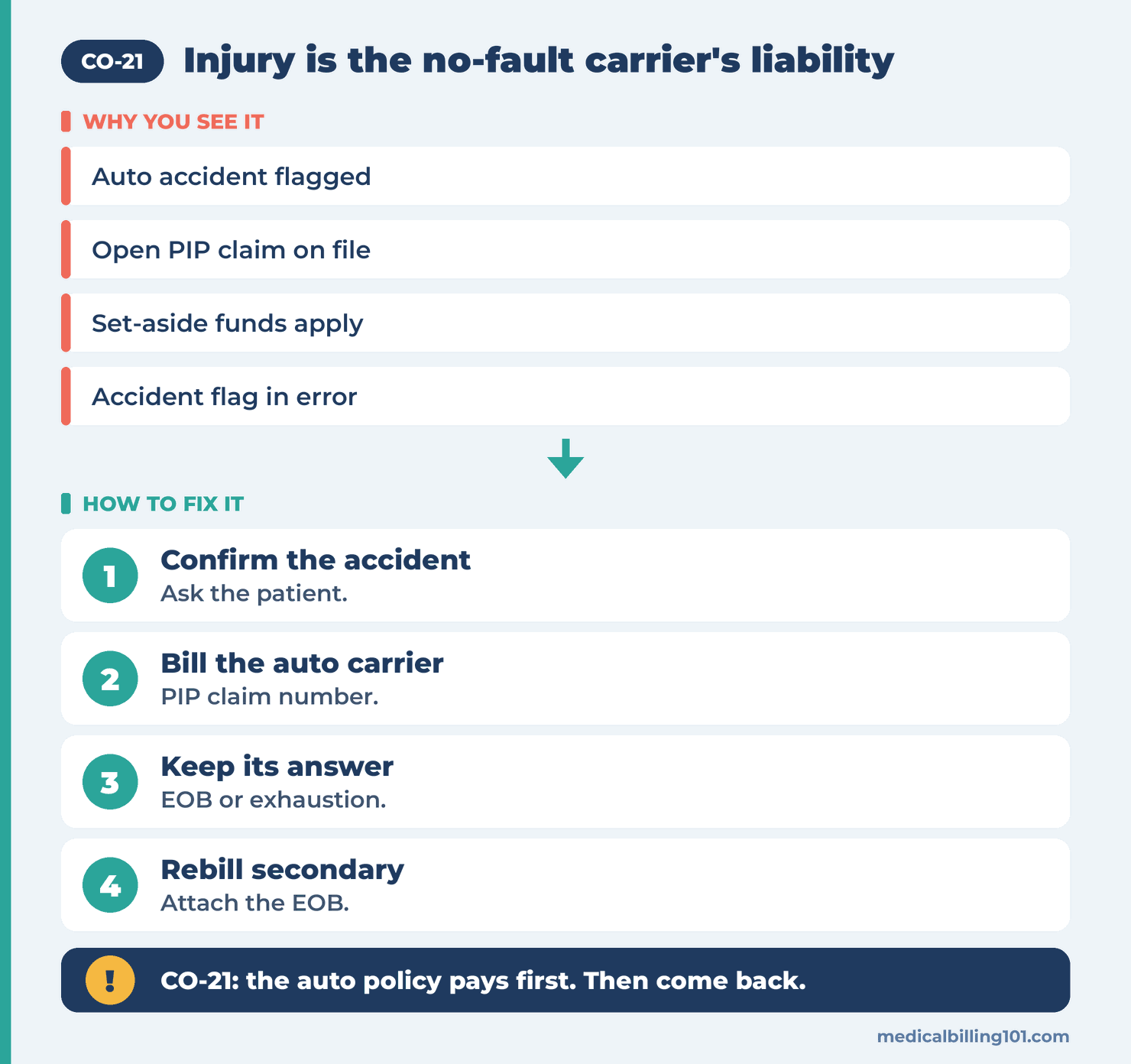
- Talk to the patient. Was this injury from a car accident, or another covered event such as a pedestrian or bicycle crash involving a car? Get the auto insurer, policy number, claim number and adjuster.
- Check the claim. On the CMS-1500, box 10b marks an auto accident and the state. On the UB-04, occurrence code 01 shows an auto accident. Make sure these are right.
- Bill the no-fault carrier. Follow its rules and the state’s no-fault deadlines, which can be short.
- Keep its answer. Save the EOB, the denial or the benefits-exhausted letter.
- Rebill the health plan as secondary, with that document attached.
- If there was no accident, fix the accident fields, tell the plan, and ask it to clear the flag in its records.
Medicare and no-fault
Medicare is secondary to no-fault insurance. Under the Medicare Secondary Payer rules, Medicare can make a conditional payment if the no-fault carrier won’t pay promptly, which the rules define as within 120 days. Medicare then recovers that money from any later settlement. On Medicare claims, the no-fault payment is reported with value code 14 on institutional claims. Check the CMS Medicare Secondary Payer pages for the current rules.
Appeal approach
Appeal CO-21 only when the plan is clearly wrong: no accident happened, or the no-fault benefits were used up or denied and the plan still won’t pay. Include:
- a short statement from the patient, if there was no accident, for example a signed accident questionnaire;
- the no-fault EOB or exhaustion letter;
- the corrected claim fields;
- the plan’s own coordination of benefits language.
Questions to ask the payer about a CO-21
- What in your records shows a no-fault liability?
- What accident date do you have on file?
- What document do you need to pay as secondary?
- How does the member clear an accident flag that’s wrong?
- What is your time limit for the rebill after the auto carrier responds?
Worked example (illustrative)
A patient sees an orthopedist for neck pain two weeks after a car crash. The front desk doesn’t ask about accidents, but the coder marks the injury as accident-related. The health plan returns CAS*CO*21*210.00 with remark N744. The biller calls the patient, gets the PIP claim number and bills the auto insurer, which pays until the PIP limit is reached. For later visits, the biller sends claims to the health plan with the PIP exhaustion letter attached, and they pay as secondary.
Prevention checklist
- [ ] Ask every injury patient whether an accident was involved, and where.
- [ ] Capture the auto insurer, claim number and adjuster at the first visit.
- [ ] Set accident fields only when the record supports them.
- [ ] Track PIP limits so you know when to switch to the health plan.
- [ ] Scan EOBs and exhaustion letters into the patient’s account.
Related denial codes
- CO-22: care may be covered by another payer per coordination of benefits.
- OA-23: the impact of prior payer adjudication.
- CO-109: not covered by this payer. Send to the correct one.
- CO-P1: state-mandated property and casualty requirement.
- CO-16: the claim lacks information or has billing errors.
- Denial codes hub for the full library.
Key takeaways
CO-21 means the health plan thinks the no-fault auto carrier should pay first. Confirm the accident, bill the no-fault or PIP carrier, keep its EOB, then rebill the health plan as secondary. If there was no accident, fix the claim fields and the plan’s records.
FAQ
What does denial code CO-21 mean?
It means the payer says the injury or illness is the no-fault carrier’s liability, usually an auto insurer, so it won’t pay until that carrier has responded.
What is the difference between CO-21 and CO-22?
CO-21 is specific to no-fault auto coverage. CO-22 is a general coordination of benefits denial for any other primary payer.
Can I bill the patient for CO-21?
Not under CO. Bill the no-fault carrier first, then the health plan as secondary.
What if the patient’s PIP benefits are used up?
Get the exhaustion letter from the auto insurer and rebill the health plan with it attached.
What if there was no accident?
Correct the accident fields, send a corrected claim, and ask the plan to remove the accident flag from its records.
Does Medicare pay when there’s no-fault insurance?
Medicare is secondary. It can make a conditional payment if no-fault doesn’t pay promptly, then recover it later.
Sources
How we checked: every code quote on this page was compared word for word with the X12 CARC and RARC lists on 20 October 2026.
- X12, Claim Adjustment Reason Codes (CARC 21, 22). Accessed 20 Oct 2026.
- X12, Remittance Advice Remark Codes (N744, N724, N479). Accessed 20 Oct 2026.
- CMS, Coordination of Benefits and Recovery overview. Accessed 20 Oct 2026.
- CMS, Medicare Claims Processing Manual, Ch. 22, §60.1 Group Codes. Accessed 20 Oct 2026.
Last updated: 20 October 2026 · This page is educational and doesn’t replace payer contracts or coding rules.