
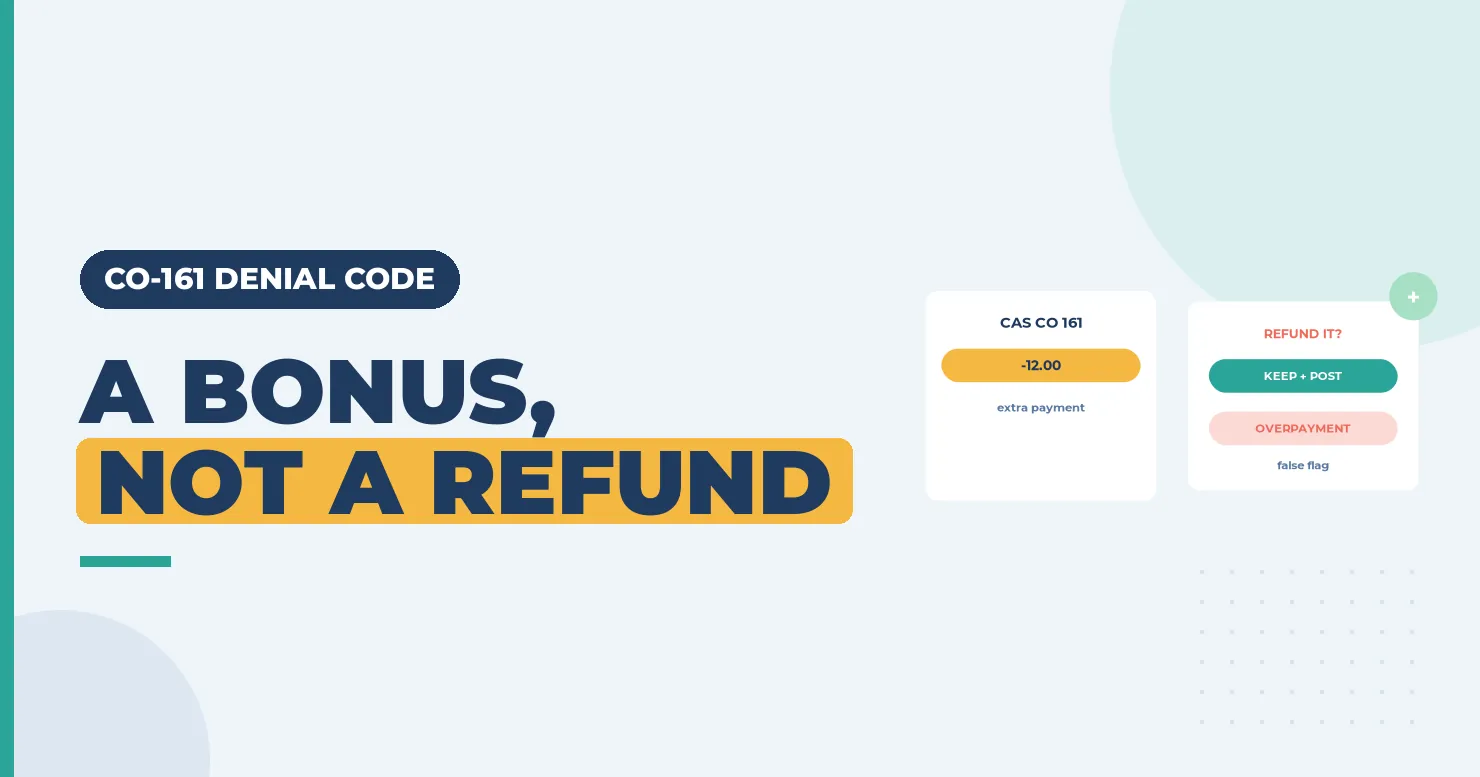
CO-161 is good news wearing a denial code’s clothes. It reports a provider performance bonus: extra money a payer pays because your practice met quality, cost or reporting targets under a contract or program. On the 835 it usually appears as a negative CAS amount, which raises the payment instead of cutting it. The trouble starts when posting software treats it as an error, nets it away or books it as a refund. (Primary source: X12 Claim Adjustment Reason Codes)
In brief: CARC 161 reads “Provider performance bonus.” Check the sign, confirm which program paid it, and post it to a dedicated bonus or incentive code. Don’t refund it, and don’t let it hide inside the contractual write-off.
Part of our denial codes library. Written by Manikandan J, CPC, CRCR, who has reconciled value-based contract payments for primary care groups. Published 22 October 2026. Last updated: 22 October 2026. Code wording quoted word for word from X12.
Official CARC 161 description
| Field | X12 text |
|---|---|
| Code | 161 |
| Description | “Provider performance bonus” |
| Start | 02/29/2004 |
| Typical group | CO |
Source: X12 Claim Adjustment Reason Codes, checked 22 October 2026.
Key terms behind CARC 161
A performance bonus is extra payment tied to meeting targets, such as screening rates or patient experience scores. A value-based contract is an agreement where part of the payment depends on quality or cost results. A negative adjustment is a CAS amount below zero, which adds to the paid amount.
Medicare’s Quality Payment Program is the best-known public example of payment tied to performance. Commercial and Medicaid plans run their own programs, and some of them report per-claim bonuses with CARC 161.
How a CO-161 line looks on the 835
- Per-claim add-on. For example, a plan pays a few dollars more on each qualifying visit and reports it with a negative 161 amount.
- Lump sum on a provider-level line. Some payers report bonuses in the PLB segment instead of on a claim. That isn’t CARC 161, but it often confuses the same staff.
- Reversal. If the payer later finds the target wasn’t met, it may take the bonus back with a positive 161 amount.
Example scenario (fictional names), part 1
CO-161 Denial Example: What Happened
Tasha Greene posts payments at Willow Creek Pediatrics. Willow Creek joined a quality program with Orchard Bay Health, a fictional Medicaid managed care plan, which pays an add-on for well-child visits when immunizations are up to date.
On the next 835, each well-child visit (99392 with Z00.129) showed the normal allowed amount plus CAS*CO*161*-12. The paid amount was higher than allowed. The posting system flagged every one of them as an overpayment and queued refunds.
Did Willow Creek owe the money back, or was it theirs to keep? Keep reading, or jump to how the CO-161 denial was resolved.
Remark codes that can appear with CARC 161
| RARC | X12 wording | What it tells you |
|---|---|---|
| N381 | “Alert: Consult our contractual agreement for restrictions/billing/payment information related to these charges.” | The contract explains the bonus |
| N697 | “Alert: This reversal is due to a payer’s retroactive contract incentive program adjustment.” | A bonus or incentive was reversed later |
See the X12 RARC list for the full set.
How to post and check a CO-161 bonus

- Read the sign. A negative 161 amount adds to the payment. A positive one takes a bonus back.
- Find the program. Match the bonus to the contract amendment or program letter that created it.
- Check the math. Confirm the per-visit amount or percentage matches the program terms.
- Post to a bonus code. Use a dedicated incentive code so you can report program income on its own.
- Stop false refunds. Clear any overpayment flags the bonus set off.
- Watch for reversals. Match a positive 161 or a remark N697 to the original bonus.
Example scenario (fictional names), part 2
How the CO-161 Denial Was Resolved
Tasha found the Orchard Bay program letter. It promised a $12 add-on per well-child visit when the child’s immunization record was complete, paid on the claim and reported with CARC 161.
Fix: she cancelled the queued refunds and mapped CO-161 to a new incentive posting code. She also asked the system vendor to stop treating paid-above-allowed as an overpayment when a negative 161 is present.
Outcome: the bonus money stayed with the practice. At the quarter’s end Tasha could report program income from one code, and the pediatricians saw what their immunization work earned.
Names and details are illustrative; no real patient data.
Worked example (illustrative)
An internal medicine group’s contract pays a 2% bonus on evaluation and management visits when the group hits its diabetes control target for the year. In March the payer starts adding the bonus to each eligible line as CAS*CO*161 with a negative amount. In June an audit shows the group missed the target for one site. The payer sends positive 161 amounts with N697 for that site’s claims. The group posts them against the same incentive code, so the net bonus is correct.
CO-161 vs similar codes
| Code | What it means | Effect on payment |
|---|---|---|
| CO-161 | Provider performance bonus | Usually adds money |
| CO-144 | Incentive adjustment, such as preferred product or service | Adds or reduces |
| CO-143 | Portion of payment deferred | Holds money back |
| CO-45 | Charge exceeds contracted amount | Reduces to the contract rate |
Posting checklist
- A dedicated incentive code exists for CARC 161.
- Overpayment rules ignore paid-above-allowed when a negative 161 is present.
- Program letters and amendments are filed with the payer contract.
- Reversals with N697 are matched to the original bonus.
Recap
CO-161 reports a provider performance bonus. Read the sign, confirm the program, check the math and post it to its own incentive code. Don’t refund it as an overpayment, and match any later reversal to the original bonus.
FAQ
What does CO-161 mean?
The payer added or adjusted a provider performance bonus on the claim payment.
Is CO-161 a denial?
No. It’s a bonus line. A negative amount means extra money for you.
Should I refund a payment that’s higher than allowed with CO-161?
No. The bonus explains the difference. Check the program terms before you refund anything.
Can the payer take a CO-161 bonus back?
Yes, if the program terms allow it. Look for a positive 161 amount or remark N697.
Can I bill the patient because of CARC 161?
No. The bonus has nothing to do with the patient’s share.
Where else can bonuses show up on an 835?
Some payers pay them at the provider level in the PLB segment instead of on claim lines.
Sources
How we checked: each code quote on this page was matched word for word with the X12 CARC and RARC lists on 22 October 2026.
- X12, Claim Adjustment Reason Codes (CARC 161, 143, 144, 45). Accessed 22 Oct 2026.
- X12, Remittance Advice Remark Codes (N381, N697). Accessed 22 Oct 2026.
- CMS, Quality Payment Program. Accessed 22 Oct 2026.
Last updated: 22 October 2026 · Educational content; not legal advice.